Obama’s Select Religious Compassion

US President Obama spoke about the United States’ plan to admit refugees from Syria, while he was in Turkey for the G20 Summit. He spoke with emotion in his voice as he dismissed the suggestion that America would not admit Muslim refugees due to security concerns, after the terrorist attacks committed in Paris by the Islamic State killed 129 people just days before.

Obama saidwhen I hear political leaders suggesting that there would be a religious test for which person who’s fleeing from a war-torn country is admitted, when some of those folks themselves come from families who benefited from protection when they were fleeing political persecution, that’s shameful. That’s not American. That’s not who we are. We don’t have religious tests to our compassion.

Obama G20
President Obama speaking at G20 Summit in Turkey
(photo: Pablo Martinez Monsivals/QP)

It is interesting that Obama suddenly feels that religion should not be a test for allowing people to live in certain places.

Just last year, Obama’s White House Spokesman made the following comment about Jews moving into apartments they recently purchased in the eastern part of Jerusalem: “The US condemns the recent occupation of residential buildings in the neighborhood of Silwan by people whose agenda provokes tensions.”

Those “people whose agenda provokes tensions” were ordinary Jews moving into apartments they purchased.

The White House condemned Jews from moving into their legal residences because Palestinian Arabs were angry about having Jewish neighbors. Does Arab anti-Semitism dictate American policy or “compassion”? Why did the anger of Palestinian Arabs get an endorsement, while the concerns of Americans about their own safety get condemnation from Obama?

Obama is correct that America was founded on the principle of religious tolerance. That is who “we” are.

That Obama would uniquely advocate for the banning of Jews from living in their own homes, says who he is.


Related First.One.Through articles:

Real and Imagined Laws of Living in Silwan

Obama’s “Values” Red Herring

Subscribe YouTube channel: FirstOneThrough

Join Facebook group: FirstOne Through  Israel Analysis

Rick Jacobs’ Particular Reform Judaism

The Union for Reform Judaism (URJ) held its biennial in Orlando, FL in November 2015. The head of the URJ, Rabbi Rick Jacobs, gave opening remarks that laid out his personal politics and worldview as the belief system of Reform Judaism.

rickjacobs
Union for Reform Judaism President Rabbi Rick Jacobs
November 2015

Politics

Rabbi Jacobs is not a stranger to politics. In November 2014, Jacobs urged the state of Israel to not go forward with legislation to reaffirm its Jewish character. His position was that Israel needs more pluralism than Judaism; more universalism than particularism. In his opening speech to the Reform Movement one year later, he made clear that Judaism itself needed more of that approach too.

Jacobs spoke about Jewish values that are rooted in the Torah such as loving the stranger in your midst. He said that “thirty-six times the bible reminds us ‘v’ahavtem et ha’ger’ – to love the resident alien and treat the stranger as ourselves.” Indeed, such quotes are throughout the bible such as:

  • “The stranger who resides with you shall be to you as the native among you, and you shall love him as yourself, for you were aliens in the land of Egypt; I am the LORD your God.” (Leviticus 19:34)
  • You shall not wrong a stranger or oppress him, for you were strangers in the land of Egypt” (Exodus 22:21)
  • He executes justice for the orphan and the widow, and shows His love for the alien by giving him food and clothing. So show your love for the alien, for you were aliens in the land of Egypt.” (Deuteronomy 10:18-19)

However, Jacobs opted to then announce his own personal political views as being the official mantra of the Reform Movement: specifically that Jews living east of the Green Line (EGL) in Judea and Samaria is wrong and should be opposed. He stated the “Reform Movement has long opposed Israeli settlement policy in the West Bank. The occupation threatens the very Zionism that we hold dear: the living expression of a Jewish democratic state.

Ignore for a moment that the global community endorsed Jews living throughout Palestine in the British Mandate of 1922.  How does a movement that prides itself on universalism advocate that anyone should be banned from living somewhere? How does a Jewish movement call for Jews being barred from living anywhere? How can a rabbi advocate for an anti-Semitic policy that is also directly against the bible?

Jacobs wants to see peace in holy land; he has no monopoly on that desire.

But why does a policy of welcoming strangers, mean adopting their hateful agenda? While Palestinian Arabs may demand Jews be prevented from buying and living in homes east of the Green Line (EGL), why should Jews endorse the same policy? There are many paths to a two state solution – and actual peace – that would not bar Jews from living in parts of the holy land.

The vast majority of Jews living EGL/ Judea and Samaria, want to live at peace with their Arab neighbors. These are lands that Jews have lived in for thousands of years and without any prohibitions from the League of Nations nor under the Ottomans before them.

While many Reform Jews may agree with Jacobs and his J Street view, does Reform Judaism leave no room for Jews with different views? Is Reform Judaism only open to radical liberals?

A Failure to Educate and Celebrate Israel

Jacobs did passionately defend Israel and spoke clearly of his opposition to the boycott, divestment and sanctions movement (BDS).  He continued that many young people “feel that Israel has become too intolerant, not only of Arab citizens, but also of non-Orthodox Jews, Ethiopian Jews, LGBT Jews, asylum seekers and others.” He tacitly agreed to this viewpoint.

Exactly how does Jacobs believe that he defends Israel?  Just by saying that he is against BDS?

Why doesn’t he educate people and celebrate the accomplishments of Israel? Why isn’t he and the Reform Movement at the forefront of telling fellow liberal friends that Israel is the most liberal country in the entire Middle East and North Africa (MENA) region, and in much of the world?


Jacobs called for a Reform Judaism that welcomes everyone in something he called “audacious hospitality.” He advocated a universalistic approach to the world over one of particularism.

Yet the leader of the Reform movement put forth a narrow political agenda regarding Israel that only spoke to a slice of its members, and by doing so created a wedge within the community about Israel. He failed to educate the community about Israel’s values that it shares, and thereby left a gap between Reform Judaism and the Jewish State.

There is a lot to love about Israel and much to learn about the different approaches to peace in the Middle East.  It would be better – and more consistent – for Rabbi Jacobs to understand that Reform Jews have a range of opinions about Israel that are consistent with Judaism and “loving one’s neighbor as thyself”, not in priority over oneself.

It would also go a long way to healing rifts between the broader Jewish community, and between the diaspora community and Israel.


Related First.One.Through articles:

The Fault in Our Tent: The Limit of Acceptable Speech

A Disservice to Jewish Community

Nicholas Kristof’s “Arab Land”

Subscribe YouTube channel: FirstOneThrough

Join Facebook group: FirstOne Through  Israel Analysis


Joe Biden Stabs a Finger at Israel

The Union of Reform Judaism held its biennial in November 2015.  One of the speakers was US Vice President Joe Biden.

biden reform
US Vice President Joe Biden addressed the Union for Reform Judaism
November 2015

The Vice President said in his prepared remarks that the US- Israeli ties were close, particularly on matters of security.  However, Biden berated Israel about a prospective member of the Israeli administration who had said derogatory things while a private citizen some time ago, about US President Obama and US Secretary of State John Kerry.  Biden waved his finger and scolded Israel: “There is no excuse, there should be no tolerance for any member or employee of the Israeli administration referring to the president of United States in derogatory terms. Period, period, period, period!

It is interesting for Biden to become so irate at a private Israeli citizen making jabs at the US administration.  That is the nature of free speech and press.  Israelis criticize their own government with much worse language.

And it is quite a bit of hypocrisy when a current member of the Obama administration called the Israeli Prime Minister a “chickenshit.”

It has been official US policy under the Obama administration to embarrass, berate and belittle Netanyahu.  Whether calling him names; leaving him stewing alone in a waiting room and skipping normal photo opportunities; having his Democratic party loyalists boycott Netanyahu speeches; or even Obama himself declining Netanyahu’s invitation to address the Israeli Knesset, and instead address the “real Israelis,” as if the Knesset was not a democratically-elected representative body.  Obama’s disdain for Netanyahu was so well known and public, that he and French Prime Minister Sarkozy discussed Netanyahu being a liar and how much they dislike spending time with him.

Never mind the current official comments and actions of the Obama administration towards Netanyahu.  Biden loudly lectured a Jewish audience about old comments made by a private Israeli who might possibly become an Israeli politician (even though Netanyahu had already backed away from the candidate).

Further, the Obama administration didn’t seem to mind the Iranian government actively chanting “Death to America.”  It was able to sit and negotiate with Iran for years during the verbal assaults, release $150 billion and pave a pathway to nuclear weapons.  How can the administration then lash out against old comments made by a private citizen of an allied country?


Related First.One.Through articles:

International-Domestic Abuse: Obama and Netanyahu

Seeing Security through a Screen

Obama’s “Values” Red Herring

Subscribe YouTube channel: FirstOneThrough

Join Facebook group: FirstOne Through  Israel Analysis

Oxfam and Gaza

Oxfam seems like such a nice charity.  It’s slogan is “The power of people against poverty.” What can be controversial about that?

Much of the organization’s work is focused on providing aid and services to poor communities around the world.  Work includes bringing clean water, food and basic services to people in need.

However, the organization also goes beyond a core mission of charity to other rights-based work including human rights and women’s rights.  The charity claims that “when people have the power to claim their basic human rights, they can escape poverty – permanently” and “the right to gender justice underpins all of our work.” Such activity leads Oxfam to get involved in politics and to advocate for particular actions by governments.

Oxfam produces reports and details its assessments of certain regions and their treatment of people.  Consider the report which warns about a potential slide in the treatment of women in Afghanistan.  Oxfam clearly “called on world leaders to ensure that any peace deal includes benchmarks to guarantee women’s rights” and highlighted the terrible crimes of “honor killings” in which wives and daughters are killed by family members if they engaged in something considered impure, like dressing inappropriately or turning down a male suitor.

Oxfam also puts feet on the ground to encourage peace in places such as South Sudan where “Oxfam has been working closely with communities and their leaders in Rumbek to establish peace committees that are now avenues for different clans to meet on a regular basis to discuss issues, mediate conflicts and encourage peaceful co-existence.” Such activity is obviously well beyond delivering humanitarian aid.

Consider Oxfam’s approach to Gaza.

Gaza

Oxfam has repeatedly called for “world leaders to press the Israeli government to lift the blockade on Gaza which Israel put in place in June 2007 to prevent arms smuggling after the terrorist group Hamas took over Gaza.  Hamas has used its weapons to fire over 10,000 rockets into Israel since then.

Legality: Oxfam called the blockade “illegal,” even though the United Nations Palmer Report of 2011 clearly stated “that Israel’s naval blockade was legal… Israel faces a real threat to its security from militant groups in Gaza.  The naval blockade was imposed as a legitimate security measure in order to prevent weapons from entering Gaza by sea and its implementation complied with the requirements of international law.

Ignoring the ruling authority of the terrorist group, Hamas: Oxfam stated that “The government of Israel holds the primary responsibility to lift the blockade, although agencies signing on to the campaign also recognize that reconstruction is hindered by the failure of Palestinian political parties to reconcile and prioritize reconstruction, and by Egypt’s closure of its border with Gaza.”

An amazing gloss over the facts.  Not only does Israel have “primary responsibility” for the situation, but the failure to alleviate the plight of ordinary people in Gaza according to Oxfam is also “the failure of Palestinian political parties to reconcile.” Hamas is a terrorist organization sworn to destroy Israel that repeatedly attacks Israelis. Until it relinquishes control of Gaza, the blockade will stay in place. It is not a matter that there is an internal division between Palestinian leaderships, as Oxfam states.

Collective Punishment:  Oxfam continued: “The government of Israel justifies the restrictions on security grounds. However, the United Nations and the International Committee of the Red Cross have repeatedly asserted that the blockade is a violation of international law. Indeed, there can never be justification for collective punishment of an entire population and leaving tens of thousands of families homeless and hundreds of thousands of children without a school or health centers.

Not only did the UN report specifically state that the blockade is legal as noted above, it also disputed the nature of “collective punishment” when it concluded that “although a blockade by definition imposes a restriction on all maritime traffic, given the relatively small size of the blockade zone and the practical difficulties associated with other methods of monitoring vessels (such as by search and visit), the Panel is not persuaded that the naval blockade was a disproportionate measure for Israel to have taken in response to the threat it faced.

Blame: Further, the phrasing of the Oxfam article put the blame for homeless families and “children without a school or health centers” on Israel, instead of the terrorist group Hamas that continues its war to destroy Israel.

Women’s Rights and Co-Existence:  Interestingly, for an organization that claims that “gender justice underpins all of our work,” it never once mentions in any of its numerous articles about Gaza, that Gaza now leads the world in the number of “honor killings” of women per capita.  It also doesn’t seem as keen to promote co-existence between Israelis and Palestinian Arabs as it does in South Sudan.


Oxfam is not simply a charitable organization, but a political one as well. It goes beyond important work of helping the poor, to a mission-based action group influencing governments.

When it comes to Gaza, it has turned a blind eye to an anti-Semitic terrorist government and focuses instead on demonizing a democracy that is protecting its citizens. It has produced articles with misinformation and circulated petitions to open Israel to attacks.

Consider that when you see an Oxfam volunteer walk up to you on the street.

oxfam


Related First.One.Through articles:

UN’s Confusion on the Legality of Israel’s Blockade of Gaza

Cause and Effect: Making Gaza

Honor Killings in Gaza

Gaza Blockade versus Cuban Blockade

Save the Children

Subscribe YouTube channel: FirstOneThrough

Join Facebook group: FirstOne Through  Israel Analysis

The Current Intifada against Everyone

The shootings, stabbings and car attacks in Israel in the fall of 2015 have led several media pundits and politicians to wonder whether the beginning of the Third Intifada has begun. This Palestinian intifada is against their own leaders as much as it is against Israel, and to miss that point is to miss the core issues and solutions before the parties.

Har Nof
Murder in Synagogue in Har Nof neighborhood of Jerusalem
November 2014 (photo: Israel Government Press Office)

First Intifada against Israel (1987-1993)

The First Intifada, which began in 1987, was launched by Palestinian Arabs who were angry about the lack of movement towards a creating a Palestinian state. The multi-year attacks killed thousands of people, and not just in Palestinians-versus-Israelis attacks. An estimated 1,000 Arabs who were suspected of collaborating with Israel were also killed by fellow Palestinian Arabs.

The First Intifada continued until the Oslo Accords of 1993 which started a timetable for a negotiated agreement between the parties. It was the first time that the Government of Israel and the Palestinian Liberation Organization (PLO) formally recognized each other. Counter to popular belief, the agreement did NOT call for the creation of a Palestinian state, but was crafted to transition Palestinians to self-rule (for example, a solution like American Indian reservations would have met the stipulations in the Oslo Accords) to commence within five years.

Transition (1993-2000).  Between 1993 and 2000, the leadership of Israel and Palestinian Arabs attempted to arrive at a peace treaty and settle all key issues including matters of boundaries, security and the status of the “right of return” of Palestinian refugees and their descendants. During this time there were still hundreds of attacks against Israelis with almost 100 Israelis killed. While the world may have considered the First Intifada to have concluded with Oslo, for Israelis, the murder and mayhem never stopped.

Second Intifada (September 2000-September 2014)
“No Compromise Intifada”

The Second Intifada broke out in September 2000 when it became clear that the Palestinians were not going to get everything that they demanded: a new country based on land that was controlled by Egypt and Jordan which was taken by Israel in 1967; the eastern half of Jerusalem as their capital; and a right of return to Israel for all Palestinian Arab refugees and their descendants.

Intifada 2A: Arafat’s War (2000-2005). Angry at the terms that he negotiated with Israeli Prime Minister Ehud Barak with the assistance of US President Bill Clinton, Yasser Arafat (1929-2004) launched a multi-year war against Israelis. Bombs blew up buses and pizza parlors. Arabs shot at cars and schools. Thousands of Israelis – most of them civilians – were murdered by Palestinians, and thousands of Palestinian Arabs were killed in efforts to put down the intifada.

Transition (November 2004-2008). The first wave of the Second Intifada ended when several notable things occurred:

  • Yasser Arafat (fungus be upon him) died in November 2004.
  • Israel largely completed a security barrier to stop Palestinian Arab attackers from entering Israel from the west bank of the Jordan River.
  • Israel withdrew from the Gaza Strip (2005).
  • Palestinian Arabs held presidential elections, voting for Fatah’s Mahmoud Abbas in 2005.
  • In 2006, Palestinians held Parliamentary elections and voted for Hamas, a more radical party that called for Israel’s destruction that is considered a terrorist organization by many countries including the US and Israel.
  • In 2007, Fatah and Hamas fought bitter battles against each other and Hamas evicted Fatah from Gaza and seized authority there.
  • With the Hamas takeover over Gaza, Israel put in place a naval blockade (and later a land blockade) to stop weapons from flowing to Hamas.

Intifada 2B: The Divided Intifada (2008-2014). By 2007, the Palestinian Arabs were deeply divided with Hamas controlling Gaza, and Fatah ruling in the West Bank. Each party had different stated goals and approaches to their conflict with Israel.

Hamas’s Violent War of Destruction: Hamas did not want a two-state solution and sought the complete destruction of Israel through armed conflict. Fighting from a defined region in Gaza and using missiles (as opposed to street attacks) the Hamas fight appeared more akin to a war. Indeed, the press referred to the 2008, 2012 and 2014 battles as distinct wars between Gaza/ Hamas (not Palestinians generally) and Israel. Israel referred to its defensive operations as Operation Cast Lead; Operation Pillar of Defense, and Operation Protective Edge, respectively. These three “wars” were a continuation of Hamas’s fight to destroy Israel, described clearly in its 1988 Hamas Charter.

Abbas’s Political War of Demands: In the West Bank, Mahmoud Abbas and the world courted each other. Abbas kept the Palestinian Arab masses out of Hamas’s massive attacks against Israelis and thereby portrayed himself as a moderate. In turn, many countries assured Abbas that he would achieve all of his demands that fell short in the 2000 peace talks, through diplomatic means. US President Obama made Abbas comfortable that Israel’s biggest ally (the US) would pressure Israel into conceding to all Palestinian demands: Obama pushed for a settlement freeze in 2009; in 2011 he said that borders would “be based on the 1967 lines with mutually agreed swaps,”; he stripped all Israel-leaning positions from the 2012 Democratic platform, including that there would not be a “right of return” of Palestinian refugees to Israel; he even said that Jews moving into existing homes they legally purchased in the eastern part of Jerusalem was a “provocation” in 2014.

The world similarly gave Abbas encouragement. They admitted Palestine to UNESCO in 2011, and many countries began to recognize Palestine as a country, even though it had yet to negotiate borders and security with Israel. Abbas’s moves in the political sphere to secure all of his demands were seemingly gaining traction.

Palestinians Intifada against Everyone
(October 2014- )

The “Third Intifada” began at the end of Operation Protective Edge with a few events. It resembled prior intifadas because the attacks were between Palestinian Arabs and Israeli Jews in the streets, but the nature of the intifada was quite different than the ones in the past. Whereas the first intifada was Palestinians-versus-Israel and the second intifada was Palestinian leadership-versus-Israel, the third intifada is Palestinians-against-everyone.

The start of the Intifada against Everyone: Acting-President of the Palestinian Authority Mahmoud Abbas kept the West Bank Arabs out of the Gaza/ Hamas War of Destruction based on the promise that the Palestinians would be able to achieve their goals that they failed to achieve in 2000 through diplomacy. However, the Palestinians had only won empty victories of recognition at UNESCO and were no further along in achieving a state. In the fall of 2014, several matters came to boil:

  • Anger at the destruction in Gaza. Over 2000 Palestinians were killed in the summer of 2014 and the attacks against Israel yielded nothing.
  • Anger at not being part of the Fight. The West Bank mainly stayed out of the fight, even though many people supported Hamas’s war against Israel.
  • Anger at Jewish advocacy on the Temple Mount. In October 2014, Rabbi Yehuda Glick continued to advocate for the right of Jews to pray at their holiest location. Radical Islamists shot Glick several times, though he survived the attack. The assailants were killed and Abbas praised them as “martyrs.”
  • Anger at being banned from the Temple Mount. In response to the attempted assassination of Glick, Israel closed the Temple Mount to all visitors. This further enraged Arabs both at being banned from their third holiest site, and the stark realization that Israel had control of the Temple Mount.
  • Anger at not moving forward on Statehood. For all of Abbas’s promises that the world would force Israel to accede to all Palestinian demands, the year 2014 which was hailed as the “International Year of Solidarity with the Palestinian People” was going to end with nothing. Abbas could not even get Netanyahu to release all of the prisoners that they had expected to be released.
  • Anger at Palestinian leadership. Both Fatah and Hamas failed to deliver positive results for Palestinians. They were viewed as corrupt by the vast majority of Palestinians, and the two parties could not even reconcile to coordinate a cohesive single ruling authority. Both Palestinian leaderships were failures by every measure, but no new elections were on the horizon even though the Palestinian Arabs hadn’t voted since 2006.
  • Anger at Arab States. Egypt changed leadership to General Abdel Fattah el-Sisi in 2013, but it was in 2014 that Egypt began to shut down the border between Gaza and Egypt, crippling the Gaza economy (and arms flow). Foreign supporters like Qatar which pledged money to rebuild Gaza were unable to do so because of legal hurdles.
  • Anger at the United States. While US President Obama and Secretary of State were effective in pushing Israel, the limits became apparent when they could not get Israel to release the fourth batch of prisoners in 2014. How could the US then force Israel to move forward with all of its greater demands?
  • Anger at themselves. The world took to the streets during the summer of 2014, largely condemning Israel for the war from Gaza. Yet the EGL Arabs (Arabs living east of the Green Line) were relatively quiet. They watched global protests while they didn’t protest. They witnessed fellow Palestinian Arabs fighting and dying in Gaza while they didn’t fight.
  • Anger at the world. For all of the waiting and promises from the US and the world to pressure Israel to deliver Palestinian demands, it became clear that such a path would not yield everything the Palestinians sought. Palestinians realized that the world would not impose their demands on Israel.

The Start of Attacks: While Hamas was behind the abduction and murder of three Israeli teens in Judea in June 2014, the “lone wolf” EGL Palestinians began to attack Israeli civilians in the streets and synagogues in October.

  • Car attacks rammed people in Jerusalem (October 2014)
  • Mahmoud Abbas called for Palestinians to defend Al Aqsa (October)
  • An attempted assassination of Yehuda Glick (October)
  • Car attacks and stabbings in Gush Etzion (November)
  • Arabs hacked Jewish worshippers to death in a synagogue in the Jerusalem neighborhood of Har Nof (November)
  • Various other attacks and calls for a “car intifada

The Anger-at-Everyone Intifada was underway.

Yet to understand the spike in the current wave of attacks in the fall of 2015, requires an appreciation that the end of the Palestinian Authority is at hand.

The 2015 Collapse of the Palestinian Authority and Oslo.  As described above, Abbas has remained unpopular since 2006.  He remains a puppet in the eleventh year of a four-year term.  He is old – 80 as of March.  And the old, ineffective, unpopular Abbas is only part of the story.  The Palestinian Authority is collapsing.

1.Impending PA Bankruptcy.  The PA was never particularly well-funded.  The PA suffered from several serious flaws even before the current crisis: large scale corruption and theft by PA leadership, and a reliance on Israel to collect and submit taxes on the PA’s behalf. In 2015, new problems emerged:

  • In February 2015, the PA lost a court case in the United States filed by Shurat HaDin on behalf of Americans killed in the Second Intifada.  The court awarded the victims of terrorism $655.5 million.  The verdict would likely have spelled the end of the PA so US Secretary of State John Kerry came to the PA rescue in August and had the PA post only a $10 million bond while the case is appealed.  The case will be heard March 2016, and the PA will likely lose and declare bankruptcy.
  • In June 2014, in the wake of a possible reconciliation government between Fatah and Hamas, the US Congress threatened to withhold funding of the PA since Hamas is a designated terrorist organization.  Obama voted to overrule Congress. The 2014 Gaza War started soon thereafter so the Palestinian reconciliation government has been slow to take form. But the impact of the US cutting funding lingers of the PA.

2. Hamas Funding. While the PA sits on the brink of bankruptcy and Hamas sits without funds or infrastructure, a game-changing event happened in July 2015.  The world powers agreed to allow Iran to run a curtailed nuclear program in exchange for releasing up to $150 billion.  There were no constraints to how Iran could use the money and it has made no secret of its desire to erase Israel from the map.  Iran has had a long-term relationship with Hizbullah in Lebanon, and the release of these funds could provide a huge windfall for Hamas, particularly if the world softens the Israeli blockade on Gaza.

3. Goodbye Obama. Good night Ban Ki-Moon.  The best chance Abbas had for imposing the 2000 Palestinian demands on Israel were through the United Nations and the United States.  Both US President Barack Obama and United Nations Secretary-General Ban Ki-Moon were strong advocates for the Palestinian cause.  Each one consistently berated Israel and tried to force it to accept Palestinian terms.  However, while their rhetoric was powerful, the heavy-handed approach to Israel did not yield the Palestinians promise.  Ban Ki-Moon’s term at the UN expires December 2016 and Barack Obama’s term expires January 2017.  It is hard to imagine that a new US president or SG of the UN will be as anti-Israel as the parties Abbas had working for him.

So Abbas took the podium at the United Nations in September 2015 and essentially announced that the Oslo Accords were dead.  He knew that he was done and the Palestinians were done with him.  He could not imagine that a PA facing bankruptcy while Hamas gained Iranian funds would keep his straw-man position propped up any longer. He left open the possibility that the lame ducks Obama and Ki-Moon might save him, but he knew his game was basically over.

The Rise of Intifada-against-Everyone. The Palestinians celebrate the end of the PA.  In addition to its corruption, they viewed the Authority as a tool of the Israeli government to suppress violence.  The EGL Arabs sat out the Divided Intifada because of the PA, and there was no honor in that. With the closing of the PA, it could pick up its part of the Divided Intifada, and perhaps do it with money and weapons from Iran.

In time, it may even have a nuclear-powered sponsor to enforce its demands.

For now, the Palestinians arm themselves with encouragement on social media like Facebook and Twitter.  They share videos of how to stab and attack Israelis and selections from videos of Israelis attacking Arabs. They come to the streets armed with knives, rocks and Molotov cocktails all around Israel and Judea and Samaria, looking for Jews to attack.

While the anger is at everyone, for now the attacks are limited to Jews.  As the Palestinian Authority truly collapses and the Iran deal either collapses or is implemented, the attacks will likely expand to other groups in other locations.

The Solution


The Temple Mount / Al Aqsa. World focus is now on security at the Temple Mount.  Indeed the rights of Jews on the Mount was seen by many as the excuse for starting the second intifada so parties are eager to calm the situation there. A narrow focus on Jewish rights and access is a small part of the bigger picture.

Ending Incitement. World leaders have urged parties to refrain from incitement, even while they barely berate Mahmoud Abbas’s calls for jihad.  While such calls for calm are appropriate, they also confuse the source of the anger. Palestinians have doubled their use of daily social media over the past 18 months according to polls. They do not wait for Abbas or Ma’an to tell them what is news or how to kill.

Compromise. The core issue can only be addressed when the global community states very clearly that the Palestinians must compromise.  They will not get everything they hope for nor will they even get everything within each core issue that they seek.

Obama thought that the old ways of supporting Israeli positions did not yield peace so he threw out that method and ran his presidency on being a bully to Israel.  But an Israel that feels threatened and insecure – despite Obama’s security cooperation – will not be in a position to conclude a deal with Palestinian Arabs.

The even bigger obstacle than the Obama administration has been the United Nations which has taken to every Palestinian position and encouraged them to believe that there is no need to compromise on their aspirations. That is a fatal flaw.

The UN must state clearly that the path to two states does not rely on negotiations but on compromise. A new Palestinian state will not come to being on “1967 borders.” All of East Jerusalem will not be the capital of such state. A total of 5 million refugees and their descendants will not move to Israel. The UN must stop encouraging these fantasies.

The first and easiest step to move towards a final resolution between the parties is to unravel the refugee mess that the United Nations promotes. The UN should make clear:

  • While the UN will continue to provide services to 5 million refugees and their descendants in the near-term, the only people that could be entitled to go to Israel under a “right of return” as defined in UN Resolution 194 are actual refugees. It will be up to Israel to allow any additional people enter the country.
  • Any refugee re-entering Israel must abide by the language of Resolution 194 which states that that they are willing to “live at peace“, and follow Israel’s guidelines for affirming such which may include acknowledging that Israel is a Jewish State.

If the UN and US really care about avoiding a third intifada and resolving the Israel-Palestinian Arab conflict, it must move past the smaller issues of focusing on incitement to the bigger picture of publicly stating that Arabs must compromise on their stated demands to resolve the conflict.  To date, Obama and Ki-Moon have encouraged the same unrealistic Palestinian expectations, and with it, the anger of the Palestinians for not delivering on an unrealistic goal.

The second intifada was against Israel for not meeting Palestinians demands, and the third intifada against everyone is about the world’s failure to enforce those demands. It is time for an honest conversation – publicly – about those very demands, to avoid more bloodshed and to end the conflict.


Related First.One.Through articles:

A “Viable” Palestinian State

Failing Negotiation 102: Europe

Subscribe YouTube channel: FirstOneThrough

Join Facebook group: FirstOne Through  Israel Analysis


Abraham’s Hospitality: Lessons for Jews and Arabs

The biblical portion of Vayera showcases stories of the patriarch Abraham welcoming strangers. The stories of Abraham’s hospitality became incorporated into the ways that the children of Abraham think of themselves today. However, the nature of the hospitality of Arabs (descendants of Abraham’s son Ishmael) and Jews (descendants of Abraham’s son Isaac) diverge in many ways.

Giovanni_Andrea_de_Ferrari_-_Abraham_and_the_Three_Angels
Abraham and the Three Angels
by Giovanni Andrea de Ferrari (1598-1669)

Man and God

Jewish perspective: Judaism prides itself in being a religion of actions, not faith. God gave the Jewish people 613 commandments to follow, some of which are active (make the Sabbath holy) and others that are passive (don’t kill). A division could also be made of laws between people (like murder) and those between man and God (like the Sabbath).

A casual observer of religions would imagine that laws about God would take precedence to laws about people.  The Jewish organization Limmud, posted an article about Vayera, which argued the opposite.

During the story of Vayera there was an encounter between Abraham and God. In the middle of the conversation, Abraham asked God to wait so he could welcome three strangers that were passing his tent. The author of the Limmud article, Jeremy Rosen argued that Abraham’s action taught Jews a lesson for today, “that however primary God is, there are certain types of human crises or obligations that are so important that one can actually tell God to wait. In the end religion must enhance our relationship with other humans.

Islamic perspective: The website “OnIslam” is dedicated to educating Muslims on a variety of subjects. An article on hospitality and the “joy of honoring others” made a clear effort to differentiate between the kind of hospitality that Muslims extend, and those of non-Muslims. The true concept of hospitality is not something that is widely practiced in most non-Muslim countries. For many non-Muslims, the entertainment of guests is of primary importance in many cases for worldly reasons only, not rooted in real hospitality for the sake of God. In Islam, however, hospitality is a great virtue that holds a significant purpose. Being hospitable to neighbors and guests can increase societal ties as well as unite an entire community. Most importantly, God commands Muslims to be hospitable to neighbors and guests. There is a great reward in doing so. Hospitality in Islam is multi-faceted and covers many different areas in addition to the hospitality that we show guests who visit our homes.”

In Islam, hospitality is performed because it is commanded by God. The act of hospitality may have benefits of creating communal harmony, but it is a derivative of the second degree. The primary obligation is to follow God’s command, and He commands all Muslims to be hospitable. God’s command leads man to action, and such action may, in turn, lead to friendship and social cohesion.

The difference in the approach of the religions is both subtle and significant. Judaism has a value system of helping others. Welcoming a stranger takes precedence to a direct conversation with God. In contrast, Islam focuses on obedience to God’s commands. Hospitality happens to be one of those commands and is therefore performed – within the bounds of religion.

Hospitality Today on a National Level

It is interesting to look at the nature of hospitality on a national level and how the one Jewish State handles hospitality compared to various Muslim countries (note that there are many Muslim countries, like Turkey, Malaysia and Indonesia, that are NOT Arab and descendants of Abraham).

Welcoming Refugees
Israel: Israel has an incredible record when it comes to welcoming Jews from around the world. Whether in bringing Jews that were persecuted in the Arab world in the 1950s, or Russian and Ethiopian Jews in the 1990s, Israel took in so many Jews from around the world, that they dwarf the number of European Jews who came to the country due to persecution in Europe during the 1930s and 1940s.

Those Moroccan, Yemenite, Ethiopian and Russian refugees received Israeli citizenship immediately. They got housing and job training. They had teachers to teach them a new language (Hebrew) and lessons about incorporating into a society that was completely foreign to their old way of living.

Arab/ Muslim Countries: The Middle East has witnessed a large number of wars and corresponding waves of refugees fleeing the battles. Many Arab countries did not welcome their fellow Arabs.

  • When Arabs left the British Mandate of Palestine to Lebanon and Syria in 1948-9, they were forced to live in refugee camps. They were not offered citizenship nor given an opportunity to have white color jobs. Those conditions continue for their children and grandchildren almost 70 years later.
  • When the PLO sided with Iraq when Iraq invaded Kuwait in 1991, Kuwait expelled roughly 360,000 Palestinians that were living there.  Fellow Arabs that were neighbors for 75 years were evicted en masse because of the actions of people hundreds of miles away.
  • Most recently, the millions of Arabs fleeing the civil war in Syria, and ISIS in Iraq have been shut out of the wealthy countries of Saudi Arabia; Qatar; Bahrain; United Arab Emirates and Kuwait.  Westerners may wonder how these oil rich countries are not embarrassed to refuse to welcome fellow Arabs, especially as Europe and America open its doors.  Only Lebanon, Jordan and Turkey (Muslim, but not Arab) have shown these refugees Islamic hospitality.

Welcoming “Others”
Israel: The phrase in the bible “love thy neighbor as thyself” (Leviticus 19:18) has been interpreted by various scholars as both a model for treating fellow Jews and for interactions with all of mankind.

  • When Israel declared independence in 1948, it granted 160,000 non-Jews citizenship.  When Israel reunited Jerusalem after Jordanian and Palestinian Arabs attacked it in 1967, it offered citizenship to all non-Jews.
  • When Menahem Begin became prime minister of Israel in 1977, he brought in and gave citizenship to roughly 300 Vietnamese people fleeing their country.
  • Today the country is grappling with how to deal with Eritrean and Sudanese asylum seekers as many Israeli Jews believe in the principal of hospitality, even while the government considers issues of safety.

Arab/ Muslim Countries: The Arab countries do very poorly in regards to their hospitality with non-Muslims.

  • When Jordan seized Judea and Samaria in 1949, it expelled all of the Jews in the area and forbade them from even visiting their holy sites in Jerusalem.
  • Today, Mahmoud Abbas has laws preventing the sale of any land by Arabs to Jews and has demanded a new country to be established devoid of Jews.
  • After Israel was founded, the Arab countries forced over 850,000 Jews to flee their homes where they had lived for generations.

Helping Others
Israel: Israel has a reputation of rushing to assist countries around the world suffering from natural disasters.  Whether from earthquakes in Turkey or Haiti or tsunamis in the Pacific Ocean, Israel is on the scene with disproportionate numbers with life-saving assistance.

Arab/ Muslim Countries: The Arab world typically does not send much assistance to countries in need.  That fact is surprising since it is a core tenant of Islam.  OnIslam states: “In Islam, hospitality extends well beyond the walls of the home. Being hospitable also means having good manners and treating others with dignity and respect. Hospitality can be applied to the greater community and Muslims must strive to help out whenever there is a time of need. Natural disasters, for example, often result in community turmoil as residents grapple with the aftermath. This provides Muslims with an excellent opportunity to pitch in, whether delivering hot meals to those affected or donating gently used items to someone who has lost everything.”

However, the Charities Aid Foundation did rank some Islamic nations among the most generous in the world, including: Malaysia; Indonesia; and Iran in the top 20.  However, none of those three countries is Arab.  Israel, the Jewish State, ranked number 32.


Abraham taught Jews and Arabs about the importance of hospitality.  Each group interpreted his acts of kindness through their respective prophets and teachers over the centuries, with Jews extracting a primary value of the kinship of men, while Muslims placed hospitality as just one of God’s commands to be observed.  Jews learned a life-lesson from Abraham; Arabs stifled that more human example and took the message of hospitality from the Quran.

The children of Abraham – the Jewish State and the Arab states – should all be mindful of the importance of hospitality in their dealings today.


Related First.One.Through artices:

The End of Together

Joint Prayer: The Cave of the Patriarchs and the Temple Mount

Subscribe YouTube channel: FirstOneThrough

Join Facebook group: FirstOne Through  Israel Analysis

An Inconvenient Truth: Palestinian Polls

There were a growing number of violent attacks by Palestinians against Israelis in October 2015.  Various politicians such as the US Secretary of State John Kerry blamed the root cause as Palestinian frustration about ongoing Jewish “settlements” east of the Green Line.  Acting President of the Palestinian Authority Mahmoud Abbas pointed the finger at defending Al Aqsa Mosque in Jerusalem from Israelis changing the status quo.  United Nations Secretary-General Ban Ki-Moon considered that it was due to Palestinians frustration about the failed peace talks and lack of progress towards creating a Palestinian state.

Why all of the guessing for identifying the root cause when the Palestinians poll themselves every three months?

The Palestinian Center for Policy and Survey Research conducts a poll every quarter on a range of issues.  It breaks the analysis between Palestinian Arabs living in the West Bank/ east of the Green Line and the Gaza Strip.  A review of the poll numbers gives a much better sense of Palestinian Arabs sentiments about their situation than biased and bogus statements from Kerry, Abbas and Ban Ki-Moon.

A Growing Majority of Palestinians Support Attacking Israeli Civilians

The poll figures do show a growing support of attacking innocent Israeli civilians.  In December 2013, the percentage of Arabs supporting unprovoked attacks was 34% and 58% in the West Bank and Gaza, respectively.  Those figures jumped to 48% and 68% for WB and Gaza in September 2014 and then to 50% and 70% in September 2015.  Overall, a clear majority of 57.2% of Palestinians were in favor of terrorism as of September 2015, up from 42.9% in December 2013.

Terrifying numbers about terrorism in both the absolute percentage and in the terrible trendline of support.

No heightened Palestinian fear regarding Annexing the West Bank and Changing the Status Quo on the Temple Mount. Palestinians are ALWAYS afraid.

Despite Kerry’s assertion that Palestinians are increasingly fearful of Israelis living east of the Green Line and Abbas’s statement about Israel changing the status quo on the Temple Mount, the statements are untrue.

kerry harvard
John Kerry at Harvard attacking Israeli settlements
(photo: Brian Snyder/Reuters)

Settlements: Palestinians have always been afraid of Israeli intentions regarding annexing land. In December 2013, 85.3% and 80.5% of Arabs in the West Bank and Gaza, respectively, believed that Israel would annex the entire region.  Those figures dropped after the 2014 Gaza War to 81.2% and 75.3% in September 2014, before rising again to 88.5% and 78% one year later.

In every quarter over the past two years, between 80% and 90% Palestinian Arabs in the West Bank thought Israel was intending to annex both the West Bank and Gaza.  The range was 70% to 82.5% for Palestinians living in Gaza.  Presumably the Arabs in Gaza did not have as great a fear as the Arabs in the West Bank since they clearly saw that Israel left Gaza in 2005.  The question remained why the fear factor numbers remain so consistently high, even in Gaza.  In any event, there was no correlation between the increased Arab desire to kill Jews and their fear of Israelis annexing territory.

Al Aqsa: The poll numbers show similar results for the Temple Mount/ Al Aqsa.  In March 2014, the PCPSR asked whether people were concerned that Israel would change the status quo on the Temple Mount.  Almost everyone – 93% – believed Israel intended to make changes to access and prayer rights.

In December 2014, 66.2% of West Bank Arabs, and 38.8% of Gazans thought that Israel intended to completely destroy the Al Aqsa mosque.  In the most recent September 2015 poll, those figures dropped to 60% and 33.4% for the West Bank and Gaza, respectively.  Again, there was no correlation between the uptick in violence due to Palestinian fears, despite the October 2015 protestations of John Kerry and Mahmoud Abbas.

The UN Fantasy of Palestinian Support for a Two State Solution
and Negotiated Process

Despite the United Nations repeated comments that the key to peace lies in a two state solution, it has never been a particularly popular dream of the Palestinians. In March 2014, a slim majority of 51.2% of Palestinians supported the idea. In the last poll of September 2015, 47.9% of Palestinians were in favor of two states.

Further, throughout 2015 a majority of Palestinians favored an armed struggle with Israel more than negotiations.  In December 2014, Arabs broke down as 41.9%, 25.6% and 28.3% in favor of using either violence, negotiations and non-violent protests, respectively. In September 2015, the polls showed little movement, with a breakdown of 41.6%, 29.2% and 24.2%.

The Palestinian polls show that the two state solution has never been a very popular idea, and those that favor it believe it can best be accomplished through violence. The recent uptick in actual violence actually accompanied a move from a preference for negotiations, counter to expectations.

Safety and Social Media

The poll numbers do show some trends that correlate to the spike in what Wall Street Journal’s Brett Stephens referred to as a Palestinian “blood lust.”

Safety: In December 2013, a majority of Arabs east of the Green Line (54.4%) and in Gaza (61.7%) felt safe.  That changed dramatically after the 2014 Gaza war.  Between June 2014 and December 2014 the sense of safety in the West Bank dropped from 51% to 38.3%, and in Gaza from 63.9% to 46.1%.  The numbers continued to stay low over 2015, with a perceived safety growing from 38.3% to 48.7% in September 2015 in the West Bank, and dropping further in Gaza from 46.1% to 39.5%.  Those are very dramatic declines from two years earlier.

Social Media: Palestinians, particularly those in the West Bank, have been getting their news from social media in much greater numbers.  In the West Bank, Arabs that use Facebook and Twitter jumped from 14.7% (June 2014) to 19% (December 2014) to 26.4% (September 2015). The numbers in Gaza over that time period went from 21.3% to 21.6% to 24.1%.  These are significant changes, particularly in the West Bank.

The survey does not cover what kind of items people are watching and sharing on social media.  According to some news reports, videos of Israeli forces shooting Palestinians and “how to” videos showing ways to stab Jews, have gone viral.

The Palestinian Authority

The Palestinian Authority has always been viewed as corrupt by Palestinians according to polls.  Anywhere from 78% to 84% of West Bank Arabs that live under the PA consider the government corrupt according to every poll.  In Gaza, the percentage is lower, from 72% to 82%, but the overall sentiment is the same.

However, what has not stayed the same is the confidence in Abbas.  While coming in dead last in a theoretical three-person presidential election each quarter, his support has plummeted in the West Bank, while it has grown in Gaza.  In the WB: 32.1% (12/13); 28.5% (6/14); 26.7% (12/14); 21.5% (9/15). In Gaza: 17.2% (12/13); 27.1% (6/14); 20.8% (12/14); and 27.4% (9/15).  By September 2015, 62.9% of West Bank Arabs and 67.4% of Gazans wanted Abbas to resign.

Conclusion

Principal players in the Israeli-Palestinian conflict are using stale and incorrect information to describe the current violence, and as such, are focused on irrelevant solutions.  The settlements and the Temple Mount are not reasons for violent attacks.  A negotiated two state solution was never popular, despite the many efforts of those who strongly advocate for it.  Like the corruption of the Palestinian Authority, these things are constant white noise that don’t suddenly motivate people to murder.

Today’s violence is erupting due to concerns over safety, and fueled by the credibility and incitement of Palestinians on new media.

Abbas announced the beginning of his retreat from the Oslo Accords and managing security in the West Bank. The West Bank Arabs now feel more threatened and communicate directly with each other over social media about attacks and injuries.  The raw videos of families and friends being injured make them feel more unsafe and angry.  They, in turn, make videos for their friends to attack Israelis and reject Palestinian leadership, which fuels the security fears on all sides.

World and regional leaders are rehashing old misconceptions about a pathway towards peace and security in the region.  They should look at what Palestinians are actually saying: they are ambivalent about of a negotiated two state solution. They do not believe or trust their own leadership any more than the intentions of the Israelis.

With such understanding, it is time to rethink always propping up Abbas, ignoring Hamas and condemning the Israelis. It is time to stop obsessing about the settlements and Temple Mount and focus on security and communications.

The inconvenient truth is that Palestinians don’t like and don’t trust any of today’s leaders, and those same leaders refuse to listen to what the Palestinians are telling them.  It is hard to imagine peace and security emerging from such a dynamic.

Subscribe YouTube channel: FirstOneThrough

Join Facebook group: FirstOne Through  Israel Analysis

Palestinians of Today and the Holocaust

The New York Times berated Israeli Prime Minister Benjamin Netanyahu for tying Palestinians to the Holocaust in its editorial pages on October 23, 2015 “Mr. Netanyahu’s Holocaust Blunder.”  It is interesting for the Times to be so angry about this remark while failing to note certain current truths about the Palestinians and the Holocaust:

  • Acting-President of the Palestinian Authority Mahmoud Abbas wrote his doctoral paper on Holocaust denial
  • Abbas’s April 2014 disturbing comments trivializing the Holocaust when he said that Palestinians understand genocide because they suffer “ethnic discrimination and racism” from Israelis was celebrated by the NY Times
  • Regular NY Times contributor Roger Cohen suggested a pathway to peace between Israelis and Palestinians was that “Jews should study the Nakba. Arabs should study the Holocaust” trivializing the torture and killing of millions of innocent people with a conflict about land.
  • Abbas repeatedly said that Israel is engaged in “a war of genocide” against Palestinians, in a deeply insulting distortion of both the conflict and the Holocaust.
  • Palestinian leaders forbid Holocaust education in UNRWA schools in Gaza, counter to the United Nations wishes and curricula.
  • The list goes on

The Palestinians are the most anti-Semitic people in the world, with almost every person (93%) holding negative feelings about Jews according to a May 2014 poll.  By almost every measure, the Palestinians today are more extreme than Germans were in 1933, whether in passing laws that forbid Jews entry onto Palestinian college campuses; laws that prevent land sales to Jews; or the stated desire to have a country free of any Jews.  Shouldn’t that be the main focus of the Times?  Why does it perpetually give a pass to the vile anti-Semitism and trivialization of the Holocaust by the Palestinians, but immediately attack of Netanyahu?

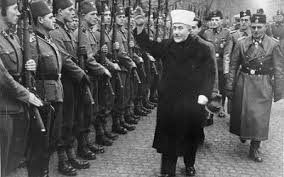
The Times stated that Netanyahu attempted “to distort history in order to draw a straight line between Mr. Husseini’s Nazi views and the current Palestinian leadership.”  Netanyahu didn’t need to do that. Palestinians do that themselves.

Pal nazi2Pal naziFatah nazimufi Jlem Nazi
Palestinians with Nazis yesterday. Palestinians acting like Nazis today.


Related First One Through articles:

Abbas Knows Racism

What do you Recognize in the Palestinians?

Extreme and Mainstream. Germany 1933; West Bank & Gaza Today

Subscribe YouTube channel: FirstOneThrough

Join Facebook group: FirstOne Through  Israel Analysis

UN Concern is only for Violence in “Occupied Palestinian Territory,” not Israel

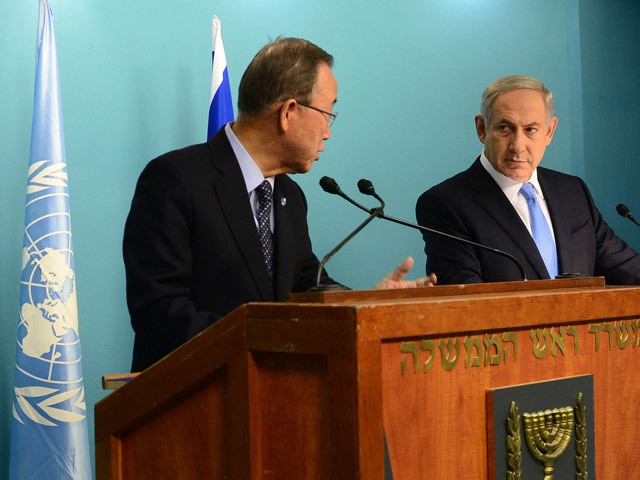
United Nations Secretary General Ban Ki-Moon arrived in Israel on October 19, 2015 with the claim that he hoped to stop “the dangerous escalation in violence across the occupied Palestinian Territory and Israel, especially in Jerusalem,” according to the UN official press release.

PM Netanyahu meets with UN Sec. Gen. Ban Ki-moon

PM Netanyahu meets with UN Sec. Gen. Ban Ki-moon (photo: GPO Kobi Gideon)

In discussing the situation, the United Nations opted to highlight certain cities where attacks took place: “in East Jerusalem, Ramallah, Hebron, Bethlehem, Jenin, Tulkarm and Nablus.” Note that every city that was mentioned was east of the Green Line. Seven cities, and not one west of the Green Line, where several attacks occurred including:

  • Petach Tikva (Stabbing October 7)
  • Kiryat Gat (stabbing October 7)
  • Tel Aviv (stabbing October 8)
  • Afula (stabbing October 8 & 9)
  • Jerusalem, west of the Green Line (stabbing and beating October 9 & 14)
  • Raanana (stabbing October 13)
  • Beer Sheva (shooting October 19)

Are these seven cities west of the Green Line not important? Is violence a concern to the United Nations only if it happens in “occupied Palestinian Territory?”

In case anyone thinks that mentioning seven random cities happened to coincidentally be east of the Green Line, the United Nations repeated those same seven cities the following day on October 20 in the press release mentioning:  “A series of deadly clashes between Palestinians and Israelis, including Israeli security forces, has marked much of October, with violent incidents reported in more than 50 different locations, including in East Jerusalem, Ramallah, Hebron, Bethlehem, Jenin, Tulkarm and Nablus.

When Ban Ki-Moon said that “No society should have to live in fear. No society can afford to see its youth suffer in hopelessness,” did he really only mean Palestinian Arabs?


Related First One Through articles:

The Narrative that Prevents Peace in the Arab-Israeli Conflict

Eyal Gilad Naftali Klinghoffer. The new Blood Libel.

Every Picture Tells a Story: The Invisible Murdered Israelis

Subscribe YouTube channel: FirstOneThrough

Join Facebook group: FirstOne Through  Israel Analysis

The Journeys of Abraham and Ownership of the Holy Land

One of the most famous cartographers in the world was Abraham Ortelius (1527-1598). Appointed as cartographer to King Phillip II of Spain, the religious Christian Flemish cartographer is credited with creating the first world atlas called “Theatrum Orbis Terrarum” or “Theatre of the World.” The atlas was originally printed in 1570 and became one of the most popular books of its time and resulted in a few printings. In total, there were 178 plates amounting to approximately 730,000 printed copies of the various maps.

In addition to the maps printed in the atlas, Ortelius also produced “Parergon” maps of interesting places. These “classical” maps were produced by Ortelius himself, as opposed to some maps in “Theatrum” which were adopted from other cartographers. The 56 such plates produced roughly 143,000 printed maps.

One of the maps of the Parergon was called “Abrahami Patriarchae” which chronicled the life of the biblical patriarch Abraham. The first map was printed between 1590 and 1595 (975 copies made) with a second plate produced 1592-1624 (2925 copies made). The map shows the journey and life of Abraham with an inset map of his journey from Ur to Canaan, as well as 22 medallions of significant life events. The map highlights Ortelius’s gift as cartographer, artist and historian.

Ortelius
Abrahami Patriarchae Peregrinatio et vitae, 1592

Some notable medallions in the map are detailed below which underscore the belief that God gave Jews the holy land:

  • Medallion 6. Genesis 13: 14-15 “The Lord said to Abram after Lot had parted from him, “Look around from where you are, to the north and south, to the east and west. 15 All the land that you see I will give to you and your offspring forever.”
  • Medallion 10. Genesis 15: 17-21 “17 When the sun had set and darkness had fallen, a smoking firepot with a blazing torch appeared and passed between the pieces. 18 On that day the Lord made a covenant with Abram and said, “To your descendants I give this land, from the Wadi of Egypt to the great river, the Euphrates— 19 the land of the Kenites, Kenizzites, Kadmonites, 20 Hittites, Perizzites, Rephaites, 21 Amorites, Canaanites, Girgashites and Jebusites.”
  • Medallion 12. Genesis 17:3-8 “Abram fell facedown, and God said to him, “As for me, this is my covenant with you: You will be the father of many nations. No longer will you be called Abram; your name will be Abraham, for I have made you a father of many nations. I will make you very fruitful; I will make nations of you, and kings will come from you. I will establish my covenant as an everlasting covenant between me and you and your descendants after you for the generations to come, to be your God and the God of your descendants after you. The whole land of Canaan, where you now reside as a foreigner, I will give as an everlasting possession to you and your descendants after you; and I will be their God.
  • Medallion 18. Genesis 21: 27-31 (ownership of Beersheba) “27 So Abraham brought sheep and cattle and gave them to Abimelek, and the two men made a treaty. 28 Abraham set apart seven ewe lambs from the flock, 29 and Abimelek asked Abraham, “What is the meaning of these seven ewe lambs you have set apart by themselves?” 30 He replied, “Accept these seven lambs from my hand as a witness that I dug this well.” 31 So that place was called Beersheba, because the two men swore an oath there.
  • Medallion 20. Genesis 23: 19-20 (ownership of Hebron) 19 Afterward Abraham buried his wife Sarah in the cave in the field of Machpelah near Mamre (which is at Hebron) in the land of Canaan. 20 So the field and the cave in it were deeded to Abraham by the Hittites as a burial site.”

This map was made by a religious Christian, not a Jew. Many evangelical Christians and others that believe in the Old Testament firmly hold that while the holy land may be holy to all of the monotheistic faiths, the land itself is God’s gift to Jews. Indeed, God is the original Zionist.