Joseph, Yusuf and the Stories We Tell

The story of Joseph is the longest sustained personal narrative in the Bible. It is a life told end-to-end—youth and jealousy, betrayal and exile, moral clarity under pressure, reversal of fortune, and reconciliation. Jews have lived inside this story for millennia and drawn from it lessons about love misdirected, loyalty earned, leadership forged, and fate revealed only in retrospect.

It begins, uncomfortably, at home.

Jacob’s overemphasis on Joseph—his public favoritism, symbolized by the coat of many colors—fractured the family. It was not Joseph’s dreams alone that enraged his brothers, but the hierarchy their father imposed. Love, unevenly expressed, curdled into resentment. That resentment escalated to violence. The brothers nearly killed Joseph, then sold him into slavery, persuading themselves that exile was mercy.

And yet, the terror of the pit became the opening move in a larger design. Joseph’s descent—into slavery, into prison, into obscurity—ultimately saved thousands from starvation, including the very brothers who betrayed him. The Torah insists on an uncomfortable truth: human cruelty can coexist with divine purpose, without being excused by it.

Over time, the transformation that matters most occurs not in Joseph, but in Judah. The brother who once proposed selling Joseph later rises to moral leadership. Faced with the potential loss of Benjamin, Judah offers himself instead. Ultimatelty, kingship does not emerge from brilliance or dreams, but from responsibility and loyalty. Judah learns what Jacob failed to teach early: leadership is love with a wide visual field.

But this is not the only Joseph story in the world.

Yusuf and Zulaykha: A Different Emphasis

In Islamic tradition, Joseph is Yusuf, and his story unfolds with different texture and purpose. The Qur’an (Surah Yusuf) adds layers absent from the biblical text. Where the Bible does not even name Potiphar’s wife, Islamic tradition gives her a name—Zulaykha—and an entire inner life.

Her attraction to Yusuf begins as physical longing, but in later tradition becomes a spiritual ascent. Love itself is refined—from desire for beauty to yearning for the divine. This is not biography alone; it is allegory.

Persian culture preserved these layers visually, through extraordinary manuscript art that does not merely illustrate scripture but interprets it.

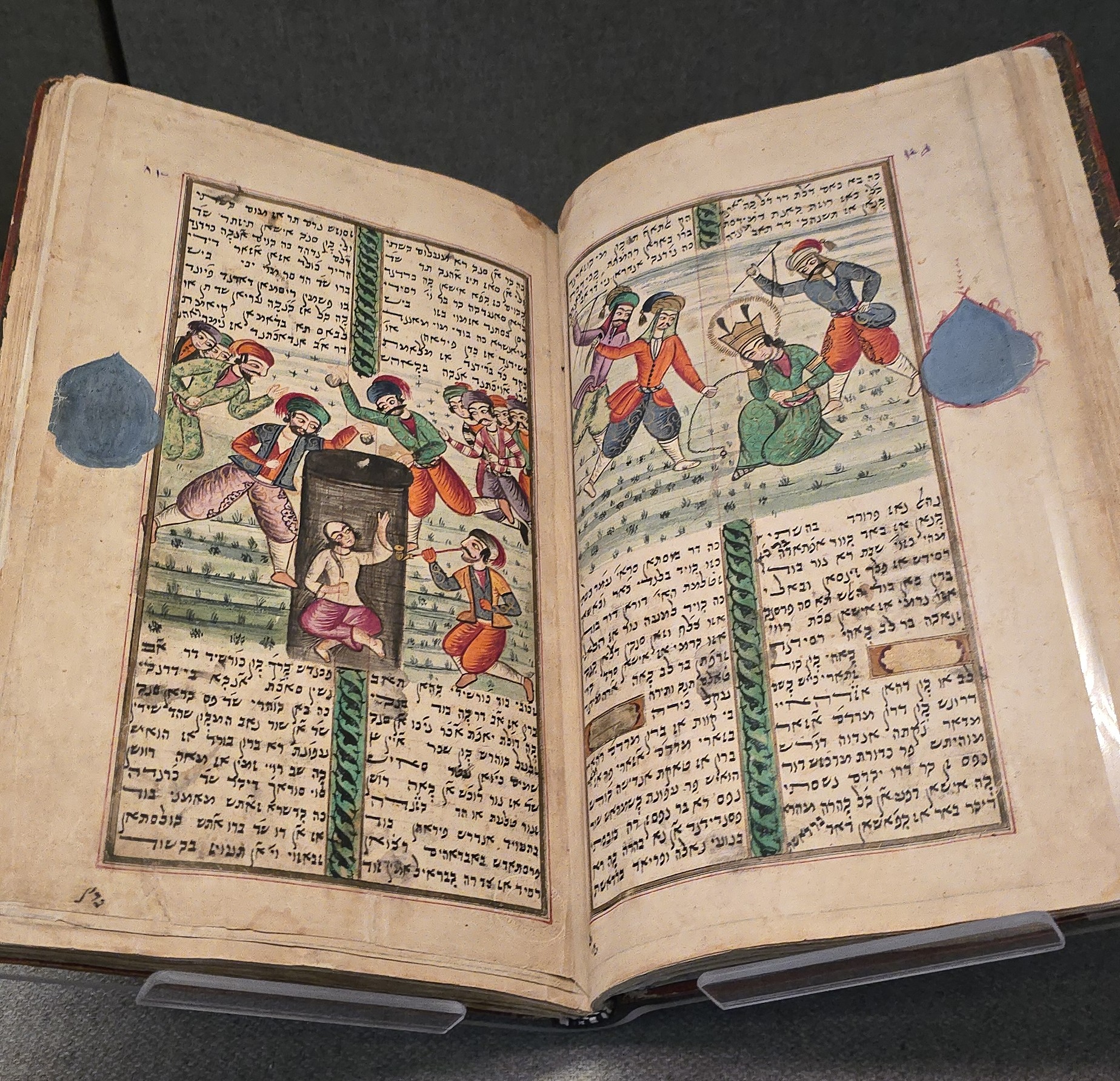
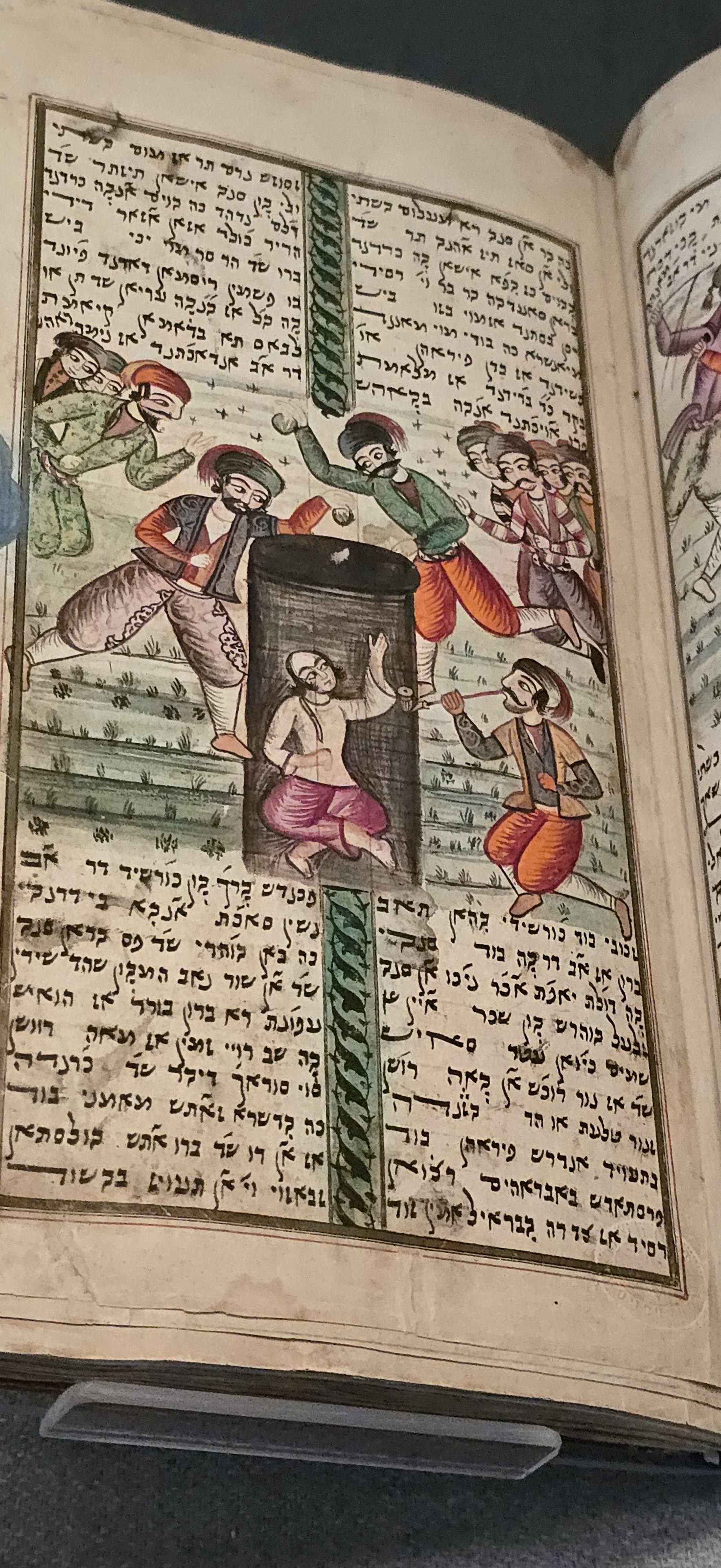
One remarkable manuscript—now on display at the Grolier Club from the collection of the Jewish Theological Seminary (until December 27, 2025)—shows Joseph cast into a well. The details are arresting. Joseph has lost not only his coat of many colors, but his hat and shoes as well—status stripped away piece by piece. The brothers even drop rocks down on him.

Story of Yusuf and Zulaykha from Mashhad, Iran in 1853 by the Jewish scribe Eliyahu ben Nisan ben Eliyahu Gorgi. Digitized entire manuscript can be viewed here

One figure stands apart in the drawing. At the bottom of the scene, a brother sits almost contemplatively. His hands alone are painted with henna, marking higher status. He smokes a long çubuk (copoq)—a dry-tobacco pipe, not the classic Persian water-based hookah—an unsettling detail as Joseph languishes in a dry well below. The image quietly foreshadows hierarchy, survival, and reversal. Even in betrayal, the future is being seeded. This must be Judah, on the side of the well with his five brothers from mother Leah, who is destined to help Joseph out of the pit and rise to fame himself.

One brother seems to connect at the same level of Joseph – at a low point in this story but will rise to fame later in life: Judah

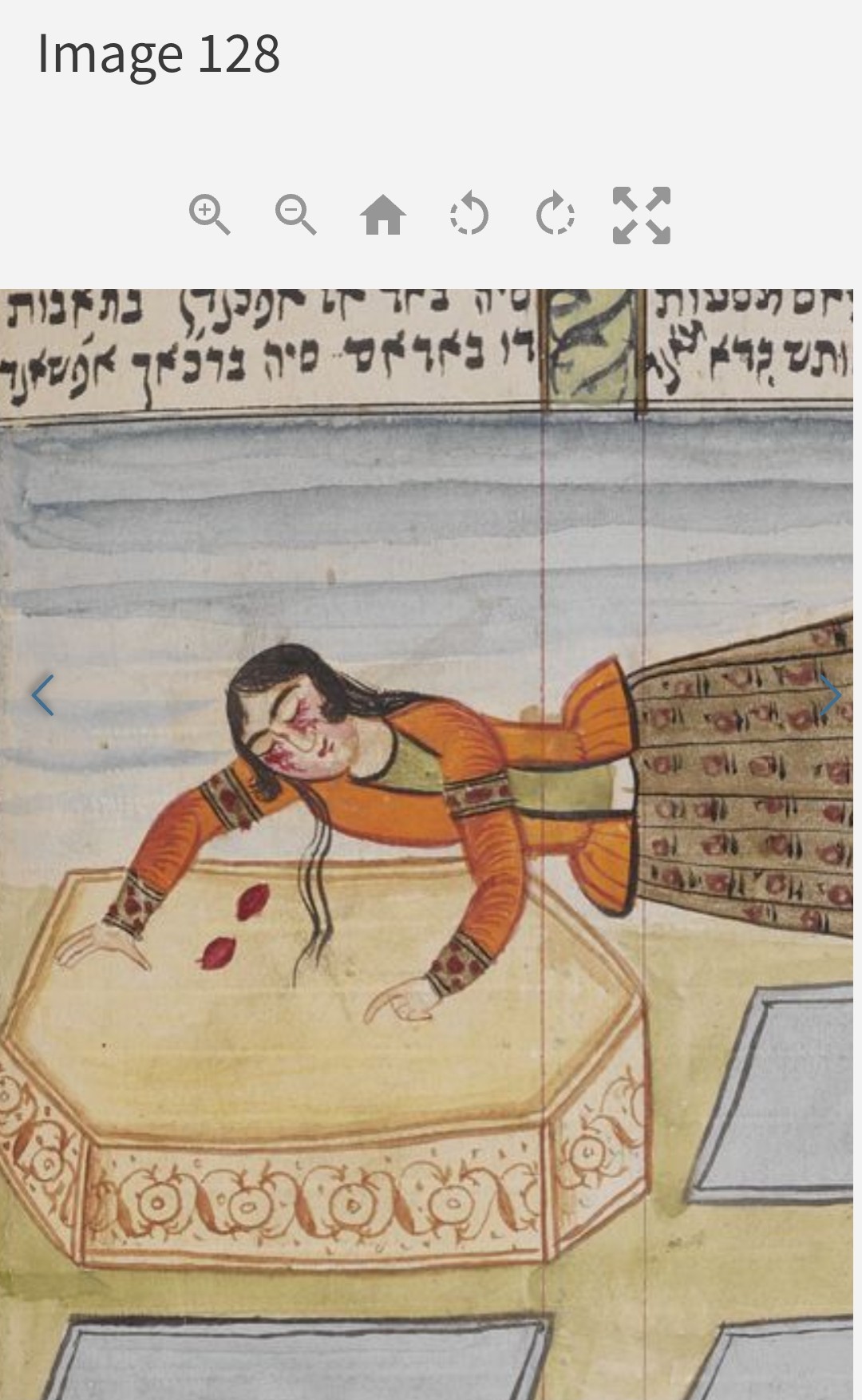
Other images in the Yusuf cycle go further still in the manuscript. Women cut themselves upon seeing Joseph’s beauty (image 70 from Surah Yusuf 12:31). Zulaykha is said to lose her sight from longing for him (image 128). Beauty becomes dangerous, overwhelming, transformative. The Islamic tradition does not deny desire; it seeks to discipline and redirect it.

Zulaykha losing her sight at the end of the story is one of the versions transmitted through the ages

Two Traditions, One Origin

For Jews, Joseph’s story is about dreams and reversals, exile and return, family rupture and national survival. For Muslims, Yusuf’s story adds a meditation on beauty, temptation, and love’s ascent toward God. The Islamic telling emerged nearly two thousand years after the Jewish forefather lived. It is not wrong; it is different.

What matters for us today is that these differences did not need to fight. The stories coexist without trampling on the other.

The same characters—Jacob, Joseph, the brothers—carried distinct lessons without cancelling one another. No one is frozen forever as a villain. Jacob loved poorly but learned. The brothers failed catastrophically but changed. Judah rose. Sacred storytelling, at its best, refuses to eternalize blame.

That restraint is precisely what feels absent today.

Stories, Power, and the Present

The Holy Land, sacred to both Jews and Muslims, is no longer widely treated as a shared inheritance, but as a zero-sum possession. Hamas openly declares that Jews will be wiped out. Clerics in parts of the Islamic world speak in timelines of Jewish disappearance due to their being “enemies of world peace.” This is not interpretation; it is incitement. It rejects the Joseph model, in which history bends—slowly and painfully—toward survival, accountability, and reconciliation rather than annihilation.

And yet, Islamic civilization itself offers another precedent. Islam historically made room for Jewish continuity—absorbing biblical figures, preserving Jewish prophets, and allowing traditions to dovetail rather than collide. Yusuf did not replace Joseph; he walked alongside him. Zulaykha did not negate Potiphar’s wife; she deepened the moral inquiry. Reverence did not require negation.

That capacity still exists.

If Joseph teaches anything durable, it is that sovereignty, survival, and holiness are not insults to one another. Jews returning to and governing their homeland need not be read as a theological defeat for Islam. They can be understood, instead, as another chapter in a long, shared story—one that does not deny difference, but refuses extermination as destiny.

The question is whether we choose that inheritance again.

The Little Drummer Boys of Terror

President Obama once derided those who warned of Iran’s nuclear ambitions as promoting a “drumbeat of war.” It was a curious charge, especially as his negotiated JCPOA deal paved Iran’s legal pathway to nuclear weapons within a decade—despite Tehran’s unabashed calls to utterly destroy an American ally, and referred to the United States as “Satan.”

The phrase “drumbeat of war” is worth pausing over, because its imagery is meant to point a damning finger at generals and war profiteers, when in fact it refers to a beating passion that comes from a variety of sources.

Music itself teaches us the power of the drumbeat. Maurice Ravel’s “Bolero” begins as a whisper—a single snare tapping a faint rhythm—but its relentless pattern swells, layer by layer, into a rapturous explosion. Nothing changes except the intensity. It is a master class in how a simple beat, repeated without interruption, can inflame emotion, tighten resolve, and propel an entire orchestra toward an inevitable climax. Passion grows not from complexity but from persistence.

Cinema took that lesson to the battlefield. Ennio Morricone’s “L’Arena,” born from spaghetti-western duels and later carried into modern war films, shows how percussion can elevate tension into confrontation. Its pounding drums accompanied by trumpets push characters toward conflict; the beat does not merely accompany battle—it summons it. Morricone understood that rhythm can be a weapon, a psychological drumroll that makes violence feel fated long before the first shot is fired.

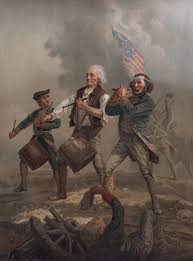
In American history, drummers were not symbolic ornaments—they were battlefield communicators. The famous “Spirit of ’76” painting captures a young boy and an old man beating time through the fog of revolution. In both the Revolutionary War and the Civil War, the drummer corps relayed commands, kept formation, and lifted morale. Soldiers needed to be adults to enlist, but drummer boys could be barely in their teens. They were not the policymakers of war; they were the ones whose youthful energy pushed men forward into battle.

“The Spirit of ’76” (1875) by Archibald Willard (1836-1918)

It is an uncomfortable truth: the drumbeat of war is often carried not by governments or generals but by the young.

We like to imagine youth as the innocent bystanders of conflict—swept up, exploited, or victimized by forces beyond their control. That is often tragically correct. But not always. In the Middle East, teenage Palestinian Arabs have repeatedly been at the center of anti-Jewish violence. During the knife intifada of 2015–2016, most of the attackers were adolescents. Arabic media even gave them a romanticized nickname: Ashbāl al-Quds—the lion cubs of Jerusalem.

On October 12, 2015, two Palestinian boys, 15-year-old Hassan Khalid Manasra and his cousin 13-year-old Ahmad Manasra, stabbed two Israeli civilians in Jerusalem

They were not pawns in someone else’s narrative. They were active participants in it.

While they were stabbing Israelis in the streets, new legions of drummer boys was forming. The Lions’ Den was inaugurated in the West Bank to unleash dozens of attacks. The United Arab Emirates named a school for children for these young murderers. In the United States, a group calling itself the Palestinian Youth Movement openly glorifies the murderers of October 7 and calls for an intifada on American soil. They harass Jews at universities, shut down bridges, disrupt traffic, and chant for “uprisings”—all under the pretext of activism, and often shielded by tax-exempt organizations like WESPAC.

In the immediate aftermath of the October 7, 2023 massacre by Gazans of Israelis, Cornel West marches with PYM calling for an “Intifada revolution”. West has taught at Princeton, Harvard and Yale, indoctrinating the next generation of American leaders on intifada.

The drumbeat is steady. It is disciplined. And it is aimed squarely at Jews.

Where does this beat begin? It is not in the Israeli cabinet rooms the media delights in blaming. It begins at UNRWA schools, where generations of children are taught that Jews are colonial invaders with no history in their homeland. It echoes through activist teacher unions in the United States, where “decolonization” rhetoric is repackaged into lesson plans that erase Jewish indigeneity. It thunders at the United Nations, where Muslim-majority blocs and their allies advance resolutions asserting that Jews must be removed from Judea, Samaria, and even parts of Jerusalem “by any means necessary.” The young Palestinian Arab terrorist are then shielded from blame and prosecution by the poorly named “UN Coordinator for Middle East Peace.” Laughable if not such a tragedy.

The young listen. And they march.

At Christmastime, the world hears “The Little Drummer Boy”—a melody of humility. A child with nothing to give but a simple rhythm of devotion for a newborn Jewish baby in Bethlehem. A beat based on innocence and purity.

But the modern Middle East and its Western echo chambers have perverted that image.

Today’s little drummer boys are not offering gentle hymns. They are being raised, trained, and celebrated for a beat of hatred—an indoctrinated cadence that valorizes “martyrs,” delegitimizes Jews, romanticizes violence, and promises glory for those who shed blood.

The world should hear the drumbeat. And it should finally ask: Who handed these children the drums? Who taught them that murder is heroism, that Jews are prey, that violence is virtue?

These teenagers did not invent the rhythm—they are marching to a score composed by UN agencies, radicalized teachers, political opportunists, and ideological arsonists who hide behind the language of “justice” while grooming minors for war.

UN Watch’s Hillel Neuer presents new report, “Schools in the Grip of Terror: How UNRWA Allowed Hamas Chiefs to Control its Education System,” to the Italian Senate in September 2025

At Christmas, we think of a young drummer offering a humble gift to a Jewish child in Bethlehem. Alas, today too many young drummers are taught to offer not devotion, but destruction—and the world nods along as if the rhythm were unavoidable. It isn’t.

The beat continues only because we refuse to silence the conductors who train the next generation of drummers to hate.

The Age of Rocks and the Arrogance of History

To walk the land of Israel is to feel stitched into the fabric of time. Every trail from Beersheva to the Galilee whispers of footsteps that appear in the Bible—not legends, but people who actually lived, planted, quarreled, dreamed, and prayed on this soil. The stones beneath one’s feet carry the gravity of memory. They seem fused to the foundation of the earth itself, like the Even haShtiyah—the legendary rock at the center of the Temple Mount from which creation is said to have sprung.

Rocks in Judean Hills

But that connection is not geological. It is human.

The rocks of Eilat, the oldest in the region, date to around 800 million years. They feel unimaginably ancient to us—far older than Abraham’s tents, King David’s psalms, or the Hasmonean rebellions that command our sense of deep history. Yet even those craggy cliffs and mineral seams are infants compared to the rocks of Canada. In the Canadian Shield lie formations over 4 billion years old—some of the earliest surviving pieces of Earth’s crust. Five times older. A geologic eternity older.

And yet no one reveres those rocks. No pilgrim circles them. No faith assigns them cosmic origin stories. They are “pretty,” not primordial. They are scenery, not scripture.

Why?

Because we measure age in lifetimes. We crown the stones of the Holy Land as ancient not because they are old, but because we are old here—because human meaning saturated this place for millennia. The rocks become vessels for our significance.

It is, in a sense, a subtle arrogance: the centering of human experience as the measure of the world. We treat Earth’s deep past as a backdrop to our stories rather than a reality that dwarfs them. We act as if history begins with us, as if time itself depends on our noticing it.

When we walk these trails—past the ruins of synagogues, the outlines of Israelite cities, the remnants of Crusader walls—we feel connected because these places speak to human time. They anchor us. They dignify us. But the rocks beneath those ruins hum a different message: we are temporary here. Our religions, nations, languages, and conflicts occupy a blink of the planet’s eye.

A dose of humility would serve us well. To appreciate the holiness of our stories without mistaking them for the age of the world.

We walk ancient paths, and the ground reminds us we are all newcomers.

Chagall’s Ladder and October 8 Jews

Marc Chagall (1887–1985) returned again and again to the image of Jacob’s Ladder throughout his long life. But his 1973 rendering, painted near the end of his days, stands apart. It is visually explosive—layered, dissonant, and urgent.

The moment one sees it, the eye is pulled upward to an orange sun burning at the top center. At that height, the sky should glow with daylight yellows. Instead, the sky is red, a communist-red firmament. And the town below, which should be illuminated by that sun, sits in unnatural midnight blue.

Something is wrong in this world. This is not a window into serenity; it is a scene of foreboding.

That imbalance is profoundly Chagall. Born in the Jewish shtetls of the Russian Empire, he fled early waves of antisemitism. He lived through the destruction of European Jewry and spent his career painting ghost-towns of a shattered civilization. But he also painted the biblical narratives that shaped Jewish imagination. In this canvas, he fuses those worlds—eternal story and fragile reality—into a single warning.

At the center of the darkened town rises a ladder stretching into the sky. Three white angels punctuate the blue shadows, announcing that this is Jacob’s dream. Yet Chagall departs from Genesis: the ladder doesn’t stretch into the heavens and all the angels are not identical. Instead, the ladder is held in place by a blue angel, while a second, yellow angel reaches for it from the red sky above.

This ladder has competing destinations.

The blue angel, painted in the same hues as the town, embodies the pull of entrapment—those who cannot or will not flee their circumstances. In 1973, when Chagall painted this work, Soviet Jews were locked inside a system that barred their departure and suppressed their identity. The blue angel is not hostile; it is immovable. It represents the status quo, the path of staying even as danger grows. It is the sleeping Jacob at the bottom of the painting pondering the outcome of fleeing while laying immobile.

The yellow angel, by contrast, belongs to the daylight that should have filled the sky. It symbolizes clarity and escape. Beneath it, at the bottom-left, a mother and child ride a yellow rooster—Chagall’s emblem of dawn, deliverance, and a new beginning. Above them, nearly hidden in the deep blue, a quiet procession of Jews slips toward a safer horizon.

This is Jacob’s dream retold by a man who watched Jews flee the Russian Empire, flee Europe, flee the infernos of the 20th century. It is a ladder that offers a way out—if one chooses the right direction. It is there on Jacob’s face, the yellow glow of peaceful escape.

The October 8 Jews

Today, a new group is dreaming of climbing Chagall’s ladder: the October 8 Jews.

These are the Jews who woke the day after the October 7 massacre not only to the horror in Israel, but to the celebrations of that horror across Western cities. They heard the chants of “Globalize the intifada!” and “There is only one solution—intifada revolution!” echoing at major universities, boulevards, and civic squares. They watched crowds revel in Jewish fear, justify kidnapping, rape, and murder as righteous “resistance,” and proclaim open season on Jews everywhere.

Suddenly, the Western Jew realized that the ground beneath his feet might no longer be stable.

He now lives between Chagall’s two angels. Does he cling to the familiar town—the blue angel of inertia, habit, and misplaced trust? Or does he follow the rooster, the yellow angel, toward a place where Jewish existence is not conditional, tolerated, or revocable?

In the early 20th century, Jews fled the USSR and Europe for the United States and the Land of Israel. Today the destinations remain, but the calculus has changed. The Jewish state is stronger than ever—and simultaneously the focal point of global vitriol. Safety and danger now sit braided together.

The Ladder Still Stands in the Center of Town

Chagall painted Jacob’s Ladder for those who knew safety can vanish overnight. His warning now belongs to us. On October 6, Jews believed they lived in stable towns; on October 8, they saw the sky had been red for years. The chants weren’t metaphors, the mobs weren’t marginal, and the threats weren’t theoretical. The blue angel of normalcy had held the ladder while danger gathered in plain sight.

So the question becomes stark:

Will Jews try to reclaim trust in places that celebrated their terror—or follow the mother and child on Chagall’s yellow rooster toward the only light that doesn’t depend on someone else’s tolerance?

For a century, Jewish survival has meant movement: away from the USSR, away from Europe, away from every place that insisted Jews stay quiet and endangered. The October 8 Jew must decide whether today is any different.

In Chagall’s vision, only one angel leads to dawn.

The ladder still stands. The choice is ours.

The Prophetic Bird Of The Holy Land

Israel’s national bird is not the mighty eagle or the muscular vulture which many countries select. It is not a predator circling above the desert in effortless dominance. Instead, Israelis chose a small, cinnamon-colored creature with a zebra crown — the hoopoe.

The hoopoe going for a walk in Israel (photo: FirstOneThrough)

The hoopoe is striking without being fearsome, regal without being tyrannical. Its crest rises like a tiny crown, not in arrogance but in alertness. Its quiet confidence is perhaps the most Israeli trait of all.

Ancient Jewish texts and Middle Eastern folklore saw in the hoopoe a messenger of wisdom. King Solomon, in one Midrash, learns from the bird’s insight. In Islamic tradition, it is the hoopoe who spots the Kingdom of Sheba and brings word of distant realms. Small in stature, large in perception — the bird was never the warrior; it was the one who saw.

And in that, too, there is something deeply familiar. Israel has always survived less by size than by awareness, less by brawn than by vigilance. The hoopoe does not conquer terrain; it adapts to it. It finds food in the hardest soil. It endures heat and drought. It survives because it is resourceful, not ruthless.

It is also fiercely protective through a strange biological ingenuity. When predators threaten its nest, the hoopoe emits a foul-smelling secretion that drives them away. It is a defense born of determination: My family will not be harmed.

That combination — gentle but unyielding, peaceful but protective — resonated in the public vote that crowned it Israel’s national bird in 2008. Israelis did not choose a symbol of domination. They chose one of resilience, devotion, and wisdom. They chose a creature that guards life rather than takes it.

Israel didn’t know in 2008, when it voted for the hoopoe, that Hamas would launch war after war with openly genocidal intent. It didn’t know that October skies would fill with rockets, or that invasions, massacres, and kidnappings would carve themselves into the national psyche. But the country understood something deeper — that, like the hoopoe, it would have to adapt to danger, live alert, and protect its family with whatever tools it had.

A small bird in a vast desert landscape.
A small country in a vast expanse of Arab and Muslim nations.

The hoopoe survives not by dominating its predators, but by outsmarting them, outlasting them, and never abandoning its young. Israel, too, has learned to persist in a world that often misreads its vigilance as aggression and its survival instincts as provocation.

The national bird turned out to be prophetic.

Israel may be small, but like the hoopoe, it adapts, endures, and protects its own — even when surrounded, even when threatened, even when the world insists it should fold its wings and pretend it is safe.

The Copyrights of Winnie the Pooh and Jews

When Winnie-the-Pooh entered the public domain in 2022, the cultural floodgates opened. A once-beloved children’s character, wrapped in honey jars and innocent nostalgia, was immediately remade into a monster. “Blood and Honey” turned Pooh into a savage killer. Games, parodies, and dark pastiches flooded the market. The comforting bear was no longer safe; he had been transformed into a canvas for other people’s fears, cynicism, and jokes.

It feels eerily familiar.

For two thousand years, Jews have been cast into the public domain. Stripped of the right to define their own story, they became available for anyone’s use. And abuse. Once known as the people of the Book, bearers of commandments, prophets, and a covenant, their identity was seized and rewritten. Medieval Christians branded them Christ-killers. Islamic empires reduced them to dhimmis. The Enlightenment caricatured them as rootless and ruthless bankers. In the modern age, they became “colonizers,” “supremacists,” and the avatars of “genocide.”

The Jews never sold the copyright to their name or history, but the world took it anyway. Just as horror producers found amusement in twisting Pooh into a monster, antisemites—left, right, secular, religious—have scribbled their darkest nightmares onto Jewish bodies. Pogroms, expulsions, inquisitions, and now, boycotts and campus rallies all stem from a warped creativity that insists Jews cannot own their own narrative.

Israel’s rebirth was supposed to end this. After all, if you reclaim your home, revive your language, rebuild your state, surely you also reassert your identity. But even here, the appropriation continues. Israel was smeared as “apartheid,” “genocide,” “ethnic cleansing,” “racist,” and “colonial” decades before Hamas launched its latest genocidal war. “Jewish self-determination” is rewritten as oppression. “Defending children” is recast as war crimes. The oldest continuous nation on earth is treated as a villain in someone else’s morality play.

The difference between Winnie-the-Pooh and the Jews is stark. The fictitious character Pooh was released into the public domain by the natural passage of time, his copyright protection simply expiring. The Jews were thrust into the public domain by malice—by the unwillingness of societies to allow them ownership of their story. The Jewish Bible was rebranded as the Old Testament, out of copyright protection. Blood libels took hold on the bleached pages of Jewish foundational documents.

The current Jewish year is 5786. Traditionally, Jews write the date in Hebrew letters like Roman numerals and drop the 5 as being well understood. The letters for 86 spell “Pooh” in Hebrew, so now is as good a time as any to attempt a change that the 1948 reestablishment of the Jewish State did not provide.

One simple action is for everyone to write a large ‘5’ before the date, making clear to themselves and others that their faith predates all others, and continues still.

Challenge every use of the phrase “Promised Land” as a vicious varietal of cultural appropriation, which strips Jewish indigenous people from their divine heritage.

More dramatic is to reclaim Jewish rights on the Temple Mount. Why should the world care about Jewish faith and feelings if the majority of Jews treat the center of its religious devotion as a vestigial organ instead of the beating heart? Are we a living people or a hollow chamber for others to draw upon?

We must not countenance the free license for others to slander, parody, or profit off the Jewish name. The Jewish people are not public property. They are the authors and owners of their own identity—and it is time for them to act as such.

The Wisdom of Waiting

The ability to delay gratification has long been seen as a mark of intelligence. The famous “marshmallow test” placed children in front of a single treat and offered a simple bargain: eat it now, or wait and get two. Those who resisted often went on to succeed academically, socially, even financially. Patience was not just a virtue; it was predictive.

Yet it turns out this trait is not uniquely human. In a Cambridge experiment, cuttlefish were given a similar choice — a mediocre meal immediately or a shrimp, their favorite, if they waited. They waited. In fact, they sometimes endured two full minutes of temptation, holding out for the better prize. Even more remarkable: those same cuttlefish who delayed showed sharper learning in other tests. Intelligence, it seems, wears many disguises.

This was the first time this kind of patience was found in an invertebrate. Chimpanzees, crows and parrots have long been known to delay satisfaction in order to save food for later.

What makes this discovery all the more striking is that cuttlefish are solitary creatures. They do not form schools, build social bonds, or raise their young. Their patience evolved for the hunt — the advantage of waiting for the better prey, of holding still in camouflage until the perfect strike. Their foresight is purely individual, a strategy of survival.

Humans, by contrast, require patience not just for survival but for flourishing. Patience is what allows us to build together — to trust one another, to undertake projects that span generations, to cultivate communities and civilizations. Our ancestors planted trees whose shade they would never sit under and built cathedrals that took centuries to complete, as an extension of delayed satisfaction – a commitment towards a future society they would never enjoy.

But in our age of instant messages, instant news, and instant outrage, society no longer prizes waiting. Why suffer a moment of discomfort when a thousand distractions beckon from a glowing screen? Why wrestle with the silence of patience when clicks deliver dopamine now? Where our forebears saw wisdom in restraint, we see boredom. Where they saw the dignity of discipline, we see inconvenience.

Patience as a virtue is not just about self-control; it is the very condition that allows for deep thought and deep bonds. To abandon patience is to abdicate our gifts of reflection, to trade away the ability to imagine futures greater than the present moment. In our hurry, we become more animalistic, lunging at whatever stimulus flashes before us. And unlike the cuttlefish, whose patience serves survival, we squander patience’s higher purpose — the power to build not only buildings that endure, but bonds that sustain.

Are we in the process of losing our basic survival skills – in both the present and future? Are we burying our ability to ponder to be led like dolts to an unsuspecting danger?

The irony is sharp: solitary cuttlefish wait with foresight, while humans — the only creature who truly needs patience to hold communities together — are in danger of forgetting how. Delayed gratification once built civilizations. Instant gratification now tears at their foundations.

The cuttlefish reminds us that intelligence is not about speed but foresight. A creature with no interest in faith, family, or future still knows the wisdom of waiting. The question that remains is whether we do.

Advancing Religion In America

On October 28, 2011, Lord Jonathan Sacks, the Chief Rabbi of England, came to New York City and sat with Rabbi Meir Soloviechik at Yeshiva University. Their hour long talk touched on Lord Sacks’ book The Home We Build Together, and the role of religion in society, focusing on the United States and the United Kingdom, in particular.

Chief Rabbi Lord Jonathan Sacks Speaks at Yeshiva University with Rabbi Meir Soloveichik, October 2011

In the opening remarks (3:10), Rabbi Soloveichik shared a story about Senator Joseph Lieberman, who once observed that on Simchat Torah, Jews dance with the Torah in the streets with joy, yet often fail to carry that Torah into the world during the rest of the year. It was a reminder that religion cannot remain confined to ritual but must be brought into society.

Lord Sacks followed with a story of his own. Prime Minister Tony Blair once teased him that he had reached the “boring part” of the Hebrew Bible—the lengthy passages about the building of the Mishkan (Tabernacle). Why, Blair asked, does the Torah devote hundreds of verses to it, compared to just 34 for the creation of the universe?

Lord Sacks replied:

Prime Minister, it is not difficult for an omniscient, omnipotent, infinite God to create a home for human beings. But for finite, fallible human beings to create a home for the infinite God, that is difficult.

The Mishkan, Sacks explained, was not just architecture—it was a project that united the people. More than what God does for us, it is what we do for God that transforms and binds us together. “If you want to take this diverse, fractured culture of Britain and turn it into a united nation,” Sacks said, “you have to get them to build something together.”

Rabbi Soloveichik and Lord Sacks went on to describe that the decline of religious life and secularization of Europe was tied to fewer children being born. A self-centered focus weakens families, weakens faith, and weakens society. In contrast, raising children—caring for someone more than oneself—provides both the foundation of belief and the roots of charity: “having somebody whose life you care about more than yourself, that could actually be the foundation of faith for many of us.”

Washington (D.C.) and Rembrandt

Nearly fourteen years later, on September 8, 2025, U.S. President Donald Trump held an event at the Museum of the Bible in Washington, D.C. He invited members of the newly established (May 1, 2025) Religious Liberty Commission to hear how he was advancing the centrality of religion in American public life. He said “When faith gets weaker, our country seems to get weaker. When faith gets stronger… good things happen for our country…. To have a great nation, you have to have religion.”

President Trump remarks at the Museum of the Bible, September 8, 2025

One of the members of the Presidential Committee on Religious Liberty is Rabbi Meir Soloveichik. He was unable to attend the speech by the president in Washington because he was giving a day long-lecture in New York City at the home of Mem and Zalman Bernstein and the Metropolitan Museum of Art for the Tikvah Fund about art, religion and western society.

Rabbi Meir Soloveichik discussing Rembrandt’s 1635 painting “The Sacrifice of Isaac” for Tikvah

Rabbi Solveichik focused on Rembrandt’s two versions of the Sacrifice of Isaac. He contrasted Abraham’s devotion to God’s command to offer his son Isaac, to the investment of love and devotion he had made in his son. The angel broke the conflict, and with it, the end of human sacrifice which was prevalent in the world at that time. From this point onward, belief in a higher power could be accompanied by protecting and investing in our children.

Religion, Children and Western Democracy

It made for an interesting sermon triptych connecting religion, children and western values: Lord Sachs, Rabbi Soloveichik and President Trump all emphasized that religion has the power to strengthen ourselves, our families, our communities and our nation.

In Lord Sacks book, The Great Partnership, published in June 2011, right before his talk at YU, he wrote:

My argument has been that contrary to the received narrative, freedom has been better served in the modern world by a religious vision rather than a secular one. The Abrahamic vision, with its insistence on the non-negotiable dignity of the human person and the importance of protected space – the families and communities that make up civil society – where relationships are not based on power, saved England and America from the worst excesses of the revolutionary politics that cost tens of thousands of lives in France and tens of millions in Russia….

Abrahamic politics, by contrast, is politics with a human face, the politics that knows the limits of power, as well as the transformative effect of free persons freely joining together to make social institutions worthy of being a home for the divine presence. Abraham politics never forgets that there are things more important than politics, and that is what makes it the best defense of liberty.”

That is the motion before Western democracies: can humble faith as embodied in “Abraham politics” lead our different faiths to help build a cohesive society of respect and growth.

Concluding Circle

The discussion of religion and democracy is being advanced passionately today because it feels abandoned.

According to Lord Sacks, democracy under secularism preached intersectionality which yielded segregation and isolationism. Rabbi Solveichik responded that “a Mayflower of persecuted religions might leave England and Europe to come to safer shores [like America].” For his part, President Trump established the Religious Liberty Commission to deal with such matters, with the first group’s term ending on July 4, 2026, on the nation’s 250th anniversary.

So it was fitting that Rabbi Soloveichik should end his talk to the Tikvah Fund, a group whose motto is “Advancing Jewish Excellence and Western Civilization through Education & Ideas,” before Emanuel Leutze’s Washington Crossing the Delaware, while President Trump was concluding his remarks in Washington, D.C.

Rabbi Soloveichik at the Metropolitan Museum of Art, September 2025

In the 1851 painting, the future president of the United States stood aboard a boat filled with a diverse crew, readying to end the rule of England and break with the British monarchy and Church of England, to establish a new democratic state in 1776. Nearly 250 years later, the Chief Rabbi of England, the president of the United States, and the rabbi leading the oldest synagogue in the United States were championing the importance of religion in strengthening democracies everywhere. A quiet revolution to return to the foundations of faith to help build a more perfect union.

Who’s Afraid Of Superman?

The newest Superman movie incarnation is out and critics and journalists have grabbed a pen even before a seat. Their reflections on modern society will inform how they view the characters and plot more than the cinematic quality of the film.

An interesting take was made in The New York Times opinion section called “My Problem With Superman.” The guest essay was written Junot Diaz, an immigrant from the Dominican Republic who teaches creative writing at MIT. One would imagine the story of Superman would resonate with this first generation immigrant but Diaz makes clear that he never liked Superman as originally presented to the world.

He recognizes that Superman was brought into the world as a story of a foreign refugee who escaped his dying world, something with which he should be able to relate. Diaz is well versed in the storyline in which Superman’s powers were used to fight for good in a mad world.

Yet it does not resonate for him. Not through his eyes when he was young, nor in looking at society today.

Because for Diaz – and possibly (presumably?) many immigrants like him, Superman is a force unlike any around him, a body of permanent power inequality. He might be a refugee but the dynamic is irrelevant in a progressive worldview obsessed with inequalities and power.

In today’s environment, Superman is internalized not as an individual but a nation. For Democratic-Socialists, the United States is not a “shining city on a hill,” but a monstrous force convinced of exceptionalism which wreaks havoc on the Global South.

Diaz article in The NY Times “My Problem With Superman”

In this mindset, the “annihilating exceptionalism” of power IS the evil. It is neither a force for good nor an aspiration or inspiration. It is an unnatural entity in a society intoxicated by a mission of massive redistribution of wealth and power.

Diaz makes his point clear, quoting Frederick Douglass in a call for a revolution of “fire, thunder and earthquake” to mobilize a nation of people to combat the “world in peril” from a sick governmental order.

Diaz article in The NY Times “My Problem With Superman”

The citizens of Metropolis are voting for Democratic Socialists like Alexandria Ocasio-Cortez and Zohran Mamdani who believe that “billionaires shouldn’t exist.” Exceptionalism is viewed as inherently racist and/or enabled by a society which is deeply corrupt. Capitalism is tarred as deeply unfair. All of the power structures are fair game for targeted assassination – whether political, financial or moral.


Superman – and many of the superheroes of the era like Spiderman, Captain America and Batman – were created by young Jews before the start of the World War II and the Holocaust of European Jewry. They were young immigrants who wanted to survive in a world which had cast them out and marked them as forever different. The creators of these superheroes wrote stories of good defeating evil in a world which saw little support for the underdog. Evil was everywhere, and the only way of balancing the world between sparks of good and an inferno of evil was to oversize the good. Good needed to be extra – extra-powerful, extra-moral, and yes, extraterrestrial – to gain the upperhand.

That narrative spoke to Americans watching Nazi Germany incinerate Europe. It continued to capture the West’s attention in the following decades.

But now?

Much of the world is not looking at morality in the plain sense of the last generation. It is defined first – no, only – by equity. In this framework, without a balancing of power and wealth there can never be a good society. DEI (diversity, equity and inclusion) for progressives is the only solution, and a nation which strips those initiatives is attempting to install a permanent dynamic of inequalities. Democratic-socialists are seeking to dismantle such America via a revolution of the masses.

The two Jewish writers and illustrators who created Superman – Jerry Siegel and Joe Shuster – might be amazed that their creation finally has a Jewish actor, David Corenswet, playing the part in a major movie. If alive today, they might imagine that such milestone would mark a blessed society which finally welcomed the stranger, the immigrant, the survivor of the destruction of his old world. Embraced him as someone kind and noble who fought for justice for all.

David Corenswet as Superman

Alas. Imagine their amazement, the horror, if they could time travel to today, to see the target audience for their stories – immigrants in America – turn on Superman as a grotesque to be liquidated. Not because of White nationalism of Nazism that they faced a hundred years ago, but for the sin of exceptionalism in a society hell-bent on equity.

Related:

The Disappearing Jew (July 2024)

Now Is The Time For Sabra, An Israeli Superhero, To Join Captain America (October 2022)

From the Hitler Youth to Woke Classrooms: State Indoctrination Then and Now

Zohran Mamdani, a radical socialist won the New York City Democratic primary for mayor. He did it on the strength of young voters who turned out to vote in Brooklyn and Queens. It was not solely about race or income level as commonly thought (Bronx is poorest and went +18 for Cuomo and Manhattan has the greatest percentage of Whites and went for Mamdani). The young people in liberal districts who came out in droves and secured his victory.

Poor Hispanics generally preferred Cuomo; Asians preferred Mamdani. But the real divide was in age: both in candidate preference and coming out to vote

America’s young people – especially in urban areas like New York City – are much more likely to be non-White than older Americans. They are more likely to get their news from social media influencers than credible news outlets, know little about the Holocaust, don’t remember the terrorist attacks of 9/11, and have been indoctrinated in a public school system that has advanced an “oppressor/oppressed” narrative in which “White privilege” has not only intentionally placed young non-White people at a disadvantage, but stolen their wealth and power in a racist generational kleptocracy.

Today’s youth have been indoctrinated by a socialist public school system which has compulsory attendance. Powerful teacher unions block alternatives like new charter schools and fight any monies going to private schools, thereby making them out-of-reach for many and frequently non-viable. Further, the teacher unions demand that they have total control of the education and block parental involvement.

This forced indoctrination of youth into a divisive ideology has a historic parallel: Nazi Germany.

When people think of black-and-white images of Hitler Youth, they instinctively recoil. The idea of a government-run school system indoctrinating children with a twisted dogma, demonizing whole groups of people, and eliminating parental rights is rightfully condemned. But the problem of the real world modern incarnation is ignored. Western democracies employ the same mechanisms, just with different terminology and new targets.


Germany’s National Socialist Party Educational System

In Nazi Germany, schools were not really about education—they were about indoctrination. From an early age, children were taught racial supremacy, loyalty to the Führer, and hatred of Jews, communists, and other so-called “enemies of the state.” Textbooks were rewritten to glorify White Aryans and dehumanize others. History was a fable of German victimhood and revenge. Biology became eugenics.

Parents were sidelined and teachers were party enforcers. Loyalty was not to truth or family, but to ideology.


America’s Democratic Socialist Party Indoctrination

Today, we do not see classrooms preaching eugenics or worshipping a dictator. But we do see a disturbing echo of the same approach: children are being indoctrinated to hate fellow classmates and members of society.

Public schools across the United States and other Western democracies increasingly push a worldview centered around oppressor and oppressed—not in terms of deeds or choices, but by skin color and gender. Critical Race Theory, once an obscure legal theory, has bled into K–12 education in the form of “equity-based learning,” and “antiracism,” approaches that specifically elevate non-White and low income students, and sideline Whites and Jews.

White children are taught they benefit from “privilege,” regardless of their life experience. Minority children are taught that their struggle is rooted in systemic bias. And the lesson is rarely a call for unity or shared values—it is a call for reordering society through grievance and power struggle.

History is reframed as nothing more than a record of Western oppression. Heroes like Washington, Lincoln, and Churchill are minimized or vilified. Meanwhile, activists are lionized regardless of method or truth. There is no longer a shared civic narrative—only the mantra of “deconstructing power structures.” The language of “revolution” and “liberation” are instilled in America’s youth.

And the teachers – and only the teachers – are in charge. Parents and politicians who push back against the curricula are demonized under a banner of “disguised censorship” who are “trying to dictate what teachers say and block kids from learning about our shared history.”

But it’s not shared history; it’s divisive history.


Teachers as Activists

During the Nazi regime, teachers were required to join the National Socialist Teachers’ League and toe the ideological line. They encouraged teachers to intimidate and harass perceived enemies: Jews. Today, public school teachers are forced to join powerful teacher unions. It promotes teachers becoming open activists that feast on current enemies, such as attacking “Zionist” Jews.

Holocaust Museum review of education in Nazi Germany

These teacher unions aggressively fight against charter schools and school vouchers, keeping millions of students trapped in underperforming, politically biased and morally deformed systems. Parents who speak up at school board meetings could be tarred as “domestic terrorists” by the National School Boards Association (NSBA), as happened in September 2021.

In Nazi Germany, dissent was criminal. In the modern West, dissent is canceled.

Michael Mukasey reviewed attempt by NSBA to shut down parental involvement in classrooms, vilifying parents who “disrupt” school board meetings as engaged in “domestic terrorism.”

Compulsory Attendance, Controlled Curriculum

In both Nazi Germany and America today, attendance was (and is) compulsory. Children cannot simply walk away and parents are similarly held captive. And in most school districts, there is no alternative—no charter school, no voucher for private education, no support for homeschooling. The state dictates the curriculum. The unions staff the classrooms. And the ideology is enforced, not debated.

Then and Now

FeatureNazi GermanyModern Public Schools
CurriculumRacial supremacy, hatred of JewsOppressor vs. oppressed, white guilt, DEI focus
ControlTotal state monopolyUnion-dominated, resistance to school choice
TeachersNazi enforcersIdeological activists protected by unions
EnemiesJews, Slavs, Communists“Whiteness,” traditional values, parents who dissent
DissentCriminalizedCanceled, ignored, or labeled extremist
OutcomeFanatical loyalty to regimeCultural division and civic unraveling

Indoctrination by Any Other Name

Today’s teachers are not training students to become SS officers but they are shaping how children see their country, their history, their families, themselves – and their neighbors. And when a government-backed education system insists that children adopt one political ideology, demonize dissent, and question parental authority, we are no longer talking about education—we are talking about indoctrination.

ACTION ITEM

Get involved in your local school board. There are elections every year and public fora held throughout the year.

Related:

A Fever Called Antisemitism Hatched In Schools (June 2025)

School Boards Are the New Battleground: Why the New York Jewish Community Must Vote on May 20 (May 2025)

Anti-Israel Socialists Are Coming For Public Schools (May 2025)

Global South’s Beachhead On American Universities (March 2025)

Ignoring Columbia’s – And The Education Industry’s – Systemic Antisemitism (July 2024)

CNN And NY Times Call Congressional Hearing On Antisemitism in Public Schools A Fake Issue Concocted By Republicans (May 2024)

In San Francisco Schools, Anti-Zionism is Anti-Racism (February 2021)

Follow the Money: Democrats and the Education Industry (November 2020)