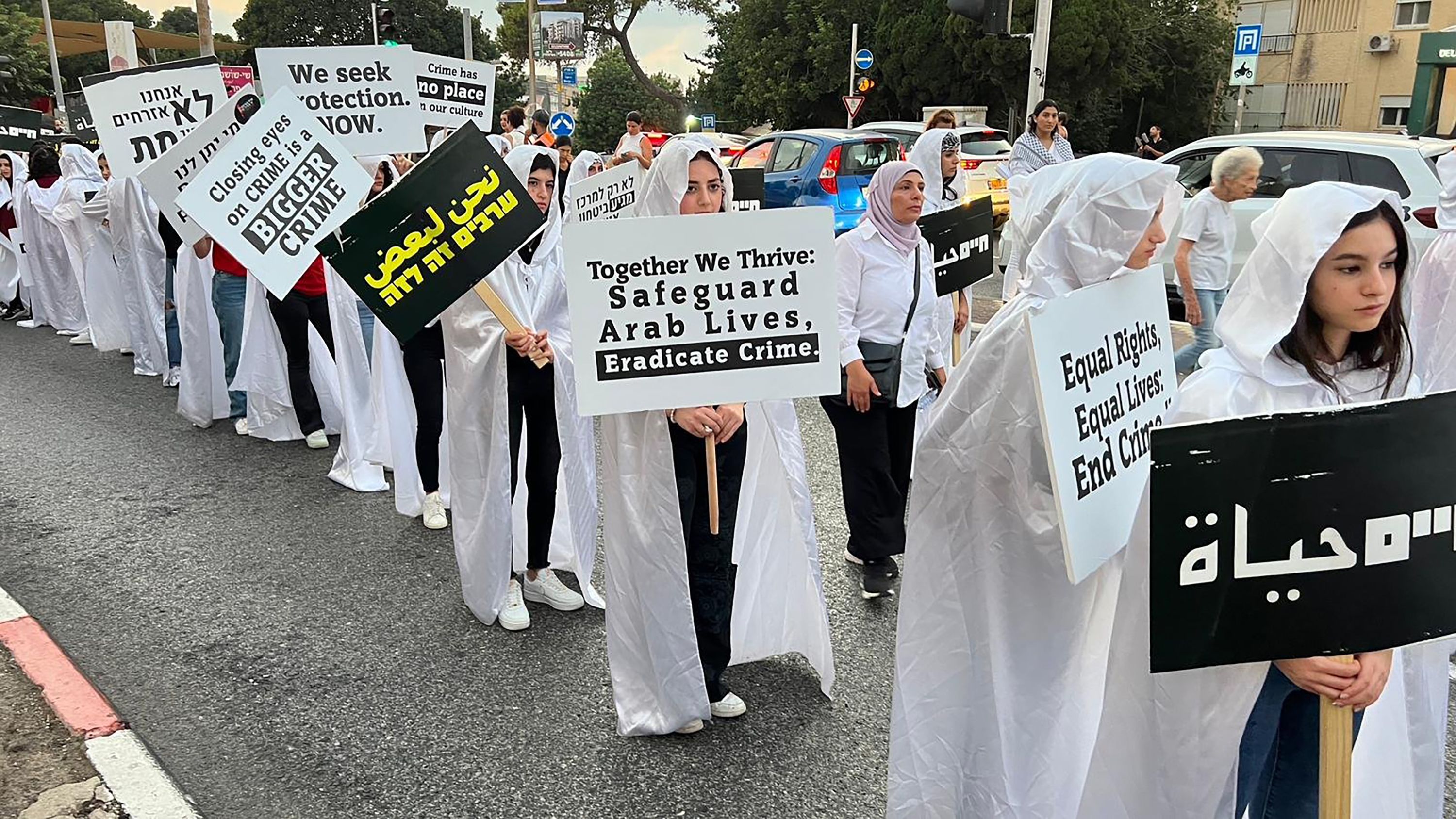
Among the dead in Israel were a young Arab man and his fiancée in Yarka, shot dead together just weeks before their wedding. They were building a home, planning a life, and in a moment both were gone.
Their murders did not trigger an emergency session at the United Nations Human Rights Council. No international campaign formed around their names. No protests filled campuses demanding justice.
But the ratio matters.
For every SAP killed by a West Bank Jew this year, more than six Israeli Arabs have been killed by fellow Arabs.
Yet only one category reliably commands international attention.
When Jews kill Arabs, the broader human rights ecosystem reacts swiftly. The UN warns of “ethnic cleansing.” Condemnations follow. Activists mobilize.
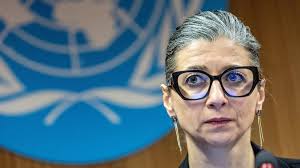
Francesca Albanese, UN special rapporteur on human rights in the Palestinian territories, attends a side event during the Human Rights Council at the United Nations in Geneva on March 26, 2024. Photo: Reuters / Denis Balibouse
When Arabs kill Arabs, the deaths rarely travel beyond the local crime blotter.
If Arab life matters, it should matter regardless of who pulls the trigger.
A human rights system that treats one dead Arab as an international crisis and six dead Arabs as a local inconvenience is not organized around human dignity.
It is organized around narrative.
Somewhere in Yarka, two families are mourning a wedding that will never happen.
And the world moved on because no Jew could be blamed.
The menorah in the Mishkan was about the height of a person at that time. According to the rabbinic tradition in Babylonian Talmud, the menorah stood eighteen tefachim high, somewhere between four and a half and five and a half feet depending on the measure.
That is a strange choice. The Torah could have commanded a towering monument, a giant golden structure rising upward into sacred space. That is what the ancient world did. Temples were built to dwarf the worshipper. Gods were elevated into inaccessible heights, their homes designed to overwhelm and diminish those who approached. Yet when the Torah returns to the menorah in Leviticus in Parshat Emor, it commands to keep its lamps burning continually – at human scale.
The God of Israel does not seek awe; He seeks encounter. The menorah stood at eye level because holiness in Judaism is not built on distance but relationship.
Its form deepens the message. The menorah is shaped like a tree. Hammered from one piece of gold and adorned with almond blossoms, buds, and flowers, it evokes organic life, growth, and rootedness. Rashi and Nachmanides understood it as a symbol of divine wisdom and life itself. The imagery reaches backward to Eden and the Tree of Life standing at the center of creation. The menorah is that tree brought into history, planted in the center of Israel’s sacred life.
And it is more than a tree. It is time in the shape of a tree. Seven branches, seven flames, seven points of light. Like the seven days of creation, the menorah gathers into one object the architecture of existence itself. In Judaism, seven is the structure of the world. Creation unfolds in seven days. The land rests in the seventh year. Freedom resets in the seventh cycle of the jubilee. Sacred time is built in sevens, and the menorah gathers that pattern into gold.
Yet the number seven is only part of the symbolism. The structure itself carries the deeper lesson. The menorah has one central shaft, with three branches extending from one side and three from the other. Everything depends on the center. That center can be read as Shabbat itself, the seventh day that gives shape to the other six.
This is one of Judaism’s deepest interventions into human experience. Most people think of Shabbat as the end of the week, the point of collapse after six days of work. But the Torah’s vision runs in the opposite direction. Shabbat is not simply the conclusion of labor. It is the center of time. The six days are not meaningful because they arrive at rest; they are meaningful because they emerge from sanctity. The week is not six days of secular striving interrupted by a religious pause. It is six days of labor structured around a holy center.
Modern life has reversed that structure entirely. Modern man builds his life around work and treats rest as recovery. Judaism builds life around sanctity and treats work as extension. One organizes existence around productivity and squeezes meaning into the margins. The other organizes existence around holiness and allows labor to become part of that larger order. One produces burnout. The other produces orientation. The menorah, in that sense, is profoundly anti-modern. Its center is not productivity. Its center is sacred time.
The menorah’s design teaches the structure of the soul. Find the center first. Build outward second. The center is what gives coherence to everything else.
That is why the menorah stands at human height. Divine presence enters human dimensions. It stands face to face, and orients each of us to the life to lead.