The Menorah and the Two Olive Trees

Parshat Beha’alotcha opens with the lighting of the Menorah.

The Haftorah from Zechariah returns to the same image but adds a remarkable detail. The prophet sees a golden Menorah fed by two olive trees, one on each side, supplying a continuous flow of oil.

Confused by the vision, Zechariah asks what it means. The answer contains one of the most famous lines in the Bible:

“Not by might, nor by power, but by My spirit, says the Lord of Hosts.” – Zechariah 4:6

The vision came during the rebuilding of Jerusalem and the Second Temple. A small Jewish community had returned from Babylonian exile and faced the daunting task of restoring both a city and a nation.

Many readers focus on the famous verse. The prophet, however, devotes considerable attention to the two olive trees.

Rashi, following the Talmud, identifies the two olive trees with Joshua the High Priest and Zerubbabel the governor. One represented the spiritual leadership of the nation. The other represented its political and civic restoration.

The symbolism is powerful.

The Menorah stands between spiritual leadership and political leadership. Between the Temple and the city. Between faith and statecraft.

The vision’s message was not that politics would save the Jewish people. Nor was it that spiritual life alone would rebuild Jerusalem.

The Temple could not stand without a city. A city could not fulfill its purpose without the values embodied by the Temple.

That lesson echoed throughout Jewish history.

Kings and prophets, priests and governors, rabbis and communal leaders each played different roles in sustaining Jewish life. Sometimes they cooperated. Sometimes they clashed. Yet Jewish continuity depended on both the preservation of spiritual purpose and the institutions capable of carrying that purpose into the world.

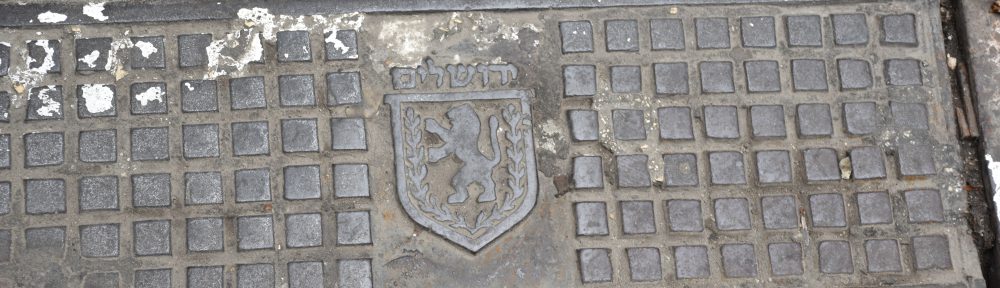
Today, Israel’s state emblem places a Menorah at its center, flanked by olive branches. The design was inspired by the Menorah depicted on the Arch of Titus in Rome, commemorating the destruction of Jerusalem nearly two thousand years ago. Yet the image also echoes Zechariah’s vision of a Menorah being reestablished in Jerusalem, standing between olive trees.

A people of faith needs security, institutions, and leadership. A nation needs purpose, values, and a mission greater than itself.

Zechariah’s vision does not place the Menorah beneath a single olive tree.

It stands between two.

The light of Israel emerges from the meeting point of spiritual purpose and national life.

Orienting the Menorah

The menorah in the Mishkan was about the height of a person at that time. According to the rabbinic tradition in Babylonian Talmud, the menorah stood eighteen tefachim high, somewhere between four and a half and five and a half feet depending on the measure.

That is a strange choice. The Torah could have commanded a towering monument, a giant golden structure rising upward into sacred space. That is what the ancient world did. Temples were built to dwarf the worshipper. Gods were elevated into inaccessible heights, their homes designed to overwhelm and diminish those who approached. Yet when the Torah returns to the menorah in Leviticus in Parshat Emor, it commands to keep its lamps burning continually – at human scale.

The God of Israel does not seek awe; He seeks encounter. The menorah stood at eye level because holiness in Judaism is not built on distance but relationship.

Its form deepens the message. The menorah is shaped like a tree. Hammered from one piece of gold and adorned with almond blossoms, buds, and flowers, it evokes organic life, growth, and rootedness. Rashi and Nachmanides understood it as a symbol of divine wisdom and life itself. The imagery reaches backward to Eden and the Tree of Life standing at the center of creation. The menorah is that tree brought into history, planted in the center of Israel’s sacred life.

And it is more than a tree. It is time in the shape of a tree. Seven branches, seven flames, seven points of light. Like the seven days of creation, the menorah gathers into one object the architecture of existence itself. In Judaism, seven is the structure of the world. Creation unfolds in seven days. The land rests in the seventh year. Freedom resets in the seventh cycle of the jubilee. Sacred time is built in sevens, and the menorah gathers that pattern into gold.

Yet the number seven is only part of the symbolism. The structure itself carries the deeper lesson. The menorah has one central shaft, with three branches extending from one side and three from the other. Everything depends on the center. That center can be read as Shabbat itself, the seventh day that gives shape to the other six.

This is one of Judaism’s deepest interventions into human experience. Most people think of Shabbat as the end of the week, the point of collapse after six days of work. But the Torah’s vision runs in the opposite direction. Shabbat is not simply the conclusion of labor. It is the center of time. The six days are not meaningful because they arrive at rest; they are meaningful because they emerge from sanctity. The week is not six days of secular striving interrupted by a religious pause. It is six days of labor structured around a holy center.

Modern life has reversed that structure entirely. Modern man builds his life around work and treats rest as recovery. Judaism builds life around sanctity and treats work as extension. One organizes existence around productivity and squeezes meaning into the margins. The other organizes existence around holiness and allows labor to become part of that larger order. One produces burnout. The other produces orientation. The menorah, in that sense, is profoundly anti-modern. Its center is not productivity. Its center is sacred time.

The menorah’s design teaches the structure of the soul. Find the center first. Build outward second. The center is what gives coherence to everything else.

That is why the menorah stands at human height. Divine presence enters human dimensions. It stands face to face, and orients each of us to the life to lead.