Considering Campus Antisemitism

College is the first time that many young people live away from home. Young adults find new friends and community to experience learning and fun for several important formative years.

Alas, it is not always simple for Jews at universities.

Campus antisemitism has been a growing issue, and after the October 7 Hamas massacre, it has escalated and made Jewish students fear for their basic safety. Threats against students at Cornell, Cooper Union, New York University, Columbia and Hunter College are seemingly mentioned daily.

And that’s just in New York, home to the largest population of Jews outside of Israel.

As the current Gaza War is likely to go on for some time, it is likely that the tepid reaction of universities will enable more antisemitism on campuses, so this article is meant as a guide for how to ingest the latest incidents.

First Framework: 98% and 2% of Campuses with Jews

In the United States, there are roughly 5,300 colleges. Of those, roughly 100 have a Jewish presence of note, whether by number of Jewish students, percentage of Jews or those with a visibly Orthodox presence. That means that 98% of American colleges might have antisemitic incidents that do not actively harm Jews at that moment in time. While the toxicity of antisemitism spreading should not be overlooked, the antisemitism may go unnoticed and unreported.

The figures may hold true for other countries with large Jewish populations including Canada, United Kingdom and France. While there are many fewer universities there, it is likely that 90%-plus percentage of them have under-reported antisemitic occurrences.

Second Framework: The Three Groups of Antisemitic Actors

Antisemitism at universities have three principle actors: the alt-right, jihadists and the alt-left.

The alt-right and neo-Nazis were historically viewed as the classic antisemites. While the alt-right continues to taunt and attack Jews, they have a quiet presence thus far at the two percent of universities where most Jews attend. They have greater voices in the other 98% of campuses so that antisemitism is often unreported.

When White Supremacists marched at the University of Virginia in 2017, the world took notice. There wasn’t a need for the Hillel, which claims there are 1,000 Jews at UVA, to alert the press as everyone was shocked by the scale of the provocative march meant to intimidate the relatively small Jewish population and other minorities.

The jihadists have been gaining significant ground since the turn of the century. Led by Students for Justice in Palestine (SJP), the pro-Hamas group has roughly 250 chapters around the United States, including almost all of the 2% schools which Jews attend including the large state universities (Florida, Michigan, Maryland, Indiana, Wisconsin), the City of New York/ State of New York and University of California school systems, as well as the Ivy League schools. Their presence on campus directly correlates to more antisemitic actions on campuses as shown by work done by the AMCHA Initiative.

In the current environment after the October 7 Hamas attack, they are a leading cause of anti-Jewish hostility on campus, and Jews are directly feeling the brunt of their extremism and hatred.

The third category of antisemites comes from the alt-left, such as groups associated with the Democratic Socialists of America. They are profoundly anti-Zionist, and have falsely labeled Israel as a “settler colonial state”, denying Jews their history and heritage in the holy land. Since the 2014/15 Black Lives Matter protests, socialists have bonded with the jihadists in coming for Jews and Zionists. Like the jihadists, they are found in almost school where Jews are located.

The cumulative effect is that one doesn’t hear much about campus antisemitism from the alt-right, especially during conflicts in the Middle East. If one hears about it at all, it will be from something major like the “United the Right” UVA march which included many people from outside the university.

In contrast, jihadists feel uncomfortably close with their daily confrontations with Jews and the spectacle is frightening.

The alt-left socialists feel even closer for progressive Jews. They belong to the same clubs and advocated for many of the same causes. To see them celebrating the murder and butchering of Jews is deeply hurtful and shocking.

Third Framework: The Three Levels at Universities

The third way to consider antisemitism is understanding the three tiers of a university: the institution, the teachers and the students.

Groups like SJP are made up of students and tend to be the most vocal actors on campuses. They stage die-ins, put on Israel Apartheid Weeks and are the ones generally responsible for vandalism. The university has little sway over them, other than the ability to not officially recognize them or allow them to hold events on campus grounds, or expel them if they go against rules of conduct.

Teachers are directly employed by the university so the institution has much greater influence on them. However, once a teacher gets tenure, it becomes very difficult to discipline them unless they do something egregious.

The institutions are businesses, whether they are not-for-profit or for-profit, public or private universities. They need funding, students, professors, accreditation, real estate and many other things to operate. As such, it is possible to impact their direction by donors and federal mandates.

Using these three lenses about universities, one can better evaluate the impact of campus antisemitism.

Examining Donors Via The Frameworks

Many wealthy Jewish university benefactors lashed out about the state of antisemitism on campuses. Marc Rowan, Bill Ackman, Leon Cooperman, David Magerman and others stated that they will no longer send universities millions of dollars as they have in the past.

It matters much less than they think. Not only do the universities have billions of dollars already in endowments, but the monies those benefactors spent were on hospitals and center for the arts and to put their names on buildings. The Jews gave money at the institutional level.

That is in sharp contrast to the Gulf states including Qatar and Saudi Arabia. Foreign forces gave over $10 billion to American universities at every level including the student and professor levels. At the institutional level, they spent money opening up campuses in their kingdoms to legitimize their autocratic regimes.

At the student level, the governments sent tens of thousands of students onto American campuses, changing the nature of the schools. The universities appreciate the fully-funded tuitions and the ability to appear diverse and international. In the 2015/6 school year, over 61,000 Saudi students attended American schools. That represented 0.2% of the entire population of Saudi Arabia to a single country. By way of comparison, the ENTIRE American students abroad cohort all over the world is around 162,000, or 0.05% of the U.S. population. Imagine 650,000 American college students all going to Brazil for college, and you get the absurdity of what transpired on American campuses with petrodollars.

The Gulf money also funded professors and chairs of departments. In July 2000, the president of the United Arab Emirates, Sheik Zayed bin Sultan al-Nahyan, donated $2.5 million to the Harvard Divinity School to endow the Sheik Zayed Al Nahyan Professorship in Islamic Religious Studies. Within a short period of time, the Zayed Center became a noxious fountain of anti-Semitic screed complete with Holocaust denials and blood libels. It took the non-profit group The David Project and a student at the Harvard Divinity School, Rachel Fish, to loudly protest the donation and Center itself.

But the damage is often already done. With an application of two students and approval of a professor, a new SJP chapter comes to campus. The AMCHA Initiative has shown that campuses with five or more professors who support the boycott, divestment and sanctions (BDS) of Israel and has an anti-Zionist group like SJP on campus, is over seven times more likely to have antisemitic incidents.

These professors actively push the antisemitic narrative to Decolonize Palestine, framing Jews as interlopers and the Jewish State as a European Colonial State. It is inherently antisemitic, as it negates Jewish heritage and history. The professors claim that it is worthy of debate and administrations remain silent.

Ramifications

Historically, Jews focused on choosing schools with a good Jewish campus life. If there was a Hillel, AEPi Jewish fraternity, Chabad or OU-JLIC couple on campus, students and parents felt comfortable with a supportive environment. Walking through campus and seeing Jewish names on buildings like Stern and Lauder gave people comfort that they would not confront antisemitism.

That is simply not the case.

The correct questions are whether the university has an SJP or Jewish Voice for Peace on campus. Does the university take millions of dollars from Gulf states? Are there tenured professors with a history of antisemitic remarks like Columbia’s Joseph Massad? Does it promote the antisemitic libel that Jews have no history in the holy land and that it is noble to “normalize and globalize Hamas” the way Brown University suggests?

Action Items

The jihadists have focused on American universities for twenty years, and the alt-left has long had a hold on campus life but only bonded with the jihadists since 2014/5. It will take time to undo the damage that has been done.

But there are several things which can be effectuated to start the change. For those who don’t want or cannot wait, consider Yeshiva University or Touro which are Jewish institutions with no jihadist groups and very few members of the alt-left.

  1. Get universities to stop taking money from toxic regimes. Qatar openly supports the terrorist group Hamas. Saudi Arabia beheads minors. There must be some human rights bright lines which should block universities from taking money. At a minimum, there should be a cap of say $5 million over any five year period for any foreign government or agency to pour money into American schools.
  2. Label SJP a hate group and kick them off campus. With seven times more antisemitic incidents with their presence, the groups should be blocked from school recognition.
  3. Place a morality clause in all contracts. If misgendering someone can be cause for dismissal, then certainly celebrating the slaughter of babies and raping of women should result in immediate firings.
  4. Get the Biden Administration to adopt the IHRA definition of antisemitism as it relates to Title VI for universities. The administration already approved it as the best working definition of antisemitism but has not applied it to Title VI which would pull government funding to universities that allow rampant anti-Zionism and antisemitism.
  5. Expel foreign students involved in hate crimes. Universities like MIT have been loathe to suspend foreign students as it would result in their deportation. American Jews should not be forced to endure visiting students’ antisemitism because the university wants to keep the foreign nation’s tuition funnel flowing.
  6. Support Jewish and Israel groups. OU-JLIC, Hillel and other groups need active support, as do external groups which help out university students like StandWithUs and Students Supporting Israel. The infrastructure must be continuously enhanced for a strong Jewish campus life.
  7. Get benefactors to fund Jewish scholarships and Jewish and Israel studies departments. Just like the Gulf states, Jewish benefactors should fund scholarships for Jews to their alma maters as well as professors focused on Jewish studies.
  8. Write about the problem. Penning letters to the school administrators, posting on social media, and telling members of congress and governors about the horrific situation on campuses will help drive change. Write letters to the media that they must cover campus antisemitism more regularly and honestly.

Campus antisemitism is at alarming levels. You can help.

Related articles:

The Campus Inquisition

An Open Letter To Progressive Diaspora Jews

The Anti-Semitism In Anti-Zionism

The Insidious Jihad in America

Biden Enables Anti-Semitism On College Campuses

Bigots In Power, Checked And Unchecked

Hamas And Harvard Proudly Declare Their Anti-Semitism And Anti-Zionism

Should The KKK Open Chapters In Every American University, What Say You?

Brooklyn Chanukah Donut Crawl 2023

The riders of the sugar storm went to Brooklyn again this year, focused on Flatbush. We started at Schreiber’s which is usually at the end of the trip, because we picked up an important taster who had just flown in from Israel into JFK Airport after ten days of volunteering after the horrible October 7 massacre. We hoped the sugar would alleviate the jet lag and stress.

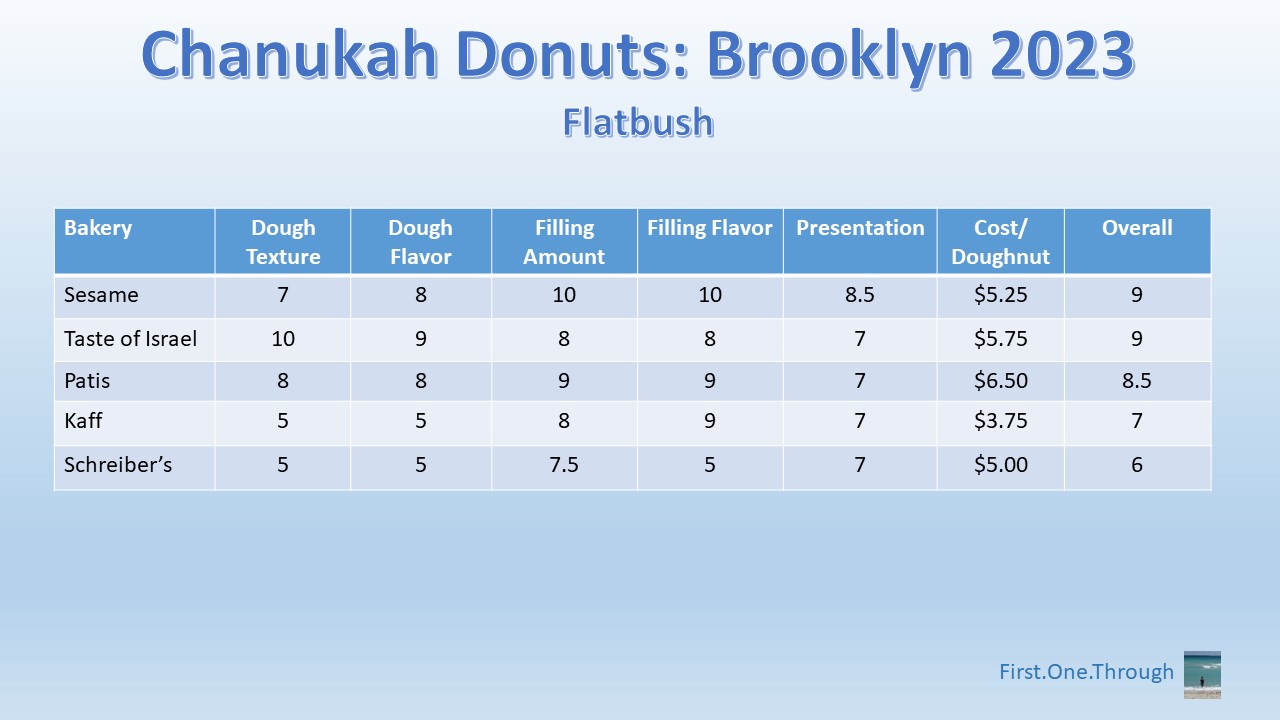
All of the bakeries we tried were good, as this was our fifth year going to Brooklyn, and have eliminated those bakeries which did not score at least a “6” in the overall ranking in the past. We were sugared out after five locations, so did not make it to some favorites like Ostrovitsky’s.

Schreiber’s Homestyle Bakery, 3008 Avenue M

Per tradition, we immediately picked up Schreiber’s lace cookies which are amazing. We grabbed dairy cheese sufganiyot from the back of the store to bring to a niece who said they were amazing. We sampled the pareve selection which were just mediocre. The pistachio one only had pistachios on the outside but no pistachio flavor inside. The dough was too heavy without a lot of flavor. Overall a 6.

Pistachio donut from Schreiber’s

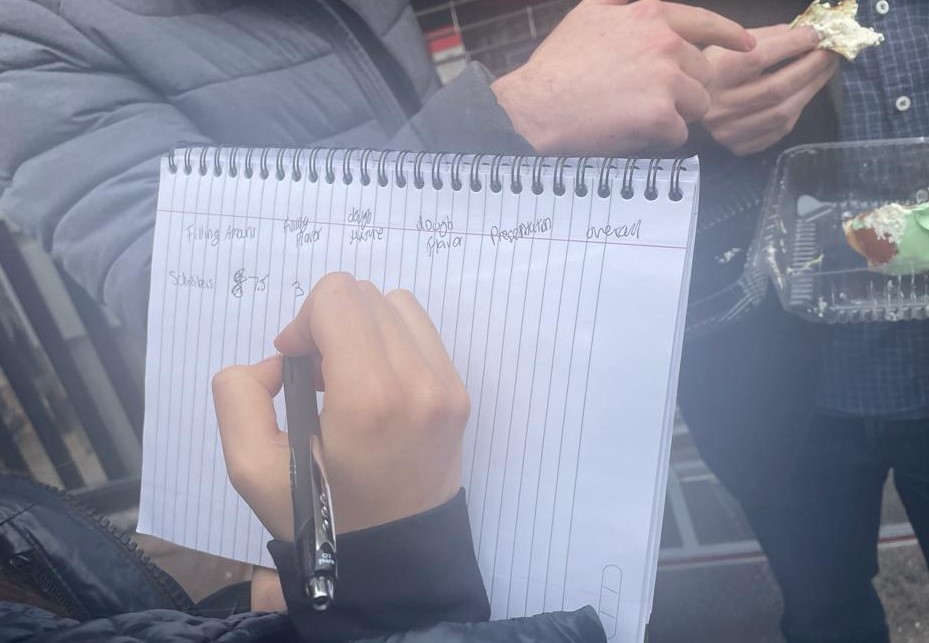
As we debated our scores outside of the bakery (note the filling flavor started as a ‘3’ and settled on a ‘5’ after everyone’s input), a local came over and asked our thoughts on the top bakeries in the neighborhood. It seems that other people are also doing the crawl.

Schreiber’s bakery kicked off the scoring for Hanukkah 2023

Kaff Bakery 1906 Avenue M

Kaff was a new addition to the crawl. We were impressed that several sefaradi people were picking up jelly donuts, as their bakeries do not have a tradition of making the holiday treats. Each one said that Kaff was a favorite but we were disappointed. While the lotus donut was packed with filling, it was not smooth and creamy, and was overly sweet (for me). Fellow travelers loved them which gave a more balanced overall score of ‘7’.

Kaff Bakery had a nice selection of donuts

Presser’s Kosher Bagels and Bakery, 1720 Ave. M

Presser’s donuts candidly did not look at all appetizing and we didn’t purchase any. Instead we tried the chocolate horn which had tasty chocolate but the dough was not as flaky as Weiss’s bakery.

Patis Bakery, 1716 Ave. M

Patis was almost completely sold out by the time we arrived around 11:00am. They had one variety – almond hazelnut – which was fantastic. Very buttery soft dough, good hazelnut filling and tasty toasted almonds on top. An ‘8.5’.

Almond hazelnut donut from Patis, Hanukkah 2023

Taste of Israel, 1322 Avenue M

Taste of Israel requires a pre-order some days in advance at (347) 554-8133. We highly recommend it. It was a new addition to the crawl and tied for top marks with Sesame. The dough is actually better than Sesame in terms of fluffiness and flavor, which is not always easy because it needs to contain the heavy filling. TOI mastered it. While the presentation is not as pretty as some of the other bakeries, the overall taste was terrific even when we ate them later at night. We went for Oreo and Halva; they also have lotus, caramel, custard, jelly and rosemary. A ‘9’.

Taste of Israel donuts ranked highest for dough, and also good flavor

Sesame – Flatbush, 1540 Coney Island Ave

Sesame did not disappoint. Unfortunately, the store has developed a reputation for excellence so is a bit packed but perhaps that’s sharing the joy of the holiday. We heard that the dairy varieties (marked with blue labels) were out of this world but mostly purchased pareve to bring to people for dinner. The pareve (marked with green labels) peanut butter was outstanding – a 10. White chocolate, which I do not usually like was very tasty. Pistachio, as always, was terrific as was the lemon. Sesame puts flavor into the fondant on top of the donut for a doubly amazing experience. We bought dozens to bring back to share with people. A solid ‘9’.

Below is the overall scorecard for each bakery. We hope you enjoy them and Happy Chanuka!

Related articles:

Brooklyn Chanukah Donut Crawl 2022

Jerusalem Donut Crawl 2021

Brooklyn Chanukah Donut Crawl 2020

Chanukah Donuts: Brooklyn 2019

Brooklyn’s Holiday Donuts

French Riviera Crawl

The Last of the Mo’Kichels

CAIR On October 7 Sadistic Massacre

The Council on American-Islamic Relations (CAIR) has been very vocal and negative about the Jewish State of Israel since its founding. The Anti-Defamation League (ADL) has written that “key CAIR leaders often traffic in antisemitic and anti-Zionist rhetoric.” The ADL specifically called out Zahra Billoo, CAIR’s San Francisco Bay Area Executive Director, who called Jewish Zionist institutions in America “enemies”, as well as Nihad Awad, CAIR’s Co-Founder and Executive Director, who claims that “Zionist organizations” are “enemies of the Muslim community” and that “Zionist organizations make up the core of the Islamophobia network in the United States.”

On October 7, well before Israel responded to the sadistic massacre by the Palestinian Arab political-terrorist groups in Israel, Awad took to X/Twitter and defended the savagery.

He first wrote that “Palestinians have been experiencing ethnic cleansing by Israel for 75 years [from the founding of Israel in 1948],” seemingly calling for Palestinians to return the favor to ethnically cleanse Jews from the land.

He followed that tweet with a quote from Martin Luther King Jr “A riot is the language of the unheard,” minimizing the atrocity of killing 1,200 people – mostly civilians – as a “riot” under the name of a peaceful activist.

CAIR was originally part of President Biden’s May 2023 National Strategy to Combat Antisemitism. It took until yesterday, December 7, for the Biden Administration to remove the organization, as Awad has continued to argue that Palestinians have a right to “self defense” and that he was “happy to see people breaking the siege and throwing down the shackles of their own land.” It is also possible that Israel found evidence of ties between CAIR and HAMAS in materials the IDF captured in Gaza.

The US government may have also read the October 2023 George Washington University’s Program on Extremism paper about the Hamas Networks in America. CAIR was featured prominently.

CAIR and Students for Justice in Palestine are two groups pushing Muslim antisemitism into the United States’ mainstream. They must be combatted with the same vigor as other antisemitic groups.

Related articles:

Criticizing Muslim Antisemitism is Not Islamophobia

Examining Ilhan Omar’s Point About Muslim Antisemitism

Know Your Enemies. This Is 1948 Redux

The Center Of Intersectionality Sounds Like Adolf Hitler

Islamic and Alt-Left Extremists Declare that Normalization With Zionists Is Against Sharia Law

New York Times Mum on Muslim Anti-Semitism

Statistics on American Anti-Jewish and Anti-Muslim Attacks

We Normalized Jew-Hatred For Years

Jew-hatred was the leading form of hatred in the United States, even before the horrible spike post-October 7. Yet it was actively minimized by politicians and the mainstream media in favor of Victims of Preference, the majority-minority groups of Blacks, Hispanics and members of the LGBT+ community.

When Jew-hatred was tied to Israel, powers in government, media and universities deliberately did their utmost to claim that anti-Zionism wasn’t antisemitism, even as they promoted anti-Semitic laws and narratives.

There are a few primary antisemitic laws and narratives which have become so normalized, many fail to acknowledge their profound Jew-hatred:

  • Denying Jews their history and heritage
  • Banning Jews from living somewhere
  • Banning Jews from praying at their holiest site

Denying Jews Their History and Heritage

Jews have a unique religion. At its core, Jews are a small tribe tied to a specific piece of land, the holy land of Israel. While other religions were idealized as universalistic and therefore pushed to convert masses wherever they went, Jews had no such mantra. Whether they live in Israel or the diaspora (everywhere other than Israel) they pray facing the Temple Mount in Jerusalem, and try to visit Jerusalem at least three times each year, and did not scour the globe in search of new recruits.

Yet university professors say that Israel is a product of “European settler colonialism,” denying Jews their history and heritage, and these professors get tenure and continue to espouse their Jew-hatred to the next generation.

Banning Jews From Living Somewhere

Would anyone consider it legal to pass a law that Black people cannot live somewhere? Has Amnesty International blessed Iran’s policy of banning gay people and hanging them in public, and suggested the law be spread to more countries?

Yet the United Nations General Assembly passed resolutions in the 1970s and the UN Security Council passed Resolution 2334 in 2016 making it illegal for Jews to live in the “West Bank” and eastern Jerusalem, including the Old City of Jerusalem where Judaism’s holiest sites are located. According to international law, an Israeli Arab from Jaffa can relocate to the Old City of Jerusalem but a neighboring Israeli Jew in Jaffa would be called an illegal settler if he did a similar move.

It reeks of Jew-hatred, blessed by the United Nations.

Banning Jews From Praying At Their Holiest Site

Jews, and only Jews, are denied their right to pray at their holiest location. The world brands people who demand such basic human right as “extremists,” rather than the jihadists who insist on such law, threatening Jews with violence.

Israel has continued the antisemitic ban to calm the Muslim world. Palestinian Arabs are not satisfied and want Jews to stop even walking around the Temple Mount during regular visiting hours as they consider such visits “provocative.” The United Nations supports that Jew-hatred, and claims that the Jewish Temple Mount is a purely Islamic holy site.

United Nations map showing the Jewish Temple Mount as only holy to Muslims

All of these things have to do with Jews, not Israelis nor the Israeli government. These are laws that insult any Jew as it relates to their permissible activities in their homeland regardless of whether Israel is run by a right-wing or left-wing government, or even if Israel was a country.

There are also laws in other countries which are infused with Jew-hatred like banning the ritual slaughter of animals for kosher meat, bans on Jewish circumcision or wearing a kippah in public to make it difficult for Jews to live in those countries. Some ban Jews from being able to become the leader of the country. Those countries wrap their animus with misdirection about protecting animal and minor rights, or protecting the civil nature or culture of their societies for passing such edicts.

It is a transparent fig leaf when they extend their hatred for Jews far from their shores.

On a small strip of land far away from their own, countries still press laws infused with Jew-hatred, either because they want to appeal to 1.8 billion Muslims and over 50 Muslim-majority countries, or they simply hate Jews. Either way, these laws helped set the stage for the October 7 massacre, as they normalized Jew-hatred in the Jewish homeland.

The vile REACTIONS to the October 7 massacre did not happen in a vacuum. The UN, media and universities have normalized Jew-hatred for years, and it is well past time to strike the antisemitic laws at the UN and remove the classes and professors at universities.

Related articles:

It is Time to Insert “Jewish” into the Names of the Holy Sites

Nicholas Kristof’s “Arab Land”

The Antisemitic Campus: Decolonize Palestine

The United States Is “Morally, Historically, and Politically Wrong” About Jewish Prayer on Temple Mount

Gaslighting Gas Chambers and Indigenousness

Anti-Semitism Spikes Because Israel-Palestine is a Religious Battle

The Re-Introduction of the ‘Powerful’ Jew Smear

The Most Antisemitic Thing

Speaking Honestly About Lies In The Israel-Palestinian Conflict

Jacob’s Many Angels and Vayetze Jews

The weekly parshas read from the Torah normally begin at the start of a chapter and conclude at the end of another chapter. It is extremely rare for any parsha to both start and end in the middle of chapters, which happens for the weekly reading of Vayetze (Genesis 28:10 – 32:3).

The reason for doing so has very much to do with the story told in Vayetze, as well as the stories which the rabbis wanted to separate at the start of Genesis chapter 28:1-9 in Parshat Toldot, and the story told afterward in Parshat Vayishlach, chapter 32:4-33.

Vayetze relays the story of Jacob leaving the land of Canaan to find a wife at Lavan, his mother’s brother’s house. When embarking, Jacob dreamt of a ladder going to the heavens with angels going up and coming down. God informed Jacob that he will be blessed with many children and that God would protect Jacob on his journey and bring him safely back to his land. At the end of the parsha, Jacob headed back to the land of Canaan with wives and eleven children, and met angels once again (Genesis 32:2-3). Angels are bookends of Vayetze, telling the story of Jacob marrying, and having many children and accumulating much cattle in his uncle’s house.

If one were to read Genesis straight through the chapters instead of with the breaks of the weekly portions, that story is less clear.

At the beginning of Genesis chapter 28 (1-5), Isaac instructed Jacob to not marry a local woman from Canaan and to visit his uncle’s house, seemingly consistent with the overall theme of Vayetze. However, 28:6-9 describes Esav’s overhearing Isaac’s command who subsequently embarked to marry his father’s brother’s daughter. Esav’s actions interrupted the focus on Jacob.

At the end of the parsha, the narrative also breaks around Esav. While Vayetze’s Genesis 32:2-3 has Jacob encountering angels and naming the location due to the holiness of the event as he did after his ladder dream, Vayishlach’s Genesis 32:4-7 has Jacob sending the angels off as mere messengers to scout out Esav’s intentions as he journeyed to return to Canaan. In one sentence, from 32:3 to 32:4, Jacob treated the malachim as holy people and then errand boys, which does not happen with the weekly parsha pause separating the sentences.

The neat angel bookends of Vayetze act as separators from Esav. While Jacob got married and returned with eleven children and a large flock, the difficult years were none-the-less realized as blessings. However, the stress of the world he left and to which he returned made the blessings harder to recognize, and maybe even finite.

Esav married Ishmael’s daughter and came to meet Jacob with an army of 400 men (32:7). While Jacob had been promised by God that his progeny would be numerous as he left Canaan, his brother Esav seemed to become even greater over that same time.

Upon learning of the large gap in power with his brother, Jacob became very frightened and prayed to God (32:8-13) seemingly thinking that his heavenly protection had ended. When Jacob next sends out messengers to meet Esav, they are no longer described as malachim, angels, but avadim, servants (32:17).

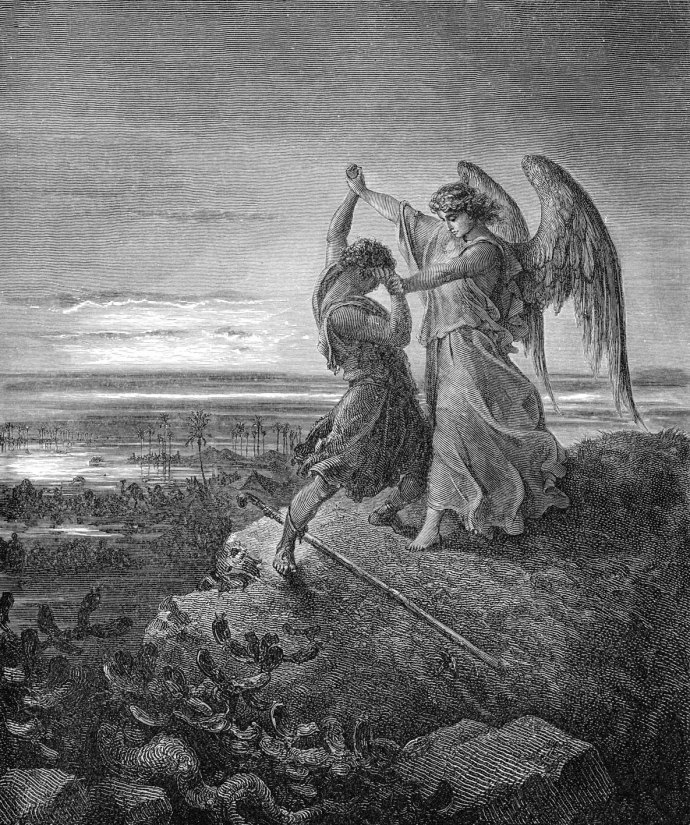
Jacob lost the ability to recognize angels as he approached his brother. When Jacob was next alone at night, he didn’t dream of angels on a ladder but wrestled with an ish, a man who is described by biblical commentators as an angel who renamed Jacob ‘Israel’ for prevailing in his fight with man and God. While Jacob should not have been scared of Esav as he had angels with him, he could no longer recognize them and fought them.

Jews today see their homes like Jacob as Vayetze Jews. Even in the face of family difficulties, a home is nevertheless a sanctuary in which we count our blessings and feel protected. It is when we compare ourselves to others and see their wealth and fear what they might do to us that we forget those blessings. We no longer see the angels and blessings they provide. So we demand that they serve our needs, and fight them thinking that they are strangers meant to do us harm.

And then we question the blessings we once enjoyed. Esav had no angels and yet prospered even more than Jacob. An unblessed life seemingly yielded greater rewards if one focuses purely on numbers.

Jacob produced a family which became a holy nation while Esav’s actions netted a massive army. During peace, it is easy to understand why Jacob’s descendants reach heights of thought and purity but in times of conflict, Esav’s army appears ready to conquer those achievements.

In a pre-October 7 world, Vayetze Jews imagined themselves blessed and protected in their home of homes, in their houses in Israel. The neat angel bookends of the parsha were the protective layer of building a home and family, and Vayetze Jews felt God’s blessings.

In the aftermath of the October 7 slaughter in which Arabs killed Jews in their homes in Israel, the Vayetze Jews were vanquished. We became Vayishlach Jews ready to fight man and God for the inhumanity inflicted on us.

Gustave DoréJacob Wrestling with the Angel (1855)

Is that our fate? Can the Jewish community become more?

Jews must internalize the text in the chapters and not just the parshas.

Esav DOES interfere with the story-telling of Jacob finding a wife. Esav does continue to build a family and army outside of Jacob’s Vayetze bubble. Jacob and the Vayetze Jew fail to internalize the outside world as they were self-absorbed which led to complacency. Jacob only saw angels’ blessings as partners for his activities in his home but did not use the gift for the fight to come outside.

We are both the Children of Jacob (Vayetze Jews) and the Children of Israel (Vayishlach Jews), and need to live lives focused internally and externally. Partnering with angels must extend beyond the bounds of angelic bookends and touch activities in everything we do. That is the pathway to true blessing and success inside and outside of our home and communities.

Related articles:

The Nation of Israel Prevails

The First Dreamer Foreshadowed The Life Of Joseph

3 1 4, Hebrew Pi

The Karma of the Children of Israel

The Descendants of Noah

The Place and People for the Bible

The Shrinking Modern Jewish Homeland