The Subtle Discoloration of History: Shuafat

Reader’s often assume that the more reputable news organization do research and perform fact-checks before posting articles. However, they do not often consider the word choices or juxtapositions of those facts relayed in a story. The truths and half-truths can combine to distort reality. This becomes exacerbated when quotes from biased witnesses are included in the article.

Witness the July 6, 2014 New York Times article on page 8 describing the terrible abduction and murder of an Arab teenager as a case in point. The second paragraph of the story: “…Mohammed was at the recreation center named for his respected, expansive Palestinian family in the ancient section of the East Jerusalem neighborhood of Shuafat.” I will avoid commenting on the “respected” background of the Abu Khdeir family who “started farming [in Israel] 250 years ago” as I do not know them (and why should I doubt Jodi Rudoren?). Consider the proximity in one sentence of the words “Palestinian”, “ancient”, “East Jerusalem” and “Shuafat”. A reader could naturally conclude that Palestinian Arabs have long been living in the ancient Palestinian city of East Jerusalem. A quote from a member of the family in the article adds that “All Shuafat is in danger, all the settlers are around us. It’s like a monster – they want to eat us.” could lead a reader to conclude that Jews are recent “settlers” to the area and harass Arabs.

All of those conclusions would be false.

Shuafat is indeed thought to be an ancient site. Archeological excavations reveal Roman encampments and Jewish homes and mikvahs from 2000 years ago. However, neither Shuafat, nor the rest of Israel, have ancient Arab finds as Arabs did not come to the region en masse until the Muslim invasion in the 7th century.

Shuafat remained a small village until 1967 when Jordan (together with Palestinian Arabs who were granted Jordanian citizenship) attacked Israel in the Six Day War. Israel took control of the “West Bank” and extended the boundaries of Jerusalem to include Shuafat and other villages around the city. In 1980, Israel declared all of Jerusalem to be its united capital.

For parties that do not recognize Israel’s annexation of the eastern part of Jerusalem, it would logically extend that those same people would not recognize Israel’s extension of Jerusalem’s boundaries. Shuafat is either a neighborhood in Jerusalem, Israel (if one accepts Israel’s position) OR it is a village in the West Bank (if one doesn’t).

Regarding the comment of “[Jewish] settlers”- there are many more new Muslims that moved to Jerusalem than there are new Jewish residents. Since 1967, when Israel reunified the city, until 2012, the Jewish population grew by 2.6 times while the Arab population grew by 4.4 times. This huge difference comes despite the higher (4.3) birth rate for Jewish women in Jerusalem than for Arab women (3.6).

Lastly, Shuafat and “East Jerusalem” are integral parts of Jerusalem. Just below 40% of the eastern part of Jerusalem which was annexed in 1967 is Jewish. Arabs and Jews work and live together in the city (compared to some Israeli cities like Umm al-Fahm that are 99% Arab). Shuafat sits just south of the second largest neighborhood in Jerusalem, Pisgat Ze’ev (pop. 37,000). The new Jerusalem light rail line includes two stops in Shuafat, one of the only neighborhoods with two stops.

A fact-checked sentence should have read:

“…in the ancient Jewish section of the predominantly Arab East Jerusalem neighborhood of Shuafat in Jerusalem…”.

Just saying…

“East Jerusalem” – the 0.5% Molehill

The Middle East is not short on drama. Things in the region are magnified by perfect faith and distorted by perceived foresight. The people in the land are The People of The Land. Their collective perspective has long ago been blurred by reading texts about ethereal matters too closely.

To wit, Arabs have stated a quest for a new country with a capital city they call “East Jerusalem”. The small matter that seems to escape them is that it doesn’t exist.

Jerusalem was founded 4000 years ago. In the city’s turbulent history, it reached religious heights and was vanquished many times. Still, in all but 19 of those 4000 years, it remained a single united city.

In 1947, the United Nations considered expanding the borders of the city and put forth a plan to create a “Holy Basin” which was to include Greater Jerusalem and Greater Bethlehem. The proposed entity would have housed the significant religious sites of the three monotheistic religions and been under international control. The Arabs rejected the proposal and five Arab armies attacked the new State of Israel in 1948 with the stated objective of destroying the country completely.

At the end of that war, the Jordanians seized and unilaterally annexed the eastern part of the Jerusalem and renamed it “East Jerusalem”. The joyful Jordanians gave the Palestinian Arabs Jordanian citizenship, but evicted all Jews from their “East Jerusalem”.

So the spiritual center of Judaism was stolen by the Jordanians. From 1949 to 1967, (0.5% of the city’s existence), the Jordanians banned Jews from the eastern part of Jerusalem.

In 1967, the Jordanians (which included Arabs from Palestine who were granted Jordanian citizenship) attacked Israel again, and lost the eastern half of the city. Israel dismantled the barbed wire that split the city and reunited Jerusalem. “East Jerusalem” existed no more.

In 1995, in an effort to establish peace in the region, Israel handed control of Bethlehem to the Palestinian Authority, thereby giving half of the “Holy Basin” to the Arabs.  The “Holy Basin” sat divided, but not Jerusalem.

Remarkably, despite the short dark blip in history 46 years ago, and current control of Bethlehem, the Arabs contend that East Jerusalem still exists and always existed. Should it surprise anyone that when it comes to Jerusalem, people would try to turn a 0.5% molehill into owning the Temple Mount?

The history of united + divided Jerusalem

The history of united + divided Jerusalem

Every Picture Tells a Story, Don’t It?

The media – whether print or digital – are experts at what they do. They know what articles make people react. They know what motivates people to buy their newspapers and watch their news programs. They know how to drive tweets and retweets.

I therefore observe and review how they craft their craft; how they shape the stories they sell.

Photographs – even in papers that art the printed word – are the most engaging. They are no longer limited to tiny and grainy black & whites of decades ago; they are now displayed in vivid colors that convey a story and an emotion. The choice of which pictures to present, as well as the how and where, essentially prioritizes the news for the reader. For example, a color photograph on the top of the front page with an associated article in the far right column is the most news-worthy story of the day. If a photograph is small and in black & white in the back of the paper, alongside advertisements and other news stories, it would transmit the passing interest in the event.

With such understanding, I reviewed the New York Times coverage of the kidnapping and killing of three Israeli teenagers, and the killing of Arab children in the subsequent days.


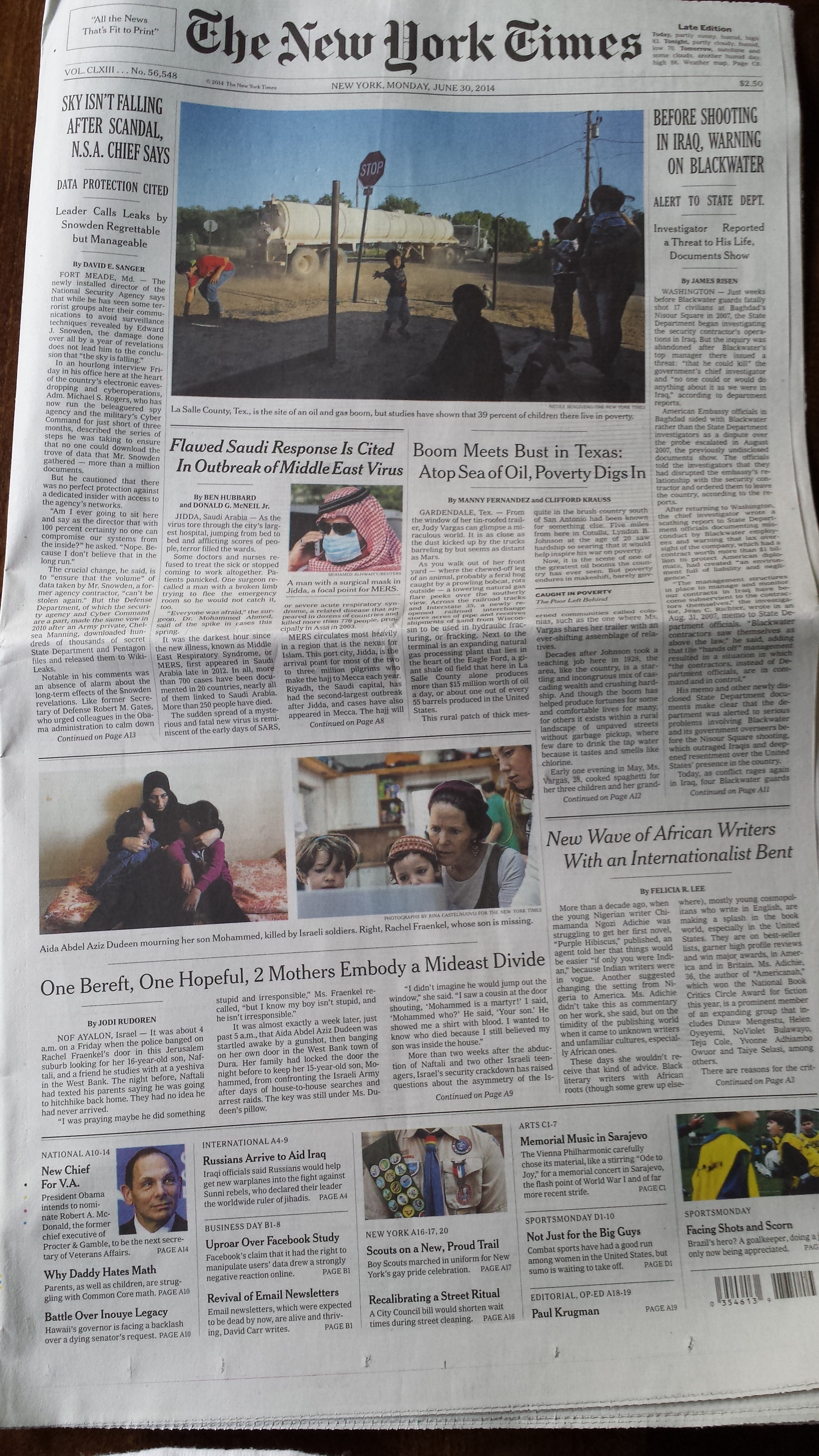
On June 30, the NYT ran a cover story on the bottom of the page, including two color photographs, about two mothers of victims – one Arab woman from the West Bank and another Jewish woman. The caption stated that the Arab woman’s son was “killed by Israeli soldiers” (one would need to read the article to learn that he was pelting the soldiers with rocks and bricks). The caption added that the Jewish woman’s son was “missing”. The article continued on page A9, with black and white pictures of equal size showing each woman together with friends praying. The captions again repeated that the Arab boy “was killed by Israeli soldiers”, and that the Jewish boy “was abducted” with other boys.

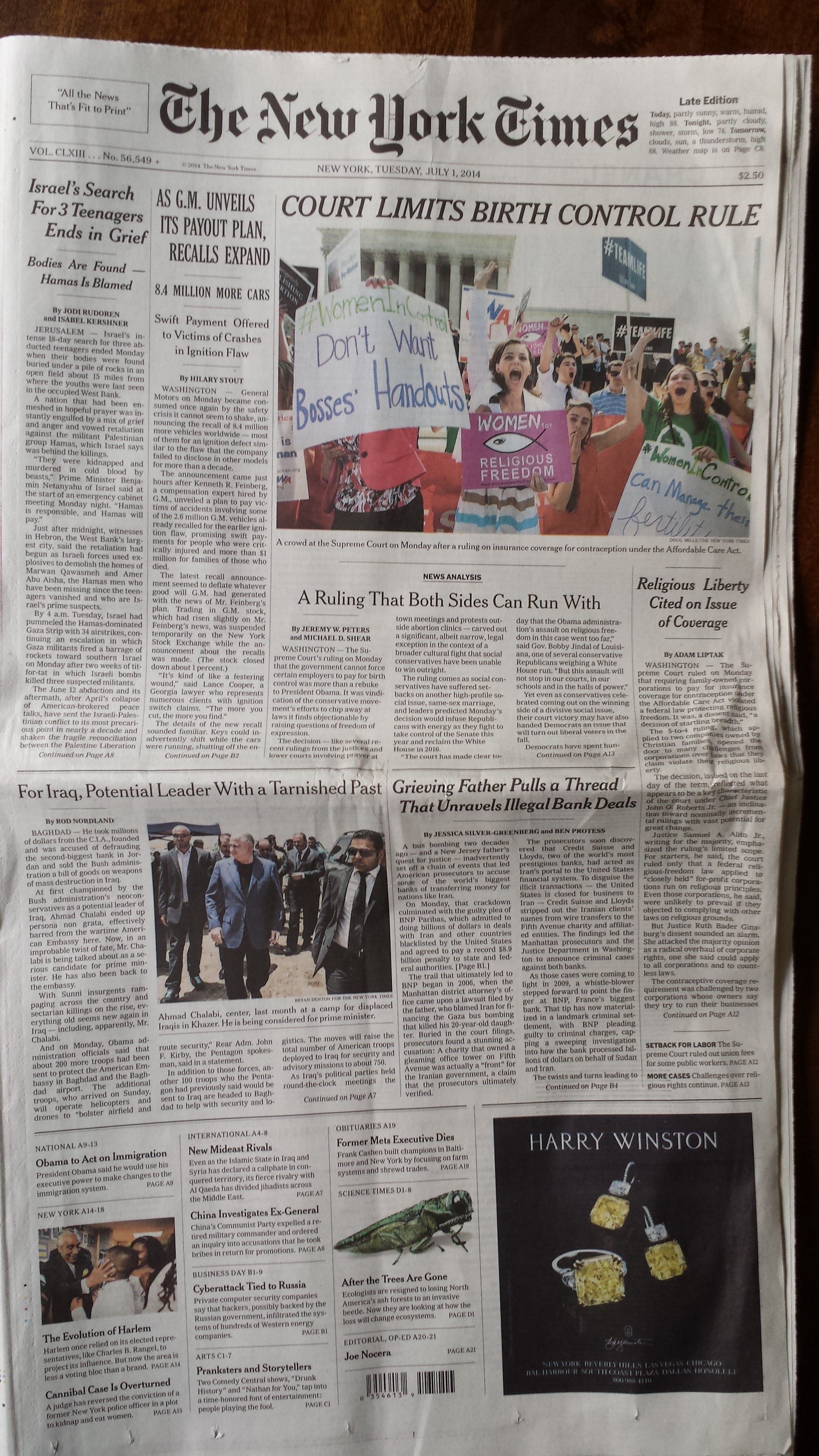
On July 1, the NYT ran a cover story that the Israeli teens were found dead. The story ran on the left hand (secondary) column of the front page and had no picture. The paper did, however, include several color photographs in the middle of the paper, on page A8, of a prayer vigil, pictures of the three boys, and army jeeps near the discovery site of the boys. The caption reads that their bodies “were found”.

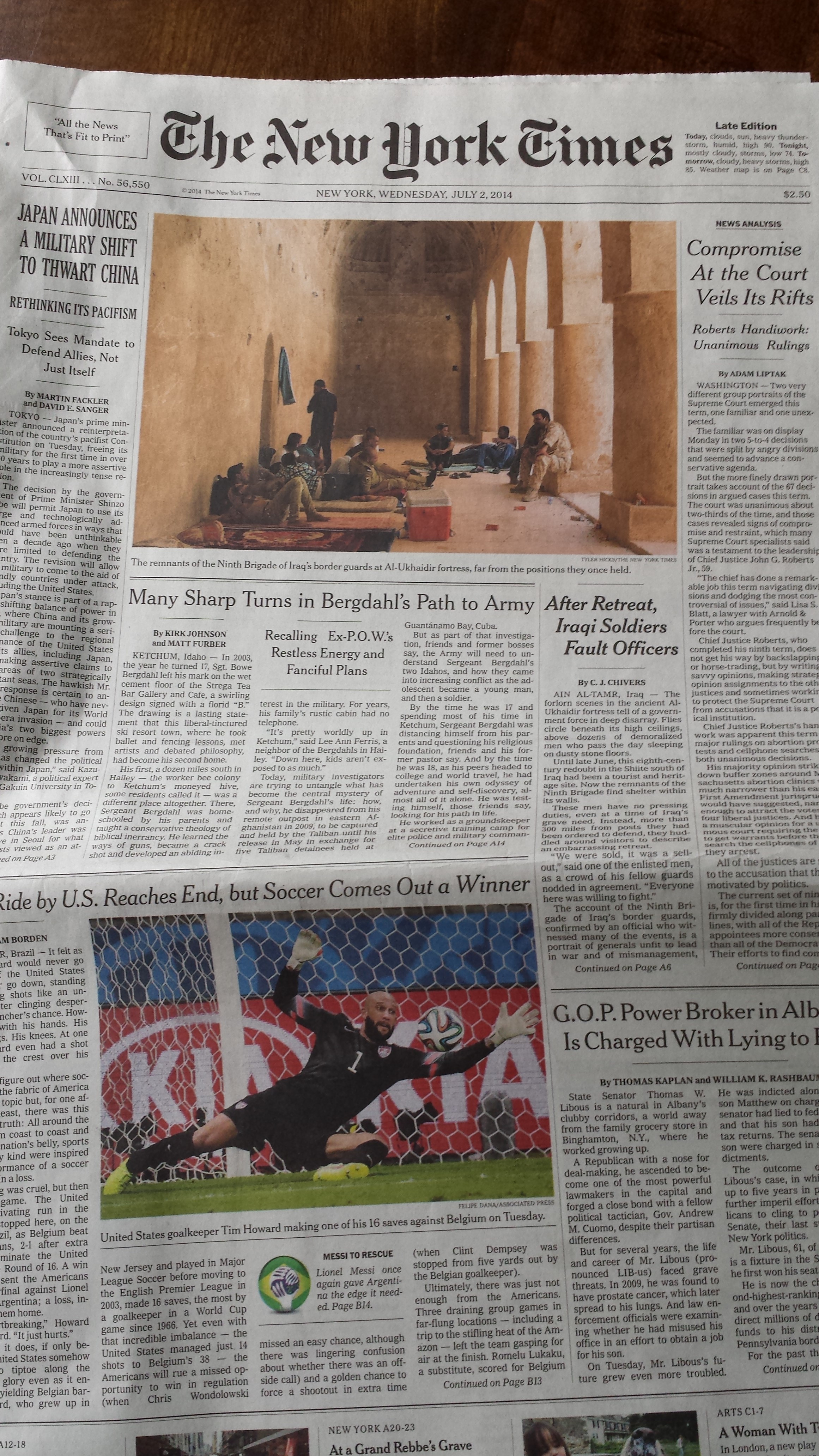
On July 2, the NYT did not have any cover stories about the killings of the Israeli boys. On page A4, it posted some black and white photographs of friends mourning at the gravesite of one of the murdered teenagers. The caption read that the boys were “found dead”. The associated article ran from page A4 and continued on page A20.

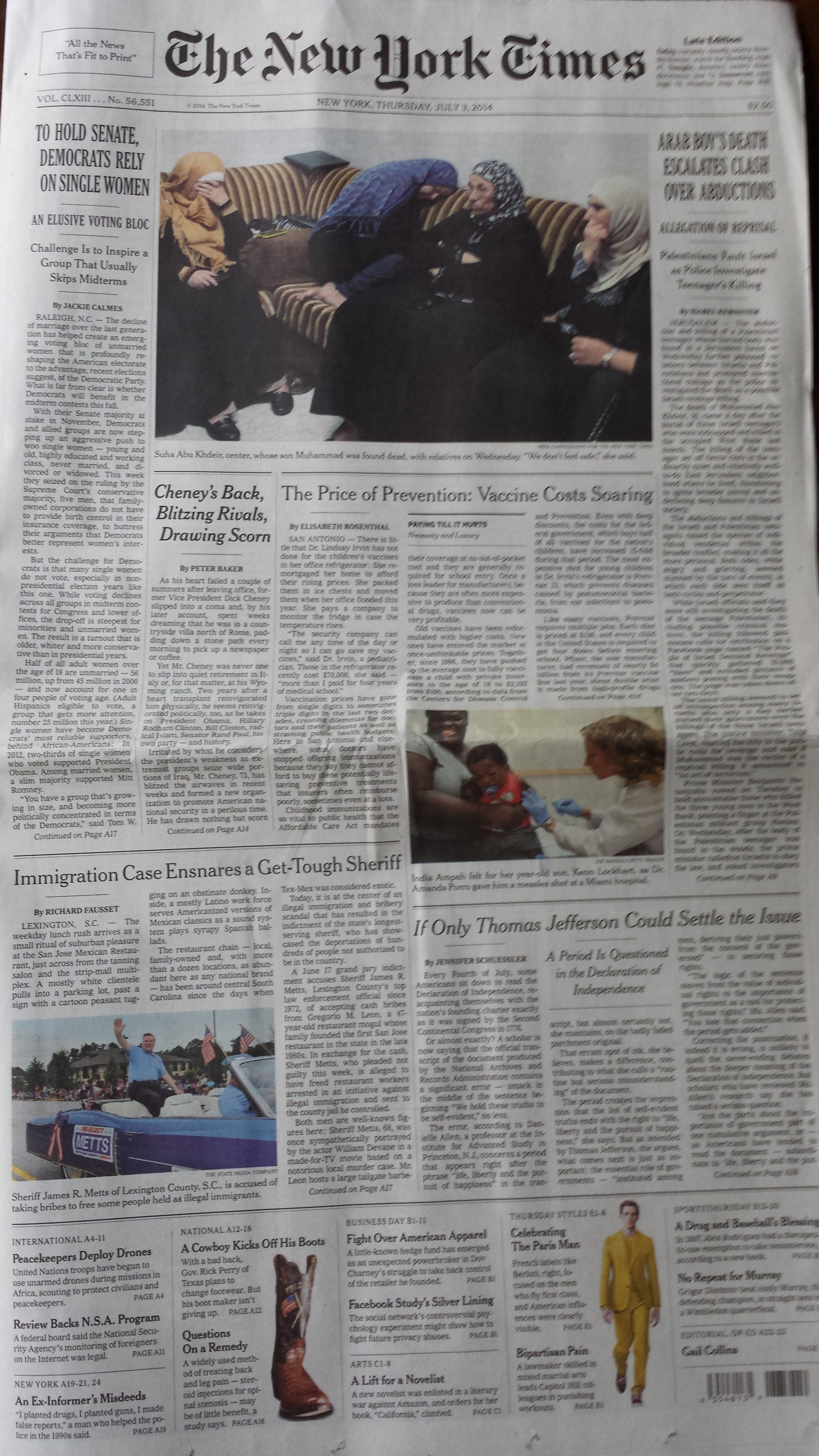
On July 3, the NYT posted a large color photograph on the top of the page of Arab women mourning and an associated right-hand column about the killing of an Arab boy (the trifecta – large color photo on top of page 1 and associated right-hand article). The caption said her “son Mohammed was found dead” included a quote from the mother of the dead boy “We don’t feel safe”. The cover article continued on page A8 with three additional color photographs of: Palestinian men clashing with Israeli police; Israeli police searching the crime scene; and the dead boy. The captions state that there was a “kidnapping and killing of a Palestinian teenager”.

Over these four days, if one were to just get news from pictures and their captions, what would a reader take away?

From the captions, it would appear that everything that happened to the three Jewish teenagers was passive. The boys were “missing” and their bodies “were found”. There was no mention of kidnapping or killing, nor any attribution of who was the aggressor.

Contrast that to the captions of the Arab boys who were “killed by Israeli soldiers” and another that stated there was a “kidnapping and killing of a Palestinian teenager”. The aggression described against the Arab victims was underscored by the cover article quote from an Arab woman that “We don’t feel safe”. Pictures and captions showed Israeli soldiers and police, but shared no sentiment of the Jewish women.

Further, the large color pictures on the top of the page with the Arab women mourning was the only time that the NYT gave the stories in the region prominence. The only time we saw a cover picture (on the bottom of page) related to the Jewish victims was when one of the mothers appeared alongside a grieving Arab woman in a story meant to convey balance in grief. In fact, the underlying message was not balance: the pictures and captions made clear that the Arab woman was a victim of Israeli aggression trying to find missing teens, while the Jewish woman still had hope that her “missing” son (not kidnapped) would reappear.

What does the NYT positioning of greater emphasis on Arab suffering convey to a reader? How do the pictures of Israeli soldiers in armored vehicles and border police with machine guns compare with Palestinians throwing rocks? Were the pictures and captions deliberately shaping a larger story than the immediate events?

Were people more likely to buy the paper or talk about it with friends? Does the Times believe that more readers sympathize with Arabs than Israelis? Does the NYT editorial board believe that Israelis are the aggressors and Palestinians the victims, even when this entire episode began with the abduction and murder of three Jewish teenagers on their way home from school?

June 30. cover June 30. A9 July 1. cover July 1. A8 July 2. cover July 2. A4 July 3. cover July 3. A8What do you think?

The USA, a Country of Immigrants

The United States has always been a country of immigrants. During the late 1800s through the market crash of 1929, ten percent of the country moved to the country every decade. After the Great Depression, immigration slowed to a trickle. It has grown to about 3.5% of the population per decade today.

Consider that the US grants more citizenship each decade than the entire populations of most countries.

The main changes to the immigrant population have been the source countries (now Asia and Latin America rather than Europe and Russia) and the greater number of illegal immigrants that are also coming to the US. Over 80% of today’s illegal immigrants come from Mexico and Latin America.

In Israel, Who’s New? Everybody.

Many items in the Middle East are subject to positioning and posturing.   People point to paragraphs in the papers and argue whether the piece has an Israeli or Palestinian perspective. Rarely does the news provide analysis or education for its readers. Instead, it rehashes the political leanings of its editorial board and applies it to the story of the day. How often does a reader put down a paper and say: “Who knew?”

Here is a review of “Who’s New” and the misrepresentation of the facts in the media. Note that statistics, while often easily distorted, can still say a lot. In an area like the Middle East, it is amazing that they are rarely discussed.

A common narrative (which has merit) is that Jews came to Israel en masse after the English took control of the entire region of Palestine (which includes today’s Jordan). That statement, however, is incomplete.

  1. Jews have always lived in Palestine
  2. Jews moved to Palestine in great numbers under the Ottomans
  3. Muslims did not move to Palestine under the Ottomans

In 1800, there were approximately 7,000 Jews in the region of Palestine. It is not a big number, and they accounted for about 3% of the population at that time.

Between 1800 and 1890, the population of Jews jumped to 57,000, then accounting for 8% of the population. Their numbers continued to grow under the Ottomans, with an estimated 94,000 Jews in 1914, or 14% of the population.

The population of Muslims and Christians during these time intervals barely moved. The Muslim population grew 113% over those 114 years, or a compounded annual growth rate (CAGR) of 0.7%. That is roughly the rate of natural growth (births minus deaths) which suggests that NO Muslims moved to Palestine for 114 years of Ottoman rule.

The Christian population grew at twice the rate of Muslims – 218% (vs. 113% for Muslims). To say that all of those Christians were Arabs would be surprising as one would expect the growth rate of both groups of Arabs to be roughly the same.

The Jewish growth in the region over the last 114 years of Ottoman rule was 1,243% – many multiples of Muslims and Christians. It clearly did not take the Balfour declaration in 1917 to get Jews to move to Palestine. They were historically (pre-1914) the only group who did move there.

4.  Arabs moved to Palestine in greater numbers than Jews during the British Mandate

Say that again?

While the common Arab narrative is that Jews came to Palestine under the British to do a “land grab”, and all of the Arabs were living in Palestine for centuries, the statistics do not support the claim.

For Jews, the Third Aliyah (1919-1923) brought about 40,000 Jews and the Fourth Aliyah (1924-1928) another 80,000 Jews to Palestine. About 15,000 Jews left Palestine due to the economic hardship at that time, meaning a total of about 105,000 Jews immigrated over the decade. The Fifth Aliyah was the most dramatic (1929-1939), bringing about 250,000 Jews. The Arab riots of 1936-9 basically shut down Jewish immigration to 75,000 people, so in total there were about 420,000 Jews who moved to Israel under the British.

The Arab narrative completely ignores the mass immigration of Arabs that happened under the British. From 1914 to 1949 (after the Israel War of Independence), the Muslim population grew to 1.18 million. That means that after over a century of 0.7% growth (and even lower 0.6% annual growth in 1890-1914), the Muslim population jumped to 2.3% annual growth. Put another way, the Muslim population was 540,000 people larger in 1949 than one would have assumed using all historical norms. So while the Arabs may point to the roughly 420,000 Jews who migrated from Europe, Russia and Yemen, they deliberately ignore the half of a million Muslims who moved from Egypt, Iraq and around the Middle East to Palestine under the British.

So who was new to Israel/Palestine? Who moved there under the British Mandate? Everybody. About 540,000 Muslims, 60,000 Christians and 420,000 Jews.

Which is all fine and good. But it is a lie to state that all Palestinian Arabs lived in their homes for centuries and Jews were “colonialists” brought by the British. There were more Muslims that moved to Palestine between 1914 and 1949 than Jews.

Consider further that the figures above net out over 300,000 Arabs that left Israel during the 1948 War to Lebanon, Syria and Jordan, which would suggest that Muslim immigration was twice that of Jewish immigration under the British.


Who knew?

Hope versus Hate. The Anthems of Different Peoples.

In the two and one-half weeks since three Israeli teenagers were kidnapped, the government of Israel dispatched hundreds in search parties to find the boys, called “Operation Brothers’ Keeper.” The citizens of the country, and Jews and civilized people around the world, hoped and prayed for the boys’ safe return. The reactions were emblematic of Israel’s culture: to actively pursue – by physical and metaphysical means – a better future. A future that includes life and peace for its entire people.

The reaction from Israel’s Arab neighbors was also emblematic of their culture. Hamas spokesman Khaled Mashaal said “If it turns out the kidnapping really happened, I welcome it.” The mother of one of the men accused of the kidnapping, Amer Abu Aysha, said that “If he truly did it – I’ll be proud of him till my final day.”

Those sentiments of hatred can be found throughout the Arab and Muslim Middle East in their national anthems. Country after country have songs calling for death, vendetta and martyrdom, as seen in the video below. These are not army marching songs, but the values that are instilled in the people every day before soccer matches and graduations. Here is a small sample:

We all sacrifice for you, we supply you with our blood” – UAE

Our martyrs’ souls are formidable guardians” – Syria

We will drink from death” – Iraq

Palestine is my vendetta and the land of withstanding” – Palestinian Authority

A life of dignity and a death of glory” – Tunisia

We never betray the call for sacrifice, death” – Sudan

On our dead we build glory” – Algeria

May God take my life” – Turkey

We are your sacrifices” – Libya

Remember through my joy, each martyr” – Yemen

The Kurdish youth are ever-ready And always prepared to sacrifice their lives To sacrifice their lives, to sacrifice their lives” – Kurdistan

These aspirations stand in sharp contrast to the national anthem of the Jewish State of Israel, a democracy in the middle of the Middle East.  Israel’s anthem is called “Hatikva”, which means “The Hope”.

Our hope of 2000 years is not lost. To be a free people in our land- the land of Zion and Jerusalem.”