There was a time when respect was earned by learning. People who studied hard, accumulated degrees, mastered facts and logic were admired. They didn’t need followers; they had knowledge. They didn’t need virality; they had depth.
That world is gone.
Fame today is not built in libraries or laboratories but in the palm of a hand. A ring light replaces a classroom. A viral clip replaces a thesis. And the more lurid, outrageous, emotional, and dishonest the content is, the faster the fame spreads. The algorithms demand provocation, not proof. They reward outrage, not understanding.
And people are responding exactly as the system intends: they’re dropping degrees, skipping college, deciding that years of expensive education aren’t worth it in a world where clout is free and clicks are currency. AI will write the papers anyway. Tuition is a fortune. Morality is optional. Why struggle through years of learning when you can fabricate a persona, press “upload,” and watch the world react?
For the first time in history, the older generation will have far more education than the young. Degrees are becoming relics. Expertise is becoming an antique. And winning hearts and minds through argument — the old democratic ideal — is becoming a luxury.
Politics is drifting toward the young, the uninformed, the inflamed, the furious, the ones who know how to play the game of attention better than the game of truth.
Hasan Piker doesn’t win debates; he wins followers. Comedian David Smith isn’t famous for jokes; he’s famous for attacking fellow Jews, because tearing down your own people brings clicks in a sick digital economy.
And here is the crisis for the Jewish people: We are the People of the Book trying to survive in a world where books don’t matter. We are a civilization built on reason, argument, text, questioning — and we cannot comprehend why we’re losing the PR battle against influencers who deal only in emotion, rage, and spectacle.
We fight with facts. They fight with feelings.
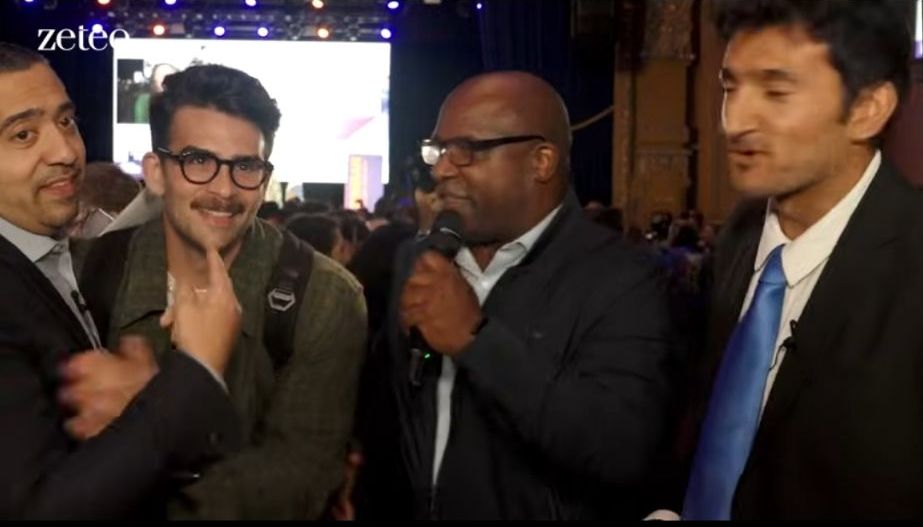
The socialist-jihadi crowd celebrates Hasan Piker showing up at Zohran Mamdani’s victory party
We build logic. They build engagement.
We look for truth. They look for traction.
And so a terrifying question hangs in the air: Must Jews abandon their values to survive? Must we trade nuance for noise? Must we jump into the sewer of social-media fabrication because that is the only battlefield the world seems to care about? Must we out-viral our enemies just to protect ourselves from the lies, the hatred, and the persecution that spread faster than any truth we offer?
Or is there a third way — a way to fight fiercely without becoming the thing we oppose? A way to compete in the digital arena without destroying the intellectual soul that has kept us alive for 3,000 years?
This is the defining challenge of the modern Jewish experience. Not whether we can win a debate — we always could. But whether debate still matters.
And if it doesn’t, then the Jewish people must decide how to defend themselves in a world where vanities, not virtues, are the currency of influence.
The People of the Book didn’t choose this kind of world. But we must learn how to survive it — without losing who we are.
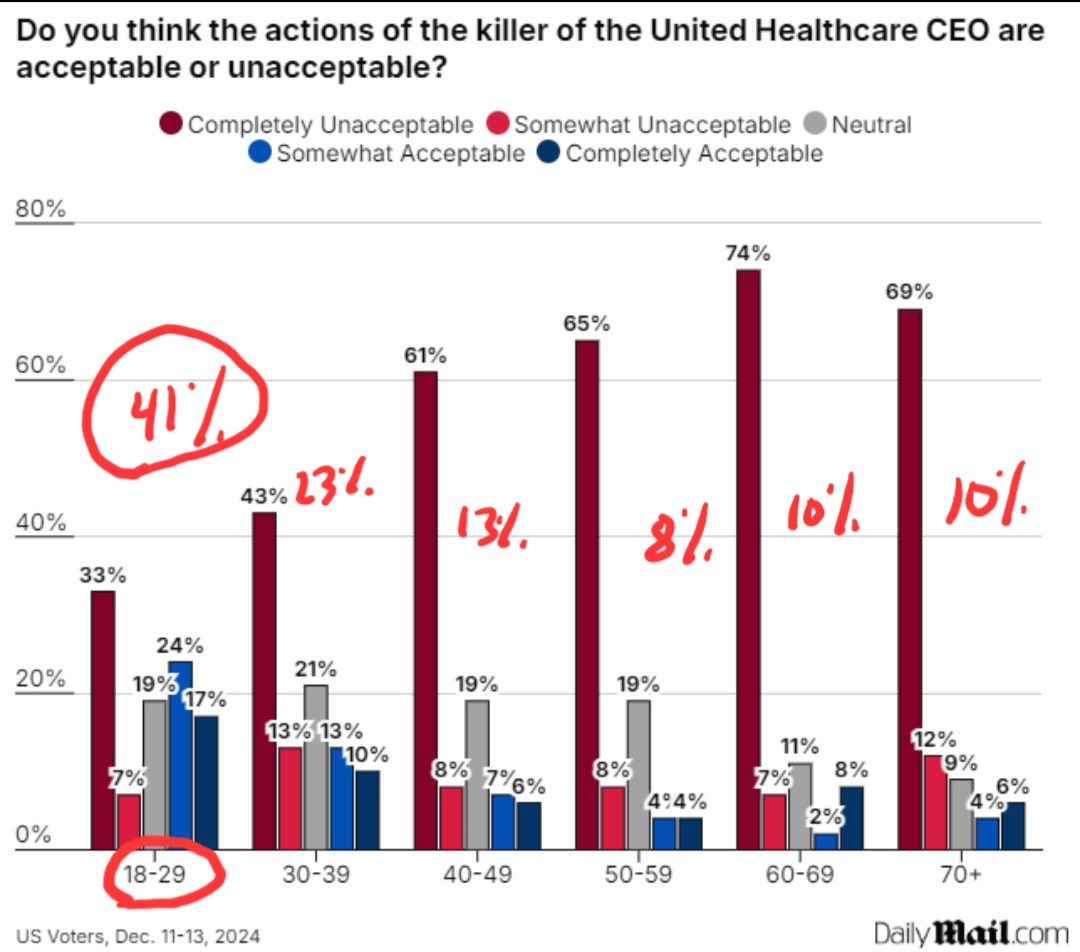
In the aftermath of the targeted killing of a healthcare insurance executive, more 18-29 year olds thought that the assassination was justified than thought it unjustified (41% to 40%) according to a DailyMail poll. The Gen Z generation was an outlier compared to every other age group, with those over 50 years old having 10% or fewer believing that the killing was justified.
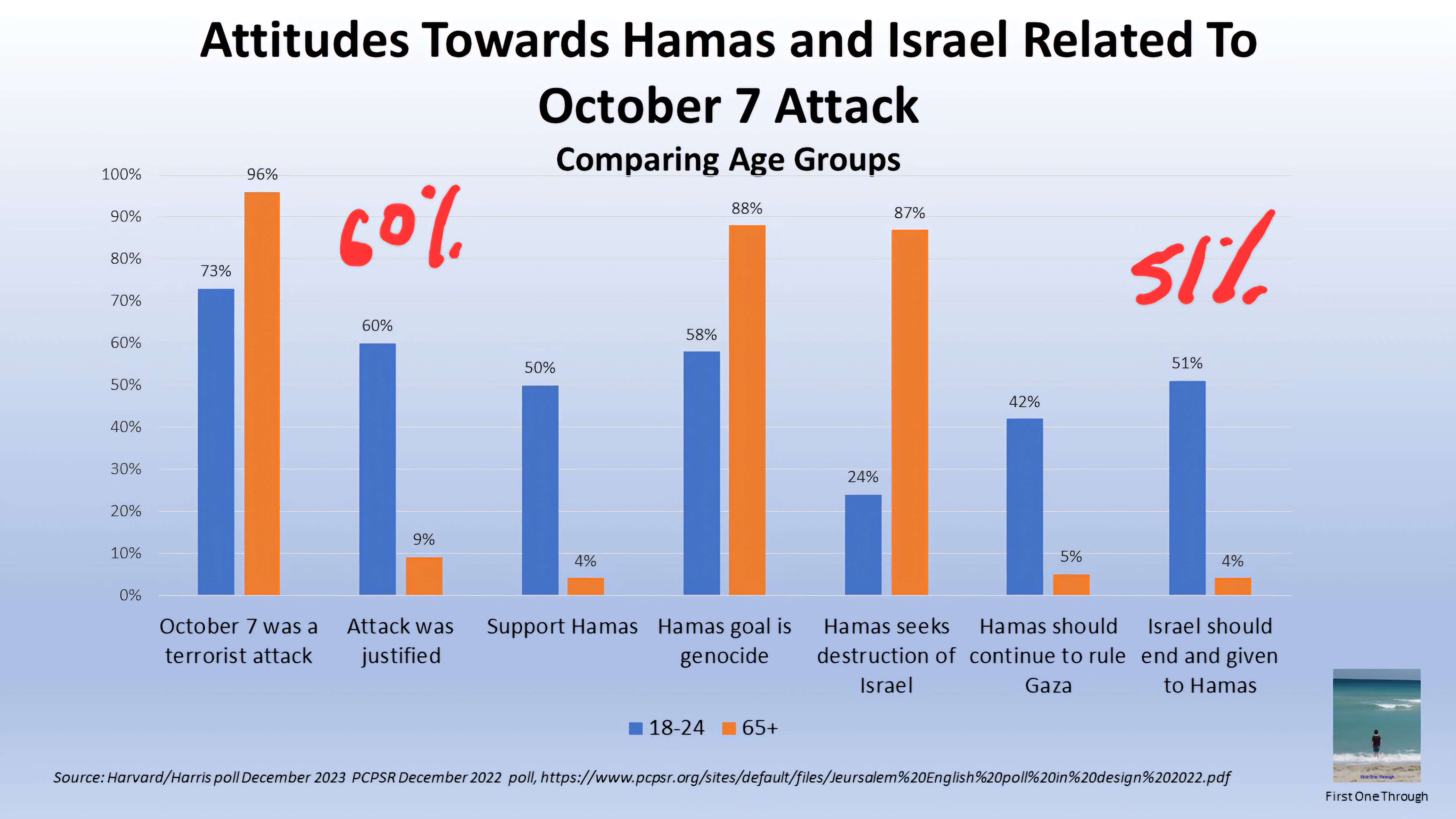
The peculiar morality of 18-29 year olds is not limited to their view of the insurance industry. In the aftermath of the Hamas slaughter of Israeli civilians on October 7, 2023, a Harvard poll showed that 60% of 18 to 24 year old thought that the attack was justified. Half of that age group supported Hamas (compared to 4% for people over 65) and 51% said they thought Israel should be liquidated and handed to Hamas.
Why is there such depravity and celebration of violence amongst today’s youth?
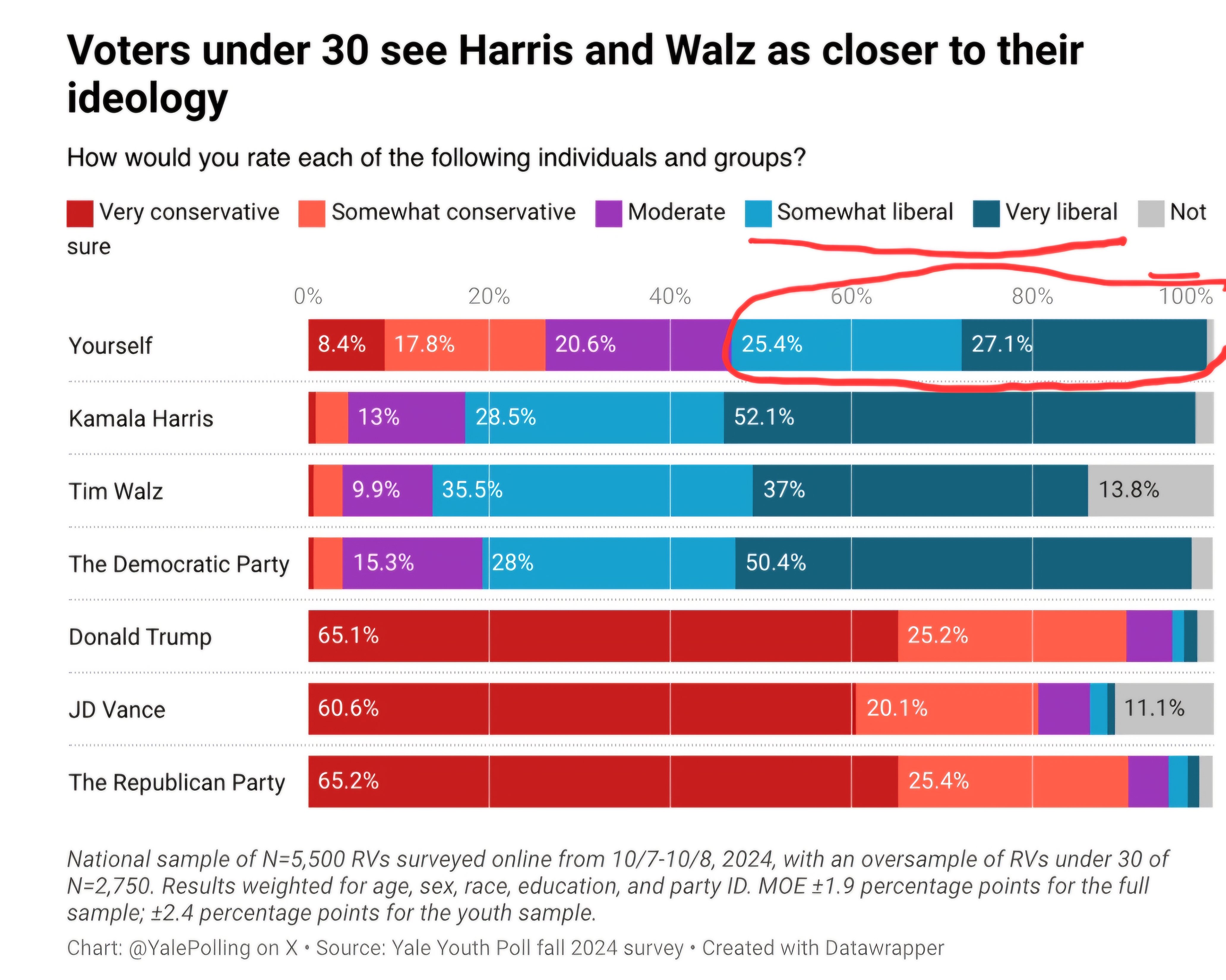
According to a Yale poll conducted in the fall of 2024, the majority (52.5%) of Americans under 30 years old consider themselves liberal. Only one-quarter are conservative, and those that are, are only “somewhat conservative.”
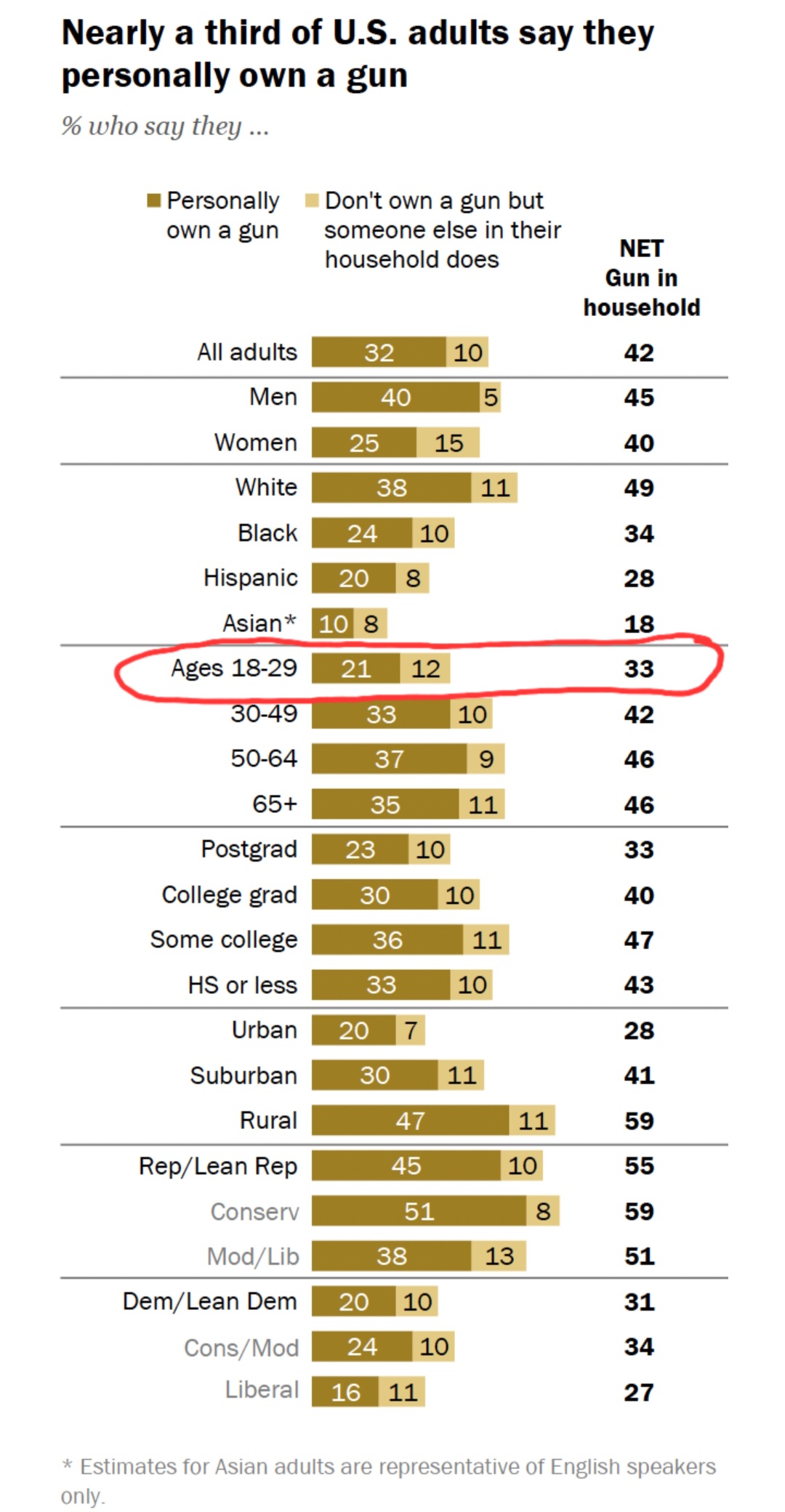
These under 30 liberals are not typically perceived as violent. According to Pew Research, they have the lowest gun ownership in America. According to a PBS poll, it is Republicans that are more likely to resort to violence “get the country back on track,” not the left (which should not be surprising as the poll was taken under a Democratic presidency; should the poll be conducted again under a Trump administration, it would be curious to see the results).
Further, according to a McCourtney poll in January 2024, Gen Z youth are the least angry age group in the U.S. They also tend to feel the most pride for certain things.
The various polls seem incongruous. On one hand, Gen Z youth applaud murder but are generally not as angry or prone to violence according to polls.
One observation made by the Brookings Institute is that today’s youth is much more diverse racially and ethnically than older generations, as well as compared to youth of prior generations. It means that current polling data may be wrong depending on the sample set selected, and it means that age may be only one determinant of how young people view the world.
Brookings Institute warns of polling data for today’s youth
Another factor is perhaps social.
Gen Z was more impacted by the pandemic and its lockdowns than other generations, forced to spend high school and college at home and behind masks. They grew up and went through puberty with social media and texting on their cellphones as the main methods of engagement rather than physically interacting with peers and society.
Jonathan Haidt, author of The Anxious Generation, said that Gen Z is suffering from a serious mental health crisis. He views this generation as more depressed and susceptible to self-harm. His analysis highlights correlation rather than causation, as there are very few Gen Z without social media to compare. The podcast linked above considers that maybe more anxious youth spend more time on social media than less anxious people, so the correlation may be from the self-selected initiators rather than from platform engagement.
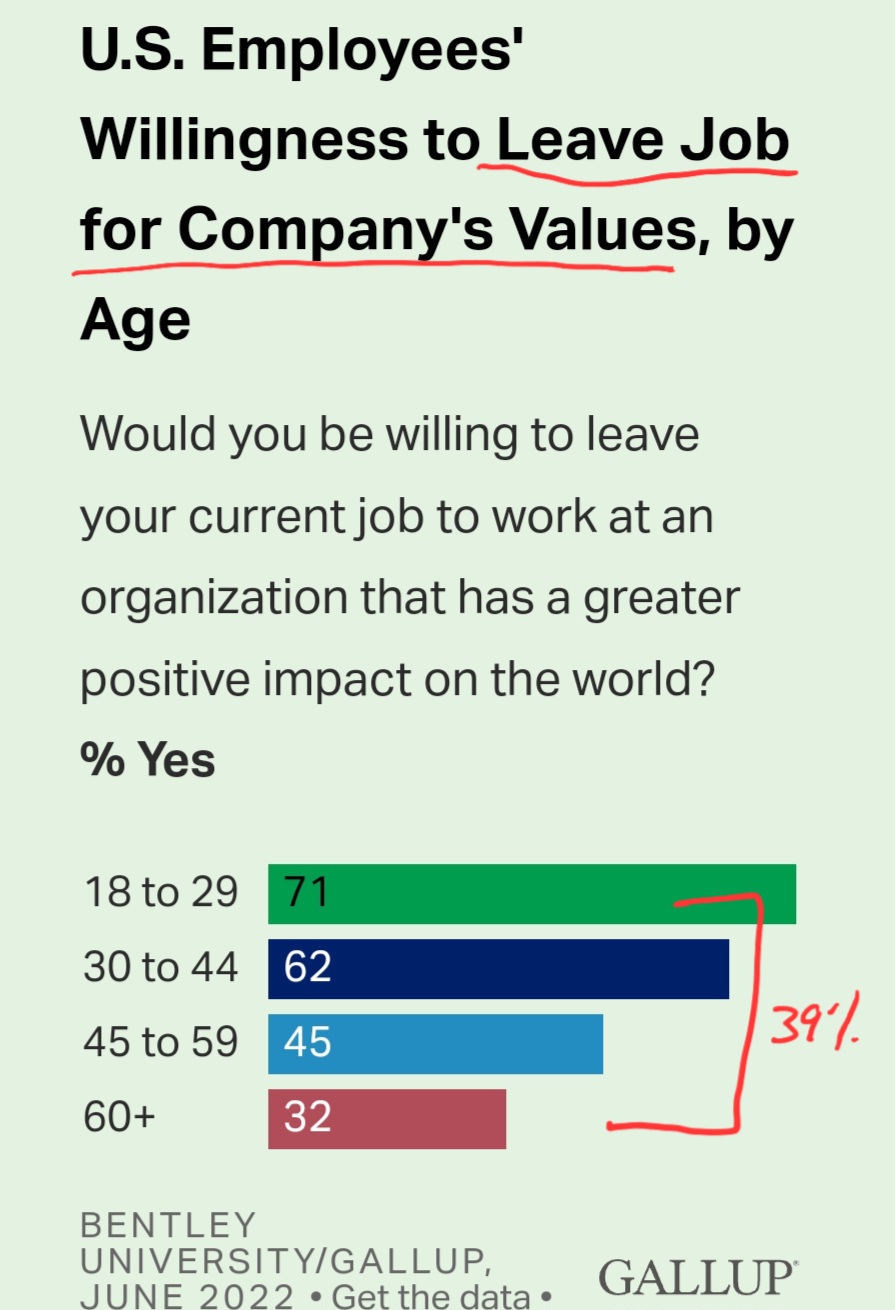
Polls have looked at Gen Z’s attitudes regarding societal values. According to a 2022 Gallup poll, those aged 18-29 were much more likely to believe that companies should be more focused on long-term benefits of society than profitability. They are much more likely than older Americans to leave a position at a firm if they disagreed with the company’s values.
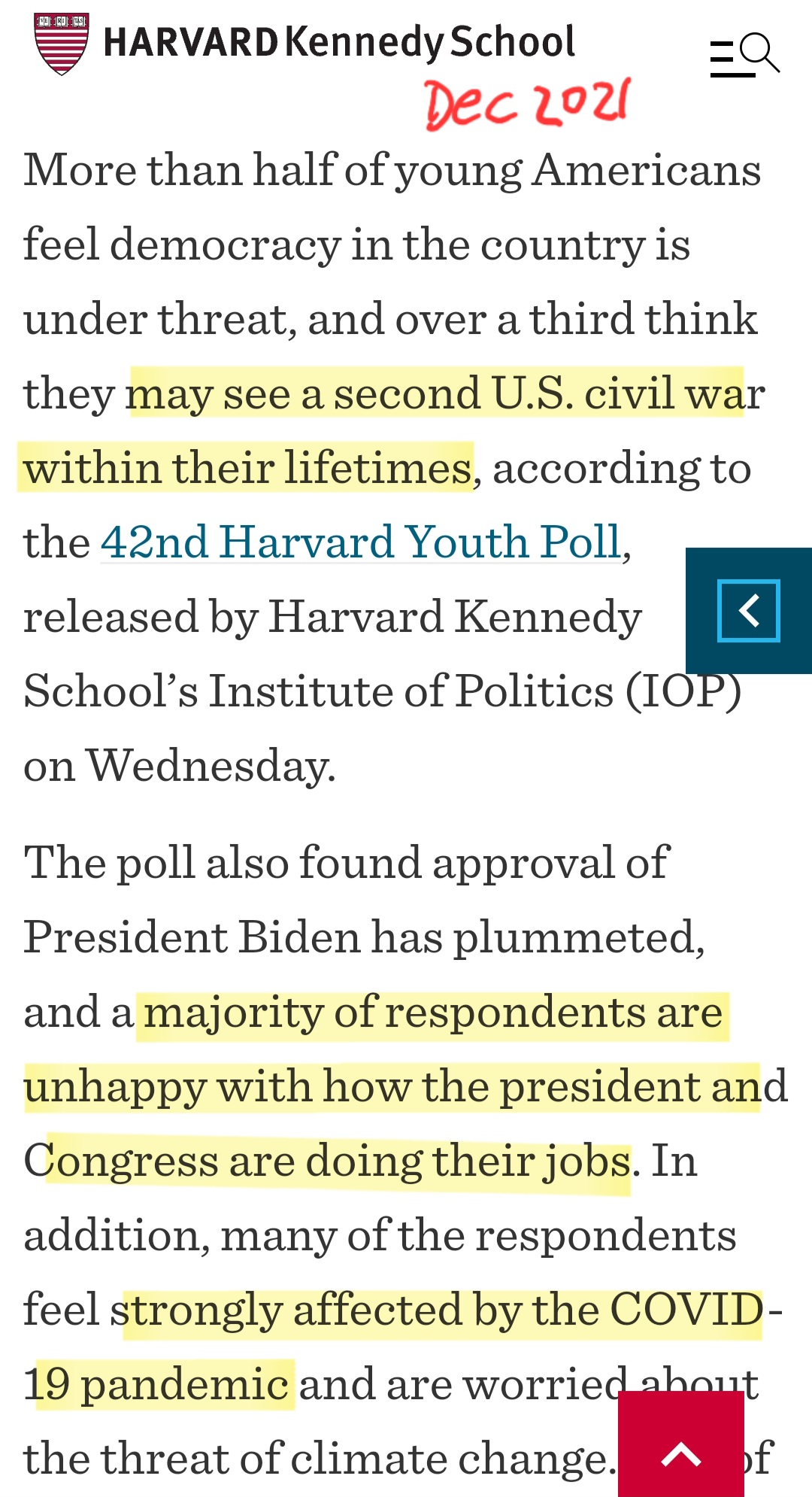
Those opinions are seemingly not limited to corporate America. Harvard’s December 2021 poll showed that young Americans were very unhappy with President Biden and Congress and “over a third think they may see a second U.S. civil war within their lifetimes.” While Gen Z may not be carrying guns, they believe that society is broken and war is coming.
Beyond society being broken, they personally feel broke. According to a 2024 NBC poll, the most pressing matter for Gen Z by far was inflation and the cost of living (31%), ahead of “threats to democracy” at 11%. Crime, immigration, foreign affairs and other matters were all far behind.
NBC poll of Gen Z before 2024 presidential election
None of the polls are perfect but the assembly of all this data leads to some disturbing conclusions about Gen Z today:
they are distressed – emotionally and financially – disconnected from society because of masks and technology
they do not see a secure future, whether because of personal financial stress or because they believe the system is rigged against them
they have no faith in institutions – whether government or corporations – to look out for them and society
while they may not be inclined or able to commit violence themselves, they empathize with those who do
It sounds like the backdrop for the movie Joker, with a society ready to venerate murder as a pathway for validation and justice. It’s Gen Z’s desire to rip down the establishment in a brewing civil war which more closely resembles the French Revolution than the 19th century war between the states.
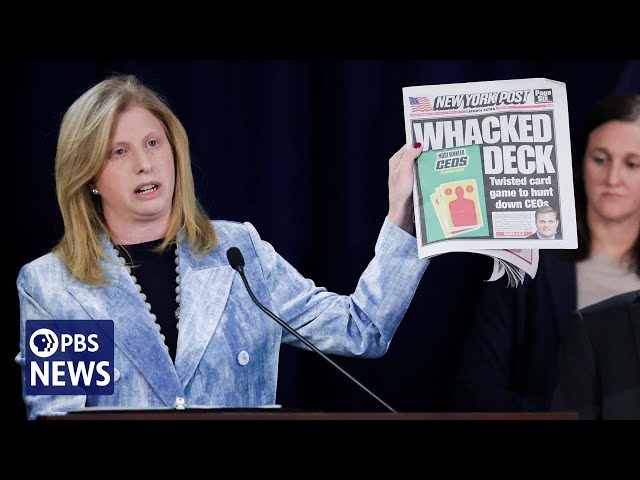
While the fictional Joker character was understood to be deeply troubled, Hamas and Luigi Mangione, the killer of the United Healthcare CEO, are being portrayed as deeply righteous. Professors at universities are praising the killers, and pointing to “wealthy Jews” as operating “behind the curtain” (to quote Rep. Rashida Tlaib (D-MI)) to entrench a corrupt system for selfish goals. The media echoes the “powerful Jew” and corrupt Republican/”White supremacy”/patriarchy themes to incite the masses. They make playing cards of other insurance executives to target.
The youth are marching with chants to “Globalize the Intifada“, to bring the October 7 massacres to every corner of the world. They are picking infidels in each town and industry to target for their rage.
March in New York City
Gen Z’s embrace of anarchy is being encouraged by liberal media, the education system, radical left wing organizations and America’s foreign foes. Each is influencing and validating “the anxious generation,” seeking TikTok moments to clone the next Joker, attempting to destroy the United States from within.
Many Jews have found it difficult to be at work since October 7. Some have been alarmed by the lack of empathy for the Jewish community after the Hamas massacre. Others are distraught over comments that Israel is committing a genocide in Gaza. Sometimes the comments come from peers and other times from people who are senior or clients.
The workplace is not like other forums. A person’s livelihood is at stake, and the office is where people work together for long stretches of time. It is a very different dynamic than passing a masked protestor on the street.
How does a person handle anti-Israel vitriol from a colleague on social media like LinkedIn? Is it different if they post something on X or Facebook?
Here are some suggested guidelines:
It is always safe to stick with facts
Opinions are best shared in reaction to something at work; in personal settings, proactive is fine
Emotions are fine to share, as appropriate for that work environment, with an emphasis on humility
Do not troll people on social media. Use your own platform to make your feelings known
Use professional work media like LinkedIn for work related matters unless you are so senior that you believe your Israel advocacy can influence people
You can share your pro-Israel positions in a permanent passive manner by posting your role on Zionist groups like StandWithUs or post pictures of you in Israel
If you feel close enough to a colleague at work and their views are within the framework of honest disagreement, ask if they are open to discussing the topic
Should someone in your office cross the line into intimidation, harassment or discrimination, bring it up with human resources immediately, whether the person is junior or senior to you
If a client crosses the line, bring the matter up internally, asking the firm to terminate the engagement or reassign the client to a different colleague
Crossing the line into intimidation, harassment or discrimination should always be called out regardless of a person’s seniority, and whether internal or external to an organization. It must never be allowed to be normalized.
Honest ignorance is still ignorance. Consider whether the person stating lies is open to learning facts and try to engage respectfully. If the person is irate and will not be swayed, there is no point in engaging directly; you could talk to others who may have witnessed the spectacle.
If you are unfamiliar with facts as you hear arguments, admit as much that you need to do more research. It’s an opportunity to learn more from respected sources and not take someone’s emotional outburst as gospel.
People often react to difficult situations with a desire to either fight or flee. In a business environment, take a breath and be more tactical.
He [Rabbi Tarfon] used to say: It is not your duty to finish the work, but neither are you at liberty to neglect it; If you have studied much Torah, you shall be given much reward. Faithful is your employer to pay you the reward of your labor; And know that the grant of reward unto the righteous is in the age to come.
We have obligations at work, and we have obligations as Jews at work. It includes providing for our families and workers, as well as infusing the environment with Jewish values, but neither should fully supplant the other. Should that happen, it is not really a place of business where a Jew should be present.
Both the political right and left are coming after the large social media platforms due to their powerful influence over society. The right has complained about the censorship executed by the likes of Facebook, Instagram and Twitter for silencing conservative voices while the left has voiced concern about these perceived monopolies destroying competition. The left has mostly been dismissive about the idea that the corporations have a left-leaning disposition, and if they do, they are nonplussed. If corporations are allowed to contribute to election campaigns (see Citizens United v. FEC which the left abhorred), they should similarly be free to share or block content.
As to the question of whether shadow-banning is real, consider this blog of FirstOneThrough which has a right-of-center orientation to American and Israeli politics.
On a typical week, Facebook would account for over 10 times the number of referrals to an article as search engines. That pattern was relatively consistent whether there were few or several posts.
But the pattern broke during the election cycle.
Weeks Ending
FB Average
Search Average
Ratio
Dec 13
672
58
13x
Nov 8
181
56
3
Sep 20
823
60
13
Aug 2
538
48
11
Jun 14
926
71
14
Impact of Facebook Shadow Banning on views of First One Through blog
During the seven week cycle before the 2020 U.S. presidential election, the blog remarkably went from getting roughly 13 times as many views from Facebook than search engines to only 3 times as much. The change was completely the result of a sharp decline in Facebook readership, as the volume produced from search engines remained constant.
That meant that fewer people had a chance to read the analysis of a vocal Libertarian and Zionist leading up to an important election. Once the election passed, Facebook permitted viewership patterns to return to normal (as of the following five weeks).
How and why did this happen?
Did a liberal reader flag the October 1 article “Vote Harvesting,” a completely true first-hand account of watching how a local election official can influence who gets to vote? Did Facebook decide on its own that posts from a writer who penned on September 25 “NY Times Tries Hard to Paint Obama/Biden as Pacifists and Trump as Mercenary” is an opinion to be silenced? Did an anti-Israel agitator do their utmost to flag a blogger who wrote on September 27 about the vile anti-Semitic Hamas Charter and how former Democratic U.S. President Jimmy Carter backed the Hamas terrorist group?
Whatever the origin of shadow ban, it clearly happened.
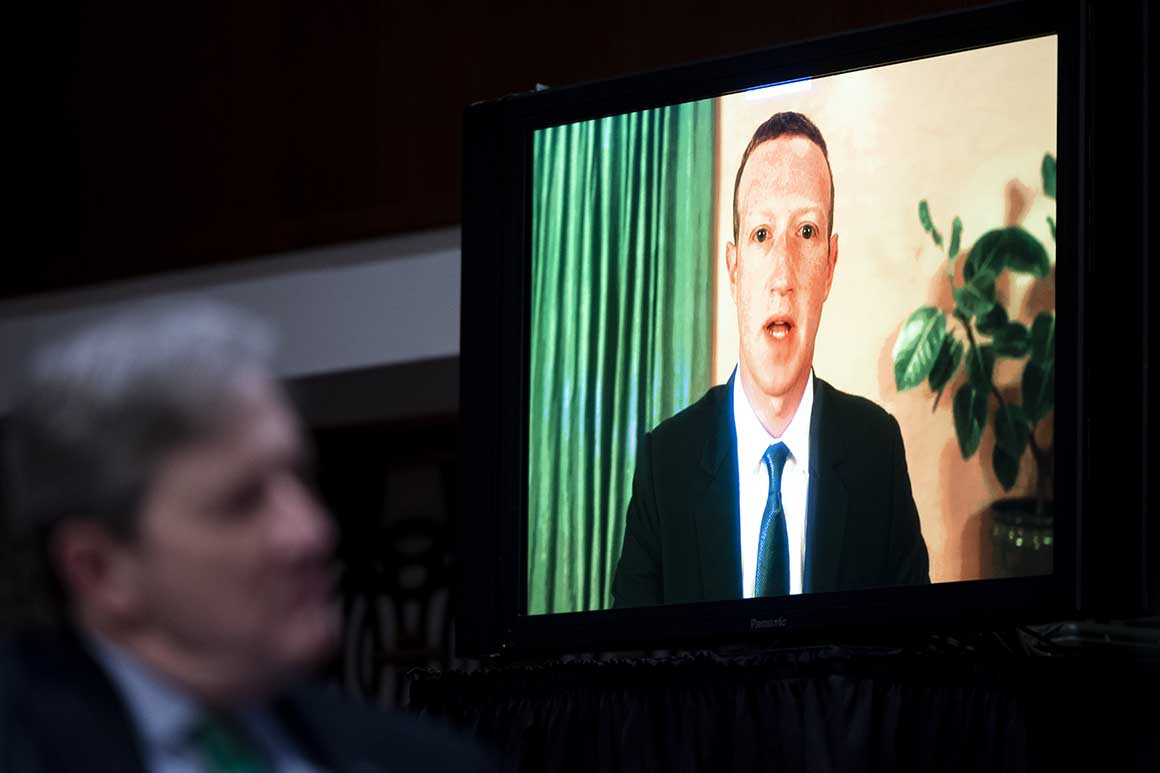
Facebook CEO Mark Zuckerberg testifies during a Senate Judiciary Committee hearing on Facebook and Twitter’s actions around the closely contested election on Tuesday, Nov. 17, 2020, in Washington. | Bill Clark/Pool via AP
If Facebook wants to present itself as a biased platform like MSNBC or Fox News, that’s fine. A private platform can take whatever form it chooses. While it may be annoying when a media company like The New York Times pretends to be unbiased and not left-leaning, the tilt is well known and consistent. Only people living in a liberal bubble believe it to be a neutral and factual publication.
However, what kind of platform swings alt-left for just moments in time like during an election season? If the analysis presented by a blogger is offensive, then make it clear for that person to take their business and opinions elsewhere. Always.
What was done by social media in this instance was clear election-meddling, and on the grandest of scales due to the enormous power of social media. (\According to Pew research, 43% of Americans got their news from social media in 2018, a number that surely went up by 2020. That growing figure is despite a majority of people (57%) being skeptical of what they read.
In 2008, Barack Obama and his supporters were very effective in using social media, especially relative to John McCain supporters according to Pew Research. Obama voters surpassed McCain voters in posting content online (26% vs. 15%) and engaged politically on social media (25% vs. 16%) to yield a very successful outcome. But now, the social media companies themselves are keeping the gap in favor of Democrats by blocking the distribution of conservative posts.
Shadow banning in social media is very real and can easily tip presidential elections that are decided by less than one percent of voters in a couple of states. It is frightening and appalling that we no longer have to only fear the actions of foreign actors in the conduct of our democracy but the large social media platforms themselves.