My Big Fat Passover Program – US Edition

A satire.

This year’s Passover excursion kept us in the United States. American programs tend to be much larger and more expensive since the law of large numbers doesn’t seem to apply to matzah. This one was the same: 1,300 people spending $25 million, while complaining about the yeshiva tuition and shidduch crises.

Despite the price tag for a single room which could have purchased a small car (pre-tariffs), my family couldn’t pass up the opportunity to spend ten days with 33 extended family members, including 14 children under 10 years old. The challenge of migraines versus memories was too enticing to pass over.

Our small tribe descended on the destination “resort” nestled 47 minutes from civilization in desert foothills with panoramic views of ugly sand and rocks. The 99 degree heat baked every living thing except for snakes which blended into the brown landscape. We ran inside to escape the sun and scenery.

The hotel “lobby” had a couch and two chairs, insufficient for my immediate family let alone 1,300 other guests. It appeared that we were going to be left with few choices for hanging out together: either in the dining room, tea room, shul or our own rooms.

We grabbed keys and programs and headed to our rooms to unpack 75 outfits.

All of the rooms were essentially “suites” with a small living room which looked great for late night reading. However, the bathroom was so small that the door bumped into the toilet seat, so one needed to shimmy around the door and place a foot in the bathtub to enter. As I extended my hand to grab the shower door for balance, I actually grabbed a fistful of curtain. I let out a small shriek and heard someone next door do the same. A chorus of “a shower curtain?!” could be heard echoing through the halls.

Our horde unpacked and changed for the first of forty meals. On American programs, people seemed extra intent on getting their money’s worth by gorging non-stop. It was especially true at this location, as rooms normally go for $109 per night.

The first dinner was set up as a barbeque outside. The pieces of steak were larger than our plates to make us forget that the program lacked vegetables. It was delicious and set the stage for a carnivorous vacation theoretically focused on small tasteless pieces of flatbread.

We awoke early the next day and rapidly learned who was going to attend prayer services and who was tasked with looking over small tykes while their wives slept. We created a mini-WhatsApp group apart from the broader family chat to notify each other about minyan times and where to grab a nosh. There was a short back-and-forth about whether to label our chat “The Minyan 7” or “Tallis Toters” and settled on The “XYs” as none of the women attended other than for yizkor.

The conference room turned shul could seat 500 people, so the 70 men and 3 young women who came home from seminary in Israel had plenty of room, if not heat or decent lighting. The first ba’al tefillah launched prayers with “she asani aved” thanking God for making him a slave, dropping the important “not” in the blessing, making people wonder whether he had sold a kidney to pay for the program or was trying to set the mood for the Passover story of liberation.

The hashkama minyan flew by quickly, allowing people to enjoy another four hours of breakfast. It was our chance to see our family’s designated table for the holiday which occupied one-third of the dining room, a behemoth square of 28 feet a side. We had the staff reconfigure the table for the other meals so we could hear each other, but the reality of eating in a room with 1,000 other people including screaming children made a conversation beyond five feet impossible anyway.

The buffet in the center of the large hall was arranged as follows: wine table, omelet or carving station depending on the meal, various hot dishes, omelet/carving, hot dishes, omelet/carving, hot dishes, omelet/carving, hot dishes, and at the very back of the room, a small salad table with hearts of palm and shredded carrots. Perhaps the caterer didn’t want to check vegetables or wanted all-brown meals like the desert outside.

On rare occasion, there was plated food when we arrived, once consisting of gefilte fish with horseradish together with seared tuna and wasabi. If it was intended to placate both the Ashkenazi and Sephardi crowds it didn’t work as my Syrian niece threw up at the sight.

For some reason, despite the enormous quantity of cooked animal flesh at lunch and dinner, the dessert table only had 20 cookies. Everyone assumed we were being encouraged to head to the tea room for sweets so the staff could set up for the next meal.

We obliged and ran over to see what was in store.

Regrettably, it seemed that some guests had paid off staff to seize all the Bisli for their entourage. The rest of the attendees made due with “tropical” ices that tasted like antifreeze and various chocolate snacks that varied more in shape than flavor.

When snack time was over we were at a loss for what to do. We went to one of the pools to watch the water evaporate before our eyes. We then hunted for shade and were informed that the indoor cabanas were already reserved by guests for $12,000 for the week, a pretty penny to watch White Jews combust but many seemed content to do so.

My wife went looking for one of the shadchanim “matchmakers” to discuss our boys and various single friends. The boys refused to engage in the “meat market” and opted to sit at the poolside barbeque and talk to girls there.

People were kvetching that the program last year in the Caribbean was much nicer in terms of hotel and food quality. As one person voiced her disagreement, she was cut off by a loud thump of an older couple tripping on the broken cobblestone pathway, crashing to the ground. It would be the first of seven hospital calls during the holiday. By the last day of chag, thirteen orange cones dotted the heavily-trafficked walkway.

For shabbat, we were handed a few velcro strips to disable the electronic door locks. Later in the week, I saw some men using them to extend their belts to accommodate their bulging waists.

During shabbat and yomtov prayers, the program auctioned off aliyahs for different charities. It got more people to attend the earlier hashkama minyan in hope for a better deal. Az Yashir went for $5,000 at hashkama, but the winner didn’t realize he had to hand the aliyah over to the program’s rabbi. It crushed the fundraise for the next much larger minyan and people wouldn’t go above $100. I suggested bridging the tzedakah gap by bidding out the right to be the sole person to yell “ka’eleh” during the second torah reading, as the masses cannot keep themselves from drowning out the ba’al koreh.

The night activities alternated during shabbat and yomtov on talks about Israel at war, antisemitism and rabbis put into herem for heresy. Very uplifting and spiritual. During chol hamoed, the nights alternated between unfunny young comedians ripping off older comics’ material, to a couple of Sephardic singers singing the same popular four songs that they didn’t write. The band behind them pretended to play various instruments while their prepared music mix blared for the stablehands six miles away. It was the Israeli version of Milli Vanilli.

And the kids loved it. They cheered their Instagram star despite his lack of stage presence and joined the 45 year old bearded male singer when he asked for girls under 14 years old to join him on stage.

For some reason, I think I was the only one to find the spectacle creepy.

As the three-day shabbat-yomtov continued, people bemoaned their Wordle streaks ending. The various right-wing speakers suggested to all that it was a perfect time to terminate their New York Times subscriptions.

People slowly became aware that the entire hotel was not reserved for the Passover guests. Loaves of bread were in the hallways and a Christian wedding party which booked the second weekend created a stir. A ruckus broke out when the hotel insisted that all Jews leave the pool area for the wedding. Fewer men complained the following day when tall blonde women came out in their bikinis.

The Latin staff seemed nonplussed by everything and kept smiling. The Jewish staff looked perpetually perturbed by the incessant demands of one thousand over-entitled kvetches from friends and neighbors.

Overall, the holiday was a win. Getting so many family members together for a week is an accomplishment in itself, and there were no major blowouts. We had a chance to meet some nice new people and collectively discover why Jews left the desert over 3,300 years ago.

Related article:

My Big Fat Passover Program (April 2023)

The Provenance Of Jews

In the world of archaeology, there is nothing as prized as finding something in situ, meaning in its original place. The location helps provide archeologists with clues as to the surroundings’ age and usage, who lived in that location and the nature of society. Once an item moves, critical details of the environment are lost forever.

From that moment, the provenance is often a curiosity. Who owned the item and for how long? How did it come to find its way into this collection or that museum and what happened to the artifact over this time? These matters are often used to prove the subject’s authenticity, by tracing it back without interruption to the point of discovery.

When it comes to works of art (rather than archeological finds), provenance is less of a curiosity. Experts and viewers mostly focus on the art itself as well as the artist. The visual and message are the primary matters, not the journey of the art onto a museum’s wall.

Yet there are stories too remarkable to ignore. Sometimes the provenance is as much of the subject as the art itself, even reorienting the very perception of the artwork to modern viewers.

A Dutch Masterwork, As Seen By A Jew, A Nazi And Complicit Government

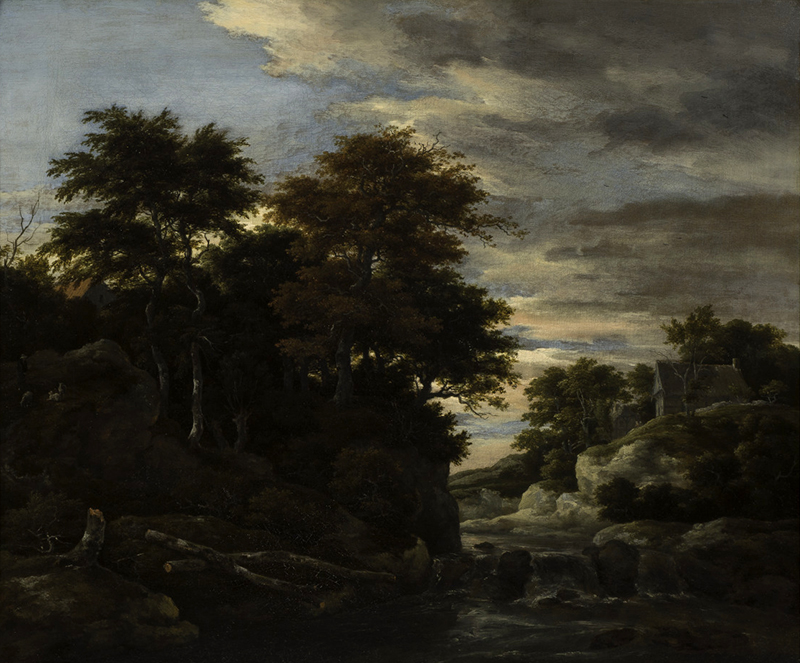
Consider the painting A River Landscape with a Waterfall (1660) by Jacob van Ruisdael (1628-1682).

A River Landscape with a Waterfall (1660) by Jacob van Ruisdael (1628-1682).

Van Ruisdael was considered among the greatest landscape painters of the Dutch Golden Age. While his peers Johannes Vermeer (1632-1675) and Rembrandt (1606-1669) mostly painted people, Van Ruisdael painted scenes of nature.

In A River Landscape with a Waterfall, we see the artist’s work with contrasts. The right side of the painting is illuminated by the setting sun, with a solid house on a hill set under clouds. To the left is dark scene in the shadow of the sun. Broken branches lay on the rocks and a hint of a house protrudes from the standing leafy trees. A barely perceptible person makes his way towards that house before sunset. A stream separates the two sides of the painting with a small waterfall.

This is one of many waterfall paintings by Van Ruisdael during the middle of his life. Of them all, this one is the most serene, with the title’s inclusion of “river” and “waterfall” seemingly an exaggeration of a modest calm landscape.

The story of the painting’s journey to the Phoenix Art Museum where it is exhibited today was anything but calm.

In the mid-1930s, the painting came into the collection of Jacques Goudstikker (1897-1940), a Jewish Dutch art dealer who was among the foremost collectors of Old Master works. When the Germans invaded the Netherlands in May 1940, Nazi military leader Hermann Göring confiscated Goudstikker’s collection. Over the course of the war, Göring is estimated to have amassed over 4,000 works of art. Most of the art was taken from France, including from the Rothschild family. Goudstikker’s collection made up a sizable part of the non-French collection, as he was partial to landscapes and the Old Masters.

Jacques Goudstikker (1897-1940), a Jewish Dutch art dealer

As the war started, Goudstikker fled Holland with his wife and one year old son. They first went to England and then caught a boat to the United States. On the ship to America, Jacques accidentally walked into an open hatch and plummeted to the ground below, dying instantly. His wife and son made it to America without him.

At the end of the war, the Dutch government confiscated the looted Nazi art. Most of the paintings did not find their way back to the rightful owners as there were few notes about the provenance of each work. However, because Goudstikker was a leading arts dealer, he had ledgers with each work, including this Van Ruisdael painting. Despite the clear markings on the back of the painting with Goustikker’s seal, and Goustikker’s wife and family showing records of being the proper owners, the Dutch government would not release the painting to the family until 2002, 57 years later. The family sold the painting in 2007 to a doctor in Phoenix, Arizona who donated it to the Phoenix Art Museum in 2022, where it hangs today.

During World War II, private art collections like Goustikker’s were often seized by the Nazis, while those from public museums were better able to protect the most prized works.

To mark the 80th anniversary of the liberation of the Netherlands, the Mauritshuis public art museum in The Hague is having an exhibition until June 29, 2025 called “Facing the Storm – A Museum in Wartime.” It relays the efforts taken by the museum to hide its most valuable art from the Nazis. As described by the museum, “The exhibition will devote attention to the travels of Vermeer’s Girl with a Pearl Earring during the war. The Mauritshuis had a bombproof ‘art bunker ’ in which it would store all its masterpieces overnight, bringing out a few – including the Girl – during the day…. During the course of the war, the most important works of art were taken to the various ‘National Storage Facilities’, where they remained until the war ended. During this time, the gallery walls at the Mauritshuis were a sorry sight, lined as they were with empty frames.” During some of the public showings during the war, Hitler featured his personal paintings and his book Mein Kampf alongside the museum’s Dutch masters.

Moving paintings from Dutch museum to hide from Nazi theft and bombings

There was a split dynamic between public and private museums as well as viewing art during the day and night during the war in Holland. Private collections were seized and public collections were hidden at night. When collections made it to the light of day, they were used as propaganda for Dutch residents and the enjoyment of Nazi officers who were able to walk the streets freely. Empty frames were like the disappeared Jews of Holland, perhaps hidden away like Anne Frank and her family, or shipped to Nazi concentration camps for liquidation.

Empty frames at the Mauritshuis museum in The Hague, July 1944

The background story and provenance of the Van Ruisdael painting is very much part of viewing the painting today. The pastoral scene of light and darkness owned by a Dutch Jewish family on the eve of World War II was seized – and enjoyed – by Nazi criminals. After the defeat of the Nazis, the Dutch government held onto the artwork and would not return it to the Jewish family which had to flea across the ocean to survive the Holocaust, even as the man who owned the painting did not survive.

To view the painting with such knowledge, the stream becomes an ocean which the Goudstikker family crossed to save themselves. They left their open, illuminated and public house on a hill for an unknown future. Indeed, Jacques’ untimely death during the journey is like the broken branches in the foreground of the painting.

The home and art the Goudstikkers left behind became a showcase for Nazi propaganda, like the house on the right side of the painting enjoying the full setting sun and completely exposed to the world. The dark left side of the painting are the works of art and the Jews of Holland who were hidden and transported to death camps, or perhaps they were lucky to leave the war early like the Goudstikkers, attempting to find a new uncertain home across the ocean. And even when they made it safely to the other side, did they get to enjoy their freedom, or were they fighting for their basic rights and property, such as against the Dutch government who would not surrender their art?

A painting made in the 17th century can be understood anew hundreds of years later because of its provenance. Journeys can shape the subject.

That is most certainly true of Jews, especially on Passover.

Passover Seder As Seen By A Guest

It is a tradition for hundreds, if not thousands of years to invite someone to a Passover seder. Inviting a guest unfamiliar with the story of the Jewish Exodus from Egypt over 3,000 years ago – especially for meals that do not have any children present – provides an opportunity to tell the story of the Jewish journey from slavery to freedom, and from Egypt to the Jewish Promised Land.

The seder uses a Haggadah, a standard text used by Jews around the world, which not only discusses the Exodus, but prior generations telling the story of the Exodus on Passover. The seder is both a story FROM 3,000 years ago at the point of origination, as well as the journey of that story over the intervening years until today.

The guest at the seder is not only learning about ancient Jewish history but seeing and hearing the provenance of that history.

A person can read the bible at any time of year to get a clinical understanding of the Exodus from Egypt. However, to sit at a seder is to see the redemption of Jews in a new light, incorporating the journeys they have taken over the centuries.

The story of the Exodus and the journey of Jews for millenia are too remarkable to ignore. Viewing both simultaneously is the magic of Passover, a gift for everyone attending a seder.

Related articles:

When Our History Begins (December 2022)

The Haggadah as Touchstone for Harmony (April 2022)

Prayer of The Common Man, From Ancient Egypt to Modern Israel (January 2021)

The Jews of Jerusalem In Situ (April 2019)

The Beautiful and Bad Images in Barcelona (March 2019)

Delivery of the Fictional Palestinian Keys (May 2015)

My Big Fat Passover Program

A satire.

I was excited to head out to the Passover program with my family this year. I had done extensive research on six WhatsApp and Facebook groups devoted to the subject with thousands of nit-picky Jews from around the world just like me over the prior five months. My choice was carefully balanced between nice hotel and physical facilities, good food, and whether I cared more about talented speakers, mixed swimming or a relatively cheap price.

Programs can generally be lumped into three groups: those under 250 people; 250 to 600 people; and a bazillion people. The tinier programs tend to get small families and Europeans, while the enormous programs get the nouveau riche who bring twenty-seven kinsman and a nanny. We opted for the middle one, assuming a Goldilocks outcome.

My cheap (prefers “frugal”) spouse insisted on taking two flights to get to our destination, to save a total of $400 for a family of five, on a program that cost in excess of $80,000. While he said the extra four hours of travel time were about principle, I’m sure he figured it would keep my mother from joining us, who could never manage the transfer in a large airport, thus avoiding both needing to pay for her and having her company for ten days.

Fortunately, only one suitcase went missing on our arrival, with all of one son’s yom tov clothing. He managed to get by with loaners from a friend on the program, who was only two sizes larger than my 20-year-old. He’s “in the freezer” and not dating yet anyway, so looking shlumpy wasn’t a big deal.

We arrived at the hotel to have a young snotty woman wearing a Vasser shirt tell my other son that she was triggered by his “NYPD” T-shirt, and demanded that he change it immediately. He laughed at her and told her to “go to a woke non-Orthodox program next time.”

Not a great start.

Our rooms were pretty nice with ocean views, but our three adult children with nine large pieces of luggage could barely fit into their shared room. We had opted to not splurge for a third room, in a ridiculous approach of pretending we weren’t spoiling our kids rotten.

By the time everyone unpacked and showered, there was very little time to call family members at other programs around the world. I opted to just post a quick family pic on the broader family’s WhatsApp. Everyone else did the same, including my brother who was unhappily at home with his in-laws, who posted a GIF of a young boy crying.

The boys ran off to minyan while the women followed a comfortable 30 minutes later to not appear too frum. The boys used the opposite approach, tucking four sefarim under each arm to “frum signal” to other bochrim on the program. Personally, I thought the white shirt, dark suit and 4-foot long tzisit dragging behind them was sufficient but I’m old school.

The Ashkenazi and Sefardi minyanim both started at the same time, with about the same number of people, however the Ashkenazis got the ballroom while the Mizrahis only got to pray in the hallway. Quite a strike in a program hosted in an Arab country, native to many of the yet-again-abused Jews.

The men looked for someone to talk to about the minyan situation, only to discover that there was no one from the program operator on premise for the first days of yom tov, presumably attempting to avoid yenching Jews. In any event, it sorted itself out, as both groups were ultimately placed in small windowless rooms, and the Sefardi minyan shrank in size as many people abandoned the long atonal davening of their Mizrahi brothers and joined the Ashki crowd. Little did they know that the Ashkenazi minyan had been taken over by a group of Five Towns’ guys who only gave aliyahs to friends and family. Worse still, the American and French families who had made aliyah let their small kids run around like lunatics, seemingly preparing them for a future of hooliganism.

The food on the program was great. If only the people treated the seder and meals with a modicum of respect.

We entered the dining room to see a woman throwing a fit, tossing platters of food to the ground when she found out that the program wasn’t gebrochts. Men stalked the buffet with full plates of lamb and steak in each hand, and then asked the Muslim waiters – who had fasted all day for Ramadan – to bring them burgers and fries without a second thought. Concurrently, two American mothers stormed the kitchen demanding that their kids are the most special, and needed white meat chicken without salt, and dessert that contained no chocolate, nuts or gluten. ASAP.

We made the mistake of taking our food before finding our table. Carrying full plates, we had to walk back to the entrance to look up our table number, an astonishing #86. The high number wasn’t the issue; we were trying to figure out the logic as the prior highest number was 44, a bizarre gap. Worse, the table numbers in the dining room were completely random with absolutely no order or logic. Even more curious, table #86 didn’t exist. We ended up grabbing an empty table next to the kitchen entrance to enjoy the incessant flow of dozens of waiters shuttling back-and-forth with plates and food, overwhelmed by the hungry Jews who remarkably ate every two hours.

Things slowed down to a normal pace after the first day, with relatively few outbursts. The “Vasser woman” switched to a PETA shirt for the remainder of the chag, alternately yelling about the 200-pound tuna flopped near the barbeque which was carved up each meal, and the seventy foot-long buffet of charred animal meat. One girl complained to management that she saw a swastika design in one of the carpets, while a few boys got into a mild fight about whether Shraga is a real yeshiva. Yet no one complained about the small children who kept playing in the lobby fountain, kicking the spotlights to squeals of delight, waiting to get electrocuted.

Two hundred pound tuna to be carved up for barbeque

The Israelis celebrated a single day of yom tov even though they left the holy land at precisely the time they are supposed to be there. One Israeli woman with fake breasts that looked like goiters if her gigantic botoxed lips had not lowered them into correct orbit, brought her kids horseback riding, not pondering the strange small gold hamsa hand dangling between her legs from a chain around her waist. I wasn’t sure if she was proclaiming abstinence or complaining about the effects of the ride.

The prayers were short and unmelodious. While the large programs hire talented chazanim, the smaller ones get men who claim they have yorzeit for their mothers-in-law and torture the prayers in their memory. Shir HaShirim was completed in 300 seconds to a round of high fives. Even at breakneck speed, davening always seemed to end five minutes after breakfast closed down. For the evening services, the self-anointed gabbaim, who showed up to every minyan twenty minutes late, shouted with the authority of geonim about the right time to recite the omer, seemingly based on nothing more than it was a few minutes later than the last screamer.

While the Facebook groups had daily photos of program dinners from around the world, my spouse kvetched about breakfast which no Jews seemed to care about. One complaint was regarding the lack of the ultimate yin yang Pesach food, something which is both the opposite and complementary at the same time: chocolate covered matzah, which reenacts the battle scenes of the movie “300” in Jewish intestines. The hotel must have been familiar with the dietary ramifications of the holiday, as every room attendant had a toilet plunger in a holster.

One group of guys took no chances on the program’s kiddush and shlepped their own to the resort: tequila and foie gras from Europe. As they sliced the gelatinous mound onto Pesadic crackers, I didn’t have the heart to tell them that the expiration date on the goose liver was 18 months earlier. Perhaps I secretly wanted the Vasser girl to claim a small victory.

A friend on the program let me in on an observation both too early and too late: the busboys were only rubbing the dirt off the cutlery and not washing it. I found myself drinking soup straight out of the bowls and eating fruit by hand during the second days.

During chol hamoed, some people went on group tours while others hired their own guides – to do the exact same tours as the rest of the group at five times the price. Still others stayed on premises and attempted to poach workers to bring back to the United States for new help.

In all, we had a great trip that cost roughly five percent of the country’s GDP. My family around the world also enjoyed their programs seemingly more than people’s posts on WhatsApp and Facebook groups would suggest. My sibling who stayed home with in laws was glad it was over and that no one fell down (or needed medical attention!)

While the tradition of saying “Next year in Jerusalem” concludes each seder, I wonder whether people ended the holidays saying “next year I’ll find a program where I can do something to get a Passover trip for free.”

Related article:

Chag Kasher v. Sa’meach

Related videos:

Choosing a Pesach Program

Passover in the Office

Transitions, Juxtapositions and the Night of the Exodus

“O Fortune,
like the moon
you are changeable,
ever waxing,
ever waning,
hateful life
first oppresses
and then soothes
as fancy takes it;”

opening of “O Fortuna” from Carmina Burana

This 13th century Latin poem was put to music by Carl Orff in 1935-6. It describes fate as an ever “whirling wheel” in which a person goes through life with ups and downs.  The pace of the rise and fall is unclear, but presumably happens over time as the wheel slowly rotates.

There are, however, moments in time when two competing realities exist side-by-side. A woman may be pregnant one second and a mother the next. The transition lasts for a moment.

There are also situations when a transition is not only defined by time but by space. A person can be inside a house and then outside. A simple threshold is crossed to change not only location but situation.

In rare situations, alternative realities are neither separated nor juxtaposed, but twist and fold upon each other. Such is the Night of the Exodus and the first night of Passover.

The Night of the Exodus

On the night of last plague on Egypt, the killing of the first born, the Jews were commanded to take a lamb, slaughter it, paint its blood on the doorposts of the home, then roast the lamb and devour every morsel.

The lamb was considered a deity in ancient Egypt. Killing it, roasting it and displaying its blood on the outside of the homes was designed as a clear affront to Egyptian sensibilities. They could smell the roasting of the meat and see how the Jews enjoyed sticking their faces in it.

Remarkably, the Jews did this while still slaves. They were still in Egypt and not yet free as they feasted and killed the Gods of their masters. They took liberties associated with free folk, pulling their future freedom into the moment of slavery. These choreographed actions helped transform their mental state from one of servants to masters. When God said “And the blood on the houses where you are staying shall be a sign for you,” (Exodus 12: 13) it was truly designed as a way for the slaves to break the orientation of servitude.

Every generation afterwards was also commanded to remember that remarkable night – to place themselves as if they were there thousands of years ago – making that transformation at the Seder, holding the matzah, the bread of slavery, together with the pascal lamb, the symbol of salvation. Holding both items together serves as a vehicle to transform time, space and mental state, just as Jewish ancestor did long ago.

The Seder

The Passover Hagaddah captures the essence of these curious juxtapositions and transformations at the beginning of the Magid section with a short paragraph called Ha Lachma Anya.

This is the bread of affliction that our ancestors ate in the land of Egypt.

Taken literally, each person at the Seder is facing a fossil, a 3,300-year old object. Perhaps more incredible, this item from antiquities is actually connected to relatives who lived far way (time AND place) in Egypt. On this special night we display a family heirloom.

All those who are hungry, let them enter and eat.

Based on the juxtaposition of the sentences it would appear that we are going to eat this precious piece of history. While we may be a tad hungry, it seems inappropriate to eat something irreplaceable.

All who are in need, let them come celebrate Passover.

This sentence seemingly addresses the whole world. As food is the cure for hunger, Passover must be the remedy for “need.” It is unclear whether the needs are physical – like food for hunger – mental, spiritual or emotional. Perhaps celebrating Passover helps them all.

Now we are here, next year in the land of Israel.

The paragraph pivots again. After two invitations for people to participate in the meal and holiday, there is a declaration that we will celebrate next Passover in Israel. Presumably, this is for all of the people who we just invited to sit down with us, to celebrate together in Israel.

This year we are enslaved, next year we will be free.

Another interesting juxtaposition of sentences of here versus next year. Does this suggest that we are here now and enslaved and next year we will be free and in Israel? Or, should we rethink the entire discussion: are we reciting words that are thousands of years old, just as we point to matzahs of our ancestors? This entire scene is a reenactment of the last night in Egypt, when Jews were on the threshold of freedom, on their journey to the land of Israel.


The first night of Passover we do not simply imagine lives as slaves in Egypt nor our freedom that we have today. We reenact that pivotal moment of transforming ourselves in time, place and mental health which happened on the last night in Egypt, when we jumped forward and feasted and imagined life in the promised land, even while anchored in the reality of slavery.

Like no other year in over 3,000 years, with a pandemic upon us with many mourning departed loved ones and spending Seders in solitude, let us all say Ha Lachma Anya and pull forward that future of freedom to live full lives in the complete Jerusalem.


Related First One Through articles:

A Plague for Others

Ruth, The Completed Jew

Taking the Active Steps Towards Salvation

Subscribe YouTube channel: FirstOneThrough

Join Facebook group: Israel Analysis and FirstOneThrough


A Plague for Others

When Covid-19 first began killing people in China it felt like a disease far away, a distant threat so remote it did not register. When it later arrived in Iran, the focus became the curious relationship between China and Iran, not that the disease was going global. Then it came to Italy, and just a short time later it was in almost every country.

Yet even as the virus found local victims, people chose to manufacture distance. This was only deadly for the elderly. It killed those with compromised health. There was no true need to worry, as the vast majority of people who tested positive for the coronavirus suffered from a mere cold.

That attitude was best captured in an interview with a teenager enjoying spring break in Florida “If I get corona, I get corona. I’m not going to let it stop me from partying.

This was a plague for “others” and the guidelines calling for “social-distancing” was not relevant for them.

It is something to consider during this holiday of Passover, when plagues came for the Egyptians.

The Quarantine of Goshen

The story of the plagues which helped free the Jews from slavery in Egypt 3,300 years ago had two parts: the first nine plagues and the final one.

During the initial plagues, the land, animals and people of Egypt were attacked broadly with a variety of vermin and afflictions, except for the Jews as God protected them. However, for the final plague, the killing of the first born, the Jews were asked to take specific actions to facilitate their protection. They were to take a lamb, paint its blood on the doorposts of the house, roast the lamb and eat it; a slew of activities which were unnecessary for the first nine plagues. Clearly God was capable of inflecting a plague on segments of the population as He had done nine times before but for the final plague, God wanted the Jews to take a part in their own salvation.

The story of the tenth plague unfolds in three parts. First, Moses addressed Pharaoh in Exodus 11: 4-8 saying that God will kill every first-born in Egypt except for the Jews “in order that you may know that the LORD makes a distinction between Egypt and Israel.” This plague was specifically designed to highlight the “other.” All people are not the same and will not be impacted the same way.

But the story and message seem to morph. In Exodus 12: 1-20 God addressed the Jews through Moses and Aaron with a detailed plan of the various steps the Jews needed to take during their last night in Egypt, and it wasn’t so much about how to pack. Tucked among the twenty sentences was a critical line “And the blood on the houses where you are staying shall be a sign for you: when I see the blood I will pass over you, so that no plague will destroy you when I strike the land of Egypt.” The key to avoiding the impact of the plague is “blood on the houses,” an item that was mentioned in passing six sentences earlier as part of a long list of things to do.

God had gone from not asking the Jews to do anything during the first nine plagues, to putting forth a long list of tasks, one of which was – incidentally – key to avoiding the impact of the plague.

In the third part of the revelation of the tenth plague, Moses addressed the Elders in Exodus 12: 21-27 and provided a much more direct plan for salvation: “Take a bunch of hyssop, dip it in the blood that is in the basin, and apply some of the blood that is in the basin to the lintel and to the two doorposts. None of you shall go outside the door of his house until morning. For when the LORD goes through to smite the Egyptians, He will see the blood on the lintel and the two doorposts, and the LORD will pass over the door and not let the Destroyer enter and smite your home.” Moses went to the crux of the matter to get the people to focus, directly connecting the blood on the doorposts to salvation. He also elaborated on God’s command telling people to stay inside – to self-quarantine – during the deadly plague.

The story of the deadly plague evolved in a curious fashion. At first Moses told Pharaoh that the plague will be very selective – it will only come for the first-born and only from Egyptians, because “the LORD makes a distinction between Egypt and Israel.” God sees that the people of Egypt and Israel are different and will act accordingly.

But it becomes less clear that this is actually true. God doesn’t seemingly recognize any difference as He asks the Jews to paint the outside of their homes with blood. It is the home markings that God sees. If Jews wandered the streets that night, they would presumably have died, which is why Moses clarified that no one should leave their houses. The distinction between Egyptians and Israelites that Moses discussed with Pharaoh was one of direction, not of personhood.

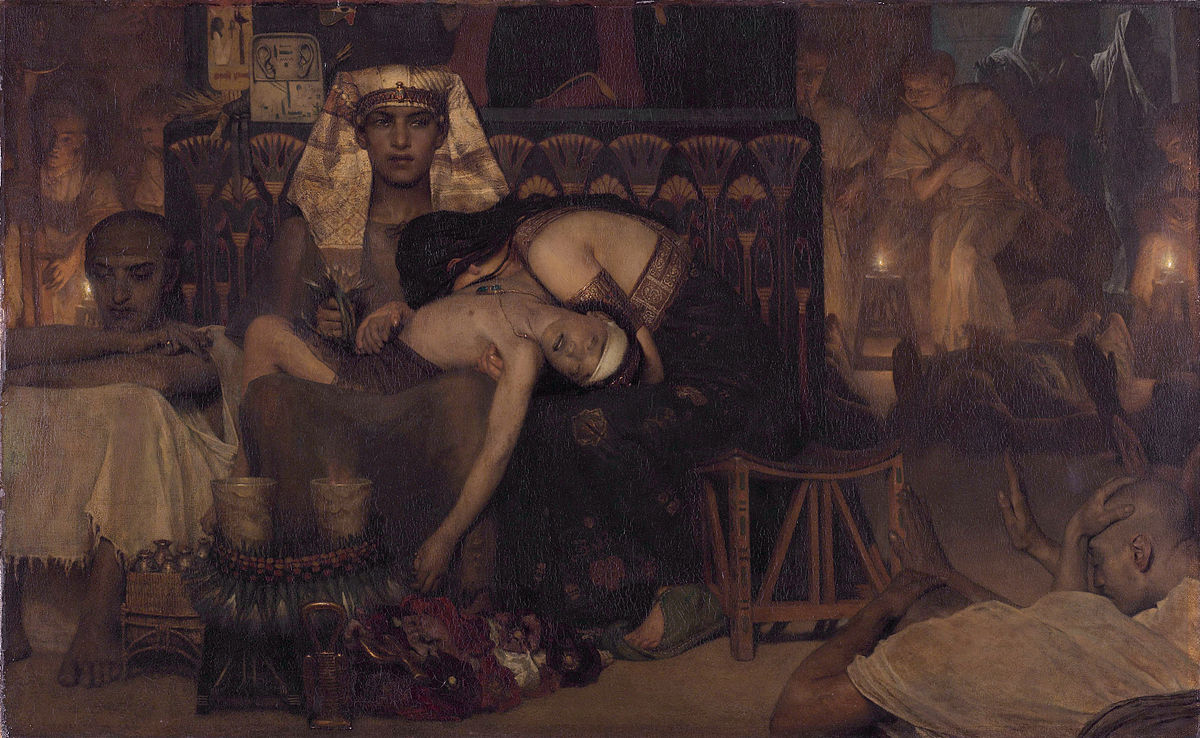
“Death of Pharaoh’s First Born” painted 1872 by Lawrence Alma -Tadema (1836-1912)

Plagues and deadly viruses may present as threats for “others” but that is delusional. Neither youth nor religion will serve as shield, and leaders as far back as Moses understood that directing people to self-quarantine in their homes is the best precaution.


Related First One Through articles:

Taking the Active Steps Towards Salvation

The CoronavirUS is Not Us Versus Them

Defeating Haman’s Big Ten Sons and Modern Antisemitism

Kohelet, An Ode to Abel

Ruth, The Completed Jew

A Sofer at the Kotel

Subscribe YouTube channel: FirstOneThrough

Join Facebook group: Israel Analysis and FirstOneThrough

Taking the Active Steps Towards Salvation

For many people, the favorite part of the Passover prayers is the Torah reading on the seventh day of the holiday.

The song “Az Yashir,” (the Song of the Sea), is a celebratory hymn that the Jews sang after they crossed through the Reed Sea safely and watched the Egyptian army drown. It is recited from the Torah in a unique melody compared to every other reading during the year, and it is the only time that the entire congregation stands for Torah-reading, other than the recitation of the Ten Commandments and the conclusion of each of the five books.

Just as the Haggadah that was read on the first night of Passover directs us to “show himself as if he had left Egypt,” everyone in the synagogue does not simply sit and listen to the words of the Torah, but takes an active step of standing while they listen to the song.

וּבְכָל דּוֹר וָדוֹר, חַיָּב אָדָם לְהַרְאוֹת אֶת עַצְמוֹ כְּאִלּוּ הוּא יָצָא מִמִּצְרַיִם, שֶׁלֹּא אֶת אֲבוֹתֵינוּ בִּלְבָד גָּאַל, אֵלָא אַף אוֹתָנוּ גָּאַל–שֶׁנֶּאֱמָר “וְאוֹתָנוּ, הוֹצִיא מִשָּׁם–לְמַעַן, הָבִיא אֹתָנוּ, לָתֶת לָנוּ אֶת-הָאָרֶץ, אֲשֶׁר נִשְׁבַּע לַאֲבֹתֵינוּ” (דברים ו,כג. In every generation, a person is obligated to show himself as if he had left Egypt:  for He did not redeem only our ancestors, but even us as well, as it is written “And He brought us out from thence, that He might bring us in, to give us the land which He swore unto our fathers” (Deuteronomy 6:23).

The participation of standing for the song is communal today, just as the song was sung by the entire congregation over 3,000 years ago.

א  אָז יָשִׁיר-מֹשֶׁה וּבְנֵי יִשְׂרָאֵל אֶת-הַשִּׁירָה הַזֹּאת, לַיהוָה, וַיֹּאמְרוּ,  {ר}  לֵאמֹר:  {ס}  אָשִׁירָה לַיהוָה כִּי-גָאֹה גָּאָה,  {ס}  סוּס  {ר}  וְרֹכְבוֹ רָמָה בַיָּם.  {ס} Exodus 15:1 Then sang Moses and the children of Israel this song unto the LORD, and spoke, saying: I will sing unto the LORD, for He is highly exalted; the horse and his rider hath He thrown into the sea.

The fact that the Jews were appreciative for their salvation is understandable, but also shocking that such emotion appears during this Song of the Sea for the first time in the bible. Throughout the story of the ten plagues and leaving Egypt, all the way until the shores of the Reed Sea, the Jews mostly complained to Moses; they certainly did not say ‘thank you’ to him nor exalt God.

11 Then they said to Moses, “Is it because there were no graves in Egypt that you have taken us away to die in the wilderness? Why have you dealt with us in this way, bringing us out of Egypt? 12 Is this not the word that we spoke to you in Egypt, saying, Leave us alone that we may serve the Egyptians? For it would have been better for us to serve the Egyptians than to die in the wilderness. (Exodus 14:11-12)

The constant actions of Moses during the story were in contrast to the persistent inaction of the Children of Israel. The Jews were content to stay where they were, to have all of their basic needs taken care of for them, whether food to eat or graves in which to be buried. The Jews were as much physical slaves to the Egyptians as they were to their own complacency. They had accepted their misery, and angry that Moses had the temerity to break the status quo.


The Crossing of the Red Sea
by Nicolas Poussin (1594-1665)

I will suggest here that the Song by the Sea was the third and pivotal step in the Jewish people taking action to break the weight of inertia and achieving salvation; not just freedom beyond the borders of Egypt, but of the slave mentality as well.

The First Steps: The Tenth Plague

The streak was on.

Nine times in a row, God had brought a plague onto the Egyptian people. In chapter after chapter, the bible recounts how God inflicted pain on land and sea, on animals and fields, yet all of the while, the Jews were in a protective bubble. They were not impacted by the plagues nor asked to participate in any way.

But at the announcement of the final tenth plague, the bible tells us that it was time for the Jewish people to take action.

וַיֹּ֨אמֶר יְהוָ֜ה אֶל־מֹשֶׁ֗ה ע֣וֹד נֶ֤גַע אֶחָד֙ אָבִ֤יא עַל־פַּרְעֹה֙ וְעַל־מִצְרַ֔יִם אַֽחֲרֵי־כֵ֕ן יְשַׁלַּ֥ח אֶתְכֶ֖ם מִזֶּ֑ה כְּשַׁ֨לְּח֔וֹ כָּלָ֕ה גָּרֵ֛שׁ יְגָרֵ֥שׁ אֶתְכֶ֖ם מִזֶּֽה׃ דַּבֶּר־נָ֖א בְּאָזְנֵ֣י הָעָ֑ם וְיִשְׁאֲל֞וּ אִ֣ישׁ ׀ מֵאֵ֣ת רֵעֵ֗הוּ וְאִשָּׁה֙ מֵאֵ֣ת רְעוּתָ֔הּ כְּלֵי־כֶ֖סֶף וּכְלֵ֥י זָהָֽב׃ וַיִּתֵּ֧ן יְהוָ֛ה אֶת־חֵ֥ן הָעָ֖ם בְּעֵינֵ֣י מִצְרָ֑יִם גַּ֣ם ׀ הָאִ֣ישׁ מֹשֶׁ֗ה גָּד֤וֹל מְאֹד֙ בְּאֶ֣רֶץ מִצְרַ֔יִם בְּעֵינֵ֥י עַבְדֵֽי־פַרְעֹ֖ה וּבְעֵינֵ֥י הָעָֽם׃

And the LORD said to Moses, “I will bring but one more plague upon Pharaoh and upon Egypt; after that he shall let you go from here; indeed, when he lets you go, he will drive you out of here one and all.  Tell the people to borrow, each man from his neighbor and each woman from hers, objects of silver and gold.” The LORD disposed the Egyptians favorably toward the people. Moreover, Moses himself was much esteemed in the land of Egypt, among Pharaoh’s courtiers and among the people. (Exodus 11:1-3)

If God was able to do everything on behalf of the Jewish people, why did He want them to take the jewels of the Egyptians? He could have just given the Jews riches or transferred the wealth to the Jews.

God knew that the Jews had a complacent mindset after hundreds of years of slavery. He needed them to break free of that inertia and confront their oppressors. To do that, He commanded the Jewish people to stand up and take back the wages and goods that had been taken from them while they worked as slaves for so long. Step 1: confront the oppressor.

Yet the single step would not be enough to earn redemption nor break the psychology of slavery, so God commanded the Jews to take additional action.

Speak ye unto all the congregation of Israel, saying, In the tenth day of this month they shall take to them every man a lamb, according to the house of their fathers, a lamb for an house: And if the household be too little for the lamb, let him and his neighbour next unto his house take it according to the number of the souls; every man according to his eating shall make your count for the lamb. Your lamb shall be without blemish, a male of the first year: ye shall take it out from the sheep, or from the goats: And ye shall keep it up until the fourteenth day of the same month: and the whole assembly of the congregation of Israel shall kill it in the evening. And they shall take of the blood, and strike it on the two side posts and on the upper door post of the houses, wherein they shall eat itAnd they shall eat the flesh in that night, roast with fire, and unleavened bread; and with bitter herbs they shall eat it. Eat not of it raw, nor sodden at all with water, but roast with fire; his head with his legs, and with the purtenance thereof. 10 And ye shall let nothing of it remain until the morning; and that which remaineth of it until the morning ye shall burn with fire. 11 And thus shall ye eat it; with your loins girded, your shoes on your feet, and your staff in your hand; and ye shall eat it in haste: it is the Lord‘s passover. 12 For I will pass through the land of Egypt this night, and will smite all the firstborn in the land of Egypt, both man and beast; and against all the gods of Egypt I will execute judgment: I am the Lord13 And the blood shall be to you for a token upon the houses where ye are: and when I see the blood, I will pass over you, and the plague shall not be upon you to destroy you, when I smite the land of Egypt. 14 And this day shall be unto you for a memorial; and ye shall keep it a feast to the Lord throughout your generations; ye shall keep it a feast by an ordinance for ever. (Exodus 12: 3-14)

God commanded the Jews to do something out-of-the-ordinary. Each family was to take a lamb into their houses for three days, and then slaughter it and paint its blood onto the outside doorposts of the house while they devoured the roasted meat throughout the night. Quite a bizarre farewell to Egypt.

Some biblical commentators believed that sheep were sacred to the Egyptians and that slaughtering them and painting their blood onto the outside of the house and eating them was a detestable offense to the Egyptians. If so, this action would be a continuation of the first step above: confront your enemy first by taking physical goods (jewels), and then by destroying their spiritual world (sacred sheep).

But the text reads differently. The bible writes that the blood is for God to see (“when I see the blood”), not the Egyptians. The blood on the doorways is therefore not designed as an insult to the Egyptians, but an act of affirmation that the Jews believed in God, and that God will protect them. For nine plagues God protected the Jews without their active participation, but for the final plague, the Jews needed to participate in their salvation. Step 2: show your belief.

The Next Step: Entering the Sea

The communal belief was short lived. As described above, the Jews quickly reverted to their old habits as they verbally attacked Moses for bringing them out of Egypt to face death at the hands of the Egyptian army at the shore of the Reed Sea.

And Moses similarly fell into the old trap of assuming that God would do everything for His people and called out:

וַיֹּ֨אמֶר מֹשֶׁ֣ה אֶל־הָעָם֮ אַל־תִּירָאוּ֒ הִֽתְיַצְב֗וּ וּרְאוּ֙ אֶת־יְשׁוּעַ֣ת יְהוָ֔ה אֲשֶׁר־יַעֲשֶׂ֥ה לָכֶ֖ם הַיּ֑וֹם כִּ֗י אֲשֶׁ֨ר רְאִיתֶ֤ם אֶת־מִצְרַ֙יִם֙ הַיּ֔וֹם לֹ֥א תֹסִ֛יפוּ לִרְאֹתָ֥ם ע֖וֹד עַד־עוֹלָֽם׃

יְהוָ֖ה יִלָּחֵ֣ם לָכֶ֑ם וְאַתֶּ֖ם תַּחֲרִישֽׁוּן׃

But Moses said to the people, “Have no fear! Stand by, and witness the deliverance which the LORD will work for you today; for the Egyptians whom you see today you will never see again. The LORD will battle for you; you hold your peace!” (Exodus 14:13-14)

Moses tried to allay the fear of the Jews and told them to sit back and watch God save them. But God was not pleased with the words of Moses.

The drama of the story is heightened, as the Torah reading takes a pause just after Moses makes his declaration. When the Torah reader takes up the reading again at the next aliyah, we imagine that the dramatic splitting of the sea is about to happen. But it doesn’t.

וַיֹּ֤אמֶר יְהוָה֙ אֶל־מֹשֶׁ֔ה מַה־תִּצְעַ֖ק אֵלָ֑י דַּבֵּ֥ר אֶל־בְּנֵי־יִשְׂרָאֵ֖ל וְיִסָּֽעוּ׃

Then the LORD said to Moses, “Why do you cry out to Me? Tell the Israelites to go forward. (Exodus 14:15)

God surprisingly questions Moses proclamation and instead calls for the Jewish people to literally take the next steps forward in another act of redemption.

The Midrash says that the Jewish people were frightened and reluctant to march ahead. But a prince from the tribe of Judah, Nachshon ben Aminadav stepped into the sea undeterred, and the waters finally split and saved him from drowning (Sotah 37a).

Nachshon’s actions can be viewed as a continuation of the important second step: show your belief, as an individual. Do not be lulled into the prevalent community attitude of letting the leaders or someone else take action. Do not sit and wait, as even a solitary person’s actions, coupled with a leader’s (Moses) prayers to realize God’s vision, can help redeem everyone.

Rabbi Aaron Kampf of Manchester, England balances the notion of individual action versus the will of God. In recounting the story of Queen Esther, Rabbi Kampf notes that Esther’s uncle charged her to speak up on behalf of the Jewish people to the king.

יג  וַיֹּאמֶר מָרְדֳּכַי, לְהָשִׁיב אֶל-אֶסְתֵּר:  אַל-תְּדַמִּי בְנַפְשֵׁךְ, לְהִמָּלֵט בֵּית-הַמֶּלֶךְ מִכָּל-הַיְּהוּדִים. Megillat Esther Chapter 4: 13 Then Mordecai bade them to return answer unto Esther: ‘Think not with thyself that thou shalt escape in the king’s house, more than all the Jews.
יד  כִּי אִם-הַחֲרֵשׁ תַּחֲרִישִׁי, בָּעֵת הַזֹּאת–רֶוַח וְהַצָּלָה יַעֲמוֹד לַיְּהוּדִים מִמָּקוֹם אַחֵר, וְאַתְּ וּבֵית-אָבִיךְ תֹּאבֵדוּ; וּמִי יוֹדֵעַ–אִם-לְעֵת כָּזֹאת, הִגַּעַתְּ לַמַּלְכוּת. 14 For if thou altogether holdest thy peace at this time, then will relief and deliverance arise to the Jews from another place, but thou and thy father’s house will perish; and who knoweth whether thou art not come to royal estate for such a time as this?’

The speech that Mordecai gave to Esther was not a pep talk of “you can do it; we’re all counting on you!” but one of humility. God has a plan, and you can either play or part or disappear into history because salvation will come from somewhere else.

An individual’s action will become successful or unsuccessful based on the will of God. A person should not be so self-centered as to believe that they alone can change the world. But as Rabbi Tarfon says in Pirkei Avot 2:16:

לֹא עָלֶיךָ הַמְּלָאכָה לִגְמֹר, וְלֹא אַתָּה בֶן חוֹרִין לִבָּטֵל מִמֶּנָּה

You are not expected to complete the task, but neither are you free to avoid it.

A person must be involved and take actions in partnership with God.

The Final Step: Gratitude

The Jews were finally free of the physical and mental slavery when they sang “Az Yashir” on the other side of the sea. They had confronted their enemies and showed their belief in God. They witnessed their Egyptian masters completely defeated.

However, one more step was required to become free: the expression of gratitude.

The actions that the Jewish people had taken in their salvation were all commanded by God: take the jewels; slaughter the lamb; paint the doorposts; move forward; etc. In many ways, the Jews had traded masters: the Egyptian taskmaster for God.

But on the safe dry ground they understood that the calls of complaints to their leader Moses were empty. Those were not steps forward but merely instinctive reactions, animalistic. Now, they decided for themselves to thank God.

Noble peace prize winner Elie Wiesel believed deeply in the action of expressing gratitude. He believed that gratitude was the ultimate expression of humanity:

“Gratitude is a word that I cherish.
Gratitude is what defines the humanity of the human being.
No one is as capable of expressing gratitude as one who has escaped the kingdom of night.”

And as the Children of Israel and Moses sang in unison about their gratitude to God, the transformation of a people was realized. They no longer were physically or mentally constrained by the will of Egyptian masters, broken of free will like cattle. They were on their way to participate actively in the teachings of their God and the God of their fathers.

Rabbi Meir Soloveitchik wrote: “While not all are loved by God in the same way, we are all held accountable for our actions, and are rewarded for a life well lived.” (Azure No. 19, “God’s Beloved: A Defense of Choseness“)’ Our ability to confront the wrongs, to demonstrate our faith and to be thankful for God’s gifts are key ingredients to the story of Passover and how we live our lives.


Related First.One.Through articles:

Shabbat Hagadol at the Third Hurva Synagogue, 2010

A Seder in Jerusalem with Liberal Friends

Subscribe YouTube channel: FirstOneThrough

Join Facebook group: FirstOne Through Israel Analysis

A Seder in Jerusalem with Liberal Friends

I am “right-of-center” when it comes to politics about Israel. I firmly believe that Israel has unquestioned legal, moral and historic right to live as a free, independent, democratic Jewish state, and that the borders of such state should include the holiest city for Jews, the united city of Jerusalem as its capital for the previous reasons, as well as based on fundamental security needs.

This year, I had the fortune of celebrating my Peach seder in Jerusalem. My hosts were liberal friends that believe that the eastern part of the city – a few hundred feet from where we ate the festive dinner – should become the capital of a new state of Palestine. I was not sure how this fact would impact the seder: how would the meal remain a celebration and educational for the dozen children, while not ignoring the momentous 50-year jubilee of the united city without a contentious debate?

The Community Obligation

I tried to stay on safe ground.

Before Pesach each year, I purchase a new Haggadah to share some new thoughts at the seder. Knowing of the attendees at this year’s meal, I decided to buy Erica Brown’s “Seder Talk,” as I considered that her essays would appeal to the more progressive crowd (compared to past year selections of R. Soloveitchik, R. Lamm, Lord Sachs, Sfas Emes among others).

One of Brown’s essays discussed the basis for the seder’s “Four Sons.” She considered that the bible wrote in four different places the need to educate one’s children about the exodus from Egypt, and each mention correlated to a different type of child:

  • Exodus 12:26-27: And when your children ask you “What is this service to you?” you will say, “It is a Pesach offering for the Lord, for He passed over the houses of the Children of Israel in Egypt while He struck the Egyptians, but saved those in our homes.”
  • Exodus 13:8: And you shall explain to your son on that day, “Because of this the Lord acted for me when I came out of Egypt.”
  • Exodus 13:14: And when, in time to come, your son asks you saying, “What is this?” you shall say to him, “With a string hand the Lord brought us out of Egypt, from the grip of slavery.”
  • Deuteronomy 6:20-21: When in time your children ask you, “What re the testimonies, the statutes and laws, that the Lord our God commanded you?” you shall say to your children, “We were slaves to Pharaoh in Egypt and the Lord our God brought us out of there with a strong hand.”

The four different types of children in the Haggadah are the hacham (wise son), the rasha (evil son), the tam (simple son), and the she’eino yo’dea lish’ol (the one that doesn’t know how to ask). Brown wrote that the rabbis believed that the role of the parent is to explain to each child according to that child’s abilities. There are “four different recipients, whose learning needs vary. All must be told the story. All must learn it and be able to transmit it.

Brown continued that the mission to tell the story of the Exodus actually extends beyond parental responsibility. The Jerusalem Talmud used an alternative term for the “tam,” the simpleton, instead calling that son a “tipesh,” a stupid child.  Brown said that “the child of the Jerusalem Talmud is the child with limited mental capacity…. This child is a child of not only the family but of our entire community.” It is not only the responsibility of the parent to educate their own children, but in certain circumstances, it is also the obligation to assist others raising those kids. To make an important adjustment to the words of Hillary Clinton – it does not “take a village” to raise children – it is the responsibility of each parent to rear their own. However, there may be extraordinary circumstances in which the broader community should be involved in educating and raising a child with special needs.

I opted to end my comments there, as the reception at the seder was lukewarm. I do not think I won fans with terms for children of “stupid” and “mentally challenged,” even though the remarks were from Erica Brown herself. Had I continued with some extended thoughts of my own, it would have surely gone downhill.

The Community Declaration

Shortly after the description of the four sons, the Haggadah quotes and analyzes a different selection from the bible.

  • Deuteronomy 26: 5-8: [Then you shall declare before the Lord your God:] “My father was a wandering Aramean, and he went down into Egypt with a few people and lived there and became a great nation, powerful and numerous. But the Egyptians mistreated us and made us suffer, subjecting us to harsh labor.  Then we cried out to the Lord, the God of our ancestors, and the Lord heard our voice and saw our misery, toil and oppression. So the Lord brought us out of Egypt with a mighty hand and an outstretched arm, with great terror and with signs and wonders.

The Haggadah uses many pages to expound on these biblical verses, however, it does not give the context for the long history leading up to the exodus.

This declaration in Deuteronomy is ordered by God at the time of bikurim, the bringing of the first fruits in Jerusalem.

  • Deuteronomy 26: 1-2: When you have entered the land the Lord your God is giving you as an inheritance and have taken possession of it and settled in it,  take some of the firstfruits of all that you produce from the soil of the land the Lord your God is giving you and put them in a basket. Then go to the place the Lord your God will choose as a dwelling for his Name

God demanded that the story of leaving Egypt be repeated in the chosen place of the chosen land for the chosen people: at the Jewish Temple in Jerusalem, in the heart of the Jewish holy land.

Nachmanides (1194-1270), also known as the Ramban considered the rationale of the bikurim commandment. Why would an offering of first fruits in the Jewish Temple be accompanied with the history leaving Egypt?

The Ramban noted that bikurim is ONLY made in public in Jerusalem; such an offering cannot be made on an individual basis. The personal declaration of thanks for the riches of the holy land is made before the entire community. The acknowledgement of the gifts of the holy land began with the exodus from Egypt, and is something that each person must publicly declare while internalizing the message: my gift of fruit is simply a portion of our collective gifts: we are a nation that was collectively brought from Egypt to Jerusalem. The offered fruit is realy the nation’s fruit, just as the freedom from slavery was a national liberation.


The bible and Haggadah are clear in the command to educate one’s own children, and Erica Brown noted the need of the community to also educate other children in the community about our freedom from slavery. We stand as part of the community helping individuals learn the lesson of God’s gifts.

But we also have a need to stand before the community to acknowledge God’s gifts. Those gifts extend beyond our freedom from slavery, to the gift of the holy land and its produce. And that declaration is to be made in Jerusalem on the Jewish Temple Mount.

As left-wing radicals like the New Israel Fund rewrite the Haggadah and eliminate “Next Year in Jerusalem” to “Next Year in Palestine and Israel,” they have rewritten the centrality of God’s gifts and the role of our community. In doing so, have they rejected God’s gift and being part of our community? Or must the community not give up, and teach this wayward son as well?


Related First.One.Thrugh articles:

Here in United Jerusalem’s Jubilee Year

Squeezing Zionism

Today’s Inverted Chanukah: The Holiday of Rights in Jerusalem and Judea and Samaria

Rick Jacobs’ Particular Reform Judaism

The Left-Wing’s Two State Solution: 1.5 States for Arabs, 0.5 for Jews

Subscribe YouTube channel: FirstOneThrough

Join Facebook group: FirstOne Through  Israel Analysis

Here in United Jerusalem’s Jubilee Year

Biblical Command to Come to Jerusalem

There are commandments in the bible that are clear and explicit, while there are others that are deduced by the rabbis. For example, “Do not kill” is easily understood, while the commandment to not eat dairy and meat together was derived by the rabbis from different parts of the bible.

The commandment for Jews to go to Jerusalem three times a year is a combination of both clear and deduced commandments.

1Observe the month of Aviv and celebrate the Passover of the Lord your God, because in the month of Aviv he brought you out of Egypt by night. 2 Sacrifice as the Passover to the Lord your God an animal from your flock or herd at the place the Lord will choose as a dwelling for his Name. 3 Do not eat it with bread made with yeast, but for seven days eat unleavened bread, the bread of affliction, because you left Egypt in haste—so that all the days of your life you may remember the time of your departure from Egypt. 4 Let no yeast be found in your possession in all your land for seven days. Do not let any of the meat you sacrifice on the evening of the first day remain until morning.

5 You must not sacrifice the Passover in any town the Lord your God gives you 6 except in the place he will choose as a dwelling for his Name. There you must sacrifice the Passover in the evening, when the sun goes down, on the anniversary of your departure from Egypt. 7 Roast it and eat it at the place the Lord your God will choose. Then in the morning return to your tents. 8 For six days eat unleavened bread and on the seventh day hold an assembly to the Lord your God and do no work.

Passover in Jerusalem (Deuteronomy 16:1-8)

9 Count off seven weeks from the time you begin to put the sickle to the standing grain. 10 Then celebrate the Festival of Weeks to the Lord your God by giving a freewill offering in proportion to the blessings the Lord your God has given you. 11 And rejoice before the Lord your God at the place he will choose as a dwelling for his Name—you, your sons and daughters, your male and female servants, the Levites in your towns, and the foreigners, the fatherless and the widows living among you. 12 Remember that you were slaves in Egypt, and follow carefully these decrees.

Shavuot in Jerusalem (Deuteronomy 16:9-12)

13 Celebrate the Festival of Tabernacles for seven days after you have gathered the produce of your threshing floor and your winepress. 14 Be joyful at your festival—you, your sons and daughters, your male and female servants, and the Levites, the foreigners, the fatherless and the widows who live in your towns. 15 For seven days celebrate the festival to the Lord your God at the place the Lord will choose. For the Lord your God will bless you in all your harvest and in all the work of your hands, and your joy will be complete.

Sukkot in Jerusalem (Deuteronomy 16:13-15)

16 Three times a year all your men must appear before the Lord your God at the place he will choose: at the Festival of Unleavened Bread, the Festival of Weeks and the Festival of Tabernacles. No one should appear before the Lord empty-handed: 17 Each of you must bring a gift in proportion to the way the Lord your God has blessed you.

Passover, Shavuot and Sukkot in Jerusalem (Deuteronomy 16:16-17)

There is no question that God commanded Jews to make a pilgrimage three times a year to “the place He will choose.” However, that place was not clearly specified by God and changed over time.

When Jews emerged from Egypt and came back to the holy land roughly 3300 years ago, they first set up the holy Tabernacle in the town of Shiloh in Samaria. It remained there for 369 years.

“The whole assembly of the Israelites gathered at Shiloh and set up the tent of meeting there. The country was brought under their control,”

(Joshua 18:1)

The Jews set up the “tent of meeting” in Shiloh and made their pilgrimages to Shiloh as directed in the bible. The Israelites themselves chose this location, which is not exactly what the text in the bible prescribed stating that God will choose the location. Presumably, the Jews chose Shiloh with divine inspiration and blessing.

After Shiloh was destroyed, the Tabernacle had temporary homes for fiftyseven years in Nob and Gibeon. When King David took over the leadership from King Saul around 1000BCE, he sought to unify the various tribes and establish a new capital. David seized the Jebusite city of Jerusalem which sat in the center of the kingdom. After David died, his son King Solomon built the First Jewish Temple there in 950BCE. From that time until the present day, it has been the center of Jewish worship.

The Temple Mount in Jerusalem,
with thousands of Jews at the Kotel plaza on chol hamoed Pesach

The Incomplete Jerusalem

Whether the Jews were self-governing, or living under Assyrians, Greeks or Romans, Jerusalem and the Jewish Temple in Jerusalem was the focus of annual pilgrimages. That began to break down in 70CE.

The Romans destroyed the Second Jewish Temple in 70CE and then banned all Jews from the city in 135CE after the Bar Kochba Revolt. While Jews continued to live in the holy land, they could not visit Jerusalem.

Eventually Jews were allowed back to their holiest city, and they resumed pilgrimages even though there was no longer a Temple. But during the Christian Crusades in the 1200s, the Jews were evicted from Jerusalem again, and only able to reestablish themselves in the city in the middle of the 13th century. By the 1860s, Jews were the largest religious group in Jerusalem, exceeding both the number of Muslims and Christians, even while the city was under Ottoman rule.

That changed in 1949.

In 1948, five Arab armies invaded Israel after it declared its independence. At war’s end, the Jordanians went about an ethnic cleansing of the Jews in Jerusalem.

  • They evicted all of the Jews from the eastern half of the city, including the entire Old City
  • They destroyed over 100 synagogues in the Old City, including the Hurva Synagogue
  • They annexed the eastern half of the city in a move not recognized by most of the world
  • They established a land law which made it a capital offense for any Arab to sell land to a Jew
  • They gave Jordanian citizenship to all Arabs in the lands they annexed, and specifically excluded Jews from gaining citizenship
  • They refused to allow Jews to visit the Old City of Jerusalem, including the Kotel and Temple Mount, even on holidays

From 1949 to 1967, anti-Semites ruled in Jerusalem, and the holiest place in the world for Jews was out-of-reach.

But that changed 50 years ago.

Jubilee is for Redemption

In June 1967 the Jordanians attacked Israel after Israel pre-emptively attacked Egypt and Syria in the Six Day War. The Jordanians lost all of the land that they had illegally annexed, including Judea and Samaria and the eastern half of Jerusalem.

Jews once again moved into their holy reunited city.

The bible notes that 50 years is a jubilee, a time of redemption.

8 Count off seven Sabbath years—seven times seven years—so that the seven Sabbath years amount to a period of forty-nine years.  Then have the trumpet sounded everywhere on the tenth day of the seventh month; on the Day of Atonement sound the trumpet throughout your land. 10 Consecrate the fiftieth year and proclaim liberty throughout the land to all its inhabitants. It shall be a jubilee for you; each of you is to return to your family property and to your own clan. 11 The fiftieth year shall be a jubilee for you; do not sow and do not reap what grows of itself or harvest the untended vines. 12 For it is a jubilee and is to be holy for you; eat only what is taken directly from the fields.

13In this Year of Jubilee everyone is to return to their own property.”

50 years is freedom (Leviticus 25:8-13)

Fifty years ago Jews were able to walk their streets again, to rebuild their synagogues and live in their homes. The anti-Semitic Arab laws were nullified as the Jewish State proclaimed liberty in their holiest city.

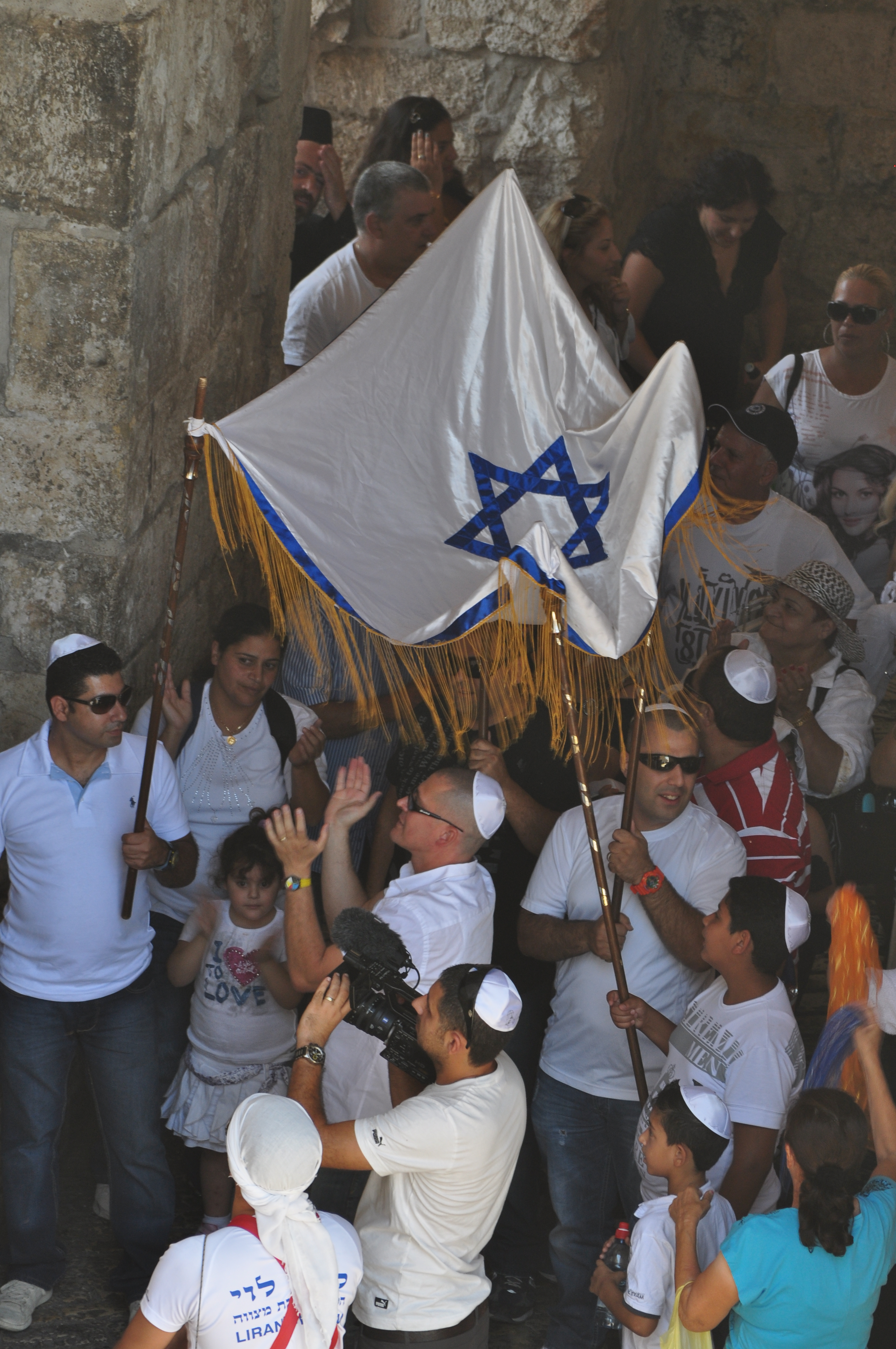
Celebrations in Jerusalem’s Old City
(photo: First.One.Through)

Just one week ago, Israeli Prime Minister Benjamin Netanyahu approved a new town in Samaria near Shiloh, the first new development in decades. The new town is adjacent to the ancient Jewish holy site. A return and redemption of sorts, thousands of years later.

Passover starts next week around the world. The seder ends with a song “HaShana HaBa B’Yerushalyim,” “Next year in Jerusalem. Next year in the rebuilt Jerusalem.” While there are still more obstacles to overcome in Jerusalem (such as the ban on Jewish prayer on the Temple Mount), the city has been revitalized and home to thousands of Jews.

Passover 2017 marks anniversaries of both the redemption of the Jews from being slaves, and the redemption of Jerusalem from being Judenrein. Celebrating Passover in Jerusalem is performing a mitzvah, a positive deed, which combines a clearly delineated action with those divinely inspired. God saved us, and blessed us when we took actions to celebrate His gifts.

Happy Passover from Jerusalem.


Related First.One.Through articles:

Shabbat Hagadol at the Third Hurva Synagogue, 2010

It is Time to Insert “Jewish” into the Names of the Holy Sites

Today’s Inverted Chanukah: The Holiday of Rights in Jerusalem and Judea and Samaria

Jordan’s Deceit and Hunger for Control of Jerusalem

The Arguments over Jerusalem

Subscribe YouTube channel: FirstOneThrough

Join Facebook group: FirstOne Through  Israel Analysis


Chag Kasher v. Sa’meach

Summary: For many people, the “v.” is for “versus”, not for “and”. In the ongoing battle between a Chag Kasher versus Sa’meach, Kasher seems to be winning again.

I am neither a cook nor a chef.

While I love to eat, my wife prohibits me from doing any food preparation for fear -not without reason or history- that should I venture into the kitchen, her holy sanctuary, the entire room – no, the house itself! – would become un-kosher.

Over time, my place has become confined to the kitchen table. It is there that I must sit and wait for my meals, not unlike our dog (which she prefers on most days) who waits before his bowl. Remarkably, I am afforded more table scraps than him. Score one for me.

This is not to say that I cannot approach the sink. My share of the household bargain falls on cleaning up after meals. My wife considers the dishwasher and garbage pail safe terrain, as I can usually deduce whether I just consumed a dairy or meat meal.

That all ends on Passover.

When I think of my wife on Passover, I am reminded of the final scene from the movie Gallipoli where manic soldiers charge an Ottoman trench, knowing of their certain death. A fury fills her eyes as the holiday approaches and I know that no cleaning I do could ever satisfy her Kashrut Compulsive Disorder (commonly referred to by Jewish psychiatrists as KCD). This non-silent killer has taken more husbands than latkes on Hanukah.

My wife, (let’s call her “Pharaoh” to protect her identity from the teachers in school who think of her as a sweet, mild-mannered parent) despises Passover. Her venom is matched by her vigilance as she tries to square the invisible shmura matzah of Passover kashrut stringencies with her own KCD.

The Pharaohs of ancient Egypt had it easier than my modern Pharaoh. The ancient kings had teams of advisers and thousands of slaves to execute their commands. Today’s Pharaoh is left with a spouse who only gets to clean in the kitchen during most of the year because we have two dishwashers.

More warriors are clearly needed for the task.

New York has an outsourced cleaning industry which features companies with jolly names like “Molly Maids” and “PIG” which stands for “Partners in Grime”. When these companies drop the non-kosher acronyms and become armed with blowtorches, perhaps Pharaoh will “let these people come.”

Well, in truth, they do come.  They come a few times in succession to make sure that one team picked up where the first team may have been sloppy. At $400 a pop, the twelve cleaning tours of duty make a not so subtle reminder that we could have gone to a Passover program in the sunshine somewhere.

The cleaning troupes do not absolve me of cleaning (nor the sin of making Passover at home). My tasks are to lift and move large objects around the house in case a morsel of bread was carried there by a microscopic antisemitic mouse.  Dishwashers are pulled from their moorings. Refrigerators are yanked from the walls.  I am ordered to lift the island in the kitchen, until my rabbi steps in on my behalf (only because he thought I was too weak). My dog snickers at my misery.  Score one for him.

After eighteen gallons of bleach have been pored over every inch of the kitchen, and the fleas on my dog would no longer consider smelling (let alone eating) anything in the house, my next task is assigned. Foiling.

Foiling on Pesach has nothing to do with fencing.  It involves rolling out aluminum foil over counter tops as a punishment for not giving one’s wife a new kitchen. For the hardcore, the foiling of tables, chairs, cushions is also warranted.  Our family is so famous for our foiling, that we get Happy Passover cards from Alcoa.

IMG_3295
Foiling at a bar

As the first seder arrives, Pharaoh starts to resemble my former wife again. The house is indeed clean enough that even Eliyahu would be impressed.  Family and friends gather around the table to recount the timeless story… of how no one in the shtetls had more than one pot and somehow made Passover.

As has become our tradition, before I recite the Kiddush to start the seder, my wife inverts the very order of the seder. She sings out in a loud, yet exhausted, teary voice “Hashana ha’ba’a b’Yerushayim” – Next year in Jerusalem. Everyone joins in.

Shabbat Hagadol at the Third Hurva Synagogue, 2010

Summary: Five years ago, I was fortunate to spend Friday night at the newly re-opened Hurva Synagogue in the Old City of Jerusalem. A reflection on history and change.

On the Friday evening of Shabbat Hagadol before Passover in March 2010, I walked with my father to the Old City of Jerusalem.

I had come to Israel with my family to celebrate my daughter’s bat mitzvah. Several members of the family walked the 1.5 miles in the light rain from our hotel towards the Kotel.  As we passed the newly opened Hurva Synagogue in the Jewish Quarter, my father and I opted to pray there, while most of the others continued to the Kotel.

THE HURVA

The very first Hurva Synagogue was built in 1694 but was destroyed a few years later in 1721 due to financial problems. The second Hurva synagogue on that location opened in 1856, as the Ottomans began to ease restrictions on Jewish development in the holy land. However, the Jordanian Arabs blew up the synagogue during their 1948 attack on Israel.

Hurva1930
Hurva Synagogue, 1930

In 1967, in response to the Jordanian and Palestinian attack on Israel, Israel counter-attacked and took control of the eastern half of Jerusalem. The Israelis opted to not rebuild the Hurva Synagogue for decades, and instead built a ceremonial arch, similar to the arch that existed in the original shul. However, in 2002, the government began a process of looking at rebuilding the synagogue, which it finally opened in March 2010.

 Hurva arch
Ceremonial Arch where the Hurva Synagogue stood

The rededication of the Jewish synagogue caused international hysteria. Palestinians and Jordanians called the action a “provocation” that was meant to begin an attack on the Al Aqsa Mosque on the Temple Mount. The main Palestinian political party, the Jihadist group Hamas, declared a “Day of Rage” against Israel.

The Palestinian Center for Human Rights said it “strongly condemns recent measures taken by Israel in East Jerusalem, the latest of which has been the inauguration of a synagogue in the old city. PCHR holds Israel responsible for the escalation of the situation in the occupied Palestinian territory.”

The United States was upset with the reopening of the synagogue in the contested part of the city and the Palestinians’ reaction. As such, Israeli Prime Minister Benjamin Netanyahu skipped the rededication ceremony to avoid harming relations with US President Barack Obama.

SHABBAT HAGADOL 2010

 I was very happy to go into the new-historic shul. It is not often that one gets to visit a brand new building with so much history.

There was security to enter the building, but nothing extreme or time intensive. The entry area had many siddurim, prayer books, and my father and I each took one and grabbed seats inside. We observed the large inside of the domed building and could see a woman’s section behind us overhead.  The tall wooden aron that held the torah scrolls sat against a wall that tried to convey the levels of history in the building – a mix of raw stone, stone with plaster applied and painted finished walls towards the ceiling. The four corners of the synagogue included painted frescos of holy places: the Cave of the Jewish Patriarchs in Hebron; and the Tomb of Rachel in Bethlehem were in the front of the building, and Migdal David; and Tiberias were portrayed towards the back.

Hurva inside2
Inside front wall of the Hurva Synagogue

After Kabbalat Shabbat, the newly appointed Chief Rabbi of Israel, Yona Metzger, delivered a speech.  He spoke clearly and strongly in Hebrew for a while about the story of the Jews leaving Egypt, and the important role that women and all of the Jews played in their own redemption. I was happy both with the content of the speech and my ability to understand it.

FIVE YEARS ON

Five years later, I spent Shabbat Hagadol at a university in Massachusetts as my daughter began to consider her college options.

On Shabbat, my wife and I walked the 1.5 miles in the light snow from our hotel to the college campus.  We were lucky enough to hear Rabbi Saul Berman, who was a visiting lecturer from Yeshiva University’s Stern College for Women and Columbia University’s School of Law. He spoke about the role all Jews played in their own redemption 3300 years ago.  He also spoke about the significance of temporarily banning a seemingly innocuous item – chametz – during the week of Passover.  As opposed to permanent prohibitions to actions that God viewed as improper (such as murder), he argued that a temporary ban was meant to be used as a time of reflection. The change acts as a catalyst to contemplate the separation itself.  In the case of chametz, Jews eschewed the characteristics of ancient Egyptians, for example, the use of slave labor. The temporary ban today allows us to reflect on how we treat our workers today.  Passover is both a time to remember and relive ancient history (we physically left Egypt centuries ago), as well as a time to consider our own actions (how do we avoid acting like ancient Egyptians in the present).

In Israel, the third Hurva synagogue still stands and welcomes Jews to pray on Shabbat Hagadol, Pesach, and all year.  The loud commotion around the rebuilding of the shul has died away and is now part of the din from protests of a large segment of the world that attacks Jews for building and living in their holiest city; a city they have built and lived in for thousands of years.

The chief rabbi who spoke at the Hurva in 2010, Yona Metzger, is no longer the chief rabbi.  He just stepped down from his position due to an indictment on bribery charges.

Israeli Prime Minster Netanyahu is still in office, having recently won a fourth term in elections.  As he did five years ago, Netanyahu continues to make conciliatory remarks and take actions regarding the Palestinians to endear himself to US President Obama. (But Netanyahu has also ratcheted up his language regarding Iran’s nuclear program which has only strengthened Obama’s dislike for him).

As for me, I have had the chance to visit the Hurva many more times.  I have come with my wife and children.  Soon, I will come with in-laws, nieces and nephews who could not attend the bat mitzvah five years ago and have never seen the synagogue.


The front wall of the Hurva Synagogue is a plum line of history. The changing materials reflect our movement into the modern with a foundation straight from the ancient. Like the seder on the first night of Passover, the Jewish story builds on the past. Jews relive ancient history, recount how Jews retold the story more recently, and add their own stories today.

Hurva
Hurva Synagogue 2014


Related First One Through article:

United Nations and Holy Sites in the Holy Land