If Palestinians are Scared, it Must be Real

On May 21, 2016, the New York Times ran a front page story “New Tunnels Instill Fear on Gazan Side Too.”  The front page story continued onto page A6 with two black-and-white pictures of attack tunnels dug from Gaza into Israel.

20160522_12124720160522_121312
New York Times front page and page A6, May 21, 2016.
The pictures include a tunnel and a destroyed Gazan home. No photos of the kibbutz in Israel where Hamas gunmen appeared,
or of Gilad Shalit who was abducted via a tunnel.

The story spoke of the fear of Palestinian Arabs living in Gaza because Israel might seek to destroy the Hamas tunnels. The article described the “parallel anxiety” of Palestinian Arabs and Israelis stemming from the tunnels.

The Times article failed to mention that Hamas was democratically elected to a majority of parliament by these same Palestinian Arabs, based on a public platform that called for destroying Israel. For their part, the Israelis had no role in bringing Hamas to power.

The article correctly pointed out that “the tunnels were the prime rationale Israel gave for its ground invasion of Gaza during the 2014 battle with Hamas.”  However, back in 2014, the New York Times did not think much about those attack tunnels.

As detailed in “The New York Times’ Buried Pictures,” it took three weeks into the 2014 war for the Times to produce any pictures of the Hamas tunnels, even though multiple news sources had already been publishing pictures of them.  When the Times finally decided to write about it in an article called “Tunnels Lead Right to Heart of Israeli Fear,” it published the story underneath a picture of Palestinian Arabs mourning.

July 29 coverJuly 29. A6
July 29, 2014 New York Times cover with large color picture with caption:
“Overcome with Grief: At a morgue in Gaza City, Palestinians mourned the arrival of children killed in the Gaza conflict.”  The follow-up to the article contains a large black-and-white of Palestinians mourning, and only beneath that, was there a smaller black-and-white picture of a soldier in an attack tunnel.
(photos: First.One.Through)

The Times author, Jodi Roduren, made light of Israelis fear of the tunnels.  She repeatedly used language to make Israelis fear seem completely overblown.  Consider her remarks:

  • Tunnels have lurked in the dark places of Israeli imagination at least since 2006,”
  • In cafes and playgrounds, on social media sites and in the privacy of pillow talk, Israelis exchange nightmare scenarios that are the stuff of action movies.”
  • “As part of the propaganda push, the military has also invited a few journalists underground for a tour.”

One would think that the Israelis were completely paranoid for no reason and dreamed of scenarios that could not take place in the real world.  Roduren seemed to suggest that the Israelis then used the tunnels to advance a “propaganda push” to validate their invasion.


For the New York Times, the war is felt in Gaza and the Palestinian Arabs’ fears are real.  However, for Israelis, fears are overblown in imagined nightmarish scenarios, which the army then uses as a propaganda to conceal their over-reactions.

Even when the left-wing paper can admit that both sides have real fears, it cannot lay blame for the situation on the Palestinians that elected -and continue to support – this terrorist party.


Related First.One.Through articles:

The New York Times Wrote About Computer Hackers Charged by the US and Israel. Differently.

New York Times Lies about the Gentleness of Zionism

New York Times’ Tales of Israeli Messianic War-Mongering

The New York Times Refuses to Label Hamas a Terrorist Group

Educating the New York Times: Hamas is the Muslim Brotherhood 

Subscribe YouTube channel: FirstOneThrough

Join Facebook group: FirstOne Through  Israel Analysis

The New York Times Wrote About Computer Hackers Charged by the US and Israel. Differently.

On March 24, 2016 the New York Times wrote an article about Israel’s arrest of a computer hacker breaking into sensitive military computers. The next day, the paper wrote about the United States charging several Iranian computer hackers attacking the United States. Similar stories should get similar coverage, right?  Not when one party is Israel.

A comparison of the two stories can provide a primer for how the NY Times continues to portray Israel in a negative light:

  1. Use of Headlines.
  2. Using soft or harsh language.
  3. Quoting insiders and outsiders.
  4. Statement of fact versus charges.
  5. Providing background on fear of attacks.
  6. Pictures of targets (or none).
  7. Use of multiple reporters covering different sides of the story

Use of Headlines

The Times article on Iranian hackers attacking the US was titled U.S. Indicts 7 Iranians in Cyberattacks on Banks and a Dam.”  The article clearly laid out that Iranians committed cyberattacks. No question.

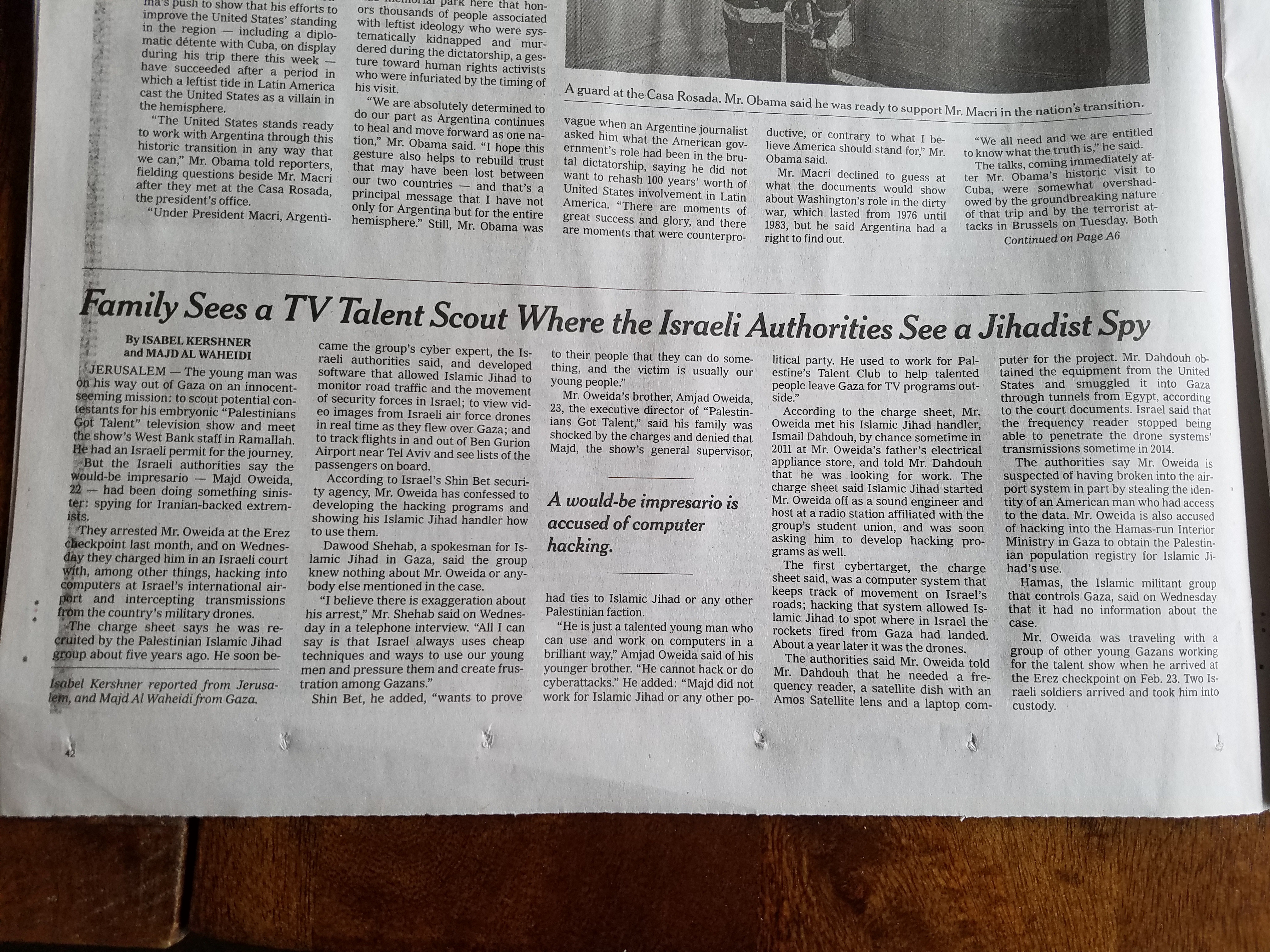
The article about the Israeli arrest had a different approach to the headline: “Family Sees TV Talent Scout Where Israeli Authorities See Jihadist Spy.” In this case, there is a difference of opinion about the facts. Israelis perceive evil, while others see a normal working person.

The Israeli situation is not cut-and-dry. The US is cracking down on attacks, while the Israelis are arresting people who may simply work for a fun media company.
20160325_140615
New York Times article with headline questioning Israeli arrest

Soft versus Harsh Language

The article about the hacker against Israel describe a “young man” on an “innocent” mission. The age and supposed profession of the hacker was given.

The US story mentioned only the attackers’ names with no ages. The only color given for the individuals were their “online handles” including “Nitr0jen26,” “PLuS,”and “Turk Server,” making them all appear guilty.

Selection of Quotes

An often used strategy of twisting the narrative of a story is carefully selecting the parties who provide personal color to the events.

For Israel, the only quotes about the arrest came from Palestinians: a spokesman for the terrorist group Islamic Jihad, and the accused’s brother (I’m not making it up- his brother). The quotes include many denials, and accusations against Israel.

In the article about the US arrest, no Iranians were interviewed (nor any of the accused family members- imagine that). Quotes came from the indictment itself, Senator Chuck Schumer, and the head of the national security department of the Justice Department.

Guess which way the quotes tilted in each case?

Statement of Facts versus Charges

This subtle and directed approach is often used by the New York Times.

The article’s description of the Israeli arrest is couched in cautionary, inconclusive language: “according to Israeli authorities” or “”according to the charge sheet” and “the Shin Bet says,” are followed by statements.  The NY Times aim is to clarify that the charges against the hackers are not necessarily true.  Maybe cyberattacks happened, maybe they didn’t.  Maybe this is the person responsible, maybe he isn’t.  The paper is just reporting what they culled from Israeli authorities.

Compare that use of cautionary language to the article about the attacks against US targets.  Those attacks were all described as factual; there is no language that suggests that hacking attacks did not happen, the question is why the attacks happened.

For example, in the attack on the dam the Times wrote “It appeared to be an effort to take over the dam itself,” meaning, the attack is a fact, but it is unclear if the attackers wanted to fully control the entirety of the dam.  There was no caveat of “according to US investigators.”

Background

The US story included information about the recent US-Iranian negotiations around the Iranian nuclear power program. It stated that “the indictment appeared to be part of an American effort to keep Iran from shifting activity from its nuclear program to its growing corps of cyberwarriors.”

However, the article on Israel mentioned nothing about the current attacks by Palestinian Arabs against Israelis, nor the missile attacks and wars launched from Gaza over the past eight years.

In other words, America was rational in trying to protect itself against Iran. Meanwhile, Israel’s arrest was seemingly made in a vacuum to “create frustration among Gazans,” as a quote said.

Use of Pictures

The story about Iranians attacking American targets included a picture of US Attorney General Loretta Lynch, and one of the targets of the cyberattacks- a dam in suburb of New York City. The picture added to the significance of the story and fear of the attack.

The Israeli story featured no pictures. Hacking into the country’s airports and drones was not prominently featured with accompanying photos. There were no captions that highlighted Israeli’s fears.

cyber-web-master
New York Times Photo accompanying article:
Caption: “Cyberattackers attempted to gain control of the Bowman Dam in Rye, a suburb of New York, in 2013. The effort failed, but worried American investigators because it was aimed at seizing a piece of infrastructure.
Credit Christopher Capozziello for The New York Times”

Use of Reporters

The long article by David Sanger about the US arrests did not rely on any other reporters. However, the Israeli article which was half the length of the US story, used two reporters: “Isabel Kershner reported from Jerusalem, and Majd Al Waheidi from Gaza.

Such wonderful balance!


Newspapers can write up a story in any manner they see fit. It is not surprising that an American paper would side strongly in its reporting with the United States and against its foes. One would imagine that papers treat American allies in much the same manner.

Not the New York Times for Israel.

As seen above and analyzed often in FirstOneThrough, the New York Times skews its reporting against Israel and in favor of Palestinians.

20160325_140548
New York Times on US indictment of Iranian hackers


The articles from the New York Times:

Article on Israeli arrest of cyberhackers:

“JERUSALEM — The young man was on his way out of Gaza on an innocent-seeming mission: to scout potential contestants for his embryonicPalestinians Got Talent” television show and meet the show’s West Bank staff in Ramallah. He had an Israeli permit for the journey.

But the Israeli authorities say the would-be impresario — Majd Oweida, 22 — had been doing something sinister: spying for Iranian-backed extremists.

They arrested Mr. Oweida at the Erez checkpoint last month, and on Wednesday they charged him in an Israeli court with, among other things, hacking into computers at Israel’s international airport and intercepting transmissions from the country’s military drones.

The charge sheet says he was recruited by the Palestinian Islamic Jihad group about five years ago. He soon became the group’s cyber expert, the Israeli authorities said, and developed software that allowed Islamic Jihad to monitor road traffic and the movement of security forces in Israel; to view video images from Israeli air force drones in real time as they flew over Gaza; and to track flights in and out of Ben Gurion Airport near Tel Aviv and see lists of the passengers on board.

According to Israel’s Shin Bet security agency, Mr. Oweida has confessed to developing the hacking programs and showing his Islamic Jihad handler how to use them.

Dawood Shehab, a spokesman for Islamic Jihad in Gaza, said the group knew nothing about Mr. Oweida or anybody else mentioned in the case.

“I believe there is exaggeration about his arrest,” Mr. Shehab said on Wednesday in a telephone interview. “All I can say is that Israel always uses cheap techniques and ways to use our young men and pressure them and create frustration among Gazans.”

Shin Bet, he added, “wants to prove to their people that they can do something, and the victim is usually our young people.”

Mr. Oweida’s brother, Amjad Oweida, 23, the executive director of “Palestinians Got Talent,” said his family was shocked by the charges and denied that Majd, the show’s general supervisor, had ties to Islamic Jihad or any other Palestinian faction.

“He is just a talented young man who can use and work on computers in a brilliant way,” Amjad Oweida said of his younger brother. “He cannot hack or do cyberattacks.” He added: “Majd did not work for Islamic Jihad or any other political party. He used to work for Palestine’s Talent Club to help talented people leave Gaza for TV programs outside.”

According to the charge sheet, Mr. Oweida met his Islamic Jihad handler, Ismail Dahdouh, by chance sometime in 2011 at Mr. Oweida’s father’s electrical appliance store, and told Mr. Dahdouh that he was looking for work. The charge sheet said Islamic Jihad started Mr. Oweida off as a sound engineer and host at a radio station affiliated with the group’s student union, and was soon asking him to develop hacking programs as well.

The first cybertarget, the charge sheet said, was a computer system that keeps track of movement on Israel’s roads; hacking that system allowed Islamic Jihad to spot where in Israel the rockets fired from Gaza had landed. About a year later it was the drones.

The authorities said Mr. Oweida told Mr. Dahdouh that he needed a frequency reader, a satellite dish with an Amos Satellite lens and a laptop computer for the project. Mr. Dahdouh obtained the equipment from the United States and smuggled it into Gaza through tunnels from Egypt, according to the court documents. Israel said that the frequency reader stopped being able to penetrate the drone systems’ transmissions sometime in 2014.

The authorities say Mr. Oweida is suspected of having broken into the airport system in part by stealing the identity of an American man who had access to the data. Mr. Oweida is also accused of hacking into the Hamas-run Interior Ministry in Gaza to obtain the Palestinian population registry for Islamic Jihad’s use.

Hamas, the Islamic militant group that controls Gaza, said on Wednesday that it had no information about the case.

Mr. Oweida was traveling with a group of other young Gazans working for the talent show when he arrived at the Erez checkpoint on Feb. 23. Two Israeli soldiers arrived and took him into custody.”


Article on US arrest of cyberhackers:

WASHINGTON — The Justice Department on Thursday unsealed an indictment against seven computer specialists who regularly worked for Iran’s Islamic Revolutionary Guards Corps, charging that they carried out cyberattacks on dozens of American banks and tried to take over the controls of a small dam in a suburb of New York.

The indictment, while long expected, represents the first time the Obama administration had sought action against Iranians for a wave of computer attacks on the United States that began in 2011 and proceeded for more than a year, paralyzing some banks and freezing customers out of online banking.

The indictment stops short of charging that the attacks were directed by the Revolutionary Guards, a branch of the Iranian military. But it referred to the seven Iranians as “experienced computer hackers” who “performed work on behalf of the Iranian government, including the Islamic Revolutionary Guards Corps.”

Nothing in the indictment addresses the motives for the attacks. But intelligence experts have long speculated that the cyberactions directed at roughly four dozen financial institutions — including JPMorgan Chase, Bank of America, Capital One and PNC Bank — were intended to be retaliation for an American-led cyberattack on Iran’s main nuclear enrichment plant. That attack, which employed the so-called Stuxnet virus, was revealed in 2010.

All of the Iranian attacks — which, the indictment said, included actions against the New York Stock Exchange and AT&T — were “distributed denial of service” attacks, often called DDoS attacks. In those assaults, the target’s computers are overwhelmed by coordinated computer requests from thousands of machines around the world. The targeted networks often crash, putting them out of service for some period.


Attorney General Loretta E. Lynch announced an indictment against seven Iranians who are believed to have attempted to hack into several American banks and a dam in New York.

But the case of the Bowman Dam in Rye, N.Y., was entirely different: It appeared to be an effort to take over the dam itself. The attempt failed because the dam was under repair and offline, but in some ways it worried American investigators more because it was aimed at seizing control of a piece of infrastructure.

“The most likely conclusion is that it was a warning shot” from the Iranians, who were saying, “‘Don’t pick on us, because we can pick on you,’” said Senator Chuck Schumer, Democrat of New York.

But Mr. Schumer said that the lesson from this case was “not that we should not employ cyberweapons, but that we should be able to protect ourselves.”

It is doubtful that any of the named Iranians will ever appear in an American courtroom. In that respect, the indictment is similar to one the Justice Department issued two years ago against members of Unit 61398 of the People’s Liberation Army of China, which it accused of stealing data from American corporations. The Chinese have never been arrested.

But the administration argues that such indictments send a strong signal and make it difficult for those who are indicted to travel, for fear of extradition.

On Tuesday, the Justice Department indicted two other hackers who it said were members of the Syrian Electronic Army, which has supported the government of Bashar al-Assad, and it believes that it has a chance to gain custody of one of them. On Wednesday, the department obtained a guilty plea from a Chinese national living in Canada, Su Bin, whom it accused of mounting a cybercampaign to steal the designs of military aircraft from Boeing, on behalf of Chinese intelligence agents.

The Iran indictment comes eight months after the nuclear deal reached between Tehran and six other nations, including the United States, which appeared to be putting Tehran and Washington on a track toward a more productive relationship after 35 years of enmity. But Iranian missile launches in recent months — also organized by the Guards — have led to calls in Congress for new sanctions.

The indictment appeared to be part of an American effort to keep Iran from shifting activity from its nuclear program to its growing corps of cyberwarriors, some of whom work directly for the government, while others, like those named in the indictment, seem to be contractors.

As a measure of the importance the administration placed on the indictment, it was announced by Attorney General Loretta E. Lynch, in a news conference in Washington with Preet Bharara, the United States attorney for the Southern District of New York, where the indictment was handed up. It was unclear how long it had been under seal.

The Iranians named in the indictment included Ahmad Fathi, Hamid Firoozi, Amin Shokohi and Sadegh Ahmadzadegan, who went by the online handle of “Nitr0jen26.” Also named were Omid Ghaffarinia, known as “PLuS,” Sina Keissar and Nader Saedi, also known as “Turk Server.” Their whereabouts was not described, but some worked for a firm the indictment called the ITSec Team, and some for the Mersad Company, both described as security companies in Iran.

John P. Carlin, who heads the national security division of the Justice Department, said in an interview that the indictments arose from a new approach within the Obama administration. “Prior to 2012, we dealt with these cases as intelligence matters,” which were hard to bring to court, Mr. Carlin said, because the evidence was classified. “Now we are following traditional investigative rules,” he said, assembling data that can be entered into court records.

Iran’s computer networks have been a primary target of the National Security Agency for years, and it is likely that in penetrating those networks — for intelligence purposes or potential sabotage — the N.S.A. could have traced the attacks to specific computers, IP addresses or individuals.

But naming individuals, some experts suggested, could lead to retaliation. Jason Healey, a cyberconflict expert at Columbia University and the Atlantic Council, asked in a Twitter post on Thursday whether naming individuals, rather than governments, put cyberoperators for the National Security Agency and the Central Intelligence Agency “at risk for similar indictments.”


Related First.One.Through articles:

New York Times Lies about the Gentleness of Zionism

Every Picture Tells a Story: Arab Injuries over Jewish Deaths

The New York Times Refuses to Label Hamas a Terrorist Group

Framing the Israeli-Palestinian Arab Conflict: WSJ and NY Times

Every Picture Tells a Story: Versions of Reality

Subscribe YouTube channel: FirstOneThrough

Join Facebook group: FirstOne Through  Israel Analysis

Every Picture Tells a Story: The Invisible Killed Terrorists

France Against ISIS

Every media outlet reported repeatedly about the devastation in Paris in November 2015. The terrorist attacks throughout the city killed 130 people going about their daily lives, and pictures filled newspaper pages of the bloody scene of the Batclan night club where most of the people were murdered. There were many other pictures and articles of the various innocent victims over the following days.

IMG_3612
Front page of the New York Times, November 15, 2015

In the following days the headlines of newspapers broadcast that France was attacking ISIS in retaliation for the attacks. Liberal papers like the New York Times editorial section even stated that “France rightfully attacked ISIS.” The papers reported 20 sorties.

Yet, where were the pictures of the dead ISIS fighters?  Where was the headcount of how many fighters were killed?

For all of the coverage about the terrorist attack and follow-up airstrikes, there was virtually no discussion of the deaths inflicted on the ISIS fighters in Syria or Iraq.

The pictures in the paper show the innocent victims of France. Nowhere does it show the images of what the French did in response.

The US Against Al Shabab

On March 8, 2016, the New York Times reported that the US struck and killed 150 fighters in Somalia, belonging to the terrorist group Al Shabab. The United States has been fighting against Al Shabab, an affiliate of Al Qaeda, for a decade.  While this group has not conducted any attacks on US soil against American civilians, a Pentagon spokesperson claimed that the group was planning a “large-scale attack” against US troops.

The US attack was the deadliest attack against Islamic militants in Africa.

There were no pictures in the newspapers to accompany the article.

There were no follow up stories.

Israel Against Hamas

Hamas has defined itself as opposed to the very existence of Israel.  They refuse to acknowledge any right or legitimacy of the Jewish State.  They repeatedly state in their charter and on their news programs that there can be no peace agreement with Israel, only jihad.

Hamas has launched over 10,000 rockets into Israel, since Israel left Gaza in 2005.  The group has instigated three wars and killed over a thousand Israelis.  Those Hamas wars have claimed thousands of Palestinian Arab lives as well.

However, unlike the invisible terrorists of ISIS and Al Shabab, the papers post the pictures of dead Palestinian terrorists.  Whether covering the front pages of the paper in the summer of 2014, or running long articles with several pictures of Gazans dying using the tunnel network, the paper relays the Palestinians in a sympathetic light.  The people of Gaza, who voted for and are governed by the terrorist group Hamas, are shown as victims time and again.


The United Nations often condemns Israel for “disproportionate” force in stopping Palestinian attackers actively involved in attacking people.  It did not condemn France  nor the United States for its actions against terrorists.

Maybe every day people can begin to condemn the media for disproportionate coverage of Israel’s handling its War on Terror.


Related First.One.Through articles:

Review of Media Headlines on Palestinian Arab Terror Spree

Every Picture Tells a Story: Arab Injuries over Jewish Deaths

Every Picture Tells A Story: Only Palestinians are Victims

Every Picture Tells a Story- Whitewashing the World (except Israel)

The Big, Bad Lone Wolves of Terrorism

The New York Times Refuses to Label Hamas a Terrorist Group

Flip-Flopping on the Felling of Terrorist Groups’ Founders

My Terrorism

Subscribe YouTube channel: FirstOneThrough

Join Facebook group: FirstOne Through  Israel Analysis

Review of Media Headlines on Palestinian Arab Terror Spree

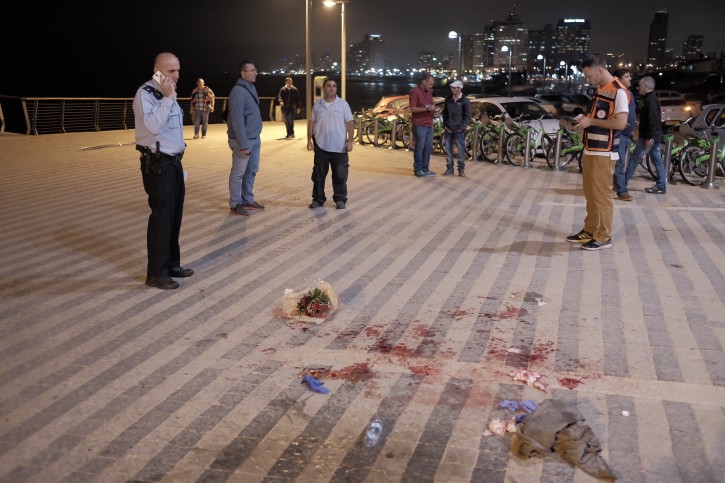
On March 8, 2016, several Palestinian Arabs attacked Israelis in various locations in Israel. A particularly horrible assault occurred in Jaffa, where a Palestinian Arab man stabbed various civilians, killing an American tourist.

jaffa attack
Scene of Palestinian Arab terror attack at Jaffa Port, March 8, 2016
(photo: Tomer Neuberg/Flash90)

The headlines from major news agencies show a range of focus: some focus on the attacker being a Palestinian, others omit the fact completely; most focused on an American being killed, some papers ignored mentioning the many Israelis injured.

The more complete news accounts came from papers often viewed as slightly more conservative. The papers that whitewashed the Palestinian Arab attacker came from more liberal papers.

The Palestinian media center inverted the story completely, focusing on the terrorist that was killed.

Focus on American Killed and Israelis Injured by Palestinian

Palestinian attacks kill American student, wound 12 Israelis” US News & World Report
Palestinian attacks kill American student, wound 12 Israelis” Washington Post
Palestinian Attacks Kill American Student, Wound 12 Israelis” .. abcnews
Jaffa stabbing spree: Palestinian kills American tourist, wounds 10 others” Jerusalem Post Israel News‎

Only American Killed by Palestinian

Palestinian kills U.S. tourist in stabbing spree on Tel Aviv boardwalk” Reuters
American tourist killed as Palestinians unleash attacks in Israel” CBS News
Palestinian kills US tourist in IsraelBBC News

American Killed and Israelis Injured – But Not by Palestinian

US student dead and at least 13 others injured in attacks across Israel” The Guardian
American fatally stabbed in Israel terror attack that wounds 10 others” CNN

 Only American Killed – not by Palestinian

Vanderbilt MBA Student Killed Amid Stabbing Violence in Israel as Biden Arrives for Talks” NBC News
American Graduate Student Killed in Stabbing Rampage Near Tel Aviv” New York Times
American dies in Israel stabbing attackUSA Today
U.S. tourist killed in knife attack in Israel, where survey illuminates deep divides” LA Times

The last two headlines could lead a reader to conclude that Israelis killed the American tourist.

Focus on Palestinians Being Killed

3 Palestinians shot dead after multiple attacks kill tourist, wound 12” Maan News Agency (Palestinian NGO)

Israel’s Killing of Four Palestinians Focus of Dailies Wafa, the Palestinian News Agency. Wafa led that the local Palestinian papers all focused on Israelis killing Palestinians, placing Israelis as the aggressors as opposed to defending themselves.


News reports are often crafted and biased.  They deliberately add and omit information and highlight certain aspects of stories.

Consider what narrative you read each day.  If you continue to only read from the same news source, your perception of the news will be unbalanced.

For most Americans, that bias has been liberal and anti-Israel, by measuring the circulation of conservative media (Washington Post 400,000; US News <1 million) versus liberal media (USA today 3 million; New York times 1.4 million).

Even in a clear-cut story of a terrorist stabbing a dozen civilians on March 8, 2016, one can see how the media directs a story.  In the more complicated Israeli-Arab conflict, readers are left at the mercy of biased journalists and editors.

Consider getting information from a different political perspective in addition to your favorite media site. Innocent victims of terror deserve more than what the popular USAToday opts to publish.


Related First.One.Through articles:

New York Times Lies about the Gentleness of Zionism

Educating the New York Times: Hamas is the Muslim Brotherhood

The New York Times’ Buried Pictures

Every Picture Tells A Story: Only Palestinians are Victims

Every Picture Tells a Story: The Invisible Murdered Israelis

Framing the Israeli-Palestinian Arab Conflict: WSJ and NY Times

Every Picture Tells a Story: Arab Injuries over Jewish Deaths

Every Picture Tells a Story: Versions of Reality

Subscribe YouTube channel: FirstOneThrough

Join Facebook group: FirstOne Through  Israel Analysis

New York Times Grants Nobel Prize-in Waiting to Palestinian Arab Terrorist

There once was a journalist who won a Pulitzer Prize for reporting on terrorism. Thirteen years later, it would appear that he cannot find terrorism at all.  Or worse. His paper endorses the terrorism itself.


Steven Erlanger has been a reporter for The New York Times for several decades. In 2002, he shared a Pulitzer Prize for his work reporting on the terrorist group al Qaeda. On February 28, 2016, he wrote an article that made a reader question whether he continued to have the faculties to recognize the nature of terror anymore.

In his article called “Talk Grows About Who Will Succeed Palestinians’ Fading Mahmoud Abbas,” Erlanger listed several potential candidates to succeed the inept current acting-President of the Palestinian Authority, Mahmoud Abbas. In addition to some leading candidates, Erlanger wrote:

“The other inescapable figure is Marwan Barghouti, 56, sometimes called the Palestinian Mandela for his long period in Israeli prison and his efforts to bring Hamas and Fatah together.”

No reasonable person calls Barghouti a Palestinian Mandela other than anti-Israel outfits like The Guardian in the United Kingdom. Will the Times also begin to refer to Israeli Prime Minister Benjamin Netanyahu as a “modern day Winston Churchill” like the National Review? I doubt it.

Using a referral to a secondary source (“sometimes called”) made Erlanger appear as an unbiased reporter rather than inserting his own editorial into the story. But sourcing such a narrow and biased paper for a quote, rather than broadly used terminology, is an editorial itself, not news.

Barghouti versus Mandela

Part of the reason the reference to Mandela is so absurd is the nature of the two individuals’ imprisonments. Nelson Mandela was imprisoned because he tried to fight the racist apartheid system in South Africa. Marwan Barghouti was not imprisoned for fighting for rights for Palestinians, nor for “his efforts to bring Hamas and Fatah together.” Barghouti was jailed for his direct involvement in murdering several civilians.

Between January and June 2002, Barghouti was directly involved with killing of: Yula Hen at a gas station (January 2002); Yosef Havi, Eliyahu Dahan and Selim Barachat in a restaurant (March 2002); and Gur Pzipokatsatakis, a Greek Orthodox monk (June 2002). For those crimes, he received five life sentences.

In addition to those direct murders, Barghouti was also held responsible for a failed suicide bombing at a major shopping mall in Jerusalem. For that crime, he received another 40 year sentence.

His involvement in the murder of scores of other civilians was beyond dispute, however, the Israeli courts deemed it was beyond its authority to convict him.

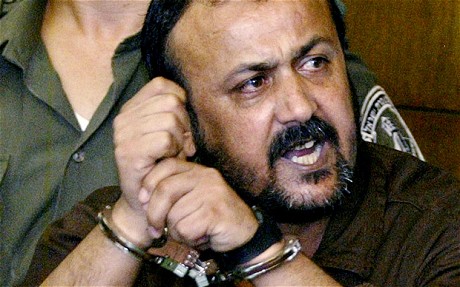
Barghouti is credited with launching the Second Intifada at the end of 2000. Tanzim, the terror arm of Fatah, targeted Israeli civilians around the country, such as on buses and at bat mitzvah celebrations. The Tanzim attacks went on continuously in 2001 and early 2002 until his arrest, and sporadically afterwards.

marwan barghouti
Marwan Barghouti, head of Tanzim

This background is in sharp contrast to Nelson Mandela, who also headed a terrorist group. UmKhonto we Sizwe, the terrorist arm of the ANC and South African Communist Party, carried out several attacks against South Africans in the 1980s.

But the similarity ends there.  Mandela fought against the racism of apartheid, while Barghouti fought against the existence of Israel.

Mandela started the group after the South African government killed 69 people. Barghouti launched the Second Intifada after Yasser Arafat rejected the terms of the peace agreement with Israel.

Mandela was never directly involved in any murders. Barghouti was involved in several.

Today, Erlanger refers to Barghouti’s call for a unity government between Hamas and Fatah.  He ignores Barghouti’s incitement for a Third Intifada.

The Evolving Palestinian Narrative of the New York Times

For several years, the New York Times has written about the Israeli – Palestinian Arab conflict from a Palestinian point of view. The biases included portraying Israelis as aggressors and Palestinians as victims. It softened the image of Palestinian fighters by not calling on Hamas as a terrorist organization, even while it is so designated by many countries including the United States.

Most recently, the Times has extended that Palestinian narrative to a new level: Palestinian terrorists are freedom fighters. Their fight against Israel is noble and just and should be welcomed by progressives:

  • On February 27, the Times called the terrorist group Popular Front for the Liberation of Palestine as a “leftist group,” embracing the murderers of Israeli civilians as part of the progressive global movement.
  • On February 28, the Times awarded a convicted murderer a Nobel Prize-in waiting, by calling Marwan Barghouti a “Palestinian Mandela.”

These are new and problematic lows.

Feeling sympathy for people who suffer is natural (ignoring for a moment the debate about the cause for such suffering).  But labeling terrorist groups and murderers in glowing terms is a hairs-breadth from endorsing murder and terrorism.

Will that be next? Is the Times preparing to endorse a Third Intifada?


Related First.One.Through articles:

The New York Times wants the military to defeat terrorists (but not Hamas)

Why the Media Ignores Jihadists in Israel

The Palestinians aren’t “Resorting to Violence”; They are Murdering and Waging War

What do you Recognize in the Palestinians?

Subscribe YouTube channel: FirstOneThrough

Join Facebook group: FirstOne Through  Israel Analysis

What’s “Left” for The New York Times?

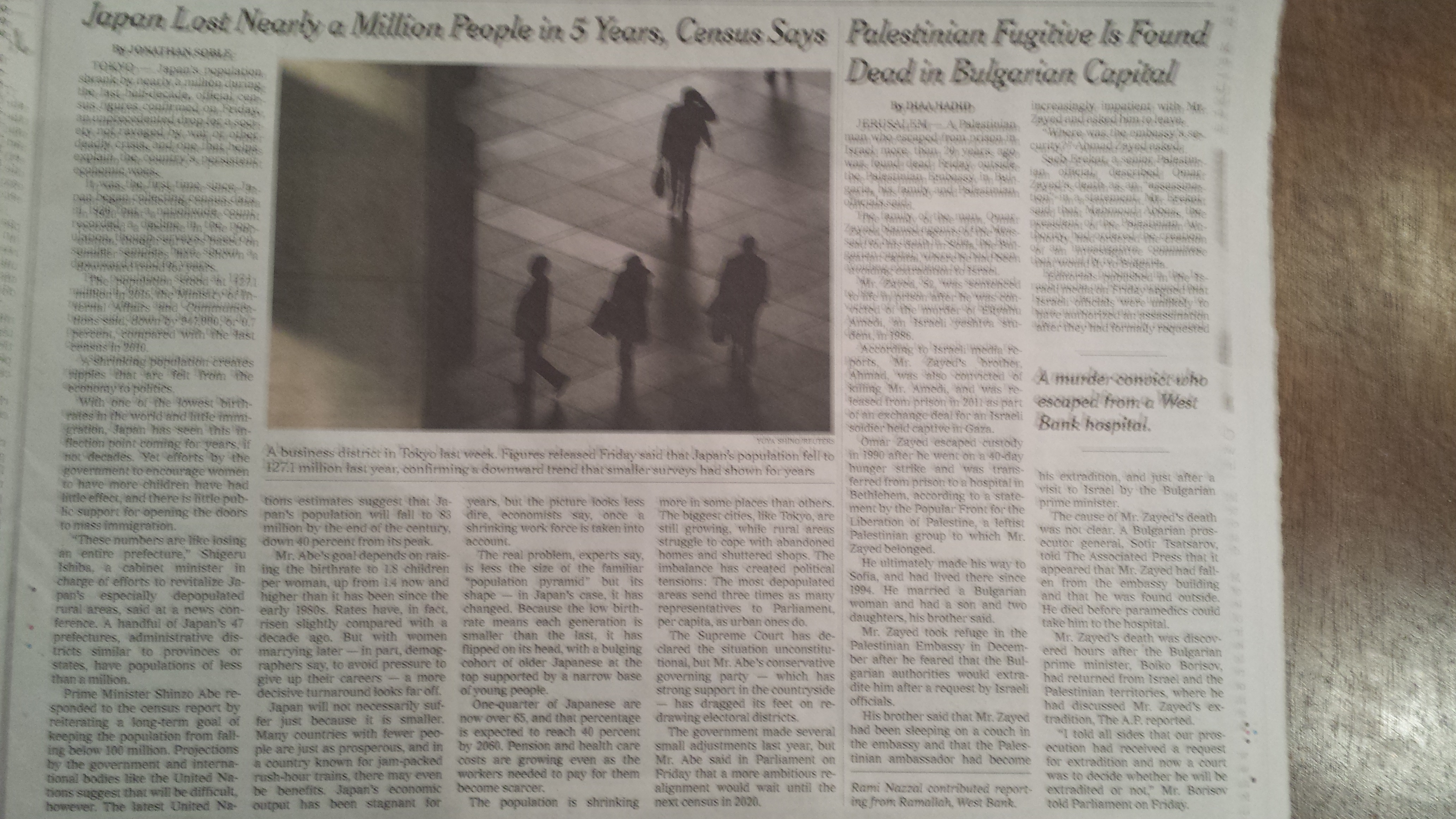
On February 27, 2016, the New York Times ran an article on page A7 by Diaa Hadid titled “Palestinian Fugitive Is Found Dead in Bulgarian Capital.” The article described how “a Palestinian man who escaped from prison in Israel more than 20 years ago was found dead outside the Palestinian Embassy in Bulgaria.” The piece described how “Mr. Zayed, 52, was sentenced to life in prison after he was convicted of the murder of Eliyahu Amedia, an Israeli yeshiva student, in 1986…. Omar Zayed escaped custody in 1990 after he went on a 40-day hunger strike and was transferred from prison to a hospital in Bethlehem, according to a statement by the Popular Front for the Liberation of Palestine, a leftist Palestinian group to which Mr. Zayed belonged.”

Wow. The New York Times described the PFLP as a “leftist group.” Is it?

Popular Front for the Liberation of Palestine (PFLP)

The PFLP was founded in December 1967, and makes no secret about its enemies: Israel; the “World Zionist Movement”; and the United States of America. The inclusion of the USA is clear, as the PFLP states on its website: “In the battle for the liberation of Palestine, we are facing a third force, that of world imperialism led by the United States of America.”

The goal of the PFLP is the complete destruction of Israel through armed conquest from all sides. As it states in its manifesto written in 1969: “The armed struggle against Israel and all imperialist interests in our homeland, the expansion of the armed struggle front which stands in the face of Arab reaction and all imperialist interests and bases in the Arab homeland, and the encirclement of Israel with the strategy of the people’s liberation war from every side – from Syria, Egypt, Lebanon, Jordan and inside the territory occupied before and after 5 June 1967 – is the only path that leads to victory.

pflp
PFLP logo, showing map representing the Arab world
entering and consuming all of Israel

Some of the group’s activities have included:

  • Hijacking El Al plane (July 1968)
  • Hijacking three planes (September 1970)
  • The assassination Israeli Member of Knesset Rehavam Ze’evi (October 2001)
  • Suicide bombing in a pizza store in Karnei Shomron killing three civilians (February 2002)
  • Suicide bombing in a bus station in Tel Aviv killing three (December 2003)
  • Suicide bombing in a food market in Tel Aviv killing three (November 2004)
  • Killing four rabbis praying in a synagogue with axes and knives in Jerusalem (November 2014)

The PFLP continues to incite terrorism, as it praises attacks and calls on all strugglers in Palestine to escalate the flame of the intifada.

Due to its mission and actions, the US State Department labeled the PFLP a foreign terrorist organization (FTO) when it formulated such list at inception on October 8, 1997, together with the PFLP-General Command.

pflpsweetsgaza
PFLP hands out sweets after the group claimed credit for hacking four Jewish worshipers to death in a Har Nof synagogue
November, 2014

And the New York Times decided to label this terrorist group a “leftist group’ rather than a terrorist group.

The New York Times Welcomes Arab Terrorism to the “Left”

The NYT is proud of its left-leaning ways.

Just recently, as the paper endorsed Hillary Clinton for the Democratic nomination for president, it considered that her challenger, Senator Bernie Sanders had fortunately brought the former Secretary of State further to the left: “[Sanders] has brought income inequality and the lingering pain of the middle class to center stage and pushed Mrs. Clinton a bit more to the left than she might have gone on economic issues. Mr. Sanders has also surfaced important foreign policy questions, including the need for greater restraint in the use of military force.

Note that the Times considers the “greater restraint in the use of military force” to be a leftist ideal. Yet, somehow, the Times called a militant Palestinian Arab group, an organization which has led dozens of suicide bombings, murders and plane hijackings, a group which is a Foreign Terrorist Organization (FTO) according to the US State Department – a “leftist group.”

Perhaps the greater restraint of military forces is a leftist ideal, only when such force is used by America and its allies.

If the right-leaning Wall Street Journal decided to label a terrorist group a “left-wing group,” presumably, many people on the left would be greatly offended. Aligning mass murderers and people who are sworn enemies of the United States, with the liberal cause would be called out as a libelous charge. Letters to the editor would pour forth from “progressive” pens denouncing the comparison.

But here, the left-leaning NYT opted to embrace the terrorist group as one of its own. It actively chose to align their political points of view.

The liberal paper has long declined to label Hamas, another Palestinian Arab group, as a terrorist group.  The paper often uses soft language like “a militant group” or “an Islamist group” to portray that FTO.

In February 2016, the Times moved passed softening the image of Palestinian terror.  It baptized and embraced Arab terror.

If this is the modern day version of being “progressive,” the entire world should loudly condemn it in every way possible.

20160227_201234
New York Times article by Diaa Hadid on February 27, 2016


Related First.One.Through articles:

The New York Times wants the military to defeat terrorists (but not Hamas)

Why the Media Ignores Jihadists in Israel

The Palestinians aren’t “Resorting to Violence”; They are Murdering and Waging War

What do you Recognize in the Palestinians?

Subscribe YouTube channel: FirstOneThrough

Join Facebook group: FirstOne Through  Israel Analysis

#NYTimes #BlackLivesDontMatter

The New York Times is one of the country’s most venerated and most liberal newspapers.  Its articles and editorials often use a pluralistic and “progressive” approach in covering events.

Yet, for some reason, year after year, the paper refuses to highlight the terrorism running rampant in Africa.

Boko Haram. Al Shabab. Ansar Dine.  It is not a short list, and the attacks are not inconsequential.

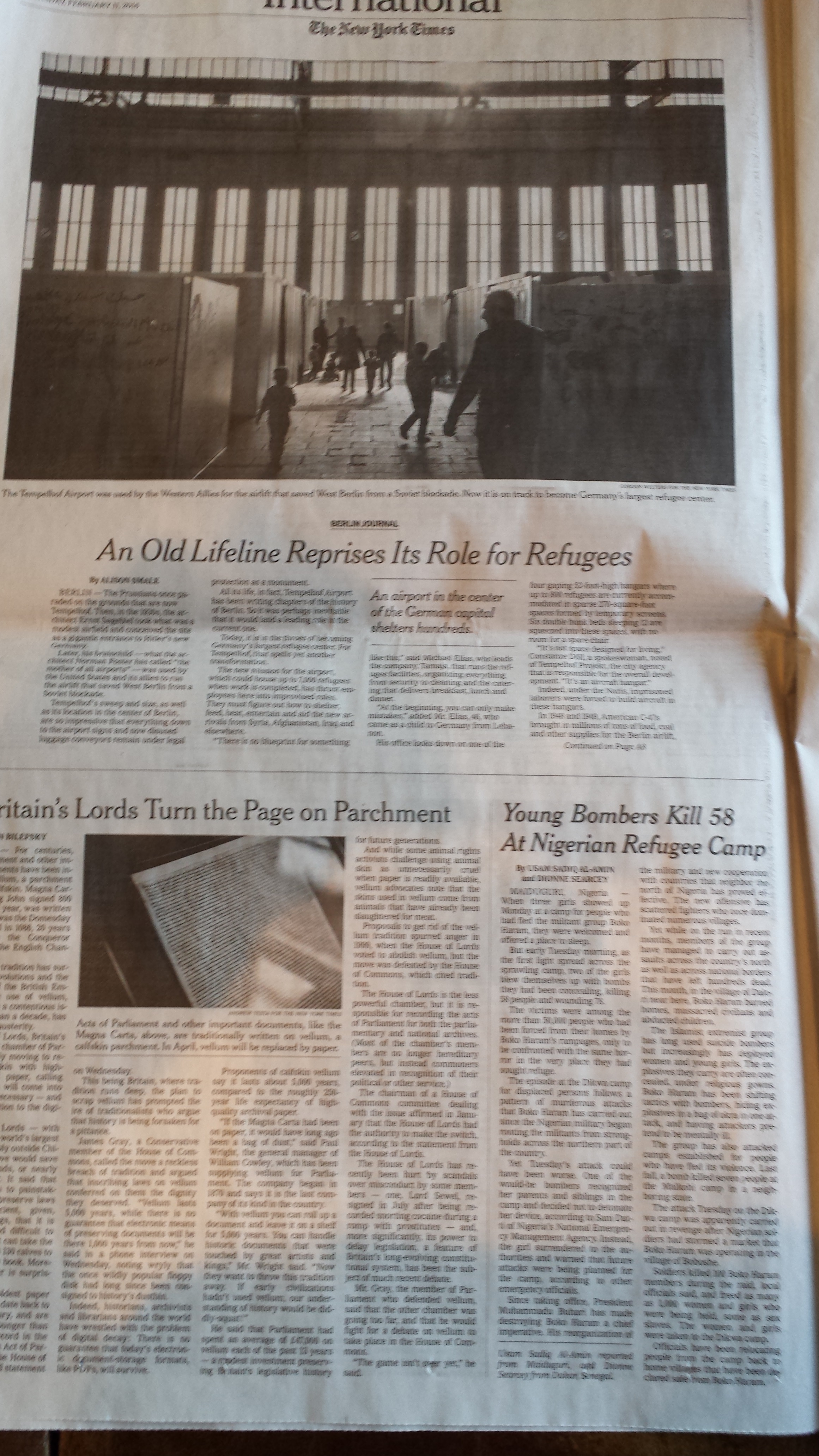
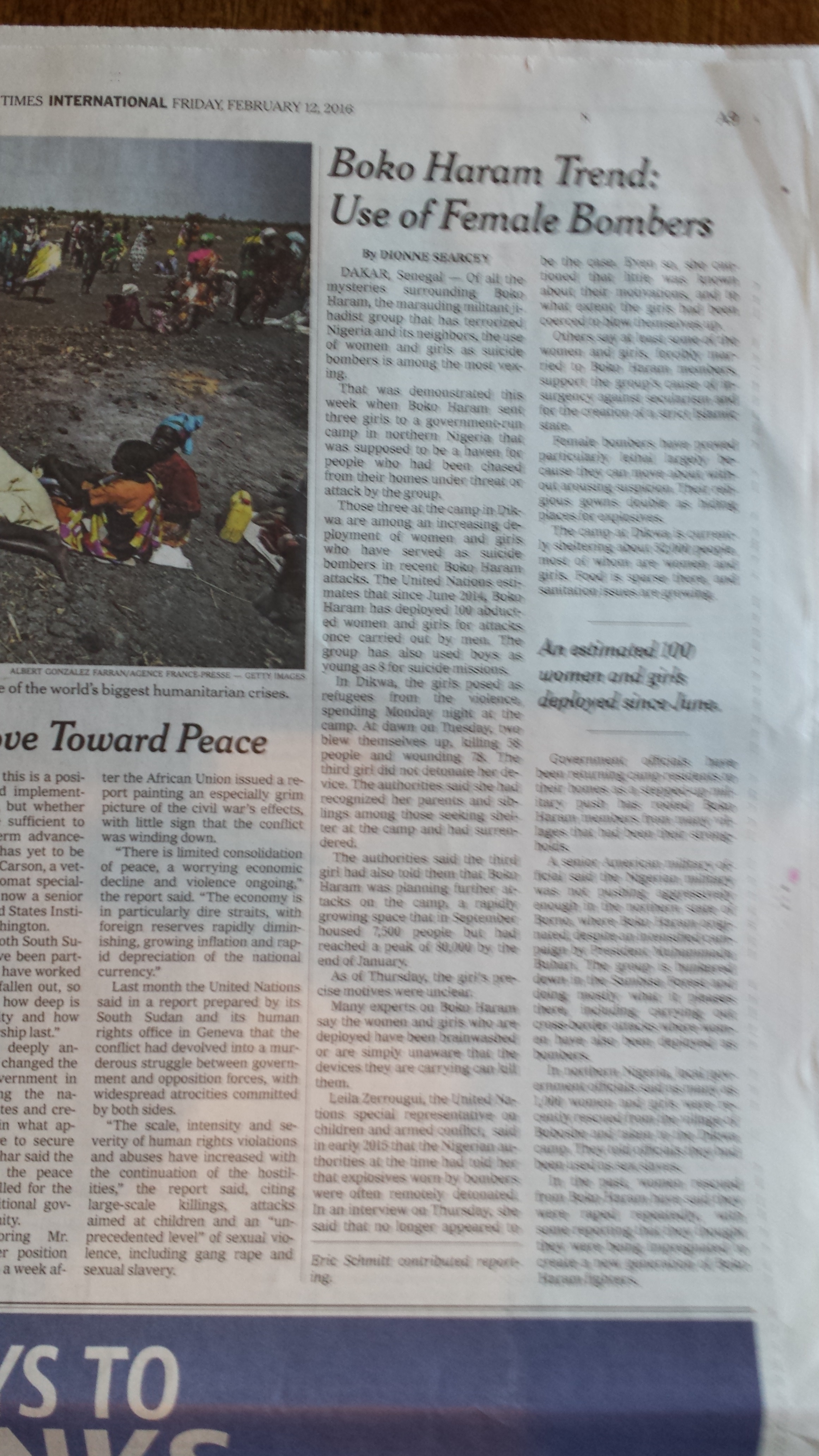
This week, three young girls blew themselves up in Nigeria killing scores.  Yet the New York Times posted the news back on page A4.  At the bottom of the page.  With no picture.

20160212_085519
New York Times February 11, 2016 Page A4
story on killing of 58 Nigerians

Would the Times ever consider showing such poor coverage of terrorism in Paris?  Never.  The murder of a dozen people there received front page attention.

If one chose to be generous to the news organization and argue that there wasn’t enough time to cover the story in Nigeria properly… what about the coverage on the following day?

20160212_085437
New York Times February 12, 2016 page A9

Nope.

The Times continued to give the story poor coverage.  It buried the story in the middle of the paper and again did not use any photographs.

Well, let’s try to find another excuse for the Times – just for fun.  Maybe the Times doesn’t cover the murders in Africa because it is a war zone with constant attacks, unlike Paris which is just a peaceful European city.

Then how does one explain the constant front page coverage of suffering Palestinians? In the summer of 2014, the Times put pictures of injured Palestinians on the front page on July 11, 14, 17, 21, 22, 24 and 29.  Quite a stretch.

This is the long sad history of the Times.  African Lives Don’t matter.  Even during Black History Month.


Related First.One.Through articles:

Every Picture Tells a Story- Whitewashing the World (except Israel)

New York Times’ Lost Pictures and Morality for the Year 2015

Every Picture Tells a Story: Arab Injuries over Jewish Deaths

Strange difference of opinion on Boko Haram and Hamas in New York Times

Select Support in Fighting Terrorism from the US State Department

Subscribe YouTube channel: FirstOneThrough

Join Facebook group: FirstOne Through  Israel Analysis

New York Times’ Lost Pictures and Morality for the Year 2015

On December 27, 2015, the New York Times shared its thoughts for a “Year in Pictures.” The Sunday Review was dominated by the waves of refugees and migrants from the MENA region (Middle East and North Africa) as well as pictures of terrorism that touched much of the world. For the Times, this excluded Israel.

The Times led its discussion with an opening paragraph: “This was the year of the great unravelling, with international orders and borders challenged or broken, with thousands of deaths, vast flows of migrants and terrorist attacks on some of the most cherished symbols of civilization, both Western and Muslim.

It continued with some reviews of terrorism: “Palmyra and Paris (twice), Aleppo, Homs, Kobani and even San Bernadino, Calif…. The outrages of Boko Haram and the Shabab in Africa. The abuse of the Rohingya minority in Myanmar. The war in Ukraine and the resurgence of the Taliban in Afghanistan. New tensions in the skies over the Baltics and a Russian plane shot down by a NATO country for the first time in decades.

The ruins still in Gaza, a year after a brutal and inconclusive war, and Israel hunkering down in a region losing its compass. Even the energetic secretary of State, John Kerry, has given up on serious negotiations for Mideast peace.”

In a year where Palestinian Arabs repeatedly attacked Israel civilians killing dozens, the Times decided to highlight the Gaza war of a year ago and dismissed the shift of the Arabs’ battlefront to Judea and Samaria from Gaza. It was not an oversight, as relayed in the Times’ actual pictures.

The chronology of pictures of the year included a number of pictures related to terrorist attacks:

  • A large picture of politicians holding hands in Paris after the January attacks (no attribution given to the killers);
  • A large picture in Kenya after students slaughtered in April (attribution to “Shabab militants”)
  • A small picture in South Carolina in July where “A Confederate flag was removed from the state house after the massacre of black churchgoers in Charelston.
  • A large picture from Gaza in August with a caption “Concrete salvagers in a building destroyed by the 2014 war between Israel and Palestinian militants in Gaza.”
  • A large picture of a victim from the Paris attacks in November (no attribution of who were the terrorists)
  • A medium sized picture of mourners in Paris honoring the victims of the November murders (no attribution)
  • A large picture of mourners in Lebanon from terrorist bombings in November (no attribution)
  • A small picture of people in California after a December attack with a caption “A candlelight vigil commemorated the victims of a mass shooting by a radicalized Muslim couple.

DSC_0041
New York Times’ large picture of ruined building in Gaza

What message could a person extract from the New York Times review of the significant events of the year? Much of the same message that the Times imparted throughout the year:

  • Terrorist attacks in the United States were not as significant as attacks elsewhere in the world
  • The Islamic State/ISIS was not labelled as responsible for any of the terrorist attacks in the world
  • The dozens of Israelis killed in the fall of 2015 were not mentioned in text nor portrayed in pictures, as the Times did not view Israelis as terrorist victims
  • Gazans were portrayed as victims, a year after their elected terrorist leaders launched their latest battle to destroy Israel and kill Israeli civilians.

The New York Times became more deliberate in separating radical Islam from global terrorism, just as President Obama did and while Republican Presidential candidate Donald Trump drew attention to the issue. The only mention of Islam in the picture captions was in the very final picture of the year.

The Times has always been deliberate about Israel. Israelis who were shot, stabbed and run over were not victims of terrorism. Israelis did not suffer. Israelis did not mourn.

However, Palestinian Arabs who have continued to fight for the destruction of Israel were featured among pictures of the sufferers and mourners.

If the trends continue, the New York Times’ 2016 Year in Pictures” will likely feature the western world as the radical terrorists.


Related First.One.Through articles:

Every Picture Tells A Story: Only Palestinians are Victims

Every Picture Tells a Story: The Invisible Murdered Israelis

Framing the Israeli-Palestinian Arab Conflict: WSJ and NY Times

Every Picture Tells a Story: Arab Injuries over Jewish Deaths

Every Picture Tells a Story: Versions of Reality

The New York Times Picture of the Year, 2014

Subscribe YouTube channel: FirstOneThrough

Join Facebook group: FirstOne Through  Israel Analysis


New York Times’ Tales of Israeli Messianic War-Mongering

Summary:  One year after acknowledging that Palestinians were to blame for the failed Israeli-Palestinian Authority peace process, left-wing NY Times contributor Roger Cohen cast Israelis as fanatical nationalists and Palestinians as passive, despondent victims. The Times’ cure for Jews’ violent adherence to their religious texts is punishing settlers with BDS, while the paper distanced Muslims from their religion and called for greater compassion towards these innocents.


Just in time for Christmas, Roger Cohen decided to write about the Israeli-Palestinian Arab conflict. Again.

In an article called “The Assassination in Israel that Worked,” Cohen portrayed an Israeli society overrun with religious fanatical murderers. He described the killer of Israeli Prime Minister Yitzhak Rabin, Yigal Amir, as “a religious-nationalist follower of Baruch Goldstein, the American-born killer of 29 Palestinian worshipers in Hebron in 1994.” He wrote about Jews living east of the Green Line (EGL) as obsessed with “Messianic Zionism,” at odds with the concept of democracy. Because Palestinians are desperate for their own state, Jews living in EGL make “violence inevitable” according to Cohen. He argued that the UN’s creation of Israel “was territorial compromise, as envisaged in Resolution 181 of 1947, calling for two states, one Jewish and one Arab, in the Holy Land. This was humankind’s decision, not God’s.” In short, according to Cohen, the vast Messianic cult of violence in Israel seeks all of the Holy Land, but the rights of Jews are limited to just half of the land as dictated by man’s laws.

Lastly, Cohen argued, the only way to push back against the right-wing Israelis and their government was to employ different angles of the BDS movement (Boycott, Divestment and Sanctions) in which Obama should “close American loopholes that benefit Israeli settlers.”

Here is a bit of education for Roger Cohen (maybe the byline was wrong and this was written by Roger Waters of Pink Floyd, the loud advocate of BDS?):

A smaller percentage of Jewish “settlers” are murderers, than are terrorists which are Muslim.  The Cohen opinion piece would lead a person to believe that every Jewish “settler” takes up arms against Arabs, while the reality is that almost every Jew living in the land seeks to live in peace with their Arab neighbors. Baruch Goldstein was an anomaly, not the rule.

Why would the Times print such an inflammatory piece against Jews when it is in the midst of a blitz about the dangers of “Islamophobia”?  The Times wrote over-and-again that most Muslims are peaceful and that Muslim terrorist abuse the interpretation of Islamic holy texts.  Yet the Times was eager to describe Jewish killers as motivated by the plain reading of the Jewish holy texts, and suggested that any Jew living in Judea and Samaria is either a potential killer, or instigates Palestinian violence.

It is untrue, unfair and reeks of hypocrisy to portray Jews in such a manner.  There are almost no Jews in Judea and Samaria that committed murders, but the Times labelled all “settlers” as devout killers.  Meanwhile, the global jihadist movement enlisted thousands and slaughtered thousands, and the Times rallied to the defense of Muslims.

IMG_3677IMG_3674
“Islamophobia” Op-Eds from Paul Krugman on December 11, 2015, and
Nicholas Kristof on December 13, 2015

IMG_3670IMG_3671
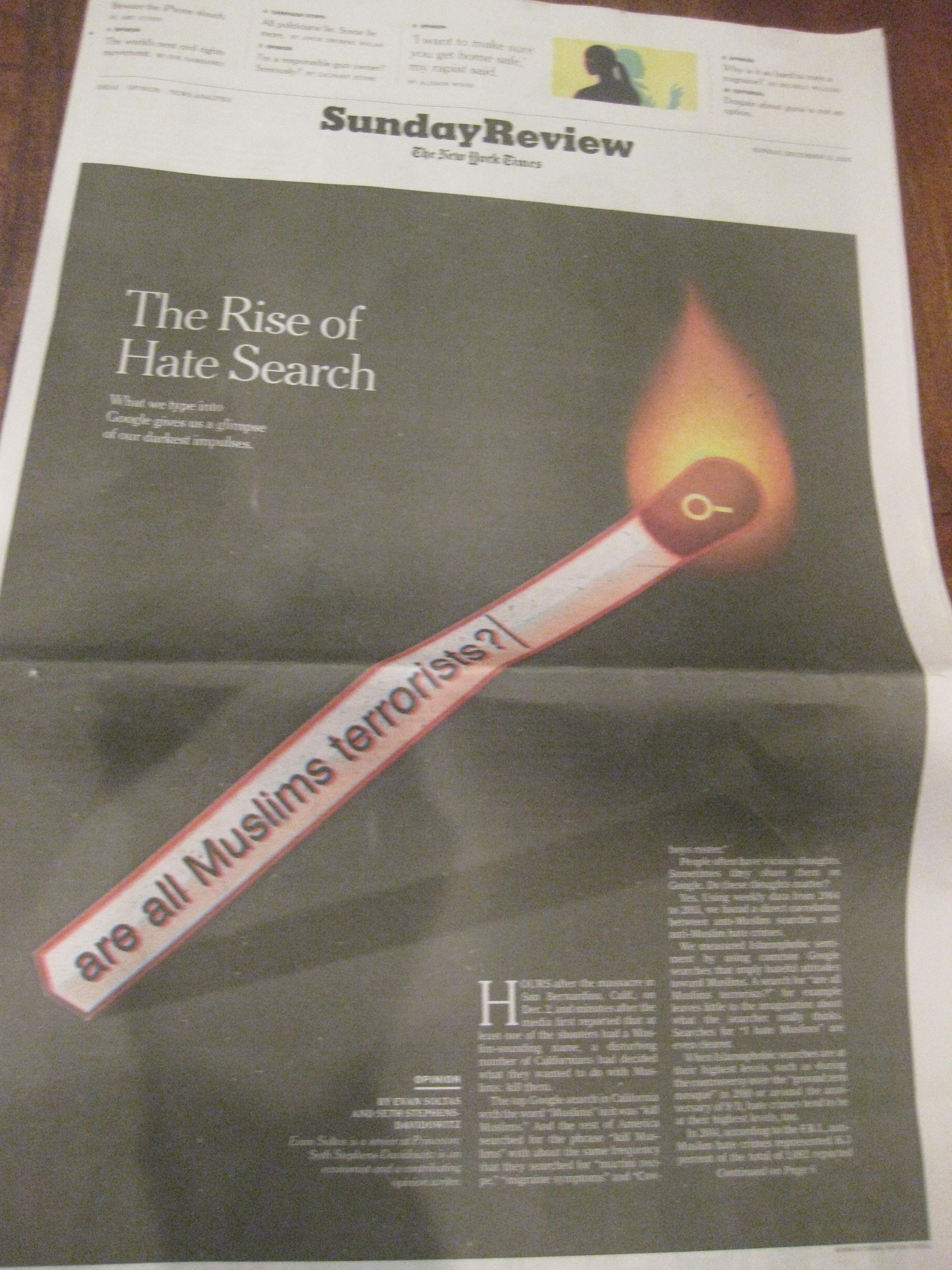
Front Page of NY Times Sunday Review on “Islamophobia”
on December 13, 2015

IMG_3662IMG_3667
Front Page New York Times story on December 15, 2015 about
Young Muslims suffering from “Islamophobia”

Jews are entitled to live in EGL/ Judea and Samaria according to international law. The 1922 Mandate of Palestine by the League of Nations clearly and specifically encouraged Jews to live throughout the Holy Land, including areas now known as the “West Bank.” The Mandate included language that specified that no one should be prevented from living anywhere because of their religion.

“Messianic Zionism” may be a driving force motivating some Jewish families to move to the region, just as they might move to Haifa or Be’er Sheva. Some people are motivated by Zionism without a Messianic component, while others go for good jobs in the only liberal democracy in the Middle East.  The motivation for living there is irrelevant; the right of Jews to live anywhere in the Holy Land was established in international law.

“Violence is inevitable” because Arab don’t want Jews as neighbors, not because Arabs want a state.  Arabs have been killing Jews in the Holy Land for 100 years.  In several episodes in the 1920s, including the brutal Hebron massacre in 1929, Arabs called for ridding the land of Jews.  On the eve of the Holocaust, they launched multi-year riots (1936-9) slaughtering dozens of Palestinian Jews and convinced the British to limit Jewish immigration, causing the death of hundreds of thousands of European Jews.

Whites in the 1950s also did not want to live with black neighbors. Racism and anti-Semitism are to be condemned, not rationalized.  Shame on the New York Times for defending Arab attacks on Jews.

The establishment of Israel as a Jewish State has been rejected by the Arabs for 100 years, and counting.  Cohen pointed to the United Nations Partition Plan which called for creating a Jewish State in 1947.  He failed to say that the Arabs REJECTED that plan.  They opted to launch a war against Israel instead.

Israel has continued to seek peace with its neighboring Arab countries: Jews approved the partition plan in 1947; the country uprooted Jews living in Sinai in 1982; it handed various cities to the Palestinian Authority in 1995; it uprooted Jews from Gaza in 2005. Israel made various peace offers to the Palestinians, including in 2000 and 2008. The Palestinians reacted to each offer with wars, and continue to reject Israel as the Jewish State to this day.

Conclusion

One year ago, Cohen wrote Why Israeli-Palestinian Peace Failed. “ In the article, he acknowledged various Israeli peace efforts including settlement freezes and prisoner releases.  In exchange for the Israeli gestures, the Palestinian Authority created a reconciliation government with the terrorist group Hamas, and joined international bodies counter to the agreed upon peace framework.  The peace talks collapsed.

Cohen has now concluded that while the Palestinians suffer from ineptitude and corruption, at the end of the day, their cause is just.  The Palestinians are not only despondent, but desperate for an external force to advance their vision of a state.  Cohen believes that Obama should begin to advance various iterations of BDS on Jews living east of the Green Line to assure the Palestinians goal of a Jew-free state (Obama has indicated in the past that he approves of a Judenfrei Palestine). Cohen had no suggestions – or concerns – of how to make Palestinians approve of the Jewish State living in security.

The radical left-wing call for BDS of the Israeli territories is easier to make when one ignores the 99% of peaceful families living in Judea and Samaria.  So Cohen, and other Israel-bashers paint all of these Jews as “Messianic Zionists” who are out of touch with reality.  They are either murderers of Arabs like Baruch Goldstein, or of the peace process with Arabs like Yigal Amir.

Cohen fails two of Natan Sharansky “Three Ds” test for anti-Semitism: demonization and double standards.  To rephrase the great ballad-rocker Meatloaf, Two of the Three IS Bad.

When will the Times and the left-wing fringe look at the Jewish families with an iota of the compassion they shower upon peaceful Muslims?


Related First.One.Through articles:

Palestinians are “Desperate” for…

Nicholas Kristof’s “Arab Land”

Framing the Israeli-Palestinian Arab Conflict: WSJ and NY Times

Names and Narrative: The West Bank / Judea and Samaria

Israel was never a British Colony; Judea and Samaria are not Israeli Colonies

Every Picture Tells A Story: Only Palestinians are Victims

The Narrative that Prevents Peace in the Arab-Israeli Conflict

Israel and Wars

Subscribe YouTube channel: FirstOneThrough

Join Facebook group: FirstOne Through  Israel Analysis
The New York Times on the History of Gush Etzion

The New York Times actually tried to give its readers some history of Gush Etzion for a change. Unfortunately, it still missed the critical points.
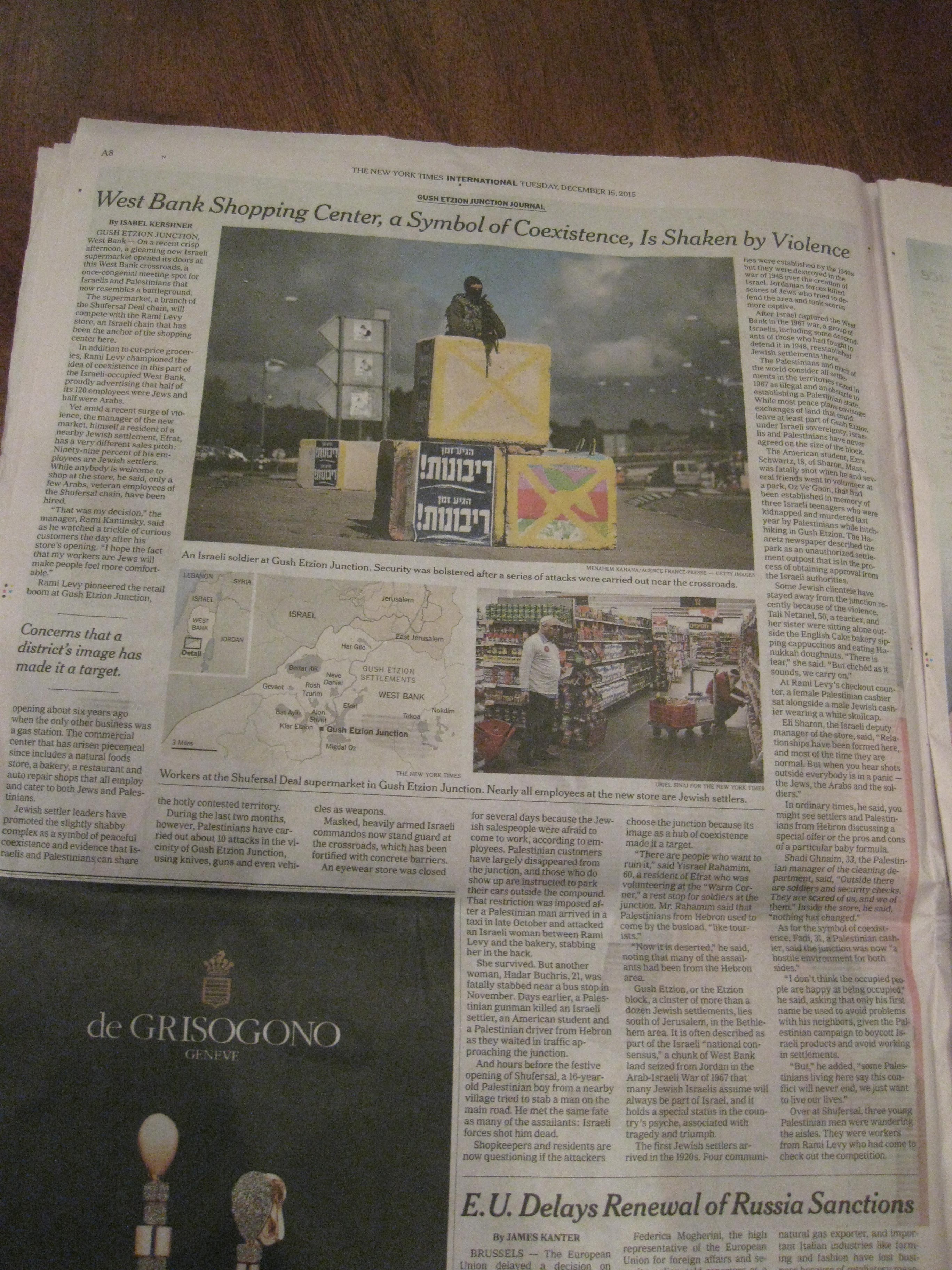
IMG_3663
New York Times article from December 15, 2015
In an article entitled “West Bank Shopping Center, a Symbol of Coexistence, is Shaken by Violence,” the Times gave more detailed history than typical when it provided background on the Gush Etzion “settlements” in Judea and Samaria/ West Bank of the Jordan River.  While the paper would typically state that “the world considers all settlements seized by Israel in 1967 as illegal,” it opted to give more historical context on December 15th.  It wrote:
“Gush Etzion, or the Etzion block, a cluster of more than a dozen Jewish settlements, lies south of Jerusalem, in the Bethlehem area. It is often described as part of the Israeli “national consensus,” a chunk of West Bank land seized from Jordan in the Arab-Israeli War of 1967 that many Jewish Israelis assume will always be part of Israel, and it holds a special status in the country’s psyche, associated with tragedy and triumph.

The first Jewish settlers arrived in the 1920s. Four communities were established by the 1940s but they were destroyed in the war of 1948 over the creation of Israel. Jordanian forces killed scores of Jews who tried to defend the area and took scores more captive.

After Israel captured the West Bank in the 1967 war, a group of Israelis, including some descendants of those who had fought to defend it in 1948, reestablished Jewish settlements there.

The Palestinians and much of the world consider all settlements in the territories seized in 1967 as illegal and an obstacle to establishing a Palestinian state. While most peace plans envisage exchanges of land that could leave at least part of Gush Etzion under Israeli sovereignty, Israelis and Palestinians have never agreed on the size of the block.”

The Times opted to repeat its often used language – twice – but it did give much more history than it normally does.  However, while it described Jews moving to area in the 1920s, and some of the new residents as descendants of those original settlers, the reader was still left with the wrong impression that Jews are living there illegally.
Key points that were omitted from the article:
  • The 1922 League of Nations Mandate specifically gave Jews the right to live and establish themselves THROUGHOUT the Holy Land. This was a matter of international law and the Jews availed themselves of this legal right.  In 1922, there was no concept of a “West Bank.”  It was all just “Palestine” and Jews legally purchased land and built homes in Gush Etzion.  As stated in Article 6, the Mandate “shall facilitate Jewish immigration under suitable conditions and shall encourage, in co-operation with the Jewish agency referred to in Article 4, close settlement by Jews on the land, including State lands and waste lands not required for public purposes.”  Further, Article 15 of the Mandate specifically stated that no part of Palestine should be off-limits to people based on their religion: “No discrimination of any kind shall be made between the inhabitants of Palestine on the ground of race, religion or language. No person shall be excluded from Palestine on the sole ground of his religious belief.”
  • When Jordan illegally attacked Israel in 1949 and killed the Jews in Gush Etzion, it did not undermine the legal rights Jews had for living in their homes.
  • Jordan’s illegal expulsion of all of the Jews from the region in 1949 counter to the fourth Geneva Convention was not mentioned by the Times.
  • The fact that Jordan illegally annexed the region in 1950 in an action that was never recognized by any country was also omitted.
  • Jordan (and Palestinians who had been granted Jordanian citizenship) attacked Israel in 1967, counter the Israel-Jordan Armistice agreement, and Israel was legally justified in responding in self-defense.
  • Jordan gave up all claim to the region in 1988.
It was nice to see the Times take steps to educate readers a bit more about Gush Etzion.  However, the details provided still left a reader with the impression that Jews live in Gush Etzion illegally, and it is only a matter of “national consensus” that leads Israelis to believe that the bloc will be formally part of Israel.  The many illegal activities of Jordan also continue to be ignored.
Perhaps the full facts disturb the Times’ narrative too profoundly to detail.

Related First.One.Through articles:

Subscribe YouTube channel: FirstOneThrough

Join Facebook group: FirstOne Through  Israel Analysis