
Comparing Coverage Of Golan Heights and “West Bank”

The media has begun paying more attention to Syria as the country’s 54-year old regime has fallen to insurgents tied to ISIS and Turkey. As part of its coverage, it has marked the Golan Heights on its maps. It makes this an opportune time to review the very different coverage of two contested areas – Golan Heights and West Bank – between Israel and its neighbors.

In the Media
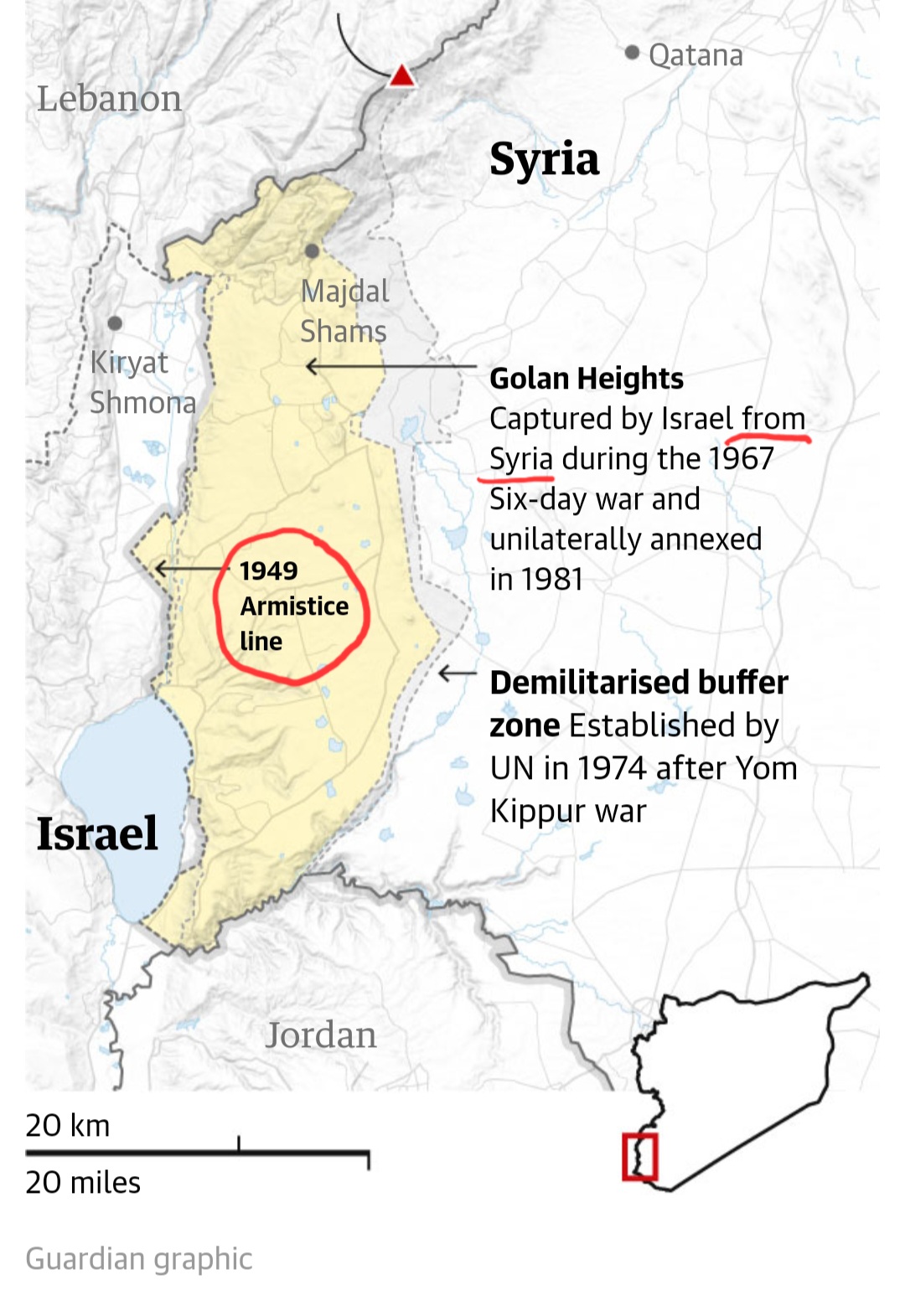
The Guardian’s map of the Golan Heights in December 2024

The Guardian presented a map of the Golan Heights calling the separation between Israel and Syria as the “1949 Armistice line.” It also noted that the Heights were “captured by Israel from Syria during the 1967 Six-day war.” Both of these statements are factually correct.

And completely divorced from how the media describes the “West Bank.”

Rather than use the term “1949 Armistice line”, the press calls it the “1967 border” even though it was never a border nor meant to be a border. As described in the 1949 Israel-Jordan Armistice Agreement in Article VI, “The Armistice Demarcation Lines defined in articles V and VI of this Agreement are agreed upon by the Parties without prejudice to future territorial settlements or boundary lines or to claims of either Party relating thereto.” In other words, the lines were simply set to separate the warring parties but political negotiations would craft the contours of the land in the future.

In regards to the phrase “from Syria,” the media never notes that Israel didn’t capture the “West Bank” land from Palestine but from Jordan, as Palestine did not exist.

The media – and the United Nations – mislead people that Israel took the West Bank from Palestine in an aggressive war. That is completely untrue, and obfuscated by terminology.

Geography

The Golan Heights are an actual topographical piece of earth. The large hills and mountains shoot up from the Sea of Galilee and beyond from volcanic activity.

Not so for the “West Bank.” It has no geographical or historical significance, other than being east of the 1949 Armistice line. It wasn’t even called the “West Bank” until after the 1967 Six-day war, as Jordan had illegally annexed it in 1950 and the UN just called it part of Jordan.

Arab States Breaking the Armistice Agreements

The Israel-Syria and Israel-Jordan Armistice Agreements specifically called on all parties to not take military action against the other. Both Arab states violated those agreements.

Syria shelled the farmlands of Israel’s Galilee for years, forcing Israel to defend itself and take the Golan Heights to keep Syria from repeating the attacks. Similarly, Jordan attacked Israel in June 1967 and Israel captured the region in a defensive action during the Six-day war.

Internationally Defined Borders

International powers created the various lines for Lebanon, Syria, Iraq and Palestine after World War I. Each region slowly declared independence but not without difficulties. Each has gone through several wars, including civil wars. A populace more comfortable with tribes and clans operating under the umbrella of the Ottoman Empire for centuries were thrust into statehood. While modern academics blame the regional powers for “colonialization” and “imperialism” which left the locals bereft of natural resources, it was actually the imposition of statehood that has confounded much of the Middle East. Syria, Iraq and Lebanon are perfect examples of the internal strife which has killed millions over the decades.

“Palestine” was similarly crafted by world powers, and then quickly divided further by chopping off the region east of the Jordan River for the Hashemite Kingdom to rule. The balance of the land (which most people think of as pre-1948 Palestine) was designed to be “a national home for the Jewish people,” in the Palestine Mandate as adopted by the League of Nations. While the Golan Heights was marked by the powers to be part of Syria, those same powers marked the “West Bank” to be part of the Jewish homeland.

On one hand, Israel captured the Golan Heights after Syria broke the Armistice Agreement, and on the other, Israel RECAPTURED the West Bank/ area east of the 1949 Armistice Lines, in 1967 after Jordan broke its Armistice Agreement.

Names

Republicans in the United States are putting forward resolutions to stop calling the land “West Bank” and instead refer to it as “Judea and Samaria.” Sen. Tom Cotton (R-AK) said in introducing the resolution that “The Jewish people’s legal and historic rights to Judea and Samaria goes back thousands of years. The U.S. should stop using the politically charged term West Bank to refer to the biblical heartland of Israel.” That is partially true.

Judea and Samaria have historical context and are much bigger contours than the “West Bank.” The West Bank is an artifice of war; it is just the land the the Jordanians took in the 1948-9 war in which they attempted to destroy the nascent Jewish State. The more accurate term for political purposes would be to call it E49JAL, for the area east of the 1949 Jordanian Armistice Lines.

Conclusion

The media is correctly referring to the Golan Heights, an actual region with topographical significance, as having an Israeli side captured FROM SYRIA, across the “1949 Armistice line.” It should similarly stop using the terms “borders,” “West Bank” and “from Palestine” which are all factually incorrect and attempt to frame the conflict with the Stateless Arabs from Palestine (SAPs) in a duplicitous manner that portrays Israel as the aggressor.

Hateful and Violent Platforms: Comparing Facebook and the Golan Heights

Social media companies have been urged by U.S. government officials to do more to curb the spread of hateful ideology on their platforms. While the major platforms like YouTube and Facebook had long ago removed content which promoted violence, last week those companies took measures to remove not only specific hateful speech, but banned the individuals and hate groups themselves.

Initially Facebook had touted itself as a town hall/ public square of sorts. If an individual or group had the legal right to say something in public – even objectionable – they would permit such expression online. However, in the wake of fake news and the spread of terrorism, Facebook opted to ban “dangerous individuals” including Louis Farrakhan, Alex Jones and Laura Loomer.

The reaction has been mixed.

While many people believe that the opinions of some individuals raise a level of hatred in society and welcome a new world order where such opinions would be deprived air, others are worried that the powerful global platforms would become the arbiters of what is considered permissible speech. Why should pointing out noxious radical Muslim Antisemitism be an action worthy of being banned while Holocaust denial is acceptable? Why should a crazy conspiracy theory that Jews were behind the terrorism of 9/11 be free to publish, while pointing to studies linking vaccinations and autism land someone in social media purgatory?

Others contend that YouTube and Facebook are private companies and are free to set the standards of their choosing. But is that so clear? Can the platforms, for example, more actively ban conservative content like PragerU than hate groups like Students for Justice in Palestine? If all private companies are permitted to decide for themselves what can be served on their platform, why the big fuss of the Colorado baker making a gay wedding cake? He didn’t ban gay people from buying items in his store, he just wouldn’t sell certain items at his store, nor create such items.

Governments also deny certain individuals particular rights if they feel such people are threats of its society.

Many countries – including leading democracies such as the United Kingdom, the United States and Israel – deny entry and citizenship to individuals “not conducive to the public good.” Some countries do more than just turn people away; they strip individuals of certain rights if they are viewed as threats, condemning them to “civil death.” These people lose the rights to use the country’s legal system, making it impossible to work in certain fields or even to own property.

The application of such principle is used in international contexts in the Middle East.

After decades of Syria shelling Israeli citizens in the 1950’s and 1960’s, and listening to Syrian taunts and threats of destroying Israel, Israel took the Golan Heights in the June 1967 Six Day War. That elevated platform was the launching pad Syrians used to attack the Israeli north. Israel effectively annexed the region in 1981 and the United States officially recognized Israeli rights to the area in March 2019, as the Syrian civil war wound down leaving the murderous dictator Basha al-Assad in place.


The Israeli Golan Heights
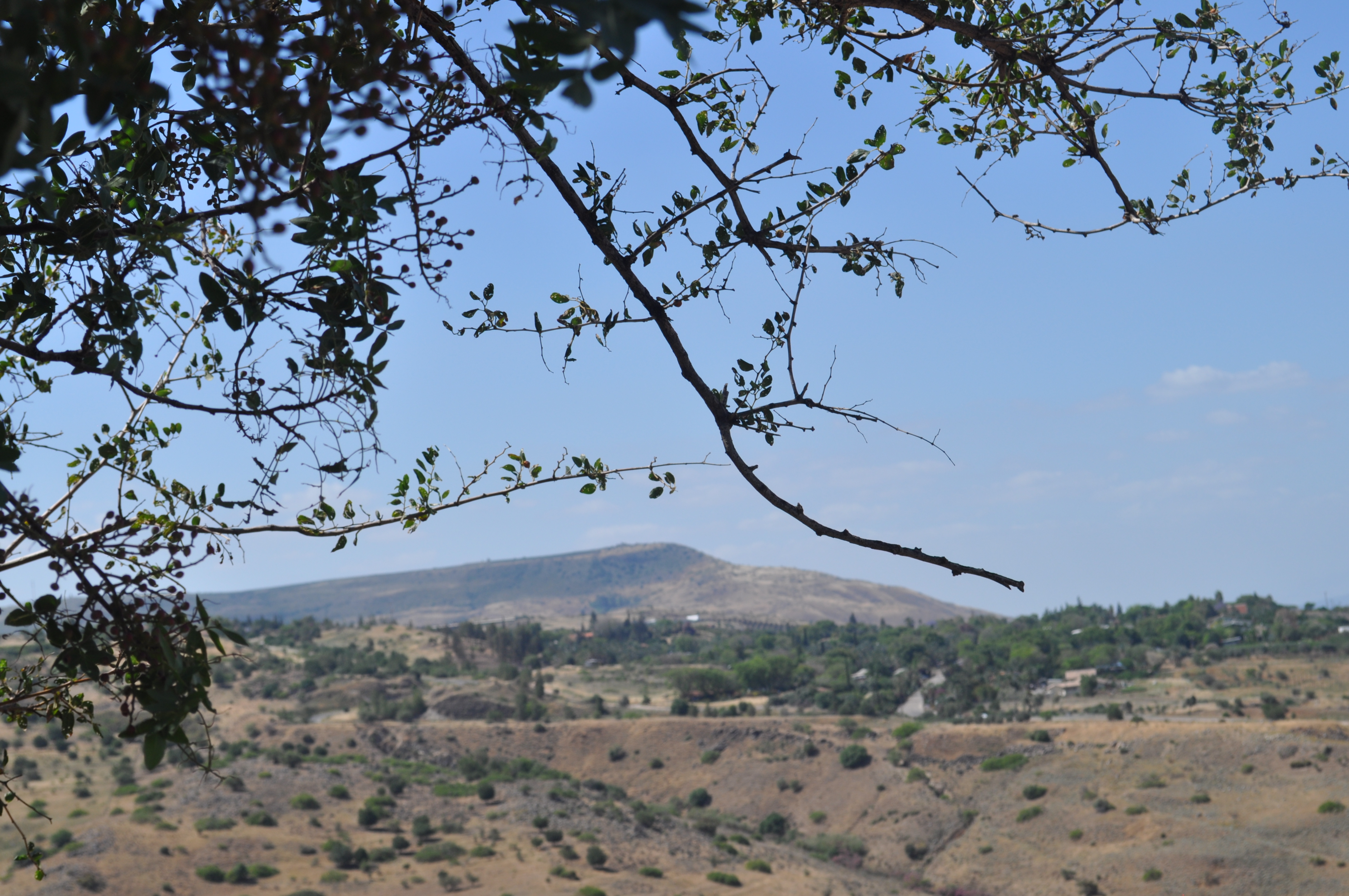
(photo: First.One.Through)

Societies around the world are making difficult decisions whether violent and hateful people, groups and governments maintain rights afforded to the public at large. How standards are applied and who protests such application, will say a lot about the organizations doing the banning and the protesters. But nothing will say more than the hypocrisies which will undoubtedly abound.


Related First.One.Through articles:

Uncomfortable vs. Dangerous Free Speech

Stopping the Purveyors of Hateful Propaganda

Selective Speech

The Press Are Not Guardians of the Galaxy

The Noose and the Nipple

New York Times Confusion on Free Speech

Alternatives for Punishing Dead Terrorists

Subscribe YouTube channel: FirstOneThrough

Join Facebook group: FirstOne Through Israel Analysis and FirstOneThrough

Israel Has Much Higher Claims to The West Bank Than Golan Heights

On March 21, 2019, US President Donald Trump said that it was time to recognize Israel’s sovereignty over the Golan Heights. The nature of the timing was viewed by cynics as a nod to help Israeli Prime Minister Benjamin Netanyahu win the election happening in a couple of weeks. For people who understand the nature of the strategic security need for the Golan, the timing had much more to do with the ending of the eight-year civil war in Syria and the rapidly expanding deployment of Iranian forces into Syria. An Iranian-Syrian axis in the Golan Heights would certainly lead to a war with Israel which would kill tens of thousands of people, conservatively.

While there was certainly some benefit politically to Netanyahu for the gesture, the rationale for Israel’s control of the plateau is definitely about security. But the arguments applied to the Golan are relatively weak compared to all of the reasons Israel should have sovereignty over the “West Bank.”

History

Jews lived in the Golan Heights for thousands of years. The ancient Kingdom of Israel occupied most of southern Lebanon and Syria and dozens of synagogues over 1000 years old can be found in the area. But most Jews did not live in that area, certainly compared to the West Bank, over the past 100 years.

Religion

There are no particularly important religious sites for Jews in the Golan. However, almost all of the sacred sites for Jews are located in the “West Bank,” which the Jordanians seized in 1949 including Jerusalem, the Cave of the Jewish Patriarchs in Hebron, Rachel’s Tomb in Bethlehem and Joseph’s Tomb in Nablus/Shechem.

Legal

When the global powers opted to divide the Ottoman Empire after World War I, they set some arbitrary lines. The French took the mandates of Lebanon and Syria and the British took Palestine. While the Syrians wanted control of all of Palestine, the global powers allotted Syria the Golan Heights, and Syria controlled the area until Israel attacked it in a preemptive defensive war in 1967.

The situation could not be more different regarding the “West Bank.” That area has always been a core part of the Jewish holy land for thousands of years. It was set as an integral part of the Jewish Homeland in international law in 1920 and 1922, specifically stating that no person should be denied the right to live there based on their religion.

The Jordanian army seized the land of Palestine and annexed it in 1949, contrary to all international laws, and evicted all of the Jewish inhabitants. The Jordanians then attacked Israel again in 1967 and lost the land for which they never had any rights.

Security

The security situation in the Golan is extraordinary, due both to the height and reach of the area which can cover all of northern Israel, as well as the military operation of an Iranian-Syrian pact.

But the security situation from the West Bank is also severe. The spine of the western West Bank is very high and overlooks all of Israel’s major population centers and airport. The miles of borders dwarf the size of borders in the Golan and Gaza.


The contrast between the Golan Heights and the West Bank is striking:

  • Original rights: Syria was allotted the Golan Heights roughly 100 years ago, while the West Bank was allotted to the Jewish homeland at the same time.
  • Rights of holder: Israel took the Golan from Syria which had rights to the land, while Israel took the West Bank from Jordan which had NO RIGHTS to the land.
  • Method of acquisition: Israel took the Golan in a preemptive attack, and took the West Bank in a DEFENSIVE ATTACK.
  • History/connection: While Israel has a connection to the Golan Heights, it pales compared to the eternal connection to the “West Bank” and Jerusalem.

It was President Barack Obama who saw the Israeli-Arab Conflict as one based purely on security. If he were president today and saw Iran embedding itself into Syria, he might have sought to help secure Israel’s rights and defenses in the Golan, just as Trump announced.

But Trump sees the Jewish State from more than just a security or political standpoint. As he appreciates the long history, deep religious connection and legal rights of Israel to the West Bank, one must foresee Trump embracing Israel’s annexation of that region as well.


Related First.One.Through articles:

Recognition of Acquiring Disputed Land in a Defensive War

I call BS: You Never Recognized Jerusalem as Israel’s Capital

The Many Lies of Jimmy Carter

Obama’s “Palestinian Land”

Israel was never a British Colony; Judea and Samaria are not Israeli Colonies

Maybe Truman Should Not Have Recognized Israel

The US Recognizes Israel’s Reality

Subscribe YouTube channel: FirstOneThrough

Join Facebook group: FirstOne Through Israel Analysis and FirstOneThrough