The tensions between the non-Orthodox Jewish denominations and Israel seemingly became tense over the Israeli government’s decision to postpone plans for an egalitarian prayer space at the Kotel, the Western Wall. In truth, the relationship between the Reconstructionist, Jewish Renewal and Reform branches of Judaism (the 3R’s) and the Jewish State have been terrible for a long time.
There are a number of Jewish organizations that actively seek to harm Israel in public fora. As detailed in “Unity – not Uniformity – in the Pro-Israel Tent,” the largest and most noxious of the left-wing organizations are: the Jewish Voice for Peace that advocates for a global boycott of Israel; J Street that advocates for sanctions against Israel at the United Nations; and the New Israel Fund, that supports organizations that go on global tours bad-mouthing Israel and groups that seek to destroy the Jewish character of Israel.
What that article did not convey and will be discussed and explored here, was that these anti-Zionist groups are uniquely backed by non-Orthodox rabbis.
Jewish Voice for Peace
Arguably the most proudly vocal anti-Zionist group is the Jewish Voice for Peace, JVP. The rabbis of JVP have supported the Gaza flotilla; written books demonizing Israel as a modern day blood libel; and arguably promoted the murder of Israelis.
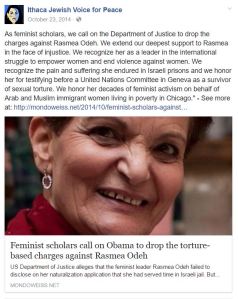
JVP post supporting convicted terrorist Rasmeah Odeh
JVP’s rabbinic leadership almost exclusively comes from the Reconstructionist and Jewish Renewal branches of Judaism. At their core, they seek a Judaism that has nothing to do with Zionism. Many are proudly anti-Zionist.
Rabbi Joseph Berman (Non-Denominational)
Rabbi Linda Holtzman (Reconstructionist)
Rabbi Buzz Bogage, Denver, CO
Rabbi Brant Rosen, Evanston, IL (Reconstructionist)
Student Rabbi Leora Abelson
Rabbi Rebecca Alpert (Reconstructionist)
Rabbi Lev Baesh (Reform)
Rabbi David Basior (Reconstructionist)
Rabbi Haim Beliak (Jewish Renewal)
Rabbi Joseph Berman (Unaffiliated)
Rabbi Andrea Cohen-Kiener (Jewish Renewal)
Rabbi Meryl Crean (Reconstructionist)
Rabbi Michael Davis (also backed by the Students for Justice in Palestine which has supported terrorist groups)
Rabbi Art Donsky (Non-denominational)
Rabbi Michael Feinberg
Rabbi Ari Lev Fornari (Reconstructionist)
Rabbi Sarah Bracha Gershuny (Egalitarian)
Rabbi Shai Gluskin (Reconstructionist)
Rabbi Borukh Goldberg
Rabbi Lynn Gottlieb (Jewish Renewal)
Rabbi Julie Greenberg
Rabbi Edward Klein
Rabbi Alan LaPayover (Reconstructionist)
Rabbi Eyal Levinson (Jewish Renewal)
Rabbi Jeremy Milgrom (Conservative)
Rabbi David Mivasair (Progressive)
Rabbi Dev Noily (Progressive)
Rabbi Alexis Pearce (Reconstructionist)
Rabbi Michael Ramberg (Progressive)
Rabbi Ken Rosenstein (Jewish Renewal)
Rabbi Shifrah Tobacman (Jewish Renewal)
Rabbi Brian Walt
Rabbi Lew Weiss (Reform)
Rabbi Alissa Wise (Reconstructionist)
Rabbi Joey Wolf (Reconstructionist)
Rabbi Laurie Zimmerman (Reconstructionist)
Rabbi Rain Zohav (Jewish Renewal)
The Anti-Defamation has essentially labeled JVP a hate group stating:
“JVP has consistently co-sponsored demonstrations to oppose Israeli military policy that have been marked by signs comparing Israel to Nazi Germany and slogans that voice support for groups like Hamas and Hezbollah. JVP has not condemned or sought to distance itself from these messages.”
The rabbis of these communities put politics front-and-center of their religion. And their politics are anti-Zionism.
J Street
J Street officially states that it is not in favor of the BDS movement, but has supported many speakers who do call for the boycott of Israel. More, J Street actively lobbied the Obama Administration to allow the censure of Israel at the United Nations and enabling the resolution labeling Israeli territory east of the Green Line to be deemed illegal.
The rabbinic core of J Street is slightly more “traditional” than the rabbis from JVP, counting many Reform rabbis. The list of hundreds of rabbis is too long to review here, but a sample highlights the trend:
Rabbi Ellen Lippmann, Brooklyn, NY (Reform)
Rabbi Lauren Henderson, Chicago, IL (Conservative)
Rabbi Alexander Kress, Abington, PA (Reform)
Rabbi Marisa Elana James, New York, NY (Reconstructionist)
Rabbi Amichai Lau-Lavie, New York, NY (Conservative)
Rabbi Amanda Schwartz, New York, NY (Conservative)
Rabbi Scott Aaron, Pittsburgh, PA (Reform)
Rabbi Alison Abrams, Deerfield, IL (Reform)
Rabbi Ruth Adar, Oakland, CA (Reform)
Rabbi David Adelson, New York, NY (Reform)
Rabbi Katy Z. Allen, Wayland, MA (Independent)
Rabbi Rebecca Alpert, Philadelphia, PA (Reconstructionist)
Rabbi Thomas Alpert, Needham, MA (Reform)
Rabbi Steven Altarescu, Bronx, NY (Reform)
Rabbi Camille Shira Angel, San Francisco, CA (Reform)
Rabbi David Ariel-Joel, Louisville, KY (Reform)
Susan J Averbach, San Francisco, CA (Humanistic Judaism)
Rabbi Benjamin Arnold, Evergreen, CO (Reconstructionist)
Rabbi Melanie Aron, Los Gatos, CA (Reform)
Rabbi Arik W. Ascherman, Jerusalem, Israel (Reform)
Rabbi Aura Ahuvia, Woodstock, NY (Reconstructionist)
Rabbi Larry Bach, Durham, NC (Reform)
Rabbi Lev Baesh, Lexington, MA (Reform)
Rabbi Chava Bahle, Suttons Bay, MI (Jewish Renewal)
Rabbi Justus Baird, Princeton, NJ (Reform)
Rabbi Rachel Evelyne Barenblat, Williamstown, MA (Jewish Renewal)
Rabbi Benjamin H. Barnett, Corvallis, OR (Pluralistic)
Rabbi Bernard Barsky, Dayton, OH
Rabbi Lewis M. Barth, Encino, CA (Reform)
Rabbi Geoffrey Basik, Baltimore, MD (Reconstructionist)
Rabbi David Dunn Bauer, San Francisco, CA (Reconstructionist)
Rabbi Renee H. Bauer, Madison, WI
Rabbi David Baylinson, Atlanta, GA (Reform)
Rabbi Micah Becker-Klein, Hockessin, DE
Rabbi Martin Beifeld, Richmond, VA (Reform)
Rabbi Anne Belford, Houston, TX (Reform)
Rabbi Marc J. Belgrad, Buffalo Grove, IL (Reform)
Rabbi Arnold Mark Belzer, Savannah, GA (Reform)
Rabbi Jordan Bendat-Appel, Highland Park, IL (post-denominational)
Rabbi Karen Bender, Tarzana, CA (Reform)
Rabbi Olivier BenHaim, Seattle, WA (Reform)
Rabbi Allen Bennett, San Francisco, CA (Reform)
Rabbi James Bennett, St. Louis, MO (Reform)
Rabbi Philip J. Bentley, Hendersonville, NC (Reform)
The Reform movement isn’t explicitly anti-Israel the way that much of the Reconstructionist and Jewish Renewal movements are currently. However, the current head of the Reform movement, Rabbi Rick Jacobs is particularly political and claims that the official stance of Reform Judaism is anti-settlements. How he declared that his personal anti-Jews living in Judea and Samaria politics should frame the entire movement is something that members of Reform Judaism need to address.
New Israel Fund
The New Israel Fund gives money to groups like Adalah that have a stated purpose of ending any Jewishness in Israel. It lures people to donate money stating that it is about equality in Israel – and by that it means ending the Jewish Law of Return; the Hatikvah; Jewish star on the national flag, et cetera.
The international council of NIF features a number of non-Orthodox rabbis:
Rabbi Rachel Mikva (Reform)
Rabbi Bernard Mehlman (Reform)
Rabbi Anson Laytner (Reform)
Rabbi Daniel Weiner (Reform)
Rabbi David Levin (Reform)
Rabbi Morris Allen (Conservative)
Rabbi Norman Cohen (Reform)
Rabbi Alexander Davis (Conservative)
Rabbi Shosh Dworsky (Conservative)
Rabbi David Freedman
Rabbi Yosi Gordon (Conservative)
Rabbi Michael Adam Latz (Reform)
Rabbi Cathy Nemiroff (Reform)
Rabbi Debra Rappaport (Reform)
Rabbi Alan Shavit-Lonstein (Conservative)
Rabbi Adam Stock Spilker (Reform)
Rabbi Sharon Stiefel (Reconstructionist)
Rabbi Aaron Weininger (Conservative)
Rabbi Marcia Zimmerman (Reform)
Rabbi Sharon Brous (Conservative)
Rabbi Rachel B. Cowan (Reform)
Rabbi Jerome K. Davidson (Reform)
Rabbi Marion Lev-Cohen (Reform)
Rabbi J. Rolando Matalon (non-denominational)
Rabbi Aaron Panken (Reform)
Rabbi Gordon Tucker, White Plains (Conservative)
Relative to JVP and J Street, the New Israel Fund has many more Conservative rabbis joining its leadership ranks. But still, none of these anti-Zionist organizations that have thousands of rabbis in leadership positions have a single Orthodox rabbi.
Why?
Beyond Liberal Politics
There is no question that some of these forms of Judaism revolve around liberal politics more than religion. Many of the synagogues state clearly on their websites that they are focused on tikkun olam (repairing the world), and they do this not through Torah-inspired commandments like helping the widow and orphan, but in new imagined ways like raising the minimum wage and saving the planet.
But there are many liberal rabbis in the Orthodox community too, and they support the Jewish State. They are proud to point out that Israel is one of the most liberal countries in the world, and certainly within the xenophobic, antisemitic and misogynistic Middle East. When liberal Orthodox rabbis find a need to criticize the Israeli government, they do it directly with the government in a constructive manner, not through antagonistic actions on the global stage.
Therefore, the issue cannot be simply attributed to the politics of many rabbis in the non-Orthodox world. There must be something systemic in the religious philosophy of those denominations that make them embrace Israel-bashing.
Who Is a Jew
The key Jewish prayer Shemoneh Esrei recited several times every day begins with the blessing of “our God and the God of our fathers.” It encapsulates the notion that Judaism is both a religion of being, passed down physically from our ancestors, as well as one of choice – “our God” – in which each person takes ownership of his faith.
In regards to being a Jew, Orthodox Judaism (and Conservative Judaism, at this point in time) have held the line on using traditional halacha in critical life events that define “who is a Jew.” Two of those are birth and marriage.
Both the Orthodox and Conservative movements believe that the child of a Jewish mother is a Jew, regardless of the religion of the father. The other denominations believe in patrilineal descent, that religion can be passed down via the father’s religion. This is a fundamental breakdown between the religious denominations regarding “who is a Jew.”
Similarly, Orthodox and Conservative rabbis do not perform interfaith weddings. The rabbis in the other movements are very proud to perform such ceremonies and openly advertise their services.
These two life events are obviously interconnected. An interfaith couple will have a non-Jewish parent, and about half of the time, produce a non-Jewish child according to the traditions of matrilineal descent practiced by Orthodox and Conservative Judaism. Sanctioning interfaith marriages has produced a chasm between the Reform/Reconstructionist/Jewish Renewal (3R) movements with other Jewish denominations, AND with Israel itself.
Israel created a Law of Return in 1950 that allowed any Jew to move to Israel. In 1970, the law was amended to clarify that a Jew “means a person who was born of a Jewish mother or has become converted to Judaism and who is not a member of another religion.” While the 1970 amendment made provisions for the non-Jewish spouse and children of a Jew to move to Israel, the Law of Return used a definition of matrilineal descent that only Conservative and Orthodox used, upsetting other denominations that support patrlineal descent. However, the law’s clause on conversion did accept non-Orthodox conversions performed outside of Israel, as decided by the Israeli Supreme Court in March 2016.
Universalism versus Particularism
Being a Jew is simply part one. The actions and demands of the religion, the mitzvot, are part two, and the breakdown between Orthodox Judaism and the branches that seek to harm Israel are profound.
Orthodox Judaism believes that the Torah has 613 commandments for a Jew to live by. Some are clear-cut, like “Do not kill,” while others are subject to broader interpretation like “keep the Sabbath holy,” as there may be many different methods of keeping the Sabbath holy. Conservative Judaism basically follows the concept of the 613 mitzvot, but interprets them differently (for example, Orthodox Jews will not use electricity on Sabbath to “keep it holy,” while Conservative Jews will often use electricity.)
In contrast, the 3R branches of Judaism have revamped the mitzvot in a way that fits a “new age” rewriting of the laws. They have made the commandments about human-centered spirituality that spreads out to God and all mankind, rather than commandments that are passed down from God to man.
The Jewish Renewal site makes its mantra clear, stating it’s “a transdenominational approach to revitalizing Judaism.” Its reach is to everyone: “Renewal is an attitude, not a denomination,” with “an emphasis on accessible spiritual experience.” In other words, this is a movement without demands, such as only eating kosher foods. It is more akin to a yoga retreat. Not only is there no need to be Jewish, a person needn’t perform ancient rote rituals. Just engage in new age meditation.
Reconstructionist Judaism is more traditional than Jewish Renewal, but far from “traditional.” Its emphasis is on “Jewish Identity,” as its website states: “what primarily gives Jews our identity is not belief but rather the feeling of belonging to the Jewish civilization itself. We observe Jewish holidays, rituals and customs, not because a divine being commanded us to, but because it is our primary method of reinforcing Jewish identity.” In other words, God’s commandments are not really commandments (or God doesn’t exist) for Reconstructionist Jews. The basis for observing any tradition is simply a matter of keeping the “Jewish identity” around, not because of any higher authority.
These days, the Reform movement has put the world front and center. It’s mission is to build “communities that transform the way people connect to Jewish life, building a more whole, just, and compassionate world.” It does this through tikkum olam, “repairing the world.” The movement’s leader, Rabbi Rick Jacobs, speaks of Reform Judaism as operating in concert with the global community: “the heart of a tikkun olam that embraces always both the universal and the particular.”
These three branches of Judaism approach religious practice very differently than Orthodox Judaism. Their Judaism is centered on global mankind’s yearning to connect – to the planet and the people around the world – to achieve a personal fulfillment of serenity. Jewish rituals are props to achieve that state of zen. Similarly, non-Jews bring their own props to their encounters with God and mankind. Universalism and particularism (of props) coexist in a human-centered meditative state of bliss.
This 3R approach towards religion is an inversion of Orthodox Judaism that is premised on a top-down philosophy. The Bible and Ten Commandments began with God, not man. The 613 commandments given to Jews were just that – commandments – not guides to validate one’s own sense of social justice. These commandments were uniquely given to Jews, as Orthodoxy believes that non-Jews were given only seven commandments which relate to universal morality.
The orientation of particularism of Orthodox rabbis extends broadly: to Jewish people (they do not perform interfaith weddings); the Bible (with unique commandments only for Jews); and to the holy land itself, which they believe was given to the Jewish people. According to a Pew poll in 2013, 84% of Orthodox Jews believe that God gave Israel to the Jews. That compares to only 54%, 35% and 24% of Conservative, Reform, and non-denominational Jews, respectively. By way of comparison, 55% of Christians believe that God gave Israel to the Jews. How remarkable is that? Christians are more Zionistic than non-Orthodox Jews.
This dichotomy between Orthodox and non-Orthodox denominations is at the core of different approaches to the Jewish State and the holy land. For Orthodox Jews, the Jewish State is particular, just like the bible and Jewish people. In contrast, the non-Orthodox denominations focus on universalism, and shun particularism as a form of tribalism and nationalism, with more than a whiff of racism.
It is therefore not a surprise that Jewish denominations that shun particularism in favor of universalism also denounce Zionism.
But why would universalists attack Israel on the global stage?
The fundamental approaches to Judaism, Jews and the holy land do not just lead to a difference of opinions; it destroys the baseline of communication, making discussion virtually impossible. In mathematical terms, the universalists are speaking in base 10 and the particularists are speaking in base 7. They can both understand each other in simple matters, like single digit numbers or that Abraham is the father of monotheism. But on complicated matters like a democratic Jewish State living in peace and security in the heart of the Arab Muslim Middle East, the interaction falls apart like discussing the number 242 (equal to 242 in base 10, but just 170 when converting base 7 to base 10). They are just not talking about the same thing. So rather than talk to each other, they talk to people with a similar language. The 3R rabbis take their version of tikkun olam to the global stage, like the United Nations.
Whereas Orthodox liberal Jews can call out for rights for Israeli Arabs and Palestinian Arabs without vilifying Israel, non-Orthodox rabbis seemingly cannot. Orthodoxy can approach equality within the rubric that the holy land as special and unique for Jews, while the non-Orthodox only see tribalism and primitive thinking. The 3R rabbis burnish their bona fides by burning ties that could reek of particularism as they engage with the global community.
The Current Dynamic
The universalism / “anti-tribalism” movement within the 3R denominations often attacks both Orthodox Jews and the Jewish state. It has sometimes provoked a backlash.
In September 2015, the Reconstructionist movement announced a new policy to allow rabbis to marry non-Jews as a reaction to the movement’s conclusion that “many younger progressive Jews, including many rabbis and rabbinical students, now perceive restrictions placed on those who are intermarried as reinforcing a tribalism that feels personally alienating and morally troubling in the 21st century.” With such declaration, several Reconstructionist rabbis became fed up.
In April 2016, twenty Reconstructionist rabbis left the denomination to form Beit Kaplan, as they felt that the Reconstructionist movement had lost its way. They said that “the decision to form the association was sparked, in part, by the recent RRC policy shift that muddled the definition of what it means for a rabbi to have a Jewish family. Other contributing factors include a desire to return the focus of liberal Judaism to Rabbi Mordecai Kaplan’s vision of Jewish peoplehood and a desire to affirm connections to the Jewish people globally, including in Israel.”
Several Reconstructionist rabbis became infuriated with the official positions of Reconstructionist’s universalism. Their new assembly felt compelled to clarify that not only did it think that sanctioning rabbis intermarrying was a destructive force on the Jewish family, it said that it “unequivocally reject[s] any movement to delegitimize Israel in the community of nations,” because the Reconstructionist movement had become a haven for demonizing the Jewish State.
In short, Beit Kaplan felt that the Reconstructionist movement had lost the basic concept of the definition of being a Jew and the special nature of the Jewish State.
The 3R rabbis’ Israel-bashing had started to gain momentum during the 2014 Gaza War, when many non-Orthodox rabbis actively vilified the Jewish State. The lunatic rabbinic fringe even held fasts for the people of Gaza, but not for anyone in Israel.
Consider Rabbi Sharon Kleinbaum, the leader of an enormous gay Reconstructionist congregation, member of J Street and listed in Newsweek’s list of 50 Influential Rabbis. Her radical left-wing politics were mostly blessed by her members, but her tirades against Israel became too much for many to bear. In 2014, one of the board members of her congregation resigned, publicly stating the “recent [2014 Gaza War] events have demonstrated that CBST [the gay synagogue] is far more committed to a progressive political agenda than to the Jewish people…. I don’t want to raise my kids in a synagogue that’s praying for people firing rockets.”
The attitude was pervasive. Leading rabbis of JVP and J Street – all non-Orthodox – called for a divorce between Judaism and the Jewish State, and between the holy land and Jews.
Consider Rabbi Brian Walt, a member of JVP and coordinator of the Jewish Fast for Gaza, who gave a talk entitled “Affirming a Judaism and Jewish identity without Zionism,” in which he declared: “political Zionism violates everything I believe about Judaism.” Or Rabbi Ellen Lippmann, on the board of J Street and signatory to the fast for Gaza who penned a letter for Code Pink to support the BDS movement, stating she “saw the destruction that is wrought by too many Israeli settlers,” making her change “my mind about the purchase of products made in the Jewish West Bank.”
Non-Orthodox rabbis comfortably argued that there are too many Jews in the holy land because they segmented the religion, the people, the land and their identity. As they believe that religion is defined solely by identity, there is no need for a particular land, and no narrow definition of the Jewish people, as identity is self-selected.
Non-Orthodox rabbis wrap themselves in a tallit as a mere Jewish prop in a universalistic and humanistic approach towards meditation, while they shudder at the particularism of the God of Orthodox Judaism and the Jewish State.
Supporting Israel is not a battle of political orientation between liberal and conservative Jews. It is a philosophical break in the Jewish community with a fault line regarding the uniqueness of Jews and the Jewish State. The non-Orthodox denominations’ religious philosophy will only let it embrace an Israel that is: about people, not God; about rights not rituals; more secular than religious; more democratic than Jewish; and more universal than particular.
Related First.One.Through articles:
Students for Justice in Palestine’s Dick Pics
The Left-Wing’s Two State Solution: 1.5 States for Arabs, 0.5 for Jews
The Reform Movement’s Rick Jacobs Has no Understanding of Tolerance
A Seder in Jerusalem with Liberal Friends
There are Standards for Unity
The Three Camps of Ethnic Cleansing in the BDS Movement
The Anger from the Zionist Center
Tolerance at the Temple Mount
The Impossible Liberal Standard
Subscribe YouTube channel: FirstOneThrough
Join Facebook group: FirstOne Through Israel Analysis






 First One Through