Changing the Israeli Knesset

The Israeli government is heading for another change. Prime Minister Benjamin Netanyahu announced the firing of two cabinet members and lawmakers voted for the effective dissolution of the current legislature.

The last Israeli elections held in January 2013 brought several changes to Israeli politics:

  • Likud combined with the Yisrael Beitenu party to win a collective 31 seats (21 for Likud and 11 for Israel Bietenu)
  • A new party, Yesh Atid, headed by Yair Lapid won 19 seats
  • Bayit Yehudi, headed by Naftali Bennett, continued to grow in strength, up to 12 seats
  • The Shas party was excluded from the government for the first time since 2006
  • The ruling coalition deliberately excluded the ultra-orthodox (Haredi) parties as they attempted to force changes in their participation in community service or military draft

The main factors that motivated the Israeli public was the economy, which was viewed as leaving too many people behind. As such, it was the first election in Israeli history that did not focus on security or a peace process. The Arab Spring enveloping the Middle East, and the inability of acting-President of the Palestinian Authority Mahmoud Abbas to reign in Hamas and manage Gaza, made the possibility of a resolution with Palestinian Arabs seem remote.


The new elections are called for March 17, 2015. Current polls suggest that Likud would win 22 seats (up from 20), Yesh Atid winning 9 seats (down from 19), Jewish Home would win 17 seats (up from 12), making for a more-right leaning coalition.

Enjoy the FirstOneThrough music video with music by David Bowie: The Changed Israeli Knesset.

https://www.youtube.com/watch?v=RMPQqkR_D04


Sources:

Netanyahu poll: http://www.bloomberg.com/news/2014-12-02/netanyahu-to-call-early-israel-vote-fire-ministers.html


Seeing Security through a Screen

 The 44th US President is surrounded by high walls
and peers out at the world through pretty screens.

In November 2014, “someone” in the Obama Administration chose to belittle the Israeli Prime Minister Benjamin Netanyahu. The choice of expletives aside, the call was not just revealing about how much Barack Obama and his administration disliked Netanyahu, it reflected a smugness and cluelessness of the US Administration about living in the dangerous Middle East.

America at Peace

America has been blessed with peace on its shores. While the country has waged many wars over the past 70 years, the actual fighting was on foreign lands including: Europe; Iraq; Vietnam; Korea; Japan; Libya; Kosovo; Somalia and many other countries. Other than two attacks on American soil, the US has been spared fear and death at home.

  1.  Points in Time: There were only two days that the USA had foreigners attacking the country: December 7, 1941 and September 11, 2001. America has not faced a prolonged attack on its shores for centuries.
  2. Troops Trespassing: Pearl Harbor and the 9/11 attacks were done via airplanes. Foreign warriors did not walk the streets of America.
  3. Families Threatened: The two attacks were on military installations (the navy fleet and the Pentagon) and financial center (World Trade Center).   America did not face an enemy that threatened homes and families.
  4. Existential Threat: America is a superpower, armed with firepower that can destroy the world many times over. It has not engaged with an enemy that could threaten the very existence of the country.
  5. Peaceful borders: America is lucky to have only two borders despite its enormous size. Both neighbors are friends, allies and trading partners of the USA.

None of these facts are true for Israel. Israel is surrounded by several enemy countries. These neighbors have stated their intention to wipe Israel off of the map and have repeatedly gone to war and fired directly into civilian population centers over and over again through the decades of Israel’s existence.

Lawyers as Commanders-in-Chief

America’s peaceful existence has enabled it to calmly elect presidents with no military experience over the last several decades. When America fought its great wars such as the Revolutionary War, the Civil War and World War II, the American people elected the respective generals to become the Commanders-in-Chief in the following years (George Washington, Ulysses S. Grant, and Dwight Eisenhower).

  1. Never in battle. The recent US presidents and vice presidents (particularly the Democratic ones) including Barack Obama, Joe Biden and Bill Clinton had no military experience at all. George HW Bush fought in World War II, while George W Bush served in the National Guard but was never in battle. Al Gore served as a military reporter for a short stint.       Other than HW Bush, these men never faced true fear or saw friends die in battle. They led the world’s largest military machine as Commanders-in-Chief without appreciating the danger and fear of deadly combat.
  2. No draft. America no longer has a draft so every person that serves in the military does so as a volunteer. Such a system can mask the decision of deploying troops for a military commander. Each soldier is a volunteer and trained professional. This “professional army” is very different than “citizen armies” that pull people out of the workforce and touch every corner of a country. As such, American presidents fight wars without the same direct economic and emotional impact that face other countries.
  3. The infrequent visitor. President George W Bush launched the Iraq War in response to the attacks on 9/11 and President Obama invested heavily in the War in Afghanistan. Each president made only four short trips to the regions despite deploying well over half a million troops in each war over many years.

In Israel, every person must serve in the armed forces. Every family deals with disruption to its business and annual routine. Each citizen faces the risks on a very personal level – physical, financial and emotional. Every family in Israel knows someone who died in one of its wars.

Israeli Prime Minister Benjamin Netanyahu served in the elite unit Sayeret Matkal, and took part in a number of military operations, including the 1972 rescue of a hijacked Sebana passenger jet. His brother died leading a raid to free Israeli civilians hijacked in Entebee in 1976. Other members of the current Israeli ruling coalition include Naftali Bennett who served in two elite units including Sayeret Matkal and Maglan. Yair Lapid served as a First Sergeant in the IDF.

Israeli Prime Ministers do not just visit the frontlines in each battle they fight- they can see the missiles standing next to their families from their bedroom windows.

The Obama Detachment

The detachment from reality regarding the fear and adrenaline of battle for an American president is compounded in the case of Obama, who is generally acknowledged to be a “detached” individual.

  1. Constitutional law. President Obama has referred to himself as a professor of constitutional law. His leadership style exemplified this attitude whether on domestic matters such as Immigration Reform or the Targeted Killing of Anwar al-Awlaki when he delved into the nuances of particular laws in large legal briefs. Despite being the Commander-in-Chief, he is most comfortable as a lawyer surrounded by other lawyers sitting around a conference room table; he is clearly not a military leader surrounded by armed forces in the field of battle.
  2. Community organizer. Obama’s background as a community organizer focused on ways to elevate a particular community within the 330 million-population of the United States. He has no background or experience in protecting the entire country, which every leader in Israel has experienced for several years.
  3. Competitive sports. Obama is very proud of his athletic skills and people have noted his deep competitive streak. However, talking dirt about dunks is divorced from the reality of deploying troops in your backyard against enemies sworn to your destruction while the world admonishes your right to defend itself. Beating an opponent on the court has little to do with protecting ones citizens.
  4. Battle by Remote. The best summary of the Obama detachment is in his moniker “The Drone President”. More than any president in US history, Obama has used drones to assassinate his enemies. The pilots of the drones may be hundreds or thousands of miles from the battle scene. Obama’s army drops the missiles and departs, never personally entering the zone of combat and therefore never exposed to danger.
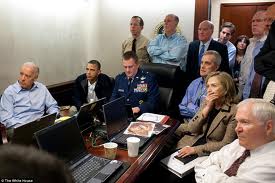
  5. The Ultimate belief in Self. Despite never being in battle, (other than some competitive basketball games), and relying more and more on mechanized drones in the battlefield, Obama has a tremendous sense of his centrality to the war machine.  After US marines assassinated Osama bin Laden while Obama sat and watched on a screen, his speech to the nation the next day was littered with an active “I” to describe the mission.
    1. “I directed Leon Panetta”
    2. “I was briefed”
    3. “I met repeatedly”
    4. “I determined”
    5. “I, as Commander-in-Chief”

Obama and his administration sit in their comfy offices in their calm country thousands of miles from confrontation and peer into the battle through TV screens and simulators.  They watch their orders for assassinations and wars, with laptops and coffee. Their added security blanket of being a permanent member of the United Nations Security Council, adds yet another shield from any serious global charge. As Mel Brooks once aptly said “It’s good to be the King.

obama screen bin laden
Obama, Clinton and crew watch the attack on Bin Laden on monitors,
May 2011

Remarkably, Obama, the cloistered captain, touts his talents and has the temerity to taunt his unloved ally, the besieged Bibi Netanyahu.

The Israeli Prime Minister, the “chick*hit” that the Obama administration referred to, never had the ability to be so smug. His backyard contains a museum memorializing millions of relatives slaughtered for the crime of being a Jew just a few decades ago.  He grew up with a gun in his hand to fight terrorists attacking his neighbors, and armies attacking his country.  He wakes each morning knowing that his house and family are in the comfortable crosshairs of enemies sworn to destroy him, his country and his people.

In addition to his enemies, today Netanyahu has to fight against a world that admonishes him for protecting his people. He has to contend with his greatest ally, the United States, which continues to make it impossible to preemptively attack and destroy Iran’s nuclear weapons.


Insults are not a big deal for a leader who has fought for the survival of his people; Bibi has been called worse by members of his own parliament.

The insult says much more about Obama than it does about Bibi.


Sources:

The Atlantic on Obama anger at Bibi: http://www.theatlantic.com/international/archive/2014/10/the-crisis-in-us-israel-relations-is-officially-here/382031/

Obama visits Afghanistan: http://www.washingtonpost.com/politics/obama-arrives-in-afghanistan-on-surprise-visit/2014/05/25/7df61452-e41f-11e3-8f90-73e071f3d637_story.html

Bush visit Iraq: http://www.cbsnews.com/news/background-bushs-surprise-visits-to-iraq-afghanistan/

Obama Constitutional Law Professor: http://www.factcheck.org/2008/03/obama-a-constitutional-law-professor/

Obama detached: http://www.weeklystandard.com/blogs/democrats-privately-calling-obama-detached-flat-footed-incompetent_793544.html

Obama competitive sports: http://content.usatoday.com/communities/theoval/post/2012/08/book-obama-driven-by-competitive-streak-/1#.VHMoCLMtCUk

Legal Case for Killing: http://www.nytimes.com/2013/03/10/world/middleeast/anwar-al-awlaki-a-us-citizen-in-americas-cross-hairs.html?hp&_r=0

Obama speech on Bin Laden: http://www.whitehouse.gov/blog/2011/05/02/osama-bin-laden-dead


New York Times Talking Turkey

Sometimes a contrast in coverage helps boldface the biases.

20140811_074503

The New York Times (for some reason) wrote quite glowingly of Prime Minister Erdogan of Turkey during presidential elections in August 2014. Some of the choice language on August 9 before the election included:

  •  “hoping to secure a legacy greater than that of the revered founder of modern Turkey”;
  • “broken down secular taboos”;
  • “economic policies have improved the lives of many”;
  • “long been a strategic ally of the United States”;
  • “In 2011, President Obama developed a close personal relationship with Mr. Erdogan, seeing Turkey as a model to emulate for countries upended by revolution’

After the elections, on August 11 the Times continued to use positive expressions: “thousands massed…and erupted in applause” to Erdogan’s victory, while caveating later in the article that there were some concerns among the country’s “liberals” about an “authoritarian” streak in Erdogan.

In both articles, the New York Times neglected to remind readers of a few policies of Erdogan over the prior year that gave Turkish citizens pause about Erdogan:

But if the New York Times likes you, certain facts will fade to the background.

Consider the surprisingly low-turnout for this first-time Turkish presidential election: only 74% came out to vote compared to 87% in 2011 general elections. The NYT said that few people showed up to vote “presumably because many had assumed Erdogan would win”. Erdogan squeaked out a win with 52% of the vote compared to the second place winner at 38% – only 37% higher. However, the NYT said “the election felt like a coronation”.


By way of comparison, look at the way the Times covered the election of Israeli Prime Minister Benjamin Netanyahu in January 2013.  The Times did not include any of the commentary used for Turkey about Israel: being a strong US ally; the strong economy of Israel; the island of stability in the sea of chaos of the Middle East.  Instead, the headline read: “Tepid Vote for Netanyahu in Israel Is Seen as Rebuke”. In that “tepid vote”, Israelis came out in numbers greater than ever before – 67% voted for the cabinet, compared to the 2009 election turnout of 65% and of 63% in the 2003 election.  Not only was the vote not “tepid”, but Netanyahu’s Likud party won the vast majority with 31 seats compared to the second place winner, Yesh Atid, with 19 votes – a margin of 63% (almost twice Erdogan’s clearance).

But the Times despises Netanyahu. The article had remarkable quotes for the victorious Prime Minister:

  • weakened Prime Minister Benjamin Netanyahu”;
  • “the outcome was a humbling rebuke”;
  • “Mr. Netanyahu posted a panicky message on Facebook”;
  • “The results were a blow to the prime minister, whose aggressive push to expand Jewish settlements in East Jerusalem and the West Bank has led to international condemnation and strained relations with Washington.”

This last quote is a particularly embarrassing and revealing lie.  Jodi Roduren (who wrote the piece from the fantasy of her head instead of based on facts) sought to lay out a scenario where the Israeli public disagreed with the “aggressive push to expand Jewish settlements”.  In the real world, both the number two party, Yesh Atid (19 seats) and the number four party, Jewish Home (11 seats), were in favor of a united Jerusalem and continuing to build homes for Jews in Judea & Samaria.  The Jewish Home party campaigned on the basis of annexing Judea & Samaria.  The Times’ favorite parties, the left-wing parties of Hatnua and Meretz came in almost last place with 6 seats each.  (If you’re counting at home, that’s 61 seats versus 12 seats for the parties that want to keep united Jerusalem- a margin so large and bold you would think Roduren’s handlers could have managed to edit her “news” article).


The Times ignored reality in both situations. In Turkey, it failed to report on Erdogan’s strong right-ward shift into deep Islamic camp and painted him as more of a moderate. His modest win as blown out of proportion.

For Israel, Netanyahu’s strong win was considered poor. The country’s support of his policies about the rights for Jews to live all parts of Judea and Samaria were not just dismissed, but painted in a way that was completely opposite of the facts.

I sometimes think of the Times the way I think about turkey:  it tastes quite good but it puts a person to sleep.  Oh, and of course, it is one of the dumbest animals on the planet.


Sources:

Turkey, most journalist jailed 2012 and 2013: http://cpj.org/reports/2013/12/second-worst-year-on-record-for-jailed-journalists.php

Erdogan banned twitter May 2013: http://www.washingtonpost.com/news/morning-mix/wp/2014/03/21/turkey-bans-twitter-and-twitter-explodes/

Erdogan blocked Youtube: http://www.cnn.com/2014/03/27/world/europe/turkey-youtube-blocked/

Turkey ban kissing in public; late sale alcohol: http://www.bbc.com/news/world-europe-22780773

Netanyahu headline “Tepid Vote for Netanyahu in Israel Is Seen as Rebuke”: http://www.nytimes.com/2013/01/23/world/middleeast/israel-votes-in-election-likely-to-retain-netanyahu.html?pagewanted=all&_r=0

Lapid, Yesh Atid: Jerusalem not for negotiation http://www.jpost.com/Diplomacy-and-Politics/Lapid-Jerusalem-is-not-up-for-negotiation-because-the-city-will-never-be-divided-330680


The Turkish Chickpea: Recep “Hummus” Erdogan

“Israel is dropping 400 tons of bombs on our brothers, not chickpeas…to agree with brutality is brutality itself,” said the prime minister.

The Turkish Prime Minister has come to the side of Gaza again, seemingly with a bowl of hummus.

Just over one year after Erdogan extracted an apology from Israeli Prime Minister Benjamin Netanyahu for the killing of nine “activists” on the Mavi Marmara, Erdogan is pointing an accusing finger at the victim of aggression again.

A satire of the Netanyahu apology to Erdogan is below. Perhaps Erdogan should leave it in his favorites folder.


Source:

http://www.jpost.com/Operation-Protective-Edge/Erdogan-accuses-Israel-of-using-terrorism-in-its-operations-against-Hamas-in-Gaza-362759


Every Picture Tells a Story, the Bibi Monster

The “Every Picture” series highlights the power of photographs in the media and reviews the impact of size, color and placement of pictures along with their captions. The first installment reviewed how the New York Times painted a picture of Arab grief and suffering while portraying Israelis in a more aggressive and less sympathetic manner in a series of articles from June 30 to July 3 about the murder of three Israeli teens and a Palestinian teenager. If that article had a subtitle, it could have been “Palestinians trump Israelis”. You might think this second article in the series could be entitled: “Palestinians trump the World”, but the reality is much more subtle.

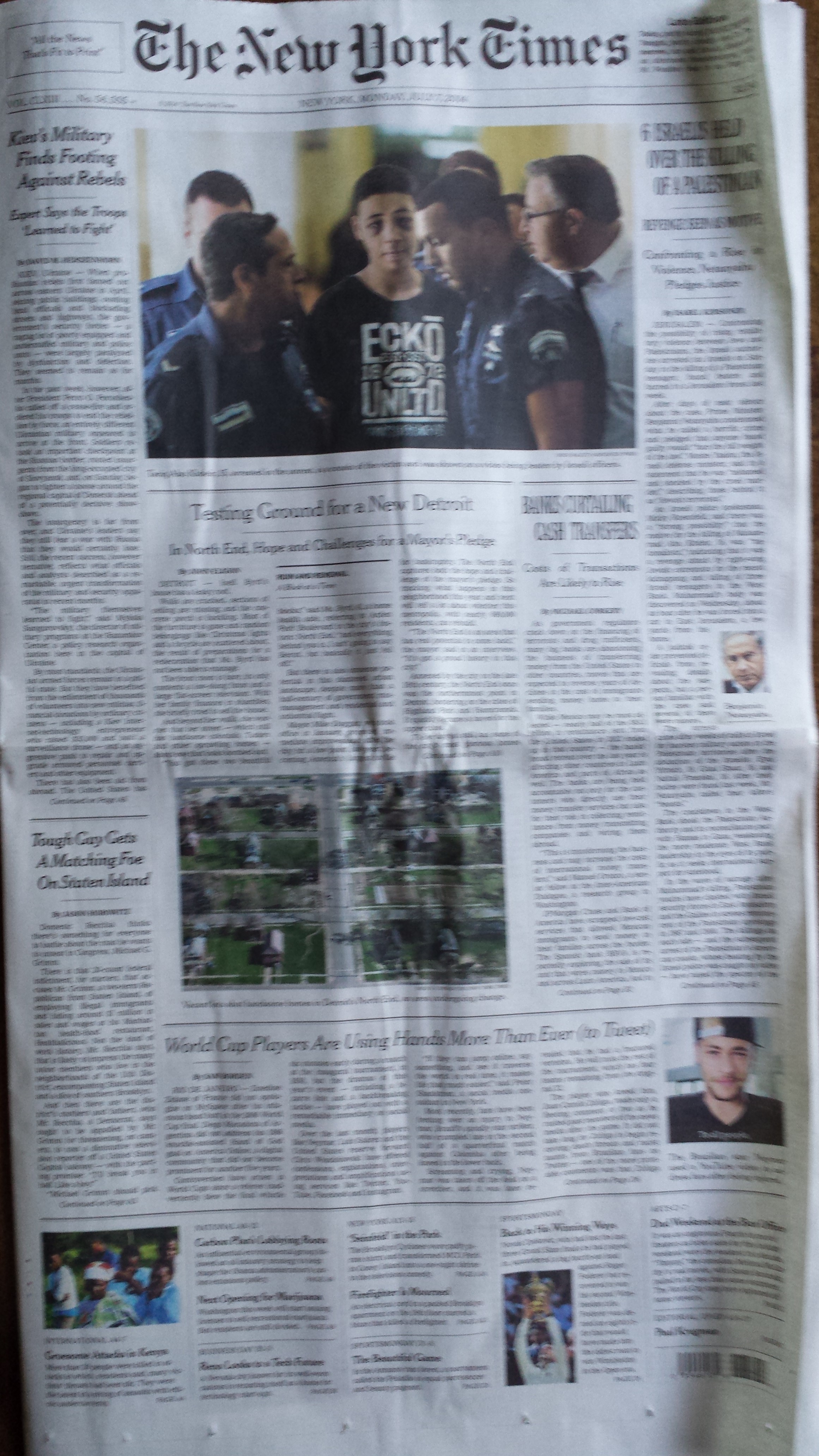
On July 7, 2014 the New York Times posted, on the top of its front page, a large color photograph of a Palestinian youth who was injured during riots against Israeli police. The bruised teenager was deemed to be a bigger story than victims of mass murders in other countries on a particularly violent day in Africa and the Middle East:

20140707_082918

On page A4, the paper posted a large black and white photograph and article about  20 people who had their throats slashed in Kenya;


On page A7, the NYT posted a black and white photograph of soldiers and militiamen in Uganda where 50 people were killed in a battle between security forces and a tribal militia;

On the bottom of that same page, a short article (with no associated picture) described how 35 to 40 people were killed in Yemen in a fight between “Shiite rebels and tribesmen associated with the government.”

20140707_08293720140707_08294820140707_083002
Pictures of mass murders buried in the NYT pages

While over 100 people were slaughtered in the region, the Times thought that a bruised youth was more significant than any and all of those atrocities. Could that have been because the teenager was a Palestinian Arab? That wouldn’t be logical as the Yemenis are Arab too. Could it be because the injured boy was a Muslim? That also would not make sense since al-Shabab is the Islamist terror group in Kenya that has been killing dozens of people every week, and both parties in the slaughter in Yemen are Muslim.

The difference in the dynamic of these stories lies in the counter-party – Israel – as evidenced by the other pictures in the news story. In a small picture on the (extreme right) side of the cover page, and then again in a color photograph on page A5, are close up pictures of Israeli Prime Minister Benjamin “Bibi” Netanyahu. Netanyahu is possibly the only world leader who is more despised by the NYT editorial board than former US President George W. Bush. The Times often uses pictures of Netanyahu alongside stories of Israeli aggression. It does this uniquely and consistently for Bibi.

By means of comparison, imagine an article about US drones killing civilians in Afghanistan, and then a picture alongside of it of US President Barack Obama. It doesn’t happen in the NYT or liberal media outlets. You probably wouldn’t even see a picture of injured people or mourning mothers in US papers. That is because they do not want to sketch a killer in Obama’s image.

As examples, here are two NYT articles that are critical of US policy of drone attacks – but include no pictures (let alone two!) of Obama. These are attacks that Obama ordered, (compared to a general situation in Israel which Netanyahu was not directly involved). Needless to say, the articles that simply report on the use of drones have no pictures of the US Commander-in-Chief.

http://www.nytimes.com/2013/10/22/world/asia/civilian-deaths-in-drone-strikes-cited-in-report.html?pagewanted=all&_r=0

http://www.nytimes.com/2014/06/26/world/use-of-drones-for-killings-risks-a-war-without-end-panel-concludes-in-report.html

In another article that is completely about Obama’s war on terrorism, the picture puts Obama so far in the background you would think he was accidentally caught in the photo.

http://www.nytimes.com/2012/05/29/world/obamas-leadership-in-war-on-al-qaeda.html?pagewanted=all

However, the New York Times and various liberal publications like to paint Bibi and Israel as attackers. They use his image alongside articles which describe attacks and counter-attacks. He has been made into a caricature of war; a cartoon of a blood libel.

Every picture tells a story. It is time to ask what the artist had in mind.