The Long Shadow of 1492

In a sharp escalation of transatlantic tensions, U.S. President Donald Trump announced that the United States will “cut off all trade with Spain, publicly castigating the Spanish government for refusing to allow U.S. military bases on its soil to be used in operations linked to strikes against the Islamic Republic of Iran and for what he termed Spain’s failure to contribute sufficiently to NATO defense spending. Trump declared that he “doesn’t want anything to do with Spain,” framing the dispute as a response to Madrid’s resistance to what he described as confronting evil in the Middle East and paying its fair share for collective defense. 

What follows is not about this immediate crisis. It’s about deeper historical currents that help explain some of the underlying dynamics in Spanish public life that stretch back to the fifteenth century and still matter today.


In Western Europe outside Scandinavia and the United Kingdom, the two countries with the smallest Jewish presence relative to population are Spain and Portugal (about 0.02% of each countries’ overall populations).

That is not a statistical curiosity. It is a civilizational fact.

Five centuries ago, the Iberian Peninsula expelled its Jews. What had been one of the great centers of Jewish life vanished over a five and a half year short window. The Alhambra Decree in 1492 ordered practicing Jews out of Spain. Portugal followed with forced conversions and the Inquisition. Open Jewish life disappeared. What had been woven into the intellectual, commercial, and spiritual fabric of the peninsula was purged.

And it stayed removed.

Unlike other parts of Western Europe where Jewish communities, even after catastrophe, remained visible and rebuilt, Iberia entered the modern era with almost no Jews at all. Medieval synagogues became churches, then museums. Sephardic music became heritage. Jewish quarters became tourist sites. The living community remained tiny.

Fast forward to the present.

In Spain, large protests erupt over the Israeli-Stateless Arabs from Palestine (SAPs) conflict. Municipal councils pass symbolic measures aligned with boycotts. Parliament debates recognition of Palestine. Streets fill with Palestinian flags while graffiti targets Israel.
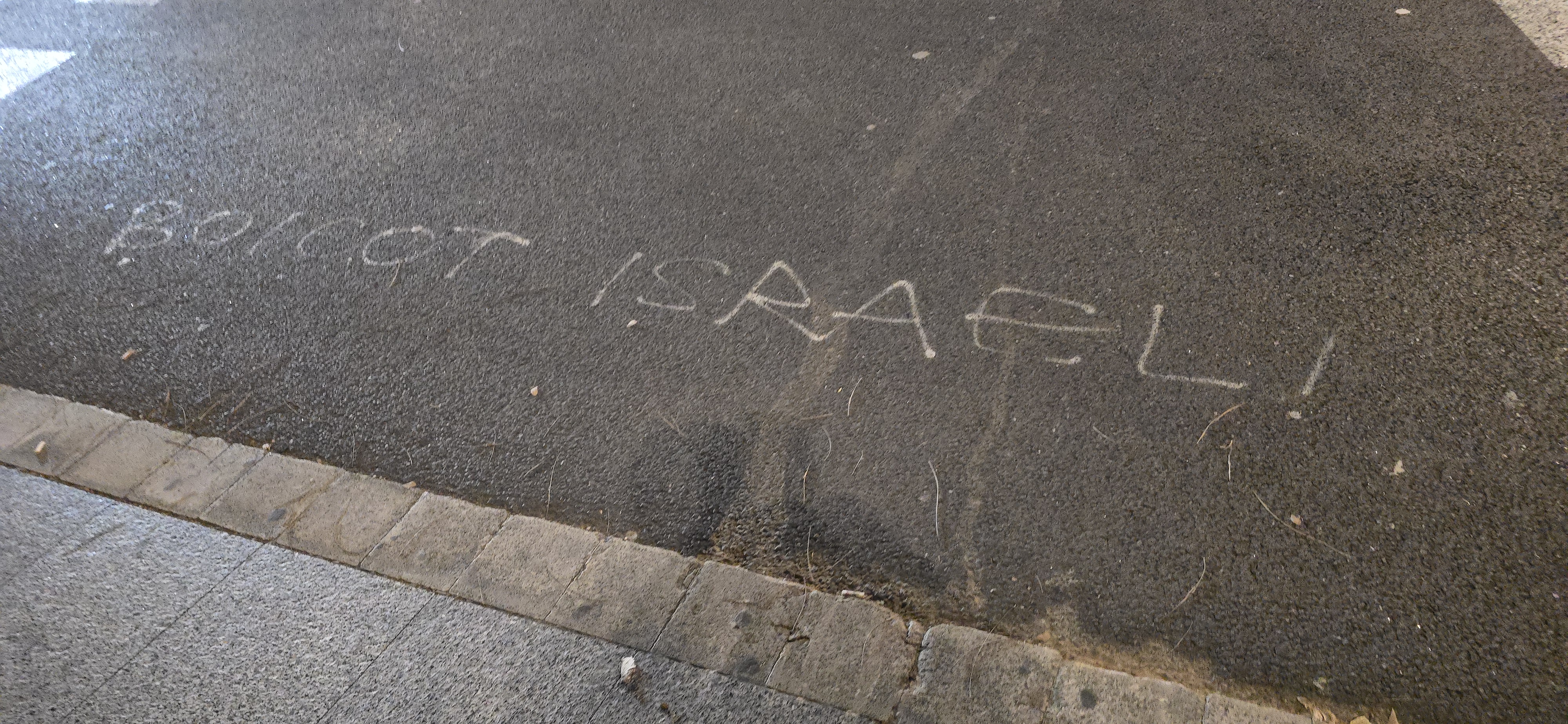
Anti-Israel graffiti on Barcelona street in March 2026 (photo: First One Through)

In Portugal, while public demonstrations are generally smaller, political and diplomatic critiques of Israeli policy align with broader European debates.

And yet.

There are no comparable national protest cultures around Sudan. No sustained marches over Somalia. No municipal votes over Afghanistan. Iran’s repression and mass slaughter of its citizens cannot find a sympathetic voice in Iberian plazas, and the Rohingya tragedy never became a regular mobilizing cause.

The difference is not just geopolitical proximity or media cycles. It is structural.

Germany, by contrast, carries the Holocaust in living memory. Its leaders speak of Israel’s security as part of state responsibility. Jewish life is visible, rebuilt, acknowledged. The past is recent enough to shape policy language. The moral vocabulary is immediate.

Spain does not carry that twentieth-century reckoning. Its rupture with Jewish life occurred in 1492, so there is no generational memory of deportation trains. The story of Jews is medieval, not modern.

When a society has lived five hundred years without Jews, when Jewish presence is primarily historical exhibit rather than daily reality, does Israel become easier to turn into abstraction? Does outrage attach more easily to a distant Jewish state when there is little lived Jewish experience at home?

Or is it even worse than detachment?

A peninsula that removed its Jews in the fifteenth century now hosts some of the smallest Jewish communities in Western Europe, public squares with the most intensely anti-Israel protests, and a government unwilling to mobilize in the slightest manner to defang the leading state sponsor of terror, especially against Jews.

Five centuries is not only long enough for history to fade; it is long enough for it to harden into culture.

Slavery, Colonization AND THE INQUISITION

On April 25, 2023, Portugal’s President Marcelo Rebelo de Sousa said that his country needed to apologize for its role in the slave trade from the 15th to the 19th century. It is estimated that 6 million Africans were kidnapped and sold as slaves, transported by Portuguese ships. Portugal has said little about its role in enslaving Black people until now.

Portugal’s President Marcelo Rebelo de Sousa

Rebelo de Sousa made his comments after Brazilian President Luiz Inacio Lula da Silva addressed the Portuguese parliament. Brazil – along with Angola, Mozambique, Cape Verde, East Timor and Goa (India) – were Portuguese colonies. The president said the colonization of Brazil also had positive factors, such as the spread of Portuguese language and culture, but “on the bad side, the exploitation of Indigenous people…slavery, the sacrifice of the interests of Brazil and Brazilians.”

Two years prior, in March 2021, Europe’s top human rights group said that Portugal needed to do more to confront its colonial past and role in the transatlantic slave trade in order to help fight racism and discrimination in the country today. The Council of Europe said that “further efforts are necessary for Portugal to come to terms with past human rights violations to tackle racist biases against people of African descent inherited from a colonial past and historical slave trade.”

At that same time, United Nations Secretary General Antonio Gutteres, a native of Portugal, marked the “International Day of Remembrance of the Victims of Slavery and the Transatlantic Slave Trade” saying that “while the transatlantic slave trade ended over two centuries ago, the ideas that propelled it remain alive today. In Europe, the United States and elsewhere, White supremacists are organizing and recruiting across borders. We must counter all lies of racial supremacy. By tackling inequities and inequalities, by building inclusive communities and economies, and by educating about history, we truly honour the memory of the victims of slavery.”

Global organizations have correctly pointed out the evils of slavery and colonization, crimes against Blacks and indigenous people in the Americas which went on for centuries. The abuse of both groups has only become a focus in recent times.

But not for the crimes against Jews. There has been no discussion of the Inquisition which decimated the Jewish population in Portugal, Spain and their colonies, as well as much of Europe. No discussion about the ingrained hatred that continues to make Jews the most persecuted minority in the world.

The Inquisition

Textbooks and encyclopedias have the Inquisition running from 1478 to 1834 but the church’s persecution of “heretics” ran much longer, going back to the 12th century. In 1391 in Seville, Spain, a preacher by the name of Don Fernando Martinez lectured his congregants that Jews were evil and were infiltrating Spanish society. While the riots that broke out that March were put down, the mob gathered strength and plundered the Jewish Quarter of the city in June. Roughly 4,000 people were killed. The synagogues in the city were either destroyed or converted to churches and the Jewish community was decimated.

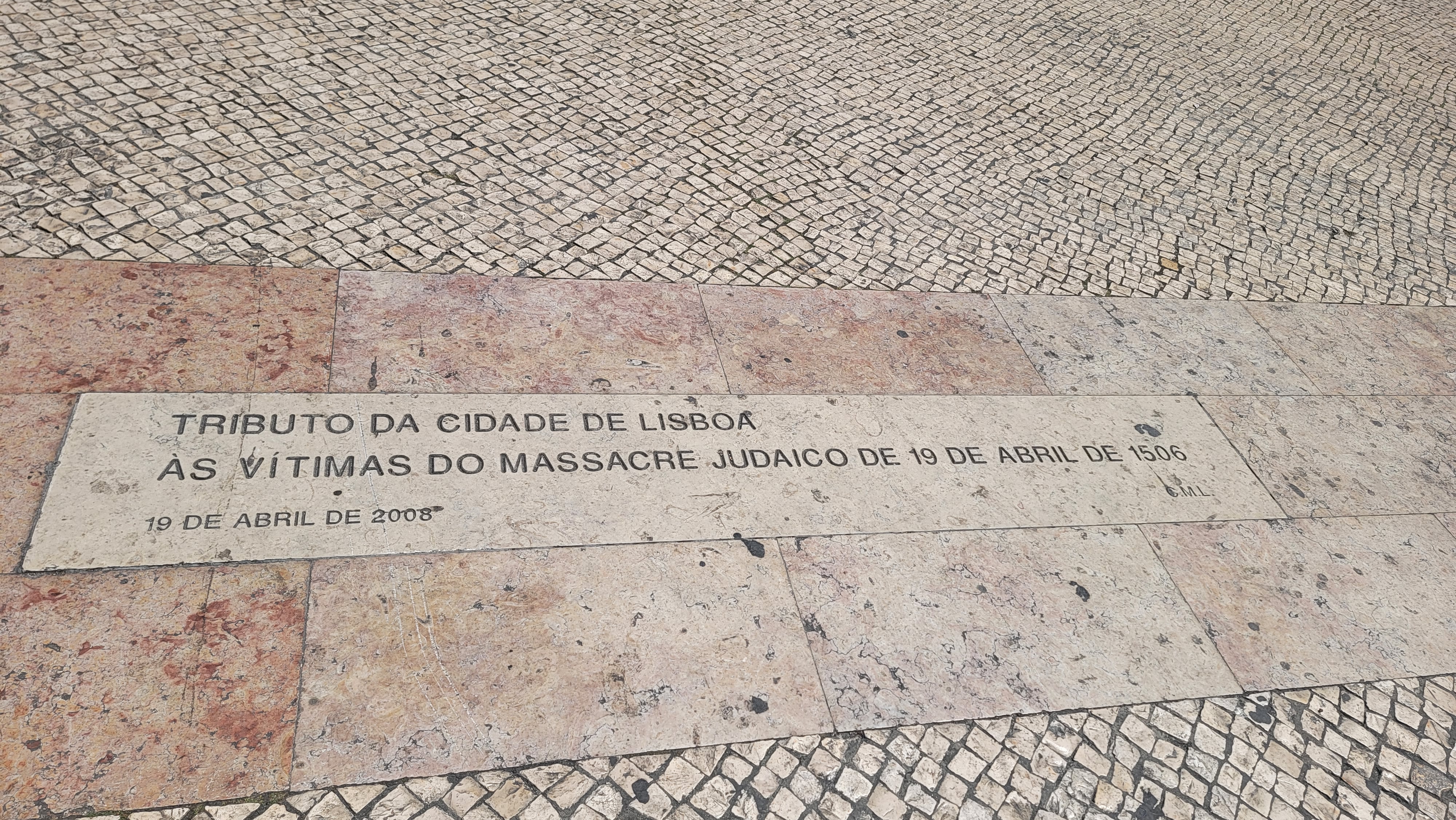
The Spanish forced their Jews to either leave the country or die in 1492. Many fled to Portugal, Morocco, the Ottoman Empire, the Netherlands or took ships to the New World. In 1497, Portugal followed suit in persecuting the Jews but also gave Jews the choice of converting. Those converts became known as New Christians or conversos. Not believing that the conversos really believed in their new religion, and looking for an alibi for a drought, the Christians of Lisbon, Portugal butchered over 2,000 conversos on April 19, 1506.

The Spanish and Portuguese took the Inquisition to the New World shortly thereafter, including to Brazil in 1536 and to what is now Mexico in 1571. Not satisfied with driving the Jews out of the Iberian Peninsula, they persecuted the New Christians in Central and South America. One example was the whipping and burning at the stake of the de Carvajal family – a mother with four of her children – in the middle of Mexico City on December 8, 1596.

António José da Silva (1705-1739), was a famous Brazilian-born playwright, nicknamed “the Jew.” As a young child, he was forced with his family to flee to Portugal because of the Inquisition. It did not provide him sanctuary. As an adult, he was accused of being a Jew and was garroted and burned at the stake in front of his wife.

By some estimates, as much as 10-20% of people living in Portugal today are actually descendants of Jews who were forced to convert to Christianity. The percentage is estimated to be much higher in Brazil and around Latin America as Jews fled from persecution but were still reluctant to publicize their Judaism.

There are only about 1,000 public Jews left in Portugal today.

Summary

The Portuguese president called out the terrible history of his country in its participation of the slave trade and colonization. The Portuguese head of the United Nations echoed the sentiment and drew a line from that history to the persecution of Blacks and indigenous people today. But no one even mumbles about the horrors inflicted on their own resident Jews during that same period as part of the Inquisition, and the antisemitism still prevalent today.

Quite the opposite. Even as he denounced Portugal’s history, President Rebelo de Sousa said that the “colonization of Brazil also had positive factors, such as the spread of Portuguese language and culture,” meaning a purely Christian society devoid of Jews.

The Jews remain outside the perimeter of Victims of Preference around the world then and today.

Related articles:

Watching Jewish Ghosts

How Many Jews?

The Beautiful and Bad Images in Barcelona

Related First.One.Through video:

1001 Years of Expulsions (music from Schindler’s List)

Subscribe YouTube channel: FirstOneThrough

Join Facebook group: FirstOne Through Israel Analysis