
Summary: When it comes to reporting on the death of civilians, it is interesting to review how and when some media outlets choose to simply report facts, rather than delve into critical reporting. Here is a comparison of the New York Times discussion of cluster bombs being used by Syria and the Kingdom of Saudi Arabia (KSA). Remarkably, the party that is lambasted the most in the articles is Israel.
Actions and Adjectives
The “Actions and Adjectives” series discusses the media’s use of language. Oftentimes, the press chooses to be fairly clinical in describing a situation, while at other times, it chooses to direct (or redirect) the conversation in a particular fashion.
For an example, an article can have different ways of describing a car crash:
- “Three people died in a car crash,” is purely factual.
- “Three people were killed in a car crash when a teenager crashed his car into oncoming traffic,” provides more color about the incident, giving an account of how the crash happened.
- “Three innocent people were killed when an irate teenager plowed his car into oncoming traffic after the teen had a big fight with his girlfriend,” takes the article to an entirely different place.
While all of the sentences are factual, the third description does two significant things:
- It gets the reader to be more engaged- “innocent people were killed” by an “irate teenager,” phraseology gets the reader more excited and angry.
- Further, the conversation moves the reader away from the victims, towards the driver. The reader is intentionally led towards possible motivation and background which caused the incident. Most likely, a more detailed description of the driver and his relationship would follow in the article. Should the balance of the article focus on teenage relationships, the headline would unlikely be about the car crash; the accident was there solely as a tool to delve into the main focus, which in this example, is the potential danger and ramifications of teenage love.
With that general overview about word choice and focus, consider the New York Times description of the use cluster bombs by Syria and Saudi Arabia.
Cluster Bombs Used by Saudi Arabia
On May 3, 2015, the New York Times published a piece entitled “Saudi-led Group Said to Use Cluster Bombs in Yemen“. The 14 -paragraph article showed up at the bottom of page 10 and discussed a report by the Human Rights Watch (HRW) which concluded that Saudi Arabia used cluster bombs on at least two occasions. No casualty figures were supplied.
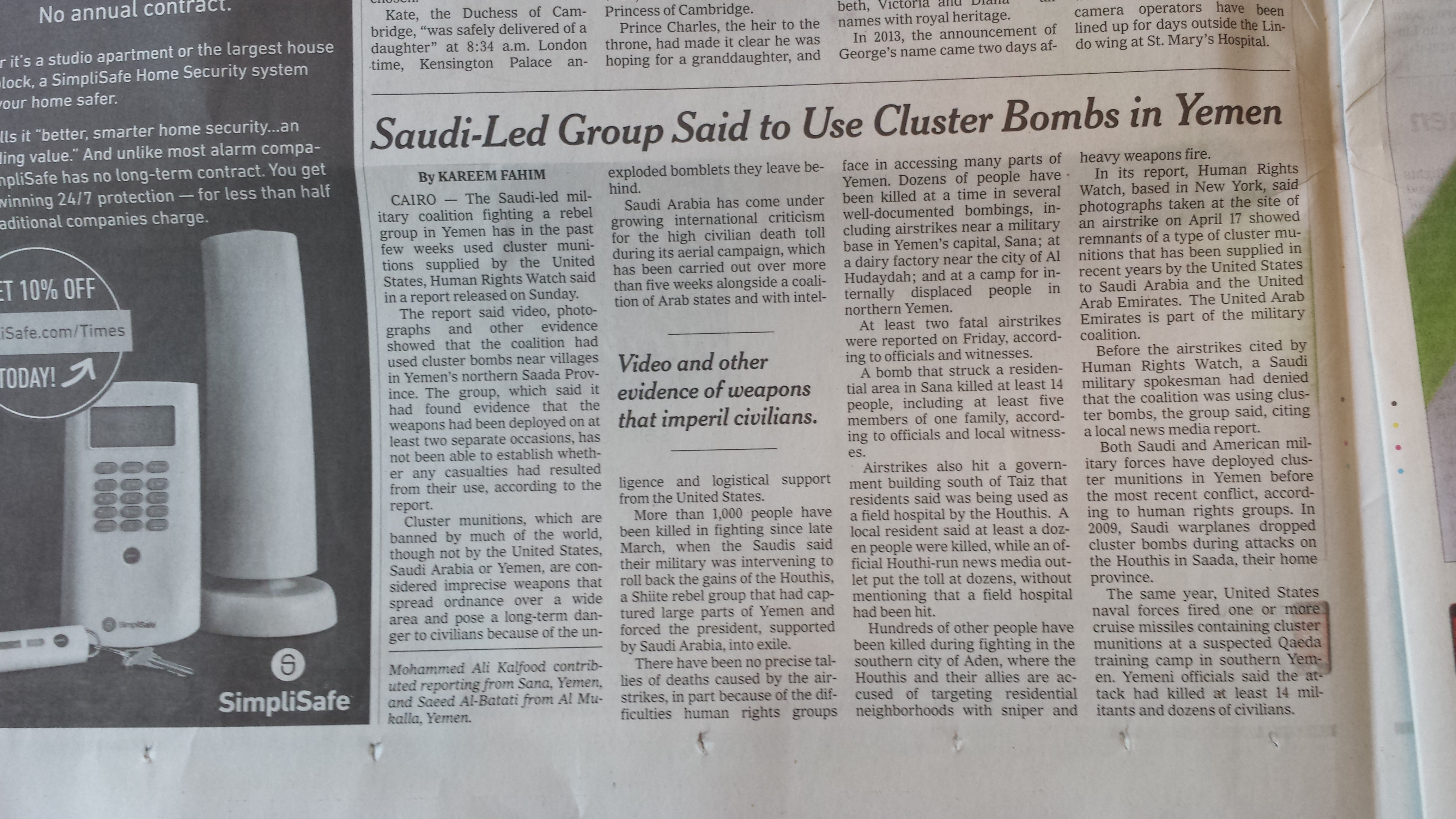
The article made clear that “cluster munitions, which are banned by much of the world, though not by the United States, Saudi Arabia or Yemen,… pose a long-term danger to civilians because of the unexploded bomblets they leave behind.” The article included a single condemnation of KSA for its use of the weapons: “Saudi Arabia has come under growing international criticism for the high civilian death toll during its aerial campaign, which has been carried out over more than five weeks alongside a coalition of Arab states and with intelligence and logistical support from the United States. More than 1,000 people have been killed in fighting since late March, when Saudis said their military was intervening to roll back gains by the Houthis, a Shiite rebel group that had captured large parts of Yemen and forced the president, supported by Saudi Arabia, into exile.”
These sentences may look unremarkable on their own, but consider what was actually written and the direction of the article as a whole:
- It was clear that the parties that engaged in the use of the cluster bombs had not signed onto the treaty barring their usage
- The “unexploded bomblets” were left behind by the cluster bombs, not by the Saudis which were a step removed
- KSA was portrayed in a negative manner only a single time in the article: “growing international criticism”
- The aerial campaign was described as having wide support from a “coalition” which included “support from the United States”
- A rationale was given for the KSA military attack- to “roll back” a “rebel group”
The article stayed roughly true to the HRW report. This was in very stark comparison to an article in the New York Times published on August 28, 2014 called “Heavy Use of Banned Cluster Bombs Reported in Syria”
Cluster Bombs Used by Syria
In September, FirstOneThrough wrote a detailed analysis of the August 2014 article which outlined how the story about Syria’s use of cluster bombs ended up becoming harsh a critique of Israel. Below is some added comparisons to this week’s NYT article.
The 2014 article had a single negative comment for Syria’s use of cluster bombs, attributed to a HRW lawyer: “This year’s use of cluster munitions shows that while these weapons have been banned by most countries of the world, some actors still flout international opinion and standards,” Mary Wareham, the advocacy director of Human Rights Watch’s arms division,” in a statement that did not specifically mention Syria.
However, the Times did heap condemnation many times upon Israel, even though it was presumably not the focus of the article. The author, Rick Gladstone, redirected the timely article about Syria towards Israel’s use of the cluster bombs eight years earlier.
“Israel-Lebanon conflict that triggered global outrage and contributed to the establishment of the ban convention. Israel’s military was widely criticized at home and abroad for its heavy cluster-bomb use in Lebanon,”
Gladstone’s 16-paragraph article mentioned Israel in six of the paragraphs. In almost each case, Israel was lambasted.
- In the 2015 article, KSA had “growing international criticism” while in 2014, Israel had “global outrage” and was “widely criticized” and many other uses of such critical language for Israel, including “insane and monstrous” and “completely immoral.” Syria was not condemned by name.
- In 2015, KSA fought against “the Houthis, a Shiite rebel group,” However, in the 2014 article, Hezbollah, a Shiite army that is considered a terrorist group by the United States, was mentioned only once while “Israel-Lebanon” was used repeatedly.
- The 2015 article articulated the reason KSA waged its aerial campaign; the 2014 article did not describe Hezbollah’s firing rockets into Israel and blowing up military vehicles which initiated the war.
As evidenced in this week’s KSA article on cluster bombs, the Times can write an article about the current news when it desires. It has also shown that it is deft at inflaming passion and redirecting an article towards Israel, as it did in August 27, 2014. Why did the New York Times report on cluster bombs in such a different manner?
In August 2014, Israel and Hamas had just ended a bloody war in which the New York Times covered Israel as an evil, murderous aggressor against civilians. The story of cluster bombs in Syria served as an excuse to continue to portray Israel as indifferent to the lives of civilians in a war. The choice of critical adjectives and adverbs such as “insane,” “monstrous” and “immoral” for Israel were meant as permanent monikers.
Other questions arise when reviewing the two cluster bomb -articles:
- Why does the New York Times goes out of its way to portray Saudi Arabia as an ally of the United States that receives “support” but does not do the same for Israel?
- Why was the United States’ usage of cluster bombs in 2009 buried at the bottom of the 2015 article, and the thousands that the US dropped in Vietnam mentioned in passing in the 2014 article?
Articles do not just convey facts. They tell a story that the editors want you to follow and believe. What do you believe?
Related First One Through articles:
Every Picture Tells a Story- Whitewashing the World (except Israel)


 First One Through