The EU’s Choice of Labels: “Made in West Bank” and “Anti-Semite”

The European Union has taken upon itself to challenge the labelling of products that are made east of the Green Line as “Made in Israel”.   They should consider international norms and the Oslo Accords between Israel and the Palestinians before doing so.

“Made in USA” in US Territories

It is common practice for countries that have territories that are not incorporated into the country, to label products produced in those locations as being made in the country. For example, products produced in American Samoa (say for Sears Department stores) sport the “Made in USA” label even though the products were produced thousands of miles away from US shores on an island that was never part of the country by non-US citizens.

“Made in Israel” in Israeli Territory

Similarly, Israeli law allows products made in Israeli territory to carry the “Made in Israel” label.  The differences between the US and Israeli polices are that the products made in Area C of the West Bank are made by Israeli citizens, and many countries consider the Israeli territory to not be Israeli at all.

The claim that Area C is not Israeli is peculiar, since the land is specifically designated as Israeli territory by the 1993 Oslo II Accords that were agreed to and signed by Israel and the Palestinian Authority. That agreement laid out that Israel continues to have both civil and security control of Area C.  The final determination of control of the area will be decided in a final status agreement, which has not yet occurred. Until that time, the area remains Israeli territory (as opposed to Area A which is Palestinian Authority Territory).

Reasons behind Labelling

The labeling of products is meant to do two main things: inform a consumer about the origins of a product; and distinguish items as they relate to taxes and tariffs.

In the United States, labelling a product from American Samoa as being “Made in USA” may be misleading to consumers about the true origin of the item, but it is consistent as it relates to tariffs. The same holds true for Israeli policy towards items from Area C.

From the EU’s perspective, not only does it seek to inform European consumers about the precise location of origin of foreign products, it wishes to uniquely harm Israel as it disputes the Israeli claim over Area C (despite the Israel-Palestinian Authority agreement noted above). It is therefore requiring a change of labels from “Made in Israel” to “Made in the West Bank” for items produced east of the Green Line.

Date-box-label-1-e1375886179109-350x379
Dates in London, England labelled “West Bank”
(photo: Friends of Al Aqsa London)

Israel has attempted to stop the European Union from embarking on this policy. It fears that the Boycott, Divestment and Sanctions (BDS) movement will hurt its economy by not only not purchasing Israeli products, but by trying to ban the items from store shelves. Some argue that providing a distinct label for products from the settlements would actually help Israel as there are people in Europe who only seek to avoid products from the settlements, but would gladly purchase items from within Israel’s 1949 Armistice Lines. The reality is that many organizations that are promoting the EU policy for distinct labelling of Israel vs. “West Bank” seek to boycott and harm all of Israel. For example, Friends of Al Aqsa (FOA) prints advertisements that call for boycotting all products from anywhere in Israel and its territory.
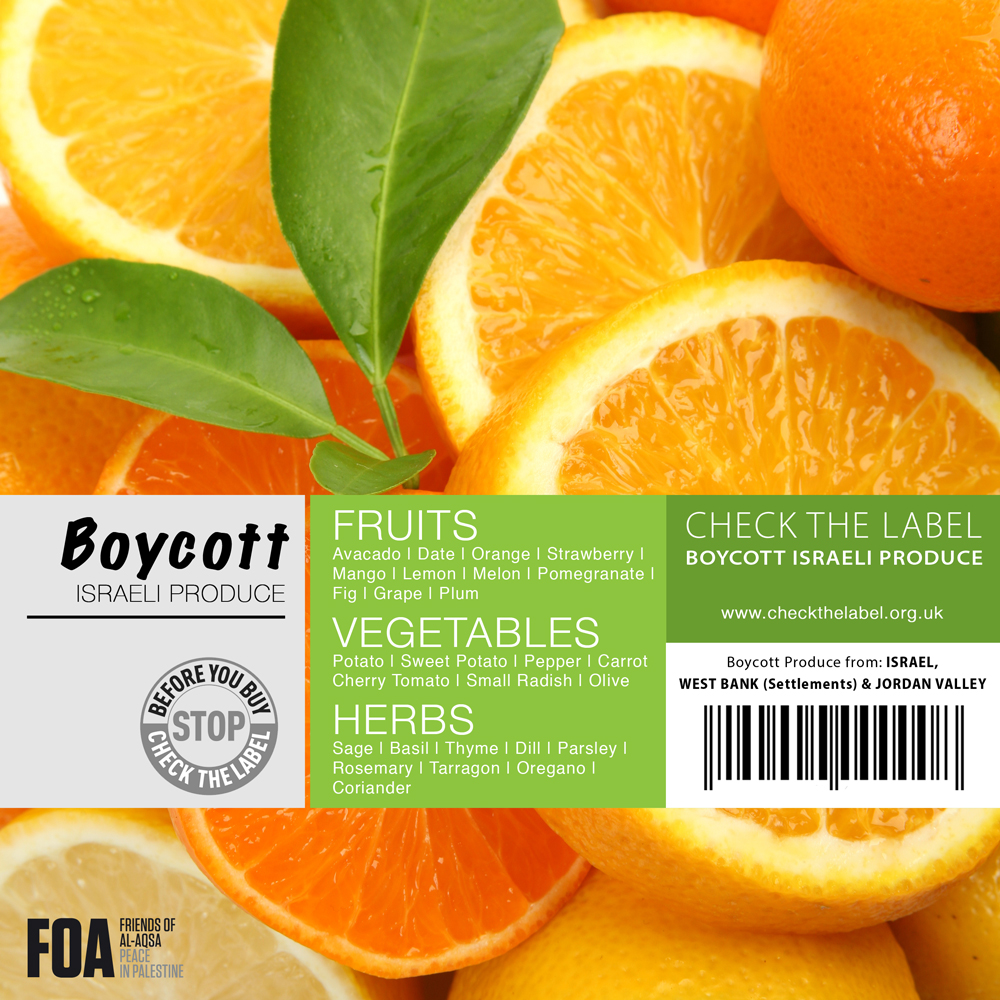
label Israel
Ad by FOA calling for Boycott of products from “Israel, West Bank (Settlements) & Jordan Valley”

As it relates to taxes and tariffs, the European Union established a framework of trading with Israel in the EU-Israel Association Agreement (1995) which took effect in June 2000. The language in the agreement repeatedly refers to “countries and territories” which can be interpreted broadly to include territories of both European member states as well as Israel.

EU Action Only for Israel

The European Union distinction of strictly labelling products to exclude Israeli territory is unique for Israel.  The EU makes no distinctions for countries where it does not challenge the legal authority (like the US with American Samoa), AND for other countries where it disagrees with the claim on disputed land. Some examples:

  • In 1974, Turkey illegally seized one-third of the Cyprus and declared the Turkish Republic of Northern Cyprus, an entity which is not recognized by any country in the world other than Turkey. Yet the EU avoids heated discussions with Turkey over the labelling of products from TRNC such as its famous halloumi cheese.
  • When it comes to China, the EU trips over itself to facilitate trade. As stated on the EU website on trade: “China is the EU’s biggest source of imports by far, and has also become one of the EU’s fastest growing export markets. The EU has also become China’s biggest source of imports. China and Europe now trade well over €1 billion a day.” Trade includes items made in Tibet, and the EU has not addressed any specific “Made in Tibet” labelling. This is despite China occupying Tibet and transferring 7.5 million Chinese into the territory, counter to the Fourth Geneva Convention.
  • India has a long running dispute with Pakistan over Kashmir. The EU stated that it is “committed to further increase their trade flows in both goods and services as well as bilateral investment and access to public procurement through the Free Trade Agreement negotiations that were launched in 2007.” No specific labelling program has been discussed for items coming from Kashmir.

The European Union has shown a unique fascination with Israeli territories.

  • It makes no labelling distinction for other disputed territories such as Tibet and Kashmir to assist consumers
  • It does not dispute the tariff system that countries use for its territories like the United States with American Samoa
  • The EU ignores the Oslo II agreements between Israel and the Palestinian Authority which specifically segment the Israeli settlements in Area C as Israeli territory
  • It ignores its own trade agreement with Israel

And the EU does all of these things knowing full well of the intention of the BDS movement to leverage their actions to harm the Jewish State.

Double standards and unique critical attention for Israel is considered anti-Semitism, even by US President Barack Obama who said “[if] you acknowledge the active presence of anti-Semitism—that it’s not just something in the past, but it is current—if you acknowledge that there are people and nations that, if convenient, would do the Jewish people harm because of a warped ideology… you should be able to align yourself with Israel when it comes to making sure that it is not held to a double standard in international fora, you should align yourself with Israel when it comes to making sure that it is not isolated.”

It would appear that many Europeans would choose to wear the “Anti-Semitism” label with honor.


Related FirstOneThrough articles:

Names and Narrative: Palestinian Territories/ Israeli Territories

Palestinians agree that Israel rules all of Jerusalem, but the World Treats the City as Divided

Subscribe YouTube channel: FirstOneThrough

Join Facebook group: FirstOne Through  Israel Analysis

The Fault in Our Tent: The Limit of Acceptable Speech

 Some passionate and eloquent liberals have bemoaned the state of inclusiveness among Jews today. Leon Wieseltier, editor of the New Republic, penned an angry piece “J Street’s Rejection Is a Scandal” about the exclusion in 2014 of J Street from the Conference of Presidents of Major American Jewish Organizations. Angry voices are again being heard about J Street due to their position in favor of the Iranian nuclear deal promoted by the Obama administration. Is Wieseltier correct in that we only seek to hear our own voices and that “the orthodoxies and the bubbles and the closed loops and the echo chambers are everywhere?” Is there a “red line” that J Street and others have crossed and therefore deserve to be excluded from the broad tent of acceptable conversation?

Individual Hate Speech

Many countries have laws that ban hate speech. Sometimes the exact language is clearly spelled out about what cannot be said publicly and sometimes it is more general in nature.

For example, several European countries, including Germany, have laws that prohibit Holocaust denial. Those countries took such steps not simply because such expressions offend Jews, but because of the continent’s failure to step in and protect Jews which led to their slaughter. Silence became complicity which must never be allowed to happen again.

For its part, the United Nations Human Rights Council adopted Resolution 16/18 whose goal is “Combating Intolerance, Negative Stereotyping and Stigmatization of, and Discrimination, Incitement to Violence and Violence Against, Persons Based on Religion or Belief.” The resolution was drafted principally at the behest of Islamic countries who were worried about the spread of “Islamophobia.”

The various laws against hate speech all seek to curtail an incitement to violence and harm. The banned speech relates to a specific group of people (ie. Muslims) and not a concept (for example, a religion like Islam).  While a person can legally say disparaging remarks about a concept (“Communism is evil”), one risks breaking the law by attacking a group of people (“All Communists should be beaten up”).

Banned Groups

Hate Speech laws are typically drafted against individuals. However, laws are also drafted against groups that incite violence.  Israel banned two political parties, Kach and Kahane Chai in 1994 as they were defined as terrorist organizations.  The groups’ ideology was based on the teachings of Rabbi Meir Kahane who called for expelling Arabs from Israel, thereby running afoul of the premise of calling for negative actions against people.  Israel has also banned some Arab parties from running in elections which supported terrorism.

BDS, Hamas and Iran

Liberals and J Street supporters feel that BDS (Boycott, Divestment and Sanctions), Hamas and the Iranian nuclear deal should be rightly within civil discourse.  However, do these topics and groups support violence against people, or are they just broad discussions about policies and ideas?

BDS: Reasonable people can arrive at different conclusions about Jewish settlements in Judea and Samaria. Some feel that all the settlements are completely legal as called for in international law in 1922, while others feel that Jews living east of the Green Line is against international law as recently stated by the UN Secretary General. Those competing viewpoints would fall within legal and acceptable conversation, both in public society and in an open-minded pro-Israel community.

However, inciting hatred against settlers is inciting violence.  Calling on the economic strangulation of Jews who legally purchased homes and businesses is akin to hate speech.  As such, new laws are being passed which specifically outlaw supporting BDS.

Hamas: Hamas is a rabidly anti-Semitic organization that calls for the complete destruction of Israel. It has fired well over 10,000 rockets into Israel, killed thousands of people in hundreds of attacks. Since completely taking over Gaza in 2007, Hamas has engaged in three wars against Israel.

Supporting Hamas in any way is supporting terror.  It should be banned completely in public society and in the pro-Israel tent.

Iranian nuclear deal: The Iranian nuclear agreement took various turns over the past several years. As Iran openly calls for the destruction of Israel, any group supporting Iran or helping Iran obtain weaponry would be supporting violence against Israel.

While the Iranian deal may arguably slow down Iran’s pathway to nuclear weapons, it certainly gives Iran tremendous financing and weaponry.  As such, 78% of Israelis oppose the Iran deal in its current format.

J Street Views

J Street has taken provocative stances on these three issues.

  • On BDS, the group technically states that it opposes the BDS movement, while it supports efforts that do call for BDS, particularly of communities east of the Green Line.
  • On Hamas, the group’s own website states that “Hamas is a political movement with an important and significant base of support within Palestinian society… and we support efforts by third parties to achieve reconciliation [between Fatah and Hamas which Israel opposes] and a unity government.”  One could similarly say that the Nazi party was a political party.
  • On Iran, the group launched a major campaign to support the deal, in direct opposition to pro-Israel groups such as AIPAC and the government of Israel itself. J Street was even against Iranian sanctions in 2009.

20150724_072448
 Full page J Street Advertisement supporting Iran Deal
New York Times July 25, 2015

On these issues which directly harm Israelis and the state of Israel, J Street has sided against the stated desires of the government of Israel.  Each time, they have taken stances which closely align with Israel’s enemies which seek to harm the country and its citizens.

Further, and most alarmingly, J Street has urged the Obama administration to vote against Israel at the United Nations Security Council, which is the sole voice of support in many instances. That action was so reprehensible, that even devout liberal politician Gary Ackerman (D-NY) said I’ve come to the conclusion that J-Street is not an organization with which I wish to be associated….America really does need a smart, credible, politically active organization that is as aggressively pro-peace as it is pro-Israel. Unfortunately, J-Street ain’t it.

Erekat
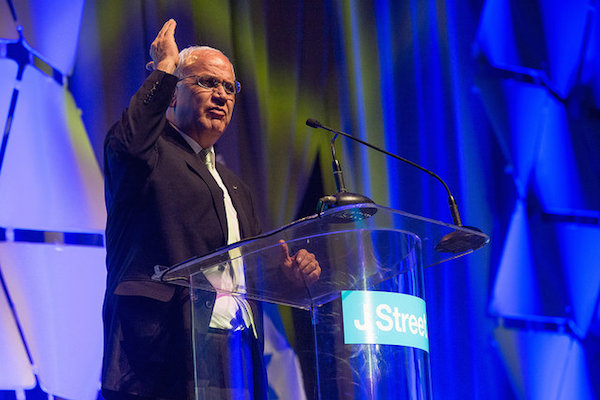
PLO negotiator Saeb Erekat at J Street Conference
March 2015 (photo: J Street)

A Related View from Tisha b’Av

The Talmud relates a story about the reason the Second Temple in Jerusalem was destroyed:

In Gittin 56ab the Talmud tells the story of zealots who wanted to fight the Romans as they got ready to attack Jerusalem. These zealots burned decades worth of food that had been stored in Jerusalem in order to force the residents of the city to confront the Romans.

These zealots undoubtedly considered themselves pro-Jewish. They thought that by destroying all safeguards and alternative options, they could force the rest of the Jewish people to adopt their position in the battle against Rome.

J Street, like the zealots 2000 years ago, view themselves as pro-Israel. While some parts of the Arab and Muslim world (f/k/a Romans) may seek to attack and destroy Israel, J Street views their approach to the conflict as the only logical course of action.  As such, they have engaged in co-opting the US government to take positions against those sought by the government of Israel.  Like the zealots who burned all of Jerusalem’s food supplies (now known as US support), they feel that Israel stripped of all of the territories won in 1967, without a Gaza blockade, and with a nuclear pact in place with Iran will secure Israel’s future. J Street is pursuing global and US pressure to make that happen, rather than seeking to convince the Israeli government.

JStreet-Map
Bookmark designed for J Street Conference
(Photo: Lisa Goldman)

 In the minds of many, the J Street positions have made them the a modern-looking version of Neturei Karta, the anti-Zionist Chasidic sect, similar to the clean-shaven Jewish outreach people who market a more modern version of Chabad outreach.


Debating the merits of different approaches for how Israel deals with hostile neighbors is within constructive debate.  Consistently arguing in favor of Israel’s enemies that seek to destroy the country and kill its people is akin to inciting violence.

Review the statements and positions of J Street here and consider whether such voices deserve to be heard in your community.


Related First One Through articles:

New York Times Confusion on Free Speech

Selective Speech

A Disservice to Jewish Community

Subscribe YouTube channel: FirstOneThrough

Join Facebook group: FirstOne Through  Israel Analysis

The Israeli Peace Process versus the Palestinian Divorce Proceedings

Summary: The gap in resolving the long running Israel-Palestinian Question has to do with the goals of each party: the Israelis believe they have been engaged in a peace process between peoples while the Palestinians are negotiating a divorce settlement between countries.

Politicians and the media – both well-meaning and otherwise – have blamed various parties for the failures to resolve the Israeli-Palestinian conflict. When they are not directly pointing accusing fingers, they still use language which conveys their biases. A person needn’t look past the language used in discussions about Jewish homes beyond the Green Line/ 1949 Armistice Lines – the “settlements”.

“Settlements”

“Viability”: As detailed in “A Viable Palestinian State”, various parties have described the “settlements” as a hindrance to a viable Palestinian state. The statement is meant as a direct attack on Israel, and is absurd. If a Palestinian state cannot exist with a 5% Jewish population, then surely Israel cannot exist with a 20% Muslim population. Are the people that make such a comment looking for Israel to expel a million Israeli Arabs?

Similarly, if a viable Palestine is compromised because such new country would be only 15km across at a single point, surely Israel cannot exist in its current configuration with a 15km narrow corridor for a dozen kilometers. Are these politicians and media pundits suggesting that Israel must annex the entire spine of the land?

“Complication” and “Provocation”: Another sentiment that is expressed is that settlements “complicate the peace process.” As conveyed in June 2015 by the New York Times in an article called “Israel’s work on a West Bank Site Gives Rise to New Suspicion,” even existing homes purchased by private individuals (as opposed to new communities established by the Israeli government) hurt the peace process. The article described a man who purchased an abandoned building and surrounding property: “Leftist Israeli politicians and advocacy groups have reacted with alarm, suspecting a new settlement in the occupied West Bank [a NYT term] that would further complicate the peace process.

This statement is similar to the rebuke of the Obama administration to Jews buying and moving into homes they own in Silwan, in the eastern part of Jerusalem. As detailed in the FirstOneThrough article “Obama supports Anti-Semitic Palestinian Agenda of Jew-Free State,” the Obama administration condemned Jews for legally buying homes and becoming neighbors in an Arab neighborhood east of the Green Line, referring to such basic act of living as a provocation.

And therein lies the basic gap in understanding the actions, intentions and goals of the two sides.

20150610_080707
New York Times article quoting “leftists” that claim that individual Jews owning land east of the Green Line “complicates peace”

Israeli Peace Process

The primary stated goals of the negotiations were to get to a peace based on two states:

  • The peace agreements with Egypt and Jordan are vital. But they’re not enough. We must also find a way to forge a lasting peace with the Palestinians. Two years ago, I publicly committed to a solution of two states for two peoples: A Palestinian state alongside the Jewish state. I am willing to make painful compromises to achieve this historic peace. As the leader of Israel, it is my responsibility to lead my people to peace.” Israeli Prime Minister Benjamin Netanyahu May 2011
  • Our goal is two states, Israel and Palestine, living side by side in peace and security. The process is the one of direct negotiations to end the Israeli-Palestinian conflict and to resolve all the permanent status issues and end the occupation that began in 1967 under which Palestinians have suffered so much.” Prime Minister of the Palestinian National Authority Mahmoud Abbas June 2003

As part of making peace with Palestinian Arabs, Israel has stated it will enable a new state of Palestine to be created.  For their part, the Palestinian Arabs are interested in their new state to be self-governing and to not deal with Israeli Jews. Israel has focused on peace with the people; Palestinians have focused on separation of the people. Two states living side-by-side in peace is not the same as two people living side-by-side in peace.

A peace process is best established with various personal, commercial and governmental relationships and dealings. Such interactions would enable the parties to navigate ongoing thorny issues like water rights and security.  It would enable partnerships to develop tourism and the economy.

Israel understands the importance of establishing relationships with its Arab neighbors.  As soon as the country was founded in 1948, the country granted 160,000 non-Jews citizenship and extended an offer and desire for peace with the neighboring Arab countries.  When Israel annexed Jerusalem, it offered all of the people there citizenship.  As of 2015, non-Jews account for 25% of Israel and have full rights in the most liberal country in the region, and one of the most liberal in the world. In the 2015 Israeli election, the Arab party placed third among the dozen parties seeking seats in the Knesset.

Over the decades, Israel forged peace agreements with neighboring Arab countries Egypt and Jordan.  It has stated that it is ready to so with Palestinian Arabs and the other neighboring countries as well.

Palestinian Divorce Proceedings

When Israel captured the area east of the Green Line in 1967 after it was attacked by the Jordanian and Palestinian Arabs, it rescinded the Jordanian ban on Jews living in the area (from 1949-67).  Israel allowed Jews to live and establish themselves in the region once again where they bought existing houses next to Arabs, built new houses, and created new companies.

All of which, made the Palestinian Arabs angry.

The Palestinians do not want Jewish neighbors in a new state.  Acting President Abbas made very clear his intention when he declared “we will not see the presence of a single Israeli – soldier or civilian – on our lands.”

The Palestinians do not want any Jewish businesses in a new state.  Despite the extraordinary efforts that some companies like Sodastream went through to hire Palestinian Arabs in its plant east of the Green Line (EGL) to work alongside Israeli Arabs and Jews, Palestinians put pressure on the company to abandon the area – which it did. Palestinians promote a BDS (boycott, divestment and sanctions) of all businesses established by Jews in the EGL.

Palestinians think Jews have no rights to buy or live anywhere in the land. They think the entire region – including Israel – is Arab land and that Jews have no history in the region. One can often hear Abbas and other Palestinians refer to the “Judaization” of the land, as if the holy land never had Jews.

The Palestinians reject the legitimacy of Israel itself. While the Palestinians will acknowledge the fact that Israel exists and will negotiate with it, they do not view the existence of the Jewish state as legitimate. They consider Jews colonialists and Israel a foreign colonial enterprise.  As such, they will not recognize Israel as a Jewish State.

The Palestinians are not looking for peace with Israel, nor are they seeking peace with Jews. They view the presence of both in the entire holy land as illegitimate. Their goals are to completely separate themselves from Israel and Jews in their own state, and to reestablish a majority Arab presence inside of Israel. Within their new country, the Palestinians do not want a single Israeli person or business.  Inside of Israel, they want millions of Arabs that are second and third generation removed from Arabs that once lived in the land, to specifically move to Israel because they feel that such land is also Arab land which Jews took illegally.


That is why Jewish “settlements” east of the Green Line are inaccurately called obstacles to a “peace process.” Jewish homes and businesses east of the Green Line do NOT “complicate the peace process”, they complicate the divorce proceedings that the Palestinians desire. A Jewish presence can only be called a “provocation” to a people that want to be rid of Jews.

It is not inaccurate to state that Jewish homes in EGL complicate permanent status negotiations, but it is an inversion of the truth to claim that they hurt the “peace process.”


Related First One Through articles:

Nicholas Kristof’s “Arab Land”

Delivery of the Fictional Palestinian Keys

Names and Narrative: The West Bank / Judea and Samaria


An Easy Boycott: Al Jazeera (Qatar)

People often complain that they would love to boycott one of the many countries with horrible human rights, but cannot do so as those countries do not make or export anything of value. Well, here’s the good news: Qatar brings Al Jazeera direct to many homes in your country.

Human Rights Abuse in Qatar

Qatar is a very small country in the Arabian Peninsula. The total country population of 2 million only consists of 10% Qatari nationals; roughly 90% of the balance are migrant workers who experience a variety of abuses according to Human Rights Watch. The abuses for these workers include:

qatar death
Preparing funeral rights for Nepalese worker killed in Qatar

The country abuses many citizens in addition to the migrant workers:

Seemingly unsatisfied with brutalized its own population, Qatar also funds terrorists in Gaza (Hamas) and in Libya.

These facts may get lost on the general American public, as the Obama administration commends its own negotiation prowess and Qatar’s joining the coalition fighting ISIS.

Al Jazeera

Qatar is a very wealthy nation thanks to its location atop various oil fields. It has used its considerable wealth to buy and build various properties around the world.  These include Harrod’s, the swanky department store in London as well as The Shard and 1 Hyde Park, expensive buildings in London. It was also able to win the competition to host the World Cup global soccer tournament in 2022. (Here is a funny video by HBO’s John Oliver about FIFA and Qatar).

Qatar also owns a large media company called Al Jazeera. It entered the United States market by buying former Vice President Al Gore’s CurrentTV for about $500 million in 2013. It has since rebranded that channel Al Jazeera America.  It is now available in many US households.

aljazeera

Al Jazeera is not simply owned by a country that supports terrorism. The channel itself is a mouthpiece for terrorism.

In 2014, the channel gave special airtime to various members of the Palestinian terrorist group Hamas. The main media channel, Al Jazeera Arabic, routinely posts anti-US and anti-Semitic pieces. But those posts are beyond the capabilities and reach of most Americans, so they believe that watching Al Jazeera America is simply watching a news channel that represents an Arab point of view.  In truth, they are supporting a media company that broadcasts propaganda for terrorists, which is owned by a government that funds those same terrorists.

For those looking for a BDS (boycott, divestment and sanction) of their own. there is an opportunity right in your home.


Related First.One.Through articles:

Apostasy: https://firstonethrough.wordpress.com/2015/01/13/apostasy/

Murderous governments of the Middle East: https://firstonethrough.wordpress.com/2014/08/01/murderous-governments-of-the-middle-east/

Dancing with the Asteroids: https://firstonethrough.wordpress.com/2014/11/14/dancing-with-the-asteroids/

BDS and Christian Persecution

It is a curious phenomenon that some Christian groups are considering a BDS of Israel.  Israel is one of the only countries in the Middle East: which has seen an increase in its Christian population; where the number of Christian tourists exceeds every other religion; has complete freedom of religion including protecting Christian holy places.

There are over 100 countries that have a terrible record in their treatment of Christians, yet no Christian groups are considering boycotting them.