The Karma of the Children of Israel

The second book of the Pentateuch is called “Exodus” in English but called “Names” in Hebrew due to the opening lines. In reviewing the first ten sentences of the book, there is seemingly a deeper message about the names themselves.

וְאֵ֗לֶּה שְׁמוֹת֙ בְּנֵ֣י יִשְׂרָאֵ֔ל הַבָּאִ֖ים מִצְרָ֑יְמָה אֵ֣ת יַעֲקֹ֔ב אִ֥ישׁ וּבֵית֖וֹ בָּֽאוּ׃

These are the names of the sons of Israel who came to Egypt with Jacob, each coming with his household:

רְאוּבֵ֣ן שִׁמְע֔וֹן לֵוִ֖י וִיהוּדָֽה׃

Reuben, Simeon, Levi, and Judah;

יִשָּׂשכָ֥ר זְבוּלֻ֖ן וּבְנְיָמִֽן׃

Issachar, Zebulun, and Benjamin;

דָּ֥ן וְנַפְתָּלִ֖י גָּ֥ד וְאָשֵֽׁר׃

Dan and Naphtali, Gad and Asher.

וַֽיְהִ֗י כָּל־נֶ֛פֶשׁ יֹצְאֵ֥י יֶֽרֶךְ־יַעֲקֹ֖ב שִׁבְעִ֣ים נָ֑פֶשׁ וְיוֹסֵ֖ף הָיָ֥ה בְמִצְרָֽיִם׃

The total number of persons that were of Jacob’s issue came to seventy, Joseph being already in Egypt.

וַיָּ֤מָת יוֹסֵף֙ וְכָל־אֶחָ֔יו וְכֹ֖ל הַדּ֥וֹר הַהֽוּא׃

Joseph died, and all his brothers, and all that generation.

וּבְנֵ֣י יִשְׂרָאֵ֗ל פָּר֧וּ וַֽיִּשְׁרְצ֛וּ וַיִּרְבּ֥וּ וַיַּֽעַצְמ֖וּ בִּמְאֹ֣ד מְאֹ֑ד וַתִּמָּלֵ֥א הָאָ֖רֶץ אֹתָֽם׃ (פ)

But the sons of Israel were fertile and prolific; they multiplied and increased very greatly, so that the land was filled with them.

וַיָּ֥קָם מֶֽלֶךְ־חָדָ֖שׁ עַל־מִצְרָ֑יִם אֲשֶׁ֥ר לֹֽא־יָדַ֖ע אֶת־יוֹסֵֽף׃

A new king arose over Egypt who did not know Joseph.

וַיֹּ֖אמֶר אֶל־עַמּ֑וֹ הִנֵּ֗ה עַ֚ם בְּנֵ֣י יִשְׂרָאֵ֔ל רַ֥ב וְעָצ֖וּם מִמֶּֽנּוּ׃

And he said to his people, “Look, the nation of the sons of Israel is too numerous for us.

הָ֥בָה נִֽתְחַכְּמָ֖ה ל֑וֹ פֶּן־יִרְבֶּ֗ה וְהָיָ֞ה כִּֽי־תִקְרֶ֤אנָה מִלְחָמָה֙ וְנוֹסַ֤ף גַּם־הוּא֙ עַל־שֹׂ֣נְאֵ֔ינוּ וְנִלְחַם־בָּ֖נוּ וְעָלָ֥ה מִן־הָאָֽרֶץ׃

Let us deal shrewdly with them, so that they may not increase; otherwise in the event of war they may join our enemies in fighting against us and rise from the ground.”

Genesis 1:1-10

The first sentence opens with calling Jacob by his changed name “Israel” before switching to his birth name “Jacob.” The text then lists all of the names of Jacob’s sons and subsequently pivots back to “Israel” after Joseph and his brothers died. At the end of the section, not only does the text pivot to using “sons of Israel” to include women and later generations but the new king in Egypt goes further in calling them a “nation of the sons of Israel.”

There is clearly more to appreciate in the names employed.

Birth Names of Human-Tension

The names given to the Jewish forefathers are explained inside the text in Genesis with some rationale given of how the parents felt at the time of the baby’s birth. Often, the names portend events in the future.

Consider how Sarah laughed when she heard she was going to have a child (Genesis 18:12) and then later Abraham named him Isaac (Genesis 21:3) after the Hebrew name for laughter. Sarah seemingly approved of the name (Genesis 21:6) only to soon witness Isaac’s half-brother Ishmael making fun of him (Genesis 21:8). Isaac’s name was an omen of things to come or perhaps served as the catalyst for how people perceived him. Maybe both.

One can see the impact of names when reading about Jacob’s eldest son, Reuben. Born to an unloved wife, Leah, Genesis 29:32 describes one of the saddest baby-namings in the Bible: “Leah conceived and bore a son, and named him Reuben; for she declared, “It means: ‘The LORD has seen my affliction’; it also means: ‘Now my husband will love me.’” How that name must have weighed on Reuben! To carry a name that shows his mother was unloved! With Leah’s sister as another wife and two handmaids also producing half-brothers, the family dynamic was extremely difficult. When his mother’s sister Rachel died years later and Jacob opted to still not enter Leah’s tent but that of Bilhah, Rachel’s handmaid, Reuben was apoplectic and raped Bilhah (Genesis 35:22).

The bible is deliberately silent on Jacob’s reaction to the event, stopping the story mid-sentence and starting a new paragraph with “Now the sons of Jacob were twelve in number.” Seemingly, Reuben is not punished by his horrific act and remained part of the collective twelve sons. Perhaps Jacob acknowledged that it was Reuben’s obligation to fight for the honor of his spurned mother, maybe even uniquely among Leah’s six sons, as he bore the name of desperate love.

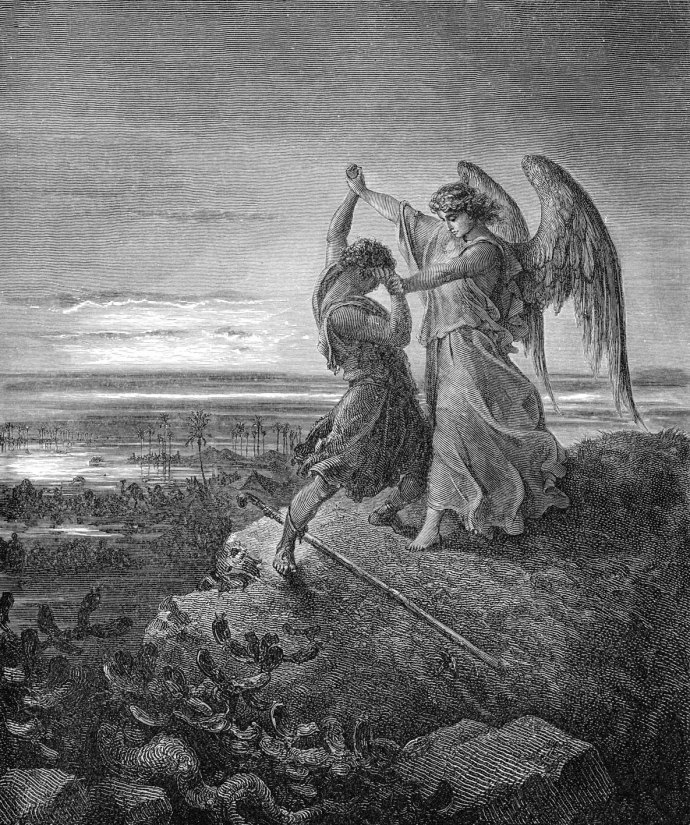
Jacob himself was named by his mother Rebecca for the contentious relationship he would have with his brother Esau. In Genesis 25:23, God told Rebecca that two nations were struggling inside her womb and she named Jacob in Genesis 25:26 because he was clutching the heel (ekev in Hebrew) of Esau. This highly fraught relationship continued for years until an angel renamed Jacob in a night struggle, seemingly redoing the struggle in Rebecca’s womb. This time, Jacob came out on top but instead of clutching the heel of the winner, he incurred a permanent limp. As the victor, he was renamed Israel (Genesis 32:29) “for you have striven with beings divine and human, and have prevailed.” It was only at this point, stripped of a name that carried the significance of brotherly-confrontation, that Jacob met with Esau who had come to meet him with a 400-person army. Peace prevailed.

Karma of the Nation of Israel

After reviewing the nature of how parent-given names influenced the lives of the biblical forefathers, we can take a fresh look at the opening sentences of Exodus in a different manner.

From the middle of the first sentence through the sixth, the Bible names Jacob and his sons by their parent-given names with Joseph separated from everyone – twice. First, he is described as already living in Egypt and then specifying his death while not listing any other deaths in the family. Seemingly this fits the narrative to come, that a new Egyptian king did not know Joseph. A casual reader would infer that the new king did not know how Joseph saved the entire region from starvation and made Egypt into a rich and powerful nation.

But such a linear reading could have been accomplished without starting and closing the section with the name “bnai Yisrael,” at first being the sons of Jacob, then the extended family and ultimately entire nation of Israel.

The birth-named middle section is a family set upon itself. As sons of Jacob, they were dysfunctional to an extreme: Joseph’s brothers sold him into slavery after throwing him into a pit; the sons lied to their father that Joseph was dead; Reuben raped his half-brothers’ mother. The list goes on. This family of Jacob was a quarrelsome bunch, quite distinct from Joseph whose position was established in Egypt. The Egyptians tolerated the sons of Jacob only because of – and under the control of – Joseph.

Joseph Lowered Into The Well By His Brothers, by Peeter Sion (1620-1695)

When Joseph died and a new king arose, it was not so much that the new king no longer appreciated what Joseph did for Egypt as much as he no longer saw a small fragmented family under the control of an Egyptian prince. Instead, the “sons of Israel” had become generations and ultimately a “nation of the sons of Israel,” large and no longer under the control of a reliable Egyptian. As alarming, this rag tag group had a blessed name, meaning that it will prevail in dealing with “beings divine and human.” This unnerved the new king.

She’mot, the Book of Names, is not only a story of how a family became a nation, but how such family matured beyond individual names of personal conflict to realize the full-potential of its divine name.


Related First One Through articles

The Nation of Israel Prevails

The Jewish Holy Land

Abraham’s Hospitality: Lessons for Jews and Arabs

Subscribe YouTube channel: FirstOneThrough

Join Facebook group: Israel Analysis and FirstOneThrough

Rabbis as Political Leaders

The first part of the Hebrew bible showcases leaders who exhibit a full range of leadership qualities and attributes. The first monotheist, Abraham, was a religious leader who spoke with God, a military leader who fought battles, and a skilled negotiator who struck treaties with foreign kings. In later books of Old Testament, as the Jews took kings in Israel, the word of God was often imparted by a prophet who kept the ruler in line with God’s desires in a division of labor.

As Jews lost their holy land, the spiritual leaders assumed greater responsibilities to lead the community. Acting as administrators, the rabbis often made poor decisions, such as Rabbi Akiva who backed the Bar Kochba revolt against the Romans in 132CE which almost led to the complete destruction of the Jewish people. Thousands of years later, many prominent rabbis in Europe did not lead their communities to flee to either the holy land or the United States and they perished in the Holocaust. Even today, many brilliant rabbis are not enforcing health protocols amid the pandemic, leading to hundreds of deaths.

It is therefore important to take note and appreciate a rabbi who was able to lead on a local, national and international level both on a spiritual and political basis. Such was Lord Jonathan Sachs who passed away on November 7, 2020.

Lord Sachs was not only the rabbi of the largest synagogue in England, but served as the Chief Rabbi of England who had a seat in the House of Lords. He wrote 25 books, was a professor at several universities and spoke around the world. He stood before English Parliament to clearly denounce anti-Semitism in a speech heard around the world. His message for compassion, love of every Jew, contributing to society, love of God, love of learning, commitment to Israel and building interfaith bonds made him a favorite among Jews and non-Jews around the world.

Lord Jonathan Sachs

God created the word through division, separating light and darkness, water and land, and man and woman. Over history, humanity saw similar benefits and instituted mechanisms to separate powers such as military, political, judicial and religious. So it is a rare situation for a leader to earn the respect of so many beyond an anointed title. Such was Lord Jonathan Sachs, an Orthodox rabbi who not only led the spiritual lives of the Jews of England but inspired people of all faiths around the world. May his memory be a blessing.


Related First One Through articles:

Kohelet, An Ode to Abel

The Hidden Side of the Moon

The Jewish Holy Land

Chanukah and Fighting on Sabbath

The Nation of Israel Prevails

Subscribe YouTube channel: FirstOneThrough

Join Facebook group: FirstOne Through  Israel Analysis

On History and Civilization from the Bible to Columbus

The Jewish new year, Rosh Ha’shana, is celebrated as the anniversary of the birth of Adam, the first human. It also marks the beginning of the Ten Days of Repentance which culminates in Yom Kippur, the Day of Judgment for every Jew each year.

Around the world, Jews read a section of the Bible during the two days of Rosh Ha’ashana. On the first day, Genesis 21:1-34 is read telling the story of Abraham sending his son Ishmael out from his home, and on the second day, Genesis 22:1-24 is read, describing the near sacrifice of Abraham’s son Isaac.

The Torah readings seem like strange choices to mark the beginning of mankind. Why isn’t the story of creating Adam and Eve read on the first day and the story of the expulsion from the Garden of Eden on the second day to highlight the ramifications of sin to capture the essence of judgment? Those would be the obvious selections to mark history by recounting history.

The Bible readings direct us to not narrowly focus on history but on civilization.

While Adam and Eve were the parents of all humanity, they were deeply flawed. Their first two sons fought, with one killing the other. Their surviving sons and daughters committed incest as they populated the world. In reading the story of Genesis, one cannot find a single exchange between humanity’s original parents and any of their offspring. Adam and Eve were seemingly terrible role models for future generations.

The Torah portions of Rosh Ha’shana take on the issue of parenting. Abraham is directed by God to separate his fighting sons. At tremendous personal pain, Abraham sends off the older Ishmael with the promise that he will become a patriarch of a great nation. While Isaac remains with Abraham, God soon commands Abraham to sacrifice Isaac until He stays the execution at the last minute. In sharp contrast to the non-parenting exhibited by the world’s first parents, the father of the Arab and Jewish nations was actively – and painfully – involved with setting each of his sons on a path towards fathering nations.

The theme of how to live with family members is capped at the Yom Kippur mincha service. The very last Torah reading as the Day of Judgment comes to a close comes from Leviticus 18 which deals with forbidden sexual relationships, the majority of which surround family members. Like the readings on Rosh Ha’shana, Jews do not recount the obvious choice – in this case, the Ten Commandments – on their most solemn day; they review how to act in a constructive civilized manner with family in sharp contrast to mankind’s founders.

Jews mark the birth of Adam every year but refrain both from naming it “Adam’s Day” and recounting the family he created, and opt instead to map a course for a healthy thriving society.

This can serve as a template for how many Americans think about Columbus Day. Some people now consider the celebration of a man who was a poor leader as a terrible message for society. Others object to the European takeover of the Americas and choose to call the day “Indigenous People’s Day.”

That is self-righteous inanity.

Columbus’s landing in America was a momentous event for the world in which 99% of humanity was introduced to nearly one-third of the planet’s land mass. It forever changed the course of history.  

The anniversary must be marked but, like Adam, not necessarily by idolizing the man. It should certainly not call out the “indigenous people” who did not alter the course of civilization. It is the land that must be considered at such time, not the people. Perhaps the correct name is “America Day” and should celebrate the incredible natural resources and beauty of the two continents.

Important events should be marked by their history and consecrated by the related timeless message, whether in regards to man or land.

Related First One Through articles:

Abraham’s Hospitality: Lessons for Jews and Arabs

The Loss of Reality from the Distant Lights

Kohelet, An Ode to Abel

Subscribe YouTube channel: FirstOneThrough

Join Facebook group: Israel Analysis and FirstOneThrough

David Duke, Ilhan Omar and the Three Lenses of Anti-Semitism

Antisemitism comes in a variety of colors and creeds. The most commonly called out in the media is alt-right White supremacists. The mascot for these Jew-haters is David Duke, a leader in the Ku Klux Klan who was a member of the Louisiana House of Representatives from 1989 to 1992. His antisemitism combines race, religion and politics as White, Christian and Conservative into a singular orientation of “White supremacy.”

Antisemitism is found in the other extreme but often viewed in three distinct lenses: Black, Muslim and Leftist. Many notable anti-Semites easily check off one or two of the boxes such as Louis Farrakhan (Black and Muslim), Linda Sarsour (Muslim and Leftist) and Roger Waters (Leftist). These anti-Semites often defy the neat caricature of David Duke on the right but the trifecta can best be painted as Ilhan Omar, a Black Muslim Somali-American who is serving in the U.S. House of Representatives from Minnesota.

The asymmetry of the amalgam on one side (White+Christian+Right) and the dissected anti-Semites on the other (Black/Muslim/Left) creates a number of issues in confronting baseless hatred of groups.

  • Group Hate. There is an easy understanding that not all Blacks or Muslims or Progressives hate Jews. People are evaluated on the basis of their statements and actions, not by the inherent traits of their persons. However, the same cannot be said of the amalgam painted on the right in which many people view White Christian Conservatives as White supremacist racists and anti-Semites unless proven otherwise. The portrayal of the alt-right is that of the establishment patriarchy, of smug White men of privilege who harbor hate. Many people jump to a conclusion that a White Republican is a racist – or as Hillary Clinton said, “a deplorable” – by default. They therefore quickly harbor their own hate for such persons.
  • Undeserved Absolution. The converse is that the Black anti-Semites as well as Muslims, Leftists and women are given a pass as they are considered the persecuted minorities. People seek to either ignore or excuse their Jew-hatred (Blacks kill Jews because of gentrification; Muslims hate Jews because they control Muslim holy land). But ugly racism and antisemitism are noxious from any source and the shields assembled by progressive defenders are undeserved.
  • Smug Self-Righteousness. Knee-jerk reactions to hating White Christians as racists and absolving Blacks, Muslims and Leftists goes beyond stupidity. It actively places a person in the very same camp of racists and anti-Semites that they seek to distance themselves from, by participating in group hatred OF Conservatives and encouraging group hate FROM Progressives. Wrapping the bile in smug self-righteousness only makes these haters more blind and unable to change.

The liberal media fosters these flawed appraoches.

Recently, The New Yorker covered the book “White Too Long,” with an opening:

“In a 2019 nationwide survey, eighty-six per cent of white evangelical Protestants and seventy per cent of both white mainline Protestants and white Catholics said that the “Confederate flag is more a symbol of Southern pride than of racism”; nearly two-thirds of white Christians over all said that killings of African-American men by the police are isolated incidents rather than part of a broader pattern of mistreatment; and more than six in ten white Christians disagreed with the statement that “generations of slavery and discrimination have created conditions that make it difficult for blacks to work their way out of the lower class.”

For the magazine and book, the poll analyzed White Christians. It coupled race with religion and concluded that not reaching the morally appropriate conclusions of the author about the state of upward mobility for Blacks and agreeing that there is systemic racism in police departments marked this group as overwhelmingly racist.

Yet the magazine and most liberal media wrote NOTHING about the ADL polls of 2014 and 2015 that showed that Muslim countries are almost completely antisemitic and that in non-Muslim countries, Muslims are three to five times more likely to be anti-Semites than Christians. The ADL polls questions were also not so vague as those posited in “White Too Long”: the respondents said that Jews have too much power and too much money and only care about their own. These were direct and clear sentiments of Jew-hatred by Muslims, not inferred racism as was done for White Christians. If anything, the media did the very opposite of giving weight to the study, as New York magazine doubted the entirety of the study in an article called “The ADL’s Flawed Anti-Semitism Survey.”

But bashing White Christians in the media is noble. The author of “White Too Long” was featured in NBCNews, The Atlantic, NPR and The Washington Post. CNN covered the book and led that these White Christian racists are all supporters of President Donald Trump. With the amalgam of Whites+Christians+Rightists as racists complete, it is easy to add antisemitism to the mix.

Society has reached a particularly bizarre point where a person’s inherent traits are the marks of being a racist and anti-Semite as well as being incapable of being a racist and anti-Semite.

  • Whites are inherently racist, or at a minimum benefit from a system of racism, while Blacks cannot be racists as they have no power
  • Christians are not taught love but hate, while Muslims have a different set of values which we simply don’t understand
  • Conservatives’ focus on capitalism is cold and ripe for exploitation, while progressives’ orientation towards empathy precludes baseless hatred

Intersectionality has made all Whites and Christians and Conservatives evil both individually and collectively, while it has simultaneously granted perfect absolution to Blacks, Muslims and Progressives.

This modern formulation is pure nonsense but is becoming the lifeblood of the Democratic Party. It has made them blind to the mainstreaming of anti-Semites in their midst while making it impossible to work in a bi-partisan manner on a wide range of issues.

All people must consider others based on their actions and comments, not their race, religion, gender or political party. As such, people should despise Ilhan Omar as much as they hate David Duke because Jew-hatred is not the sole dominion of a single type.

David Duke’s March 2019 Twitter feed on admiration for Rep. Ilhan Omar (D-MN). Term “Z.O.G.” means “Zionist Occupation Government”


Related First One Through articles:

Organized and Disorganized Antisemitism

Between Right-Wing and Left-Wing Antisemitism

New York Times Recharacterizes Hamas as a Right-Wing Terrorist Group

A Deplorable Definition

For The NY Times, Antisemitism Exists Because the Alt-Right is Racist and Israel is Racist

Ramifications of Ignoring American Antisemitism

Criticizing Muslim Antisemitism is Not Islamophobia

The Heartwarming Story of My Guilty Demise

Abbas’s Speech and the Window into Antisemitism and Anti-Zionism

Examining Ilhan Omar’s Point About Muslim Antisemitism

As Ilhan Omar Clearly Demonstrates, Not Every “First” is Jackie Robinson

Antisemitism Includes the Denial of Jewish History

Subscribe YouTube channel: FirstOneThrough

Join Facebook group: Israel Analysis and FirstOneThrough

Transitions, Juxtapositions and the Night of the Exodus

“O Fortune,
like the moon
you are changeable,
ever waxing,
ever waning,
hateful life
first oppresses
and then soothes
as fancy takes it;”

opening of “O Fortuna” from Carmina Burana

This 13th century Latin poem was put to music by Carl Orff in 1935-6. It describes fate as an ever “whirling wheel” in which a person goes through life with ups and downs.  The pace of the rise and fall is unclear, but presumably happens over time as the wheel slowly rotates.

There are, however, moments in time when two competing realities exist side-by-side. A woman may be pregnant one second and a mother the next. The transition lasts for a moment.

There are also situations when a transition is not only defined by time but by space. A person can be inside a house and then outside. A simple threshold is crossed to change not only location but situation.

In rare situations, alternative realities are neither separated nor juxtaposed, but twist and fold upon each other. Such is the Night of the Exodus and the first night of Passover.

The Night of the Exodus

On the night of last plague on Egypt, the killing of the first born, the Jews were commanded to take a lamb, slaughter it, paint its blood on the doorposts of the home, then roast the lamb and devour every morsel.

The lamb was considered a deity in ancient Egypt. Killing it, roasting it and displaying its blood on the outside of the homes was designed as a clear affront to Egyptian sensibilities. They could smell the roasting of the meat and see how the Jews enjoyed sticking their faces in it.

Remarkably, the Jews did this while still slaves. They were still in Egypt and not yet free as they feasted and killed the Gods of their masters. They took liberties associated with free folk, pulling their future freedom into the moment of slavery. These choreographed actions helped transform their mental state from one of servants to masters. When God said “And the blood on the houses where you are staying shall be a sign for you,” (Exodus 12: 13) it was truly designed as a way for the slaves to break the orientation of servitude.

Every generation afterwards was also commanded to remember that remarkable night – to place themselves as if they were there thousands of years ago – making that transformation at the Seder, holding the matzah, the bread of slavery, together with the pascal lamb, the symbol of salvation. Holding both items together serves as a vehicle to transform time, space and mental state, just as Jewish ancestor did long ago.

The Seder

The Passover Hagaddah captures the essence of these curious juxtapositions and transformations at the beginning of the Magid section with a short paragraph called Ha Lachma Anya.

This is the bread of affliction that our ancestors ate in the land of Egypt.

Taken literally, each person at the Seder is facing a fossil, a 3,300-year old object. Perhaps more incredible, this item from antiquities is actually connected to relatives who lived far way (time AND place) in Egypt. On this special night we display a family heirloom.

All those who are hungry, let them enter and eat.

Based on the juxtaposition of the sentences it would appear that we are going to eat this precious piece of history. While we may be a tad hungry, it seems inappropriate to eat something irreplaceable.

All who are in need, let them come celebrate Passover.

This sentence seemingly addresses the whole world. As food is the cure for hunger, Passover must be the remedy for “need.” It is unclear whether the needs are physical – like food for hunger – mental, spiritual or emotional. Perhaps celebrating Passover helps them all.

Now we are here, next year in the land of Israel.

The paragraph pivots again. After two invitations for people to participate in the meal and holiday, there is a declaration that we will celebrate next Passover in Israel. Presumably, this is for all of the people who we just invited to sit down with us, to celebrate together in Israel.

This year we are enslaved, next year we will be free.

Another interesting juxtaposition of sentences of here versus next year. Does this suggest that we are here now and enslaved and next year we will be free and in Israel? Or, should we rethink the entire discussion: are we reciting words that are thousands of years old, just as we point to matzahs of our ancestors? This entire scene is a reenactment of the last night in Egypt, when Jews were on the threshold of freedom, on their journey to the land of Israel.


The first night of Passover we do not simply imagine lives as slaves in Egypt nor our freedom that we have today. We reenact that pivotal moment of transforming ourselves in time, place and mental health which happened on the last night in Egypt, when we jumped forward and feasted and imagined life in the promised land, even while anchored in the reality of slavery.

Like no other year in over 3,000 years, with a pandemic upon us with many mourning departed loved ones and spending Seders in solitude, let us all say Ha Lachma Anya and pull forward that future of freedom to live full lives in the complete Jerusalem.


Related First One Through articles:

A Plague for Others

Ruth, The Completed Jew

Taking the Active Steps Towards Salvation

Subscribe YouTube channel: FirstOneThrough

Join Facebook group: Israel Analysis and FirstOneThrough


A Plague for Others

When Covid-19 first began killing people in China it felt like a disease far away, a distant threat so remote it did not register. When it later arrived in Iran, the focus became the curious relationship between China and Iran, not that the disease was going global. Then it came to Italy, and just a short time later it was in almost every country.

Yet even as the virus found local victims, people chose to manufacture distance. This was only deadly for the elderly. It killed those with compromised health. There was no true need to worry, as the vast majority of people who tested positive for the coronavirus suffered from a mere cold.

That attitude was best captured in an interview with a teenager enjoying spring break in Florida “If I get corona, I get corona. I’m not going to let it stop me from partying.

This was a plague for “others” and the guidelines calling for “social-distancing” was not relevant for them.

It is something to consider during this holiday of Passover, when plagues came for the Egyptians.

The Quarantine of Goshen

The story of the plagues which helped free the Jews from slavery in Egypt 3,300 years ago had two parts: the first nine plagues and the final one.

During the initial plagues, the land, animals and people of Egypt were attacked broadly with a variety of vermin and afflictions, except for the Jews as God protected them. However, for the final plague, the killing of the first born, the Jews were asked to take specific actions to facilitate their protection. They were to take a lamb, paint its blood on the doorposts of the house, roast the lamb and eat it; a slew of activities which were unnecessary for the first nine plagues. Clearly God was capable of inflecting a plague on segments of the population as He had done nine times before but for the final plague, God wanted the Jews to take a part in their own salvation.

The story of the tenth plague unfolds in three parts. First, Moses addressed Pharaoh in Exodus 11: 4-8 saying that God will kill every first-born in Egypt except for the Jews “in order that you may know that the LORD makes a distinction between Egypt and Israel.” This plague was specifically designed to highlight the “other.” All people are not the same and will not be impacted the same way.

But the story and message seem to morph. In Exodus 12: 1-20 God addressed the Jews through Moses and Aaron with a detailed plan of the various steps the Jews needed to take during their last night in Egypt, and it wasn’t so much about how to pack. Tucked among the twenty sentences was a critical line “And the blood on the houses where you are staying shall be a sign for you: when I see the blood I will pass over you, so that no plague will destroy you when I strike the land of Egypt.” The key to avoiding the impact of the plague is “blood on the houses,” an item that was mentioned in passing six sentences earlier as part of a long list of things to do.

God had gone from not asking the Jews to do anything during the first nine plagues, to putting forth a long list of tasks, one of which was – incidentally – key to avoiding the impact of the plague.

In the third part of the revelation of the tenth plague, Moses addressed the Elders in Exodus 12: 21-27 and provided a much more direct plan for salvation: “Take a bunch of hyssop, dip it in the blood that is in the basin, and apply some of the blood that is in the basin to the lintel and to the two doorposts. None of you shall go outside the door of his house until morning. For when the LORD goes through to smite the Egyptians, He will see the blood on the lintel and the two doorposts, and the LORD will pass over the door and not let the Destroyer enter and smite your home.” Moses went to the crux of the matter to get the people to focus, directly connecting the blood on the doorposts to salvation. He also elaborated on God’s command telling people to stay inside – to self-quarantine – during the deadly plague.

The story of the deadly plague evolved in a curious fashion. At first Moses told Pharaoh that the plague will be very selective – it will only come for the first-born and only from Egyptians, because “the LORD makes a distinction between Egypt and Israel.” God sees that the people of Egypt and Israel are different and will act accordingly.

But it becomes less clear that this is actually true. God doesn’t seemingly recognize any difference as He asks the Jews to paint the outside of their homes with blood. It is the home markings that God sees. If Jews wandered the streets that night, they would presumably have died, which is why Moses clarified that no one should leave their houses. The distinction between Egyptians and Israelites that Moses discussed with Pharaoh was one of direction, not of personhood.

“Death of Pharaoh’s First Born” painted 1872 by Lawrence Alma -Tadema (1836-1912)

Plagues and deadly viruses may present as threats for “others” but that is delusional. Neither youth nor religion will serve as shield, and leaders as far back as Moses understood that directing people to self-quarantine in their homes is the best precaution.


Related First One Through articles:

Taking the Active Steps Towards Salvation

The CoronavirUS is Not Us Versus Them

Defeating Haman’s Big Ten Sons and Modern Antisemitism

Kohelet, An Ode to Abel

Ruth, The Completed Jew

A Sofer at the Kotel

Subscribe YouTube channel: FirstOneThrough

Join Facebook group: Israel Analysis and FirstOneThrough

Ten Good Men

This weekend, March 13, 2020, will witness the first weekend without an Orthodox Shabbat minyan in Westchester County NY in probably 150 years, as the coronavirus pandemic hit this community very directly. It is so severe, that the National Guard is being deployed in New Rochelle. Other shuls around the state, country and world are also canceling their organized services.

Quarantine zone in New Rochelle, NY, with the Young Israel of New Rochelle at center

The concept of at least ten men gathering for prayer together is considered to originate in Genesis 18, where Abraham argues with God to spare the cities of Sodom and Gomorrah from destruction.  In verse 23, Abraham asks God “Will You sweep away the innocent along with the guilty?” He proceeds to argue that a large city should be spared if there are 50 good people living there. When God agrees, Abraham pushes further to lower the threshold to 45, then 40, 30, all of the way down to 10 people at which point he stops. He seemed to acknowledge that the minimum viability for a city is ten good people.

Sages used this story as the foundation to decide on a quorum and instituted a policy of ten men over the age of thirteen to be the baseline for a minyan where certain prayers and activities could take place, such as reading from the Torah.

But this week – the week after the holiday of Purim which saw the world turned upside down 2,400 years ago – is witnessing the flipping of a minyan on its very foundation. Whereas Abraham called for ten good men to save a city, the pandemic is prohibiting ten good men from assembling together. While the lack of ten doomed two cities, hundreds and thousands of good people are getting sick and under quarantine.

When Abraham argued with God to save Sodom and Gomorrah, he did not ask if ten people were assembled in one place together; he just cared that there was a decent number of righteous people living in the area. So we ask and pray today, at a time when people are not able to congregate at their synagogues but must daven at home, may God realize the breadth and depth of good and righteous people living in our towns and bring peace and health to everyone.


Related First One Through articles:

Abraham’s Hospitality: Lessons for Jews and Arabs

Kohelet, An Ode to Abel

The Loss of Reality from the Distant Lights

Ruth, The Completed Jew

Subscribe YouTube channel: FirstOneThrough

Join Facebook group: Israel Analysis and FirstOneThrough

Defeating Haman’s Big Ten Sons and Modern Antisemitism

The Book of Esther has a protagonist and antagonist with clear pedigrees. The protagonist, Mordecai is introduced in chapter 2, verse 5 as:

“In the fortress Shushan lived a Jew by the name of Mordecai, son of Jair son of Shimei son of Kish, a Benjaminite.”

The antagonist of the story, Haman, similarly has his legacy laid out in chapter 3, verse 1:

“Some time afterward, King Ahasuerus promoted Haman son of Hammedatha the Agagite; he advanced him and seated him higher than any of his fellow officials.”

Each person is tied back to their father and further to show the essence of the person and family. Mordecai’s roots are in the tribe of Benjamin, the tribe abutting the Jewish holy capital city of Jerusalem. It is the tribe whose descendants came from Jacob’s (Israel’s) favorite son.

For his part, Haman is a descendant of the King Agag, the king of Amalek (Samuel 1, Chapter 15). Some generations before the story of Esther, a fellow member of Mordecai’s tribe of Benjamin, King Saul, failed to kill King Agag as directed by the Samuel the Prophet. The Amalekites were deemed forever evil, as the nation which attacked the Jewish people as they walked in the desert hundreds of years earlier, between slavery in Egypt and freedom in their promised land in Israel (Exodus 17).

The lineages of Mordecai and Haman are an essential part of the story. Two nations in Exodus faced off, with a powerful Amalek nation attacking a weaker Jewish one, followed by two kings in Samuel 1 where the stronger Jewish king failed to kill the king of Amalek. This current story is yet a further rung down ladder, with important laymen facing off. At this time, a respected Jew without real power confronts an anti-Semite with power due to his proximity to the king.

In this third chapter, the descendants of Benjamin and the Children of Israel thoroughly defeat the descendants of Agag and Amalek with the help of the Persian king.

But is there a fourth chapter to the saga? Is the Book of Esther the conclusion of the generational battles between Israel and Amalek with the killing of Haman?

The Jewish scribes give us a clue.

The megillah, the Book of Ether, is uniquely read twice a year. It is the the only one of the five megillot that is read from a parchment like the Torah itself, and has a blessing recited before it is read. As such, the physical writing instructs the listener as much as the words.

Esther chapter 9, reveals how the ten sons of Haman are murdered after their father is killed. Scribes write the names of the murdered progeny in a unique manner:

The name of each son is written with extra large letters and each name is distinct and separated from all other words on the page. It is the only time in the story that their names are even mentioned, and after they are, the text resumes its regular style print stating

“the ten sons of Haman son of Hammedatha, the foe of the Jews. But they did not lay hands on the spoil.”

The ten sons of Haman are not tied to royalty, the King Agag, as was their father; they are simply tied to the legacy of a notorious anti-Semite. That is the summation of what defines them.

These ten Jew haters were killed by the local Jews themselves (Esther 9:5) and not by royal edict as was the case for their father Haman. While they once appeared larger-than-life for the once weak Jews, the common Jews gathered strength to defeat not royalty, but mere Jew-haters.

The battles between the Children of Israel and Amalek had four chapters: between nations, between kings, between powerful laymen and ultimately between regular people. The Book of Esther tells the story of chapters three and four, and is read twice to make sure we internalize the message of defeating antisemitism: recognize that it is neither supreme or legal by royal decree. It is just Jew-hatred which comes in various sizes and shapes, all of which must be vanquished.


Related First One Through articles:

Taking the Active Steps Towards Salvation

When Power Talks the Truth

Purim 2020, Jewish Haikus

Purim 2019, The Progressive Megillah

Subscribe YouTube channel: FirstOneThrough

Join Facebook group: Israel Analysis and FirstOneThrough

Purim 2020, Jewish Haikus

While the format of a traditional haiku is seventeen syllables in a 5/7/5 format, for this Purim, I have decided to use the Jewish chai’ku which has 18 syllables in an escalating 5/6/7 format, with some license.


I don my costume
The latest from Disney.
Rabbi’s grandson wears the same.

Her name Hadassah
Later called Queen Esther
First of Her Name, Breaker of Chains.

We all hear “Haman”
The groggers fall silent
My stomach growls, loudly.

The good guys triumph!
How unusual. Ah,
Not written in Israel.

Megillah two times
Yet Chanukah has none!
Al Ha’nissim inequality.

Diaspora Purim
Large meal and much drinking
Why only a single day?

Mishloah Manot
Only need two items
But don’t want label “cheap friend.”

Stale Hamantashen
Clearly weak store-bought fare
I rummage to find homemade.

Yes, I like muhn
A single day a year
A sweeter poppy bagel.

Two weeks trapped inside
Called for “Calm” Purim shpiel.
What day is Purim Sheni?


Related First One Through articles:

Purim 2019, The Progressive Megillah

Purim 5776/ 2016 Poem

Related First One Through video:

Subscribe YouTube channel: FirstOneThrough

Join Facebook group: Israel Analysis and FirstOneThrough

Chanukah and Fighting on Sabbath

Shuls, Jewish schools, community centers and kosher supermarkets have become battlegrounds in the United States over the past few years, much as they have been in the rest of the world for a long time. The spike in violent hate crimes against Jews has dwarfed those committed against any other group with recent murders in Pittsburgh, PA, Poway, CA and Jersey City, NJ.

Jewish communities all over the country are debating how to respond.

In 2015, New York City managed to push through a bill over the objections of several progressive politicians and organizations, to reimburse private schools – including Jewish day schools – for their security forces. That effort may have saved dozens of lives.

Synagogues are now debating whether they need to hire police officers to guard their houses of worship, or at least have people within the community be on alert, perhaps armed.

Many synagogues have turned to a group called the Community Security Service (CSS), which has been actively working with Jewish communities around the country for several years to help them prevent and prepare for emergency situations. As stated on their website:

“CSS provides a wide range of security services at no cost to the Jewish community. From securing thousands of events every year to helping secure facilities, we are the community security experts. Our teams are part of the community, trained by the community, here to protect the community, acting as a key force multiplier for law enforcement. CSS thrives to preserve our way of life and respect Jews from every walk of life. Our organization is supported by Jewish leaders, organizations, and law enforcement. Through our organization, the Jewish community receives the highest level of security training, our teams become the eyes and ears of the community, partnering up with law enforcement to help secure our community in an undisruptive, seamless way.”

Yet even with the training of the CSS and the spike in deadly attacks, many rabbis remain uncomfortable with Jews carrying weapons or using radios on the Sabbath, as it is considered a prohibited activity on the holy day.

It is therefore worth recounting the story of Chanukah, at least a particular one of the lesser known stories.

While many people are familiar with the story of the Maccabees defeating the Syrian-Greeks in battle and purifying the Temple of their pagan rituals, not all of the battles went well. As recounted by Josephus (37CE – 100CE), the Jewish historian in The Antiquities of the Jews in Book 12, Chapter 6, after the priest Matthias began the revolt, he and his sons fled into the desert:

“Many others did the same also; and fled with their children and wives into the desert; and dwelt in caves. But when the King’s generals heard this, they took all the forces they then had in the citadel at Jerusalem, and pursued the Jews into the desert. And when they had overtaken them, they, in the first place, endeavoured to persuade them to repent, and to choose what was most for their advantage; and not put them to the necessity of using them according to the law of war. But when they would not comply with their persuasions, but continued to be of a different mind, they fought against them on the sabbath day: and they burnt them, as they were in the caves, without resistance; and without so much as stopping up the entrances of the caves. And they avoided to defend themselves on that day, because they were not willing to break in upon the honour they owed the sabbath, even in such distresses. For our law requires that we rest upon that day. There were about a thousand, with their wives and children, who were smothered, and died in these caves. But many of those that escaped, joined themselves to Matthias, and appointed him to be their ruler. Who taught them to fight, even on the sabbath day; and told them, that “Unless they would do so, they would become their own enemies, by observing the law [so rigorously,] while their adversaries would still assault them on this day; and they would not then defend themselves: and that nothing could then hinder, but they must all perish, without fighting.” This speech persuaded them. And this rule continues among us to this day; that, if there be a necessity, we may fight on sabbath days.

Over 2,100 years ago, Jews observed the Sabbath to such a degree that they allowed themselves to be slaughtered rather than put up any resistance. More men, women and children died during one of the first Sabbaths of the Maccabean revolt, than died at Masada 200 years later. But few remember the story.


Judas The Maccabee Defeats His Enemies,
painting by Julius Schnoor von Carolsfeld (1794-1872)

During this Chanukah which is celebrated against a backdrop of terrible violence against Jews, let us remember all of the stories of the holiday, and make sure that every Jewish place of worship is completely prepared to handle any situation which may arise.

Wishing you a happy and very peaceful Chanukah.


Related First.One.Through articles:

Today’s Inverted Chanukah: The Holiday of Rights in Jerusalem and Judea and Samaria

What Kind of Hate Kills?

Covering Racism

Where’s the March Against Anti-Semitism?

The New York Times All Out Assault on Jewish Jerusalem

I See Dead People

The War Against Israel and Jewish Civilians

I Understand Why the Caged Jew Sighs

The Reform Movement’s Rick Jacobs Has no Understanding of Tolerance

The Holocaust Will Not Be Colorized. The Holocaust Will Be Live.

Calls From the Ashes

Subscribe YouTube channel: FirstOneThrough

Join Facebook group: FirstOne Through Israel Analysis