Car Ramming from Islamic Terrorism Explodes as it Approaches its Second Anniversary

On July 14, 2016, as the residents of Nice, France celebrated their independence day, radical Islam destroyed the holiday celebrations as a truck rammed into the French crowd, killing 85 people.

nice truck
Car Ramming attack in Nice, France July 14, 2016
(photo: Reuters/ Eric Gaillard)

While people of Europe are no longer shocked by terrorism, coming as it has not long after attacks in Brussels, Paris and Istanbul, the nature of the car ramming seemed new.

Such surprise is only because the United Nations and the press have ignored the tactic for two years while it was employed by Palestinian Arabs against Israeli Jews.

The Call for Global Car Ramming

On September 24, 2014, the spokesman for ISIS, Abu Mohammed al-Adnani, made the following call:

““If you are not able to find an IED or a bullet, then single out the disbelieving American, Frenchman, or any of his allies. Smash his head with a rock, or slaughter him with a knife, or run him over with your car, or throw him down from a high place, or choke him, or poison him…. If you are unable to do so, then burn his home, car, or business. Or destroy his crops.”

The speech went on to call US President Barack Obama a “mule of the Jews,” which must have excited Palestinian Arabs, who were the first to pick up this latest challenge to global jihad.

Palestinian Arabs Car Attacks

On October 22, 2014, a 21-year old Palestinian Arab from the Silwan neighborhood of Jerusalem, Israel rammed his car into a crowd of Israeli civilians waiting for the light rail. A three month old baby girl in a stroller and a 22-year old woman from Ecuador who had come to Israel to convert to Judaism were killed. The “moderate” Fatah movement headed by acting president of the Palestinian Authority Mahmoud Abbas, praised the attacker “The Silwan branch of Fatah honors the heroic martyr Abdel Rahman al-Shaloudi [martyr], who executed the Jerusalem operation which led to the running over of settlers in the occupied city of Jerusalem.” Hamas and Islamic Jihad also praised the attack.

Just the day before, the UN admonished Israel for actions in Area C of the West Bank/ east of the Green Line, even though the Oslo II Accords signed by the Palestinian Arabs and Israelis, clearly and specifically stated that Israel had complete responsibility for the area. After the attack, The UN would fail to call the act “terrorism” or make any statement calling for solidarity with Israel.

Further, mainstream media like the New York Times would barely cover the incident.

That formula – Palestinian Arab terror, UN remaining silent on the “terrorism” and supporting Israel’s fight against terror, UN condemning Israel for “occupation,” and the under-reporting by the press – would continue to repeat itself.

Two weeks later, on November 5, 2014, a Palestinian Arab rammed his car into pedestrians in central Jerusalem. and another Palestinian Arab rammed his car into three Israeli soldiers.

The “Stabbing Intifada” as it became known had scores of stabbing attacks, but also many vehicular attacks including:

  • September 13, 2015 stoning car: Jerusalem: Alexander Levlovich, 64, was killed while on his way home from a Rosh Hashana dinner when he lost control of his vehicle after it was struck by rocks. Two passengers were lightly injured.
  • October 1 drive-by shooting: Near Nablus in Samaria: Rabbi Eitam Henkin (31) and wife Naama (30) murdered in a drive-by shooting while traveling with their four young children (aged 9, 7, 4, and 9 months). Security forces arrested members of Hamas cell responsible.
  • October 11 thwarted attack. Maaleh Adumim-Jerusalem highway: Police officer lightly injured when he pulled over a driver acting suspiciously, and the (female) driver set off an explosive device. Gas canisters were later found in the vehicle. The terrorist was seriously wounded.
  • October 13 attack on bus. Jerusalem: Two terrorists, both residents of the adjacent Jabel Mukaber neighborhood, boarded an Egged bus in East Talpiot in southern Jerusalem, one armed with a gun and the other with a knife. Chaim Haviv, 78, and Alon Govberg, 51, were killed, and 15 wounded, several seriously. One terrorist killed by police, second apprehended. Richard Lakin, 76, who was shot in the head and stabbed in the chest, succumbed to his wounds on October 27.
  • October 14 attack thwarted. Jerusalem: Attack foiled by Border Police. Officers who boarded a bus full of passengers discovered a knife hidden under a seat. The owner of the knife had boarded the bus with a young child in his arms to allay suspicion.
  • October 16 attack thwarted. Jerusalem: Border Policeman foiled possible terror attack after detecting explosive device at a checkpoint at east Jerusalem’s Issawiya neighborhood, near the Hebrew University on Mount Scopus.
  • October 20 stoning car. South of Hebron (Al Fawar junction): Avraham Hasno (54) of Kiryat Arba run over and killed by truck after his vehicle was stoned. Earlier, an IDF officer was lightly injured in stabbing attack in Hebron.
  • October 20 car ramming. Gush Etzion junction: Two lightly wounded in car-ramming attack at bus stop at the Gush Etzion junction. The terrorist then drew his knife before he was shot and killed.
  • October 21 car ramming. Ofra (north of Jerusalem): An Israeli policeman was mildly injured in an apparent car-ramming attack when the driver crashed into a checkpoint, ignoring police warnings to stop. The driver fled.
  • October 21 attack thwarted. Maale Adumim (east of Jerusalem): Attack foiled when security forces found home-made explosive devices in a car. Two Palestinians were arrested.
  • October 21 stoning car, car ramming. Beit Ummar (north of Hebron): Five soldiers injured – after their vehicle was stoned, the soldiers got out to arrest the stone-throwers and were rammed by a Palestinian car. The attacking driver was shot and seriously wounded.
  • October 23 car bombing. Beit El (north of Jerusalem): Israeli couple and their three young children wounded in a firebombing attack on their car.
  • October 29 drive-by shooting. Shots were fired from a passing vehicle towards a bus stop near Jerusalem.
  • November 1 car ramming. In Hebron, three Border Policemen wounded in car ramming attack.
  • November 8 car ramming. Tapuah Junction (Samaria): Four Israelis were wounded, two seriously, in a car-ramming terror attack directed at a group of people at a hithchhiking stop. The attacker was shot and killed by security forces.
  • November 10 drive-by shooting. Otniel (Route 60): Rabbi Ya’akov Litman, 40, and his son Netanel, 18, were killed in a shooting attack while driving on Route 60 near Otniel, south of Hebron. His wife and four other children in the vehicle were lightly wounded by shrapnel and the resulting crash. A suspect was taken into custody.
  • November 19 drive-by shooting. Gush Etzion: Three people were killed when a Palestinian terrorist opened fire with a submachine gun at cars in a traffic jam at the Alon Shvut junction, south of Jerusalem. The victims: Ezra Schwartz, 18, of Sharon, Massachusetts, Yaakov Don, 49, of Alon Shvut, and Shadi Arafa, 40, of Hebron. Four others were lightly wounded. The terrorist was apprehended.
  • November 22 car ramming.  Kfar Adumim junction (east of Jerusalem): A Palestinian taxi driver tried to ram his car into a group of Israeli pedestrians. After failing to hit anybody, he got out of the car and attacked them with a knife. One man slightly wounded. The attacker was shot and killed.
  • November 23 car ramming. Northern Samaria: A youth (18) was lightly wounded in a ramming attack near Shavei Shomron. Later, a Palestinian tried to stab soldiers at the Samaria Brigade Junction and was killed.
  • November 24 car ramming. Tapuach Junction (northern West Bank): A Palestinian rammed a car into security forces, wounding three IDF soldiers and a Border Policeman who were at the junction assessing additional security measures to prevent terror attacks. The assailant was shot and apprehended.
  • November 27 car ramming. Beit Ummar: Six soldiers were lightly to moderately wounded when a Palestinian rammed his car into IDF troops at the entrance to the Beit Ummar refugee camp, south of the Gush Etzion junction.
  • November 27 car ramming. Kfar Adumim Junction (east of Jerusalem): Two soldiers were lightly to moderately hurt in a car-ramming attack.
  • December 4 car ramming. Ofra (northwest of Jerusalem): Two IDF soldiers were injured in a ramming attack. The Palestinian driver was shot and killed by soldiers on the scene.
  • December 6 car ramming. Jerusalem, Romema neighborhood: Three people were wounded in a car-ramming and stabbing attack. After hitting two people with his car, the assailant exited the vehicle and stabbed a pedestrian. The assailant was shot and killed by an IDF soldier at the scene.
  • December 10 car ramming. Between Beit Aryeh community and Luban village in the Benyamin region of Samaria: Ramming attack injured 4 soldiers, 2 lightly, one moderately and one seriously (20). The terrorist (a member of Hamas) was apprehended after a search.
  • December 11 attack thwarted. Halhoul Junction, near Kiryat Arba: A terrorist who attempted to run over IDF soldiers was shot and killed.
  • December 11 drive-by shooting. Gilboa (Jalame) Crossing: Shots were fired at soldiers from a Palestinian vehicle. Attacker was shot and wounded by IDF forces and later arrested by PA police.
  • December 14 car ramming. Jerusalem: Eleven to fourteen people were injured in a vehicular ramming attack at a bus stop opposite the Calatrava Bridge at the entrance to Jerusalem, around 3 pm on Monday afternoon. The injured include two moderately, a 15-month-old baby who was seriously injured, and the baby’s mother. The terrorist (21, originally from the Beit Hanina neighborhood in Jerusalem, currently residing in Hebron) was shot and killed by security forces.
  • December 14 stoning car. Beit Aryeh – Luban: Three Israelis were lightly injured by a huge rock that crashed through the windshield of their car.
  • December 18 attack thwarted. Car ramming attack thwarted during violent riot near Ramallah. Palestinian assailant attempted to ram vehicle into security forces at Kalandia Crossing. Both assailants were shot.
  • December 25 attack thwarted. Silwad, near Ofra in the Benjamin region of Samaria: Attempted ramming attack by an Arab woman (40). The driver was shot and killed on site.
  • December 25 stoning car. Bethlehem: Palestinians threw stones at the vehicle of the Latin Patriarch, Fuad Twal, who was visiting Bethlehem on Christmas day.
  • December 26 car ramming. Hawara checkpoint: Soldier lightly injured in a ramming attack. Assailant (56) shot by forces; later died of wounds in Nablus hospital.
  • December 31 car ramming. Samaria (between Hawara and Tapuah on Route 60): Ramming attack – one soldier lightly injured; driver shot and killed.
  • January 2, 2016 drive-by shooting. Jerusalem – on the road to Gush Etzion: Shooting at passing cars; Arab Israeli lightly wounded.
  • January 5 stoning car. Highway 79, northern Israel – driver lightly injured when his bus was stoned.
  • January 13 stoning car. Benjamin region, near Jerusalem: Arab driver of Egged bus was lightly injured when the windshield was smashed by a rock and a bottle of paint.
  • January 24 drive-by shooting. Dolev (Samaria): A gunman opened fire at a vehicle driving near the community, firing 6 bullets.
  • January 31 car ramming. Route 443: A vehicle with Palestinian license plates attempted to burst through a checkpoint and ram into IDF soldiers manning the post. The assailant was shot and taken to hospital.
  • March 3 drive-by shooting. Rahelim (Samaria): Shooting attack on a police car; an officer was lightly wounded.
  • March 4 car ramming. Gush Etzion junction: An Israeli soldier was wounded when a Palestinian woman drove a vehicle directly into him. The driver was shot and killed. A large knife was found in the car.
  • March 8 drive-by shooting. Jerusalem: Two Border Police officers were wounded, one critically, when a terrorist on a motorcycle opened fire with an automatic weapon on Salah a-Din Street, near Damascus Gate. The assailant was shot and killed.
  • March 14 car ramming. Elias Junction (near Kiryat Arba): Two Palestinians attempted a car ramming attack, later opening fire on civilians and soldiers standing in a nearby bus stop, near the entrance to Kiryat Arba. Both assailants were killed by IDF soldiers. A soldier was slightly wounded in the shooting. Shortly after the first incident, another vehicular attack took place at the same stop. An IDF officer was lightly wounded and two soldiers were lightly injured by shrapnel. The terrorist was shot and killed.
  • April 14 stoning car. Hwy 431, between Ramla-Nes Ziona: A woman (24) was lightly injured by a stone thrown at her car.
  • April 19 bus bombing. Jerusalem: In the early evening, an explosion on a  bus and a subsequent fire led to the injury of 21 people, including passengers on a passing bus and in a nearby car. Two of the injured are in serious condition, 7 were moderately injured and 12 were lightly injured.
  • May 1 stoning car. Near Efrat (Gush Etzion): Palestinians threw rocks at a car in which a woman and three children were traveling. Two injured, including a young child.
  • May 3 car ramming. Near Dolev, northwest of Jerusalem: Three IDF soldiers were injured, one critically, in a ramming attack in the Benyamin region. The attacker was shot and killed by IDF forces at the site.
  • May 21 drive-by shooting. Gush Etzion: Shots were fired at a passenger bus, with no injuries. The bus sustained damage.
  • May 22 bus bombing. Hawara, Samaria: Molotov cocktail thrown at a bus passing through the village. The back end of the bus caught fire; no injuries reported.
  • May 22 stoning car. Highway 443, between Jerusalem and Modiin: Stones were thrown at a bus, causing damage but no bodily injuries to passengers.
  • May 24 stoning car. Jerusalem: Arabs threw rocks at a city bus, smashing the windshield. No one on the bus was physically injured.
  • June 1 stoning car. Maccabim, Route 443: A driver whose car was stoned lost control and hit a guardrail. The driver was lightly injured.
  • June 5 stoning car. Road 437 approaching Jerusalem: Massive stone-throwing at a bus resulted in light injury to the driver and damage to the bus.
  • June 6 drive-by, Route 465, Benjamin region (Samaria): Shooting attack – a lone terrorist shone a flashlight on cars coming around a sharp curve in the road, and shot at them. No one was injured.
  • June 21 stoning car. Route 443, between Jerusalem and Modiin: Palestinian terrorists threw stones at cars traveling on Route 443, a major artery between Jerusalem and the center of the country. One terrorist was killed, one injured and several arrested by security forces.
  • June 24 car ramming. Near Kiryat Arba: A female Palestinian driver rammed into a car at a hitch-hiking stop, lightly injuring two Israelis. A soldier at the scene shot and killed her.
  • June 26 stoning car. Aboud bypass road, Benjamin region: A Molotov cocktail was thrown at an Israeli car. The woman driver was not hurt but damage was caused to the car. Security forces traced footsteps of two suspects leading in the direction of nearby village Dir Abu Mashal.
  • June 30 car burning. Nine Israel peace activists fled Ramallah after their car was set on fire by local Palestinian Arabs.
  • July 1 drive-by shooting. Route 60, Gush Etzion: A man was killed and his wife seriously wounded in a drive-by shooting in which the car ran off the road and turned over. Two of their children (13 & 15) who were in the car (out of 10 children) were moderately injured.
  • July 9 drive-by shooting. Tekoa junction, on the Tekoa-Efrat road: Shooting attack on an Israeli car. An Israeli man (30) was moderately wounded. His wife and five children who were in the car were not hurt.

The world did not pay much attention to the Israeli Jews being run over by Palestinian Arabs.  The situation was so pathetic, that the Israeli ambassador to the UN, Ron Prosor, was left begging the UN Secretary General to condemn the various attacks.

“Once again, even after a Palestinian terrorist intentionally plowed his car into three IDF soldiers today, the UN hasn’t condemned the attack, nor the other recent attacks against Israelis… I am writing to you, for the third time in three days, to call your attention to a terror attack against Israelis, and to urge you to speak out.”

Eventually, the UNSG Ban Ki-Moon responded.  Not with condemnation of the Palestinian Arab terrorism, but of violence on both sides.  Not with support for Israel to combat the terror, but vilifying Israel for allowing Jews to live east of the Green Line.  Ban Ki Moon told Palestinian Arabs:

“I urge the youth of Palestine — as the future of your people and society — to turn your frustration into a strong, but peaceful, voice for change. Demand that your leaders act responsibly to protect your future. Demand progress for a political solution — from your leaders, from Israeli leaders, and from the international community.

I am not asking you to be passive, but you must put down the weapons of despair.”

Car rammings, drive-by shootings, stabbings and other attacks were merely “weapons of despair” for the head of the United Nations.  At least when it came to Palestinian Arabs attacking Israeli Jews.

Global Jihad

Hamas, the popular Palestinian political party, and leading terrorist organization is a chapter of the Muslim Brotherhood.  The Brotherhood is a transnational movement that seeks to install sharia law throughout the Middle East, and is banned in several countries.

ISIS, Al Qaeda, Boko Haram, al Shabab and several other Islamic terrorist groups also call for the implementation of sharia law.  They seek to cleanse the region of non-Muslim people and influence, similar to Palestinian Arab leadership that seeks a Jew-free state.

As reviewed in “Pick Your Jihad; Choose Your Infidel,” the rise of Islamic extremism is not new, as the mission of jihadists has been clearly broadcast for years – the destruction and annihilation of non-Muslim people within the contours of their desired caliphate.  The western involvement in the region make those perceived interlopers to be targets.  Israel will never be recognized.

The September 2014 Islamic terrorist call to attack “the disbelieving American, Frenchman, or any of his allies,” was quickly embraced by Palestinian Arabs, and has spread throughout Europe.

The world must not adopt the Ban Ki Moon-encouraging language to terrorists to not be passive.  It must admonish the United Nations call to integrate the terrorist group Hamas into a Palestinian unity government. Would the world condone ISIS becoming part of the Iraqi government?

Car ramming is a terrible tactic that murderers use to rid much of the world of non-Muslims.  The car, like Obama’s infatuation with guns, is not the source of the problem, but simply a crude implement for terrorists to advance their evil goals.

The world must stand for the rights of ALL people – including non-Muslims – to live freely and peacefully.


Related First.One.Through articles:

The Banners of Jihad

Why the Media Ignores Jihadists in Israel

The Big, Bad Lone Wolves of Terrorism

My Terrorism

Ban Ki Moon Stands with Gaza

Ban Ki Moon Has No Solidarity with Israel

UN Press Corps Expunges Israel

The Hollowness of the United Nations’ “All”

Subscribe YouTube channel: https://www.youtube.com/user/FirstOneThrough

Join Facebook group: Israel Analysis

The Dangerous Red Herring Linking Poverty and Terrorism

There is a commonly held thought that if society understood the root cause of a problem, it would be able to arrive at solutions. Such reasoning implies that diagnosis is an essential part of solving the problem.

One of the major problems confronting the world in the 21st century is terrorism. Innocent civilians are being murdered and maimed in such diverse places as: Bangladesh; Turkey; France; United States; Nigeria; Israel; India; England and Libya. Stopping such violence is a global priority.

In attempting to stop the scourge, the United Nations and the United States made a common diagnosis and prescription for stopping terrorism: poverty leads to despair and violence, so solving global poverty would eradicate terrorism.

The problem with the diagnosis is that it has no basis in fact.

The United Nations on Poverty and Terrorism

The UN developed a global counter terrorism strategy which called on all of its member states to take a series of steps to eradicate terrorism. It stated:

Affirming Member States’ determination to continue to do all they can to resolve conflict, end foreign occupation, confront oppression, eradicate poverty, promote sustained economic growth, sustainable development, global prosperity, good governance, human rights for all and rule of law, improve intercultural understanding and ensure respect for all religions, religious values, beliefs or cultures” would promote stability and end terrorism.

The UN repeated its call for economic opportunity for all as a cure for stopping the mass murder of innocents in its Global Counter-Terrorism Strategy:

“To reiterate our determination to ensure the timely and full realization of the development goals and objectives agreed at the major United Nations conferences and summits, including the Millennium Development Goals. We reaffirm our commitment to eradicate poverty and promote sustained economic growth, sustainable development and global prosperity for all.”

While no one would suggest that poverty is positive, it also true that pollution and disease are problems plaguing our global society. Yet the UN had enough sense to not include those issues in a document meant to specifically address terrorism (yet- is global warming coming?).

The Obama Administration was in sync with this line of thinking.

The United States on Poverty and Terrorism

In February 2015, after terrorists beheaded Christians on a beach in Libya, the US State Department’s spokesperson Marie Harf said that the root cause of extremism was poverty:

“the root causes that lead people to join these [terrorist] groups, whether it’s lack of opportunity for jobs…we can work with countries around the world to help improve their governance, we can help them build their economy so they can have job opportunities for these people….If we can help countries work at the root causes of this- what makes a 17-year old kid pick up an AK-47 instead of trying to start a business, maybe we can try to chip away at this problem.”

President Obama made similar remarks about Countering Violent Extremism at a summit at the same time where he said:

“we must address the grievances that terrorists exploit, including economic grievances.  As I said yesterday, poverty alone does not cause a person to become a terrorist, any more than poverty alone causes someone to become a criminal.  There are millions, billions of people who are poor and are law-abiding and peaceful and tolerant, and are trying to advance their lives and the opportunities for their families. 

But when people — especially young people — feel entirely trapped in impoverished communities, where there is no order and no path for advancement, where there are no educational opportunities, where there are no ways to support families, and no escape from injustice and the humiliations of corruption — that feeds instability and disorder, and makes those communities ripe for extremist recruitment.  And we have seen that across the Middle East and we’ve seen it across North Africa.  So if we’re serious about countering violent extremism, we have to get serious about confronting these economic grievances.”

obama-1
U.S. President Barack Obama speaks during the White House Summit on Countering Violent Extremism at the State Department in Washington
February 19, 2015. (Photo: Reuters / Joshua Roberts)

The United Nations and the Obama administration were lock-step in finding the root cause of terrorism.  Insanity had company.

No Connection Between Poverty and Terrorism

The UN and the Obama Administration have repeated this poverty propaganda without any evidence, or more specifically, despite the evidence.

Osama Bin Laden, the mastermind of the terrorist attacks of September 11, 2001 was from a wealthly family, as were many of the hijackers on the planes.

The terrorism that struck Bangladesh in July 2016 was perpetrated by wealthy men that attended elite universities.

This is often the norm.

The National Bureau of Economic Research did a study in September 2002 that found no connection between poverty and terrorism.  Among its findings was that racism and nationalism was behind the widespread support for killing Israeli Jewish civilians among Palestinian Arabs of all income levels.

A report by the Brookings Institute in 2010 authored by Corinne Graff noted that:

“since 9/11, terrorism experts have invoked empirical evidence that poverty does not correlate with a higher incidence of terrorist attacks and participation. The consensus appears to be that poverty does not motivate individuals to participate in terrorism, and that development assistance, therefore, has no place in a longer-term counter-terrorism strategy.”

The New York Times also came around to reporting this conclusion on March 27, 2016, in an article called “Who Will Become a Terrorist? Research Yields Few Clues.” The article discussed how there is little correlation between an a person’s education and poverty level with the probability he will engage in acts of terrorism. For example, the shooters in San Bernardino, CA in December 2015 were a middle class couple.

Yet the global body of the United Nations, and the most powerful democracy on the planet, the United States, are working on combatting terrorism with a flawed world view.

Ramifications

There are many ramifications of chasing a myth.  The implications are enormous when the subject is combatting global terrorism.

President Obama was correct when he called out the “warped ideologies espoused by terrorists like al Qaeda and ISIL” that use “their propaganda to Muslim communities, particularly Muslim youth” to advance a program to kill innocents. He is also correct that “Muslim communities, including scholars and clerics, therefore have a responsibility to push back” against these dangerous notions.

All citizens of the world have a similar responsibility to push back against the Obama administration and the United Nations that is pivoting the focus of counter-terrorism to economic development. The tactic to fight against twisted ideologies cannot be to give those communities more jobs and money.  Such thinking led the Obama administration to give the world’s leading state sponsor of terrorism, Iran, an estimated $150 billion and a legal pathway to obtain ballistic missiles, while keeping its nuclear infrastructure in place. The Obama administration logic that the Islamic Republic of Iran will be so happy to have the money and be embraced by the global community, that it will abandon sponsoring terrorism and its twisted ideology, has (yet) to play out.

Meanwhile, the world does little to combat the narrative and ideology itself.

In Gaza, the United Nations has allowed the Hamas government to ban the teaching of the Holocaust in UNRWA schools, and the teaching of global human rights.  Instead, UN Secretary General just talks about providing economic opportunity to Gaza.  When the UNSG said that he stands with Gaza, while never pushing to reform the thinking of the Palestinian Arabs, what message does he think he is conveying?

There was a thin line that separated the “Hope” that characterized the election of Obama in 2008, and the “wishful thinking” without basis in fact, that Obama’s detractors feared.  The trauma of global terrorism that has spread on his watch is anchored in a worldview that often denies uncomfortable truths and replaces it with a propaganda of his own.


Related First.One.Through articles:

Failures of the Obama Doctrine and the Obama Rationale

Obama’s “Values” Red Herring

The Invisible Anti-Semitism in Obama’s 2016 State of the Union

Liberals’ Biggest Enemies of 2015

Absolute and Relative Ideological Terrorism in the United States

Subscribe YouTube channel: FirstOneThrough

Join Facebook group: FirstOne Through  Israel Analysis

Ban Ki Moon Stands with Gaza

Throughout his sad tenure as United Nations Secretary General, Ban Ki Moon has refused to state that he stands with Israel in the face of ongoing terror.

The UNSG declared his support for countries that fell victim to terrorism, including Saudi Arabia, Turkey, France and Bangladesh.  The UNSG repeatedly called for “solidarity” and the need to “combat terrorism and violent extremism.”

He did this for every country, except for Israel, as detailed in “Ban Ki Moon has No Solidarity with Israel.

In June 2016, to add insult to the silent anti-Israel injury, Ban Ki Moon declared his ongoing solidarity for the entity that launched three wars and over 10,000 rockets against Israel over his tenure as Secretary General.

On June 28, 2016, the UNSG visited Gaza and told the audience: I stand with the people of Gaza to say that the United Nations will always be with you.”

mahmoud-abbas-ban-ki-moon-gaza
United Nations Secretary General Ban Ki-moon (L) meets with Acting-Palestinian president Mahmud Abbas in Ramallah, on June 28, 2016. (Photo: FLASH90)

In case the State of Israel was never clear about how Ban Ki Moon thought of Israel over his ten year tenure, his remarks during his farewell trip to the Middle East, made it abundantly clear for all: Israel does not suffer from terrorism, it is a terrorist entity.


Related First.One.Through articles:

The United Nations’ Adoption of Palestinians, Enables It to Only Find Fault With Israel

The United Nation’s Ban Ki Moon is Unqualified to Discuss the Question of Palestine

The UN Can’t Support Israel’s Fight on Terrorism since it Considers Israel the Terrorists

The United Nations’ Ban Ki Moon Exposes Israeli Civilians

The Only Religious Extremists for the United Nations are “Jewish Extremists”

The UN is Watering the Seeds of Anti-Jewish Hate Speech for Future Massacres

UNRWA’s Ongoing War against Israel and Jews

Subscribe YouTube channel: https://www.youtube.com/user/FirstOneThrough

Join Facebook group: Israel Analysis

Elie Wiesel on Words

Most people think that shadows follow, precede or surround beings or objects. The truth is that they also surround words, ideas, desires, deeds, impulses and memories.”

Elie Wiesel (1928-2016)

Elie Wiesel
Author and Nobel Prize Winner, Elie Wiesel

The Holocaust of the Jews in Europe was one of the most brutal acts of inhumanity in the history of the world. Not only did an elected government murder its own defenseless citizens, it tortured them and enlisted other citizens to eradicate and humiliate the Jews.

The destructive actions of Nazi Germany led the United Nations to create the Universal Declaration of Human Rights (UDHR) on December 10, 1948. It was designed to protect the basic human rights of all people, not just an elected majority. The opening article declares: “All human beings are born free and equal in dignity and rights,” and goes on to enumerate various human rights. Article 7 builds on that theme:

“All are equal before the law and are entitled without any discrimination to equal protection of the law. All are entitled to equal protection against any discrimination in violation of this Declaration and against any incitement to such discrimination.”

Decades later, the United Nations looked for ways to combat the emergence of global terrorism, and on September 8, 2006, the UN General Assembly adopted the UN Global Counter-Terrorism Strategy. Similar to the UDHR, it recognized the threat of incitement:

work to adopt such measures as may be necessary and appropriate and in accordance with our obligations under international law to prohibit by law incitement to commit a terrorist act or acts and prevent such conduct.”

The United Nations advanced the position that actions do not live in a tight bubble. Words lead to actions, whether discrimination, terrorism, or even the Holocaust.

Elie Wiesel on Words

There have been many people who worked to place a spotlight in the shadow of the Holocaust, such as Simon Weisenthal (1908-2005), who fought to bring Nazis to justice. Elie Wiesel, who passed away yesterday, had a different path for combatting the horrors of the Holocaust. He wrote about it.

Over the course of dozens of books, Wiesel wrote about his personal experiences surviving concentration camps, as well as faith, God and humanity. He understood the power of his words to help create a better world, just as he understood and experienced how words can create a vicious, violent reality.

Words can sometimes, in moments of grace, attain the quality of deeds.”

I’m a teacher and a writer; my life is words. When I see the denigration of language,
it hurts me, and it’s easy to denigrate a word by trivializing it.”

Elie Wiesel

Wiesel often spoke at conferences about his experiences, and sought to educate people about words, thoughts and ideas.  He believed that words could be creative agents for the speaker, as well as for those who heard the message.

In 1999, Wiesel recalled how American soldiers liberated the Buchenwald concentration camp in April 1945, including himself as a young man. For that action, and years living in the United States, he would be forever grateful.  For him, the act of being grateful was not simply a byproduct of another’s action: it was an action in itself, and speaking about gratitude, was an important message:

“Gratitude is a word that I cherish.
Gratitude is what defines the humanity of the human being.”

Wiesel believed in the power of words to heal, but he also understood its destructive powers.  He felt that too often mankind hid from its responsibilities.

Human beings should be held accountable.
Leave God alone. He has enough problems.”

One of the greatest threats to humanity, according to Wiesel, was not just the negative incitement to violence that the United Nations addressed in 1948 and 2006, but the threat of the vast masses who say nothing; who are indifferent to the words and terrible actions of evil doers.

“The opposite of love is not hate. It’s indifference.”

“Indifference is not a beginning, it is an end. And, therefore,
indifference is always the friend of the enemy…
Indifference, then, is not only a sin, it is a punishment.
And this is one of the most important lessons of this outgoing century’s
wide-ranging experiments in good and evil.”

The world appreciated the efforts of Wiesel, and awarded him the Nobel Peace Prize in 1986 for “his message …of peace, atonement and human dignity.”


The First.One.Through blog and channel are about Judaism, Israel and the United States of America.  The messages it conveys are that words matter: not just blatant incitement to violence, but even subtle forms of discrimination, as well as positive, constructive words.  The words and videos are not made so that the producer has a voice, but for those that read and watch the material, to be positive catalysts by forwarding the anonymous pieces on to others.

We mourn the loss of Elie Wiesel, an advocate who advanced the cause that words matter, whether negative, positive, or the bitter lack thereof.


Related First.One.Through articles:

“An anti-Semitic Tinge”

“Tinge” Two. Idioms for Idiots

The Termination Shock of Survivors

Names and Narrative: Genocide / Intifada

The US State Department Does Not Want Israel to Fight Terrorism

On June 30, 2016, the spokesperson for the US Secretary of State, John Kirby gave his daily press briefing. He opened with a story about the terrorist attack against a young Israeli girl who was killed in her bed. Kirby appropriately described the “brutal act of terrorism,” however, his subsequent remarks went in a strange direction.

John Kirby
Spokesperson for the US Secretary of State, John Kirby

Consider which of these statements Kirby made on June 30 about terrorism:

  1. reiterated our steadfast commitment to our partnership with [Israel], in the shared fight against terrorism.”
  2. “This incident during the Holy Month of Ramadan underscores the extremists’ complete disregard for human life and the harm that they continue to inflict on the [Israeli] people. Attacks like these are going to only deepen our support for the people and the Government of [Israel] and their efforts to bring security and stability to their country.”
  3. “we remain committed to supporting our [Israeli] partners in their fight against [Hamas] as we continue to work with [Israel] to bolster their efforts to end this wanton violence and to restore peace.

Those are strong comments of support for the government. They are determined calls to fight against terrorism.

Unfortunately, the US Department of State did not make any of these comments about the terrorism in Israel. Only for other countries.

The first comment was about Turkey, the second about Afghanistan, and the third about Cameroon fighting Boko Haram.

When it came to terrorist attacks against Israelis, all the State Department could muster was that “there’s just absolutely no justification for terrorism.” Why would anyone even think there’s a justification for terrorism? Why make such a comment only for Israel? Why withhold voicing support to fight against the terrorists as Kirby immediately did for all of the terrorist attacks in other countries?

The World Doesn’t Want Israel to Fight Palestinian Arab Terrorists

This unwillingness to support Israel in fighting terrorists is similar to the Obama administration’s brother-in-arms, the United Nations, which repeatedly expresses its solidarity with countries in their fight against terrorism, but never stands with Israel in its efforts, as detailed in “Ban Ki Moon Has No Solidarity with Israel.”

Why doesn’t the US or the UN express support for Israel’s fight on terrorism? A few reasons:

  1. The US dislikes the tactic of terrorism
  2. The US ignores the stated goals of some terrorists
  3. The US ignores the wishes of the majority of Palestinian Arabs

The repeated comments by the Obama administration make clear that the United States abhors the use of terrorism against civilians, but considers the tactic in relation to potential goals of the groups. For example, the Islamic State/ ISIS wants to replace Iraq and Syria and much of the Middle East with a new caliphate. Boko Haram wants to create an Islamic State in Nigeria. The Kurds want independence from Turkey in their own country. These are goals that the Obama administration does not support so he voices his support to fight against terrorism in those instances because he does not support the terrorists’ mission. (Why Obama turns his back on an actual distinct ethnic group like the Kurds who seek independence, but rallies behind Palestinian Arabs who are part of the broader Arab world is a mystery to analyze another time.)

What angers many people in the pro-Israel community, is the willful ignorance of Obama and UN Secretary Ban Ki Moon about the stated objectives of Palestinian Arab terrorists. The Hamas Charter states clearly its goals for killing Jews and destroying Israel. The Fatah Constitution, which Obama likes to call “moderate,” calls for wiping out the “Zionist invasion.” These are not calls for an independent country alongside Israel, but replacing Israel.

But the US and UN do not want Israel to “fight against terrorism” the way that other governments do to protect their citizens, because they would like to see the establishment of a new state of Palestine. As such, the US condemns Palestinian terrorism (the UN almost never does), but will not advocate a forceful response to “end this wanton violence.”

Terrorism by a Community, Not a Small Group

The terrorism against Israelis does not sit in a small Gazan vacuum.

The majority of Palestinian Arabs want to see violence. A Palestinian poll in June 2016 showed that 65% of Palestinian Arabs supported the bus bombing in Jerusalem in mid-April. A majority of 54% supported the return to an armed intifada.

In the last election ever held by Palestinian Arabs, they elected the terrorist group Hamas to 58% of the parliament.

Additionally, an ADL poll in May 2014 found that almost every single Palestinian Arab – 93% – were anti-semitic.

How then does one deal with a hatred and terrorism that is supported so broadly among Palestinian Arabs?

If the elected leadership and the majority of the people support terrorism, should it continue to be called “terrorism,” or should it be called “war?”


Terrorism continues around the world and the Obama administration condemns it, but it refuses to support Israel’s active defense of its citizens, even while supporting every other country in the world in the same breath.

How should Israel supporters feel?


Related First.One.Through articles:

Select Support in Fighting Terrorism from the US State Department

US State Department Comments on Terrorism in Israel and the Territories

The US State Department’s Selective Preference of “Status Quos”

The United States Joins the Silent Chorus

Subscribe YouTube channel: FirstOneThrough

Join Facebook group: FirstOne Through  Israel Analysis
Ban Ki Moon Has No Solidarity with Israel

All countries around the world are confronting terrorism.

The United Nations condemns this violence everywhere, and it can find solidarity with every country in the world as they fight the heinous acts –except for Israel.

Ban Ki Moon
UN Secretary General Ban Ki Moon

When terrorism claimed the lives of people in the airport in Turkey on June 28, 2016, UN Secretary General Ban Ki Moon said he stands firmly by Turkey as it confronts this threat and stresses the need to intensify regional and international efforts to combat terrorism and violent extremism.

When suicide bombings hit Lebanon on June 27, the Secretary General said the “United Nations stands firmly by Lebanon as it confronts the threat of terrorism and other security challenges.”

When bombings killed people in Jordan on June 21, a spokesperson for the UNSG said Ban Ki Moon “reiterates his solidarity with the Government and people of Jordan.

When terrorism claimed the lives of Americans in a nightclub, on June 12 Ban Ki Moon expresses his solidarity with the Government and people of the United States.”

After terrorists struck Belgium in March 2016, the Secretary General notedhis solidarity with the people and Government of Belgium.

After Boko Haram killed dozens in Chad in December 2015, the spokesperson for the UNSG said that Ban Ki Moon “reaffirms his solidarity with the people of Chad and reiterates the United Nations’ support for the Government in its fight against terrorism.”

After terrorists attacked Nigeria on November 15, 2015, the UNSG stated clearly that he “reiterates the UN’s support to the Nigerian government in its fight against terrorism.”

When terrorist attacked France on November 13, 2015, Ban Ki Moon saidHe stands with the Government and people of France.”

But not in Israel

But when terrorists killed Israelis on June 8, the Secretary General could not offer his solidarity. Instead, he stated how surprising it was that Palestinian Arabs could commit such an act. The Secretary-General is shocked that the leaders of Hamas have chosen to welcome this attack and some have chosen to celebrate it.”

The fact that these attacks had been going on for over a year seemingly never registered for Ban Ki Moon. He must have opted to never read the Hamas Charter which calls for killing Jews. The Fatah Constitution, which repeatedly calls for obliterating the “Zionist invasion” still manages to surprise him.

But even an ignoramus should be able to muster the decency to stand together with a country under attack.  Regrettably, not an anti-Semitic ignoramus.


Related First.One.Through articles:

The United Nations’ Adoption of Palestinians, Enables It to Only Find Fault With Israel

The UN is Watering the Seeds of Anti-Jewish Hate Speech for Future Massacres

The United Nations’ Ban Ki Moon Exposes Israeli Civilians

The United Nation’s Ban Ki Moon is Unqualified to Discuss the Question of Palestine

The Only Religious Extremists for the United Nations are “Jewish Extremists”

Subscribe YouTube channel: https://www.youtube.com/user/FirstOneThrough

Join Facebook group: Israel Analysis

The United Nations Absolves Turkey’s Erdogan

On June 8, 2016, United Nations Secretary General spoke about freedom of the press to the UN Correspondents Association, in what can best be described as a disgraceful blindness.  Ban Ki Moon stated – with a straight face –

I will continue to defend the rights of journalists and to do everything possible, publicly and privately, to ensure that journalists have the freedom to work.”

This was similar to his statement on May 24, when he delivered prepared remarks to the Asia Media Summit in Korea:

Free and responsible media help people across the world to stand up for human rights, justice, dignity and opportunity for all.  The United Nations will continue to speak out for press freedom and the free flow of information.  These are necessary not only to inform the world about the Sustainable Development Goals, but to enable people to hold their leaders accountable for fulfilling the pledges they have made.

Ban Ki Moon
UN Secretary General Ban Ki Moon

Despite the flowery speeches to the media, how did Ban Ki Moon treat the worst actor who suppressed freedom of the press and jailed journalists with abandon? He praised him.

On May 23rd, Ban Ki Moon addressed the World Humanitarian Summit in Istanbul, Turkey. The UN Secretary General praised Turkey’s Recep Erdogan, a man who has jailed more journalists than every other country. According to the Committee to Protect Journalists, Turkey led the world with the most journalists in prison in both 2012 and 2013. It released dozens in 2014, but jumped to the fifth largest jailer in 2015.

As the UNSG praised Erdogan, the UN itself granted absolution to Turkey by allowing it to host the first-ever World Humanitarian Summit.  Turkey hosted the event while its president actively hunted the Kurds again, as he dragged his feet in confronting ISIS.  Erdogan continued to deny the Armenian Genocide, and supported terrorists in Gaza. He suppressed freedoms continuously in his own country.

Like Saudi Arabia being elected chair of the UN Human Rights Council as it decapitated people in the streets, the UN ignored Erdogan’s disgraceful actions.  Or it blessed them.  Is there no limit to the shame at the UN?

Does Satan grant absolution or blessings in Hell?


Related First.One.Through articles:

Obama’s Friendly Pass to Turkey’s Erdogan

Turkish Hypocrisy – Erdogan’s Line of Defense

New York Times Talking Turkey

Music video on Free Speech (Coldplay)

Subscribe YouTube channel: https://www.youtube.com/user/FirstOneThrough

Join Facebook group: Israel Analysis


The Only Precondition for MidEast Peace Talks

Acting President of the Palestinian Authority Mahmoud Abbas has long argued that he needed many preconditions satisfied before he would sit down with Israeli Prime Minister Benjamin Netanyahu for peace talks. Those requirements included settlement freezes and releasing Palestinian Arab prisoners from Israeli jails. Netanyahu begrudgingly did both of those things, and Abbas slowly showed up to talks, but didn’t actively engage to negotiate a solution.

Instead, during the last talks in 2014, Abbas shuttered the talks by forming a unity government with the terrorist group Hamas. Within a week, Hamas loyalists kidnapped and murdered three Israeli teenagers, leading to the 2014 Gaza War.

More recently, Abbas argued for a new set of preconditions, including that peace talks must continue for at least one year, and that Israeli withdrawal from the West Bank would be concluded by 2017. His preconditions seemingly now include demanding that his end goals (a new Palestinian State without Jews) be met before he even sits at the table.

Abbas sounds like a very serious man seeking peace.

For his part, Netanyahu continues to state that he is willing to sit down with Abbas without any preconditions and that he is open to discuss any matter. In doing so, he hoped to start bilateral talks and resolve the Israeli-Palestinian Arab conflict.

Netanyahu is wrong too.

benjamin-netanyahu-valls-france-israel
Israeli Prime Minister Benjamin Netanyahu (R) holds a joint press conference with Prime Minister of France Manuel Valls, May 23, 2016. (Photo: Kobi Gideon / GPO)

GOALS and PRECONDITIONS

There is nothing wrong with the parties stating the goals they hope to achieve in the talks, whether they be the establishment of an independent Palestinian State with every Jew evicted from the land (PA position), or that such Palestinian state needs to officially recognize Israel as a Jewish State (Israeli position). The desires may be non-starters for the counter-parties, and whether those goals are ultimately achieved will be a matter of negotiations and compromise. However, they are not, nor should they be treated as, preconditions.

Preconditions had historically been viewed as items which the parties required to initiate and sustain the peace talks. In the past, Abbas argued that he needed those tangible results to gain popular support for the talks, and Netanyahu gave in (due to pressure from the USA) with a settlement freeze and releasing prisoners. More recently, Netanyahu banned any member of the Israeli parliament from going to the Temple Mount, to calm the killing spree launched by Palestinian Arabs against Jews in the Holy Land.

Asking for and satisfying these preconditions is flawed and counter-productive.

If peace talks will ultimately put both parties on a path to a better course, why beg the parties to show up?  The Palestinians demand preconditions and use the complaint “show me that you’re serious” to obtain slices of their ultimate goal, while never publicly making a single concession.  They continue to extract items from the Israelis while conceding nothing, as they wait to see what the French proposal will produce for them, before taking any steps towards the Israelis.

The French, while likely well-meaning, have destroyed the basic parameters for peace talks: they have pushed aside bilateral negotiations.  In doing so, there is no chance of bringing the Palestinians to the table.

For the Israelis, satisfying slices of Palestinian goals without any mutual action by the Palestinians before talks commence has two negative consequences: it continues to demonstrate to the Palestinians that they can forever delay publicly stating any compromise position, undermining the Israeli public’s confidence in the talks; and it obfuscates the vital parameter of the peace process, which is not whether the parties can sustain the talks, but whether they have the ability to deliver on the outcome.

THE ONLY PRECONDITION

If the parties negotiating the peace talks have no legitimacy, and no ability to deliver on whatever is negotiated, the talks are a complete waste of time and effort.

Which leads to the only real practical precondition to peace talks: the Palestinians must hold elections.

The Palestinians last voted for president in 2005, and for parliament in 2006. They have held no elections for either president or parliament since that time.

Acting President of the PA Abbas’s term expired in January 2009. He has continued in that post for many years, but has neither mandate nor support of the Palestinian people. The March 2016 Palestinian poll concluded “If new presidential elections are held today in the West Bank and the Gaza Strip, Hamas’ candidate Ismail Haniyeh would win against Mahmud Abbas with a margin of 11 percentage points.”  Further, “a majority in both the West Bank and the Gaza Strip continues to demand his [Abbas’s] resignation.”

Abbas plo council
Acting President of the Palestinian Authority Mahmoud Abbas at the
Central Council of the PLO in Ramallah

(photo: Reuters)

Hamas won 58% of the seats of parliament in the 2006 elections and subsequently routed the rival Fatah party out of Gaza. Abbas and his Fatah party have almost zero influence in the coastal strip.  That coastal strip has launched three wars against Israel since Abbas took power, in 2008, 2012 and 2014.

So Abbas has no legitimate authority, no popular support, and no ability to deliver peace.

Yet the world wants the Israelis to negotiate with a straw man.  Why should they?  For photo ops?

The only precondition for peace talks are for the Palestinian to hold new elections and for that winner to control both Palestinian Authority territories in Gaza and Area A in Judea and Samaria.

PALESTINIAN ELECTIONS AND RAMIFICATIONS

One of the fears in the global community about holding Palestinian elections is that Hamas would win the presidential contest. Almost every poll of Palestinian Arabs over the past ten years shows Hamas winning, particularly against Abbas. As such, world leaders have been reluctant to force an election as a Hamas victory would destroy any peace process, as Hamas states clearly in its charter (Article 13), “so-called peaceful solutions and international conferences, are in contradiction to the principles of the Islamic Resistance Movement…There is no solution for the Palestinian question except through Jihad. Initiatives, proposals and international conferences are all a waste of time and vain endeavors.

As such, the world must be clear about the elections: Hamas, in its current configuration, with its current charter cannot participate in the elections. Should the Palestinians allow Hamas to run, the world will view such action as a rejection of any peace with the Jewish State.  The ramifications would be severe:

  • Nations would begin to cut off all Palestinian aid
  • From the United Nations perspective, the UNRWA relief agency which was initially designed as a short-term agency almost 70 years ago, will cut its staff and funding in half (and move those resources to help actual refugees at the UNHCR)
  • The global community would not put forward any international peace process, nor consider permitting a Palestinian admission into any UN agency for a decade

However, should the Palestinians have elections which exclude the Hamas terrorist group, the Palestinians would be represented by a leadership with a mandate, authority and capability of delivering on peace.  Such a leadership would be an actual counterparty that could deliver on the necessary compromises with Israel.


It is well past time to stop calling international conferences that exclude the Palestinians and Israelis, and forcing Israelis to negotiate with a straw man.  Begin the process of holding genuine Palestinian elections now.


Related First.One.Through articles:

The Disappointing 4+6 Abbas Anniversary

The United Nations Applauds Abbas’ Narrative

The Undemocratic Nature of Fire and Water in the Middle East

The Israeli Peace Process versus the Palestinian Divorce Proceedings

Subscribe YouTube channel: FirstOneThrough

Join Facebook group: FirstOne Through  Israel Analysis
The Jewish Holy Land

Roughly 3300 years ago, the Jews received the Ten Commandments at Mount Sinai.  Those commandments were designed for all Jews to follow at all times, whether the positive commandments like respecting one’s parents, or the negative commandments like not murdering.

One of the positive commandments included a reason for the order: keeping the Sabbath:

8Remember the sabbath day, to keep it holy. 9“Six days you shall labor and do all your work, 10but the seventh day is a sabbath of the LORD your God; in it you shall not do any work, you or your son or your daughter, your male or your female servant or your cattle or your sojourner who stays with you. 11For in six days the LORD made the heavens and the earth, the sea and all that is in them, and rested on the seventh day; therefore the LORD blessed the sabbath day and made it holy. “

Exodus 20:8-11

God told the Children of Israel to not work on the seventh day of the week, just as God rested on the seventh day when He created the entire world.  By doing so, He made that seventh day holy, and commanded the Jews to make it holy as well.

The other nine commandments did not have explanations; the commandments were simply stated such as “You shall not steal.”  The second commandment of not taking the name of the Lord in vain “For I, the LORD your God, am a jealous God, visiting the iniquity of the fathers upon the children…” reveals more about the ramifications of ignoring the commandment, when no such threat was made in the text for the Sabbath.

Jews were told to actively remember the Sabbath, so, in turn, they can actively remember God’s creations and His decision to stop, rest and make the seventh day holy. The reason is not so much of an explanation, as it was meant to focus what should be remembered.

Shmita

God gave the Jews other commandments beyond the Ten Commandments on Mount Sinai.

The Jewish tradition is that the Torah contains 613 commandments, all of which were given at Mount Sinai.  The sages conclude this from Leviticus 25, where God commands Jews to observe shmita on Mount Sinai. The biblical commentator Rashi (1040-1105) stated that clearly mentioning that such law was given on Mount Sinai was to show that all of the commandments were given there as well.

1The Lord said to Moses at Mount Sinai, 2“Speak to the Israelites and say to them: ‘When you enter the land I am going to give you, the land itself must observe a sabbath to the Lord. 3For six years sow your fields, and for six years prune your vineyards and gather their crops. 4But in the seventh year the land is to have a year of sabbath rest, a sabbath to the Lord. Do not sow your fields or prune your vineyards. 5Do not reap what grows of itself or harvest the grapes of your untended vines. The land is to have a year of rest. 6Whatever the land yields during the sabbath year will be food for you—for yourself, your male and female servants, and the hired worker and temporary resident who live among you, 7as well as for your livestock and the wild animals in your land. Whatever the land produces may be eaten.”

Leviticus 25:1-7

The commandment of shmita resembled the commandment of keeping the seventh day a day of rest.  In this case, the people may work the land for six years, but must not work the land on the seventh year, as the land must be given rest.  However, unlike the commandment for remembering the Sabbath day, the underlying reason for giving the land rest was not given.

Further, this commandment was localized to the Holy Land.  Only “when you enter the land I am going to give you,” when the Jews crossed the Jordan River, was the commandment relevant.

012
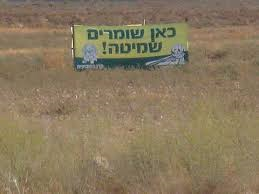
Field in Israel declaring its observance of shmita in 2008
(photo: First.One.Through)

Nachmanides, or the Ramban (1194-1270), noted that there was a similarity of the Sabbath day and shmita when he wrote that shmita is about remembering this world and the world to come.  He derived that from Avos 5:9 which described that Jews would be punished with exile if they did not keep shmita. Ramban added  “whoever repudiates [shmita] shows that he does not acknowledge the truth of Creation and the World to Come.”

However, during his long explanation, the Ramban did not delve into the local nature of shmita.

Was the intention of the command’s preface to just let the Jews know that shmita was not necessary during the time from standing at Mount Sinai until they arrived in the Holy Land?  Or was there a message behind the land itself?

The Holy Land for the Jewish Nation

The commandment to observe Sabbath day became effective immediately when it was received on Mount Sinai.  Throughout the wanderings of the desert before they entered Israel, Jews kept the seventh day holy.  They did so, because they continued to live and benefit from God’s creations – even the desert itself.  Jews continue to observe Sabbath when they are not in the Holy Land for the same reason: the commandment’s underlying reason was to remember God’s creation of the entire world.

Was the commandment of shmita about memory too? Was it about remembering the “World to Come” as Ramban suggested?  If so, why did the commandment need to only be kept in Israel and needed to be delayed until they arrived in the Holy Land?

Perhaps the parallel of memory in the Sabbath day and shmita was not about “the truth of Creation and the World to Come,” but about God’s gift of the land of Israel to the Jewish people.

God included the reason of keeping the Sabbath day as a remembrance of the world’s creation within the command itself.  Keeping the Sabbath included remembering the story of creation.

In the commandment of shmita, maybe there was also an explanation inside the text: “the land that I am going to give you.”  It was not just an explanation of when to begin observing the law, but the reason of observing the law: the land was God’s gift to the children of Israel.

דַּבֵּר אֶל בְּנֵי יִשְׂרָאֵל וְאָמַרְתָּ אֲלֵהֶם כִּי תָבֹאוּ אֶל הָאָרֶץ אֲשֶׁר אֲנִי נֹתֵן לָכֶם וְשָׁבְתָה הָאָרֶץ שַׁבָּת לַיהֹוָה:

The Hebrew biblical text is different than God’s other promises of the promised land in the Torah.

  • When God promised the land to Abraham, it was described as “the land that I will show you” (Genesis 12:1), not give you.
  • In Exodus chapter 3, God described leading the Israelites to a land flowing with milk and honey that is occupied by many other nations.
  • In Exodus chapter 33, God told the Jews to go to the land that He promised their forefathers Abraham, Isaac and Jacob.

Only in Leviticus did God change the language as giving the land to the Children of Israel themselves (Leviticus 20:24).  It was a gift for them, not just a promise made to forefathers.

That is why the commandment is localized in the Holy Land.  The commandment is not to just let the land lie fallow every seven years, but like the Sabbath, it is to remember that the land is God’s gift to the Jewish people.  It would be an insult to that special present of Israel for Jews outside of land to celebrate shmita.

God’s gift of Israel to the Jewish people is not limited by time, but an eternal present.  That is why even on the seventh year, when Jews cannot work the land, they can still enjoy the fruits of the land.  The gift never stops, even while Jews pause to remember the gift itself.

Whatever the land yields during the sabbath year will be food for you—for yourself, your male and female servants, and the hired worker and temporary resident who live among you, as well as for your livestock and the wild animals in your land. Whatever the land produces may be eaten.”

Like the Sabbath day that is commanded to Jews, but to be respected among non-Jews that live with Jews, so is God’s gift to the Jews of the land of Israel.  The fruits of such gift may be shared broadly among those living in the land together with the Jews.

Enjoy and actively remember the gift of the Holy Land every day.  Try not to wait every seven years.


Related First.One.Through articles:

Today’s Inverted Chanukah: The Holiday of Rights in Jerusalem and Judea and Samaria

The Nation of Israel Prevails

The Journeys of Abraham and Ownership of the Holy Land

“Flowing with Milk and Honey”

From Promised Land to Promised Home

Wearing Our Beliefs

Subscribe YouTube channel: FirstOneThrough

Join Facebook group: FirstOne Through  Israel Analysis