The United Nations’ Ban Ki Moon Exposes Israeli Civilians

Five years ago, in March 2011, the world was a very violent place. The Secretary-General of the United Nations often spoke at length about the responsibility to protect civilians from violence. In some places.

When it came to Israel, after two Palestinian Arab men slaughtered five people in their beds while they slept, Ban Ki Moon uttered few words, and rather than demand better protection for civilians, he argued that the government should “act with restraint.”

Just four days before the massacre in Itamar, Secretary General Ban Ki Moon said the following: “The Palestinian Authority continues to make progress in institution-building and the delivery of public services, which leaves it well-positioned for the establishment of a State at any point in the near future. Israelis should be comforted by the emergence of a reliable partner and neighbour committed to Israel’s right to live in peace and security, opposed to violence and terrorism, and able to deliver on the ground.”

More ignorant words may never have been spoken.

If the UN Secretary General was so impressed with the PA as a partner, why does he never call out the Palestinian Authority to stop inciting violence and protect people?  As seen below, he is comfortable calling on other ruling authorities to protect civilians.  Except Israel.

Quotes from Ban Ki Moon in March 2011

On Israel, March 12, 2011 (38 words): “The Secretary-General condemns last night’s shocking murder of an Israeli family of five, including three children, in a West Bank settlement. He calls for the perpetrators to be brought to justice, and for all to act with restraint.”

  • There was no call for ensuring the protection of innocent civilians.
  • There was no calling out of the Palestinian Authority for incitement.
  • There was no call to contain Palestinian extremists to prevent the further loss of life.

That would only happen for other countries, where he would wax on about the obligation to protect civilians:

On Sudan, March 14, 2011 (161 words): ” He calls upon the leadership of the National Congress Party (NCP) and Sudan People’s Liberation Movement (SPLM) to restrain the local communities in Abyei and to implement the short-term containment measures…”

On Libya, March 17, 2011 (208 words): “Resolution 1973 affirms, clearly and unequivocally, the international community’s determination to fulfil its responsibility to protect civilians from violence perpetrated upon them by their own government. The Resolution authorizes the use of all necessary measures, including a no-fly zone to prevent further casualties and loss of innocent lives

On Syria, March 18, 2011 (104 words): “The use of lethal force against peaceful demonstrators and their arbitrary arrests are unacceptable

On Yemen, March 18, 2011 (111 words): ”  He reiterates his call for utmost restraint and reminds the Government of Yemen that it has an obligation to protect civilians. He calls on all to desist from any provocative acts that might lead to further violence..”

On Libya, March 23, 2011 (64 words): “…he reiterates his call for an immediate end to violence by all parties, in accordance with Security Council resolutions 1970 and 1973, and for the responsibility to protect civilians.

On Syria, March 23, 2011 (101 words): “He reminds the Syrian Government of its obligation to protect civilians

On Ivory Coast, March 31, 2011 (175 words): “He urges all parties to abide by their responsibility to avoid harm to the civilian population. It is essential that all parties cooperate with the United Nations Mission in Côte d’Ivoire in carrying out its mandate to protect civilians. The Secretary-General reiterates that those responsible for inciting, orchestrating or committing human rights violations will be held accountable under international law.

Ban Ki Moon
UN Secretary General Ban Ki Moon

The UN Secretary General believes governments in the region should protect civilians, but Israel should rely on the Palestinian Authority for its security.  In March 2011, a family was butchered in their beds.

Five years later, Ban Ki Moon continues the same pattern of not calling out the Palestinian Authority – which he still claims is a “reliable partner and neighbor” for Israel’s security – for inciting murder.  He excuses them with words that the Palestinians are “frustrated.”  He absolves their sins with silence.

Five years on, innocent civilians continue to be killed in the streets of Israel, and Ban Ki Moon continues to deny that Israel has the right and responsibility to protect its citizens.


Related First.One.Through articles:

The United Nation’s Ban Ki Moon is Unqualified to Discuss the Question of Palestine

The United Nations’ Remorse for “Creating” Israel

The Hollowness of the United Nations’ “All”

The UN Can’t Support Israel’s Fight on Terrorism since it Considers Israel the Terrorists

UN Comments on the Murder of Innocents: Itamar and Duma

UN Media Centre Ignores Murdered Israelis

UN Comments on the Murder of Innocents: Henkins

FirstOneThrough video of Itamar massacre: The 2011 Massacre of the Fogels in Itamar (Gorecki)

Subscribe YouTube channel: FirstOneThrough

Join Facebook group: FirstOne Through  Israel Analysis

Review of Media Headlines on Palestinian Arab Terror Spree

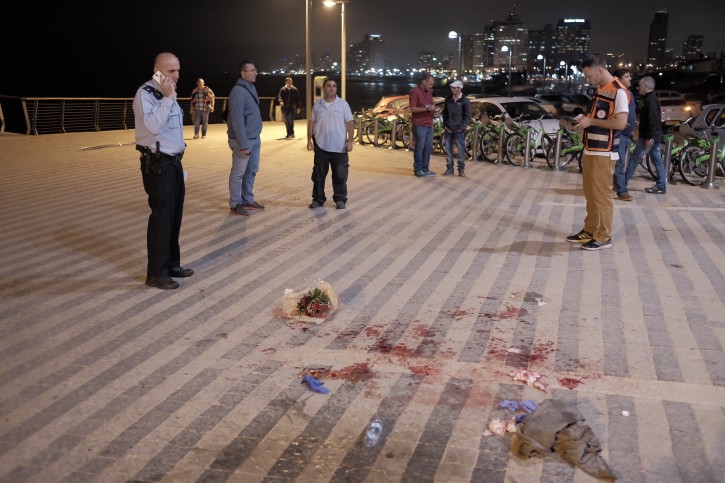
On March 8, 2016, several Palestinian Arabs attacked Israelis in various locations in Israel. A particularly horrible assault occurred in Jaffa, where a Palestinian Arab man stabbed various civilians, killing an American tourist.

jaffa attack
Scene of Palestinian Arab terror attack at Jaffa Port, March 8, 2016
(photo: Tomer Neuberg/Flash90)

The headlines from major news agencies show a range of focus: some focus on the attacker being a Palestinian, others omit the fact completely; most focused on an American being killed, some papers ignored mentioning the many Israelis injured.

The more complete news accounts came from papers often viewed as slightly more conservative. The papers that whitewashed the Palestinian Arab attacker came from more liberal papers.

The Palestinian media center inverted the story completely, focusing on the terrorist that was killed.

Focus on American Killed and Israelis Injured by Palestinian

Palestinian attacks kill American student, wound 12 Israelis” US News & World Report
Palestinian attacks kill American student, wound 12 Israelis” Washington Post
Palestinian Attacks Kill American Student, Wound 12 Israelis” .. abcnews
Jaffa stabbing spree: Palestinian kills American tourist, wounds 10 others” Jerusalem Post Israel News‎

Only American Killed by Palestinian

Palestinian kills U.S. tourist in stabbing spree on Tel Aviv boardwalk” Reuters
American tourist killed as Palestinians unleash attacks in Israel” CBS News
Palestinian kills US tourist in IsraelBBC News

American Killed and Israelis Injured – But Not by Palestinian

US student dead and at least 13 others injured in attacks across Israel” The Guardian
American fatally stabbed in Israel terror attack that wounds 10 others” CNN

 Only American Killed – not by Palestinian

Vanderbilt MBA Student Killed Amid Stabbing Violence in Israel as Biden Arrives for Talks” NBC News
American Graduate Student Killed in Stabbing Rampage Near Tel Aviv” New York Times
American dies in Israel stabbing attackUSA Today
U.S. tourist killed in knife attack in Israel, where survey illuminates deep divides” LA Times

The last two headlines could lead a reader to conclude that Israelis killed the American tourist.

Focus on Palestinians Being Killed

3 Palestinians shot dead after multiple attacks kill tourist, wound 12” Maan News Agency (Palestinian NGO)

Israel’s Killing of Four Palestinians Focus of Dailies Wafa, the Palestinian News Agency. Wafa led that the local Palestinian papers all focused on Israelis killing Palestinians, placing Israelis as the aggressors as opposed to defending themselves.


News reports are often crafted and biased.  They deliberately add and omit information and highlight certain aspects of stories.

Consider what narrative you read each day.  If you continue to only read from the same news source, your perception of the news will be unbalanced.

For most Americans, that bias has been liberal and anti-Israel, by measuring the circulation of conservative media (Washington Post 400,000; US News <1 million) versus liberal media (USA today 3 million; New York times 1.4 million).

Even in a clear-cut story of a terrorist stabbing a dozen civilians on March 8, 2016, one can see how the media directs a story.  In the more complicated Israeli-Arab conflict, readers are left at the mercy of biased journalists and editors.

Consider getting information from a different political perspective in addition to your favorite media site. Innocent victims of terror deserve more than what the popular USAToday opts to publish.


Related First.One.Through articles:

New York Times Lies about the Gentleness of Zionism

Educating the New York Times: Hamas is the Muslim Brotherhood

The New York Times’ Buried Pictures

Every Picture Tells A Story: Only Palestinians are Victims

Every Picture Tells a Story: The Invisible Murdered Israelis

Framing the Israeli-Palestinian Arab Conflict: WSJ and NY Times

Every Picture Tells a Story: Arab Injuries over Jewish Deaths

Every Picture Tells a Story: Versions of Reality

Subscribe YouTube channel: FirstOneThrough

Join Facebook group: FirstOne Through  Israel Analysis
Civil Death and Terrorism

Many governments are trying to develop legal structures to prevent and punish acts of terrorism. Their proposals and actions would extend to those who have not (yet) committed terrorism in their countries, to those who join terrorist groups such as the Islamic State/ ISIS.

France has considered stripping a person of their French citizenship if they engage in terrorist acts, if they were not born in France and held a second passport. The United Kingdom is considering a law of stripping British citizenship for naturalized Britons (those not born in the country).

While western European governments consider different ways of inhibiting terrorism and would-be terrorists, rights groups have argued that these steps infringe on an individual’s freedoms.  The groups contend that a government should not take punitive actions against a person before they actually commit a wrongful deed.

The governments are seeking a middle ground: not incarcerating a person if they are not found liable of committing a crime, yet still punishing them from embarking on a path towards terrorism.  Indeed, prison takes away a person’s freedoms, while withdrawing citizenship removes a person’s rights. Placing a person in jail removes a potential threat; the softer stance of removing citizenship inhibits dangerous associations.

The governments’ course of actions are not without precedent.

Civil Death

The United States has a legal concept called “Civil Death.” A “civil death” essentially strips a person of their rights that are connected to the government. For example, a violent felon would lose:

  • The right to vote
  • The ability to hold public office
  • The ability to be licensed for a business (many businesses require licenses to operate)
  • Ability to enter contracts or sue in court
  • The right to obtain insurance or pension
  • Any and all property

These are no small matters. Such person would not be in prison, but remain very limited in the ability to live, work and function freely in society. The courts effectively rule that if a person has shown a willful intolerance and disdain for society’s rules and laws, they will no longer be protected by those same laws.

Israel has used a similar approach in its ongoing war against terror.

Israel

Israel has long struggled with how to deter terrorists.  The military reduces acts of terrorism through roadblocks, checkpoints, and barriers, but they do not inhibit a person from considering such action.  The difference is significant, particularly for people who are willing to kill themselves in the act of terrorism.  There is no jail sentence for a suicide bomber.

Israel has ruled that people who aid and abet violent acts can be found liable, or at least partially liable, for the criminal behavior.  Israel has used home demolitions of suicide bombers as a means of punishing the murderer’s family who knowingly enabled the act of terrorism.

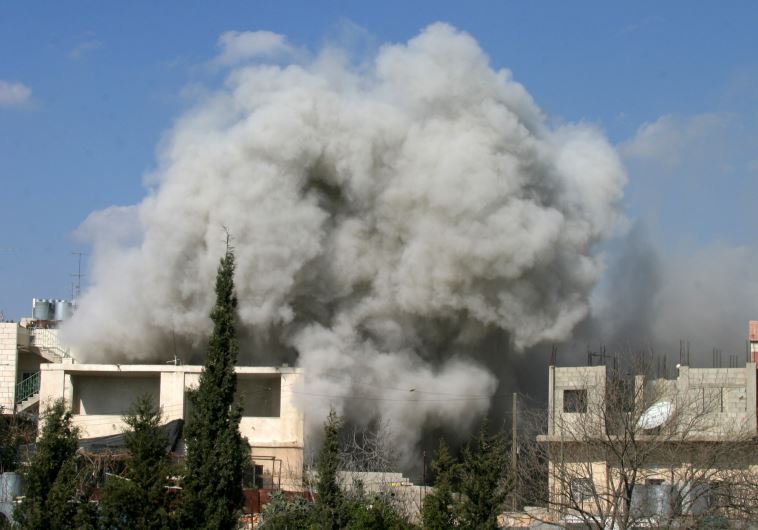
demolition
IDF demolishing home of Palestinian Arab terrorist
(photo: Reuters)

Rights groups have condemned the Israeli policy.  They claim that such actions amount to collective punishment against ordinary civilians who did not participate in any crime.  That position, while used by B’Tselem broadly, is actually unclear.  Not only may the family members be aware of the planned attack, but if the terrorist was the owner of the house, then the government could claim that all such rights to property ownership were null and void the moment the owner committed the terrorist act.  As such, the home became government property, which it can handle as it sees fit.

The Israeli government is exploring other punitive acts that are similar to the actions taken by European governments, such as revoking work papers or residency rights for terrorists and those that assist them. Other penalties could be handed down for the “civil dead” should they be found guilty of crimes in the future:

  • Forfeit any chance for parole
  • Never be exchanged in a prisoner swap


Governments around the world are investigating ways to slow the tide of would be terrorists.  As they do, the various punishments of a civil death will likely be explored in the future.


Related First.One.Through articles:

Collective Guilt / Collective Punishment

UN’s Confusion on the Legality of Israel’s Blockade of Gaza

Alternatives for Punishing Dead Terrorists

Subscribe YouTube channel: FirstOneThrough

Join Facebook group: FirstOne Through  Israel Analysis

Israel’s Peers and Neighbors

Observers of Israel often consider the appropriate benchmark for the country. To whom should Israel be compared? Against the Western world or its neighbors in the Middle East?

Western World Peers

The arguments to compare Israel to western countries such as in Western Europe and North America are plentiful.

Democracy: Israel is a democracy in which all citizens of the country elect its leadership, similar to the western world. That is in stark contrast to its neighbors that have monarchies and dictatorships.

Freedoms: Israel believes in various freedoms, including of religion, assembly and press. Such freedoms are cornerstones of western values, but difficult to find elsewhere in the Middle East.

Economy: Israel’s economy is based on capitalism. It has been termed the “start-up nation” due to the tremendous number of companies that are launched by ordinary Israelis. This compares to the economies dominated by oil money controlled by governments among Israel’s neighbors.

The long list of commonalities is detailed in “Israel, the Liberal Country of the Middle East.”  The peer group for Israel according to its principles and values is indeed the western world, not the MENA region.

Neighbors in MENA
(Middle East and North Africa)
israel_surrounded_sm
Arab World

Israel resides in a predominantly Arab neighborhood.  The people of the Arabian Peninsula spread en masse from the region shortly after the founding of Islam, during the 6th and 7th centuries.  In some locations, like Turkey, the Arab invasion was repelled, even while the Islamic religion still took hold in the area.  There are now 22 Arab countries and 57 Muslim countries, most of which surround Israel.

muslim_distribution
Muslim World

While Israel is unique in being the only Jewish State in the world, it’s uniqueness is magnified within its neighborhood that is almost uniformly Arab and Muslim.  Many of these Muslim countries are governed by Sharia, Islamic law, while others have laws that are Sharia-inspired.  These laws have little in common with laws found in western countries.  This is even true where the British held Mandates after World War I, such as in Jordan and Iraq.

Judging Peers

English Common Law has a concept that a person should be judged by a group of one’s peers.  The rationale for this provision was to afford context and humanity to the cold rule of law.  As peers should know a defendant better than a judge, those individuals in the jury could fine-tune the rule of law for the specific case and party.

In the United States, the concept of “peers” has been adjusted to “neighbors.”  The jury pool in the US courts system pulls in people from an entire region.  The individuals in such neighborhood likely have a wide range of backgrounds, including: race; religion; occupation; wealth; political views, to name a few.  US law requires that any party that knows the defendant – presumably who are more likely to be “peers” – to be excluded from the jury so as to avoid favoritism.  As such, the US system has moved from a court of peers to one of neighbors.

What happens when one’s peer group and one’s neighbors have nothing in common?  An extreme example happens every day in the court of world opinion regarding Israel.

Judging Israel

Neighbors: Israel’s neighbors have opposed the very existence of the Jewish homeland since such concept became international law in the 1920 San Remo Conference and the 1922 British Mandate for Palestine.  Sporadic riots in the 1920s became a multi-year war 1936-9, when the Arabs convinced the British to roll back the essence of the laws to curtail Jewish immigration and cap the number of Jews in Palestine, as well as to limit where Jews could live.  When Israel declared independence in 1948, Arab armies from that surrounded Israel fought to destroy the country.

The parties have been at war ever since, with the exceptions of Egypt and Jordan which made peace with Israel in 1979 and 1994, respectively.

Today, the 57 Muslim nations that comprise the Organization of Islamic Cooperation (OIC), vote as a bloc at the United Nations, and consistently condemn Israel for anything and everything, as they view the “Zionist entity” as illegal and unjust.

Clearly, this is not a group of neighbors that can be used as a “jury of one’s peers” to assess whether Israel is acting appropriately in any given matter.

oic_11
Representatives of the OIC

Peers: Israel cares about the opinions of its peer group in western Europe, North America and Australia.  These countries share Israel’s values and have ongoing trading and commercial relationships with Israel.

Much of the criticism against Israel from its peer group relates to Israel’s activities in the disputed territories east of the Green Line (EGL/West Bank). Some governments claim that Israel “occupies” the Palestinian people and takes over “Arab land.” Those critics call out Israel for its use of its military and point to lopsided casualty figures in Israeli-Arab wars. They protest Israel’s use of roadblocks, the security barrier, and of house demolitions of terrorists.

The flaw of such commentary is that it inherently assumes that Israel’s peer group exists – or could exist – in the same environment as Israel.

A Mile in Their Shoes

As detailed in “Israel: Security in a Small Country,” Israel is almost 1/500th of the size of the United States, but has three times as many neighbors. It is half of the size of the Netherlands, but no Dutch neighbor refuses to recognize its right to exist. Israel may have a similar number of countries bordering it as Argentina, but none of Argentina’s neighbors have launched numerous wars against it over the past decades.  The United Kingdom may have knowledge of the region from managing the Palestine Mandate from 1924 to 1948, but when was the last time England had foreign tanks and fighters on its home soil?  France may have experienced terrorism, but is there a country working to obtain nuclear weapons that threatens to wipe it off the map?

In short, Israel’s values’ peers do not have comparable security issues.

conflict map
Israel’s values’ peer group of western Europe, North America and Australia
are peaceful relative to the raging conflicts in MENA

When countries in the western world do have moments of inflamed security concern, such as when France suffered from terrorist attacks in November 2015, that country quickly went on the offensive. It instituted curfews. It performed raids on apartments. It curtailed a range of freedoms…. much as Israel does when it confronts security concerns on a continual basis.

Members of French special police forces of the Research and Intervention Brigade (BRI) and forensic experts are seen near a raid zone in Saint-Denis, near Paris, France, November 18, 2015 during an operation to catch fugitives from Friday night's deadly attacks in the French capital. REUTERS/Christian Hartmann - RTS7R5L

Members of French special police forces of the Research and Intervention Brigade (BRI) and forensic experts are seen near a raid zone in Saint-Denis, near Paris, France, November 18, 2015 during an operation to catch fugitives from Friday night’s deadly attacks in the French capital. REUTERS/Christian Hartmann – RTS7R5L

After the United States was attacked on September 11, 2001, it went on a multi-year, multi-country war, which is still ongoing in Afghanistan.  Many more people have been killed in the US wars on terror, than were killed on 9/11.

Israel has faced more than a terrible day of violence; it has daily assaults.  Israel has faced more than just terrorism; it has existential threats.  And it has continued to confront these security concerns, ever since the country was reconstituted in the 20th century.

Israel’s peers have not walked a mile in Israel’s shoes.  They have simply put them on and taken an uncomfortable first step.  And as they have done so, they have shown their determination to protect their civilian population and way of life.


Israel shares the democratic values of much of the western world. The critics from Israel’s peer group should recognize and celebrate the society that Israel has been able to create inside the illiberal Middle East. Those peers must also come to recognize and differentiate between the peaceful environment in which they live and the hostile environment in which Israel resides.


Related First.One.Through articles:

A Flower in Terra Barbarus

Murderous Governments of the Middle East

Seeing Security through a Screen

Obama’s “Values” Red Herring

The Disproportionate Defenses of Israel and the Palestinian Authority

Subscribe YouTube channel: FirstOneThrough

Join Facebook group: FirstOne Through  Israel Analysis