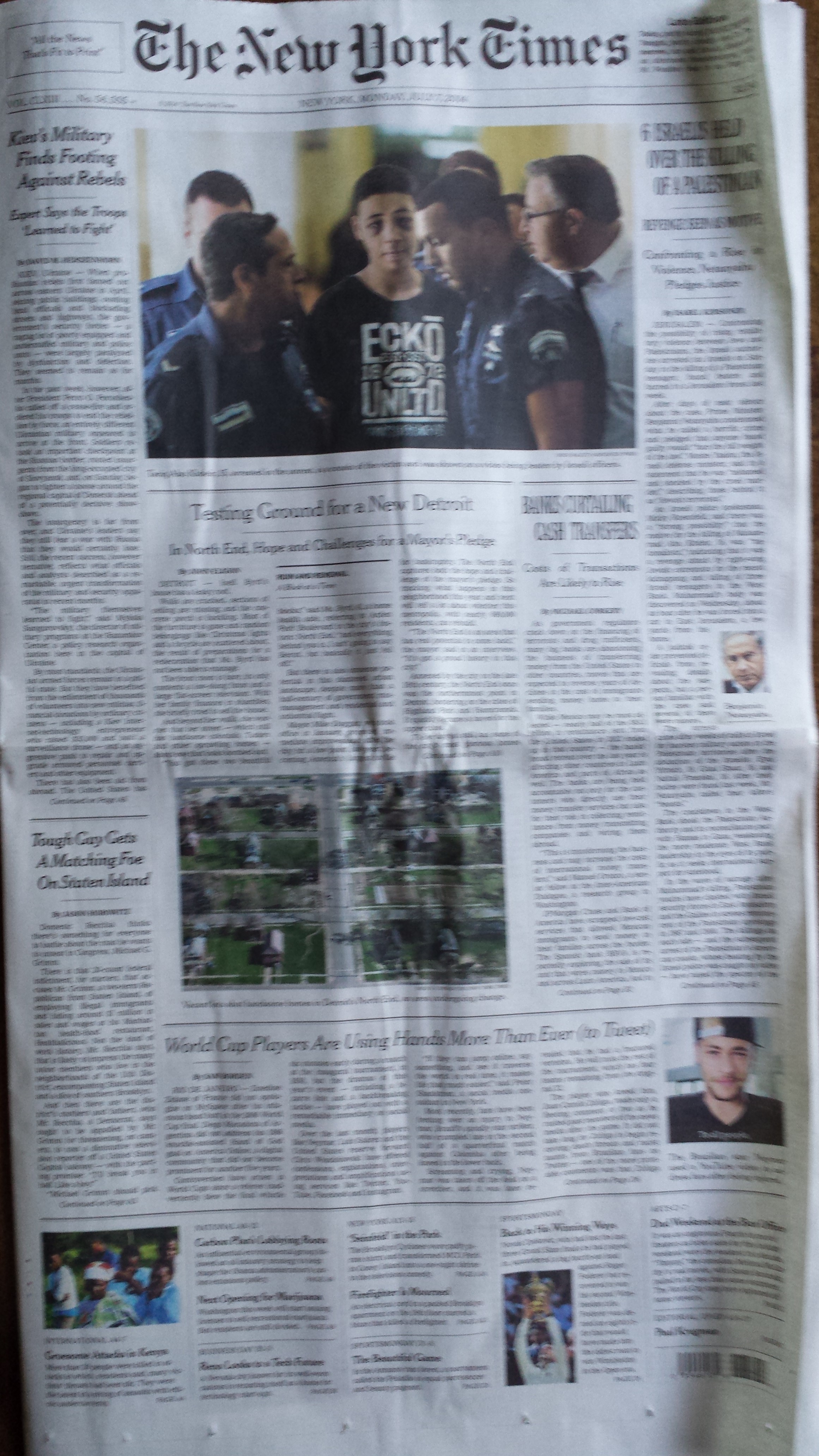
The “Every Picture” series highlights the power of photographs in the media and reviews the impact of size, color and placement of pictures along with their captions. The first installment reviewed how the New York Times painted a picture of Arab grief and suffering while portraying Israelis in a more aggressive and less sympathetic manner in a series of articles from June 30 to July 3 about the murder of three Israeli teens and a Palestinian teenager. If that article had a subtitle, it could have been “Palestinians trump Israelis”. You might think this second article in the series could be entitled: “Palestinians trump the World”, but the reality is much more subtle.
On July 7, 2014 the New York Times posted, on the top of its front page, a large color photograph of a Palestinian youth who was injured during riots against Israeli police. The bruised teenager was deemed to be a bigger story than victims of mass murders in other countries on a particularly violent day in Africa and the Middle East:

On page A4, the paper posted a large black and white photograph and article about 20 people who had their throats slashed in Kenya;
On page A7, the NYT posted a black and white photograph of soldiers and militiamen in Uganda where 50 people were killed in a battle between security forces and a tribal militia;
On the bottom of that same page, a short article (with no associated picture) described how 35 to 40 people were killed in Yemen in a fight between “Shiite rebels and tribesmen associated with the government.”


Pictures of mass murders buried in the NYT pages
While over 100 people were slaughtered in the region, the Times thought that a bruised youth was more significant than any and all of those atrocities. Could that have been because the teenager was a Palestinian Arab? That wouldn’t be logical as the Yemenis are Arab too. Could it be because the injured boy was a Muslim? That also would not make sense since al-Shabab is the Islamist terror group in Kenya that has been killing dozens of people every week, and both parties in the slaughter in Yemen are Muslim.
The difference in the dynamic of these stories lies in the counter-party – Israel – as evidenced by the other pictures in the news story. In a small picture on the (extreme right) side of the cover page, and then again in a color photograph on page A5, are close up pictures of Israeli Prime Minister Benjamin “Bibi” Netanyahu. Netanyahu is possibly the only world leader who is more despised by the NYT editorial board than former US President George W. Bush. The Times often uses pictures of Netanyahu alongside stories of Israeli aggression. It does this uniquely and consistently for Bibi.
By means of comparison, imagine an article about US drones killing civilians in Afghanistan, and then a picture alongside of it of US President Barack Obama. It doesn’t happen in the NYT or liberal media outlets. You probably wouldn’t even see a picture of injured people or mourning mothers in US papers. That is because they do not want to sketch a killer in Obama’s image.
As examples, here are two NYT articles that are critical of US policy of drone attacks – but include no pictures (let alone two!) of Obama. These are attacks that Obama ordered, (compared to a general situation in Israel which Netanyahu was not directly involved). Needless to say, the articles that simply report on the use of drones have no pictures of the US Commander-in-Chief.
In another article that is completely about Obama’s war on terrorism, the picture puts Obama so far in the background you would think he was accidentally caught in the photo.
http://www.nytimes.com/2012/05/29/world/obamas-leadership-in-war-on-al-qaeda.html?pagewanted=all
However, the New York Times and various liberal publications like to paint Bibi and Israel as attackers. They use his image alongside articles which describe attacks and counter-attacks. He has been made into a caricature of war; a cartoon of a blood libel.
Every picture tells a story. It is time to ask what the artist had in mind.


 First One Through