The past month was already horrible. Members of Congress, most of them far-left Socialists, voted to defund Israel’s Iron Dome defense system. The New York Times wrote about one of the extremists, Alexandria Ocasio-Cortez, who cried at the floor of Congress because she abstained from voting rather than “voting with her conscience” due to “influential lobbyists and rabbis.“
The anti-Zionist paper pulled the comment about rabbis in its online edition, trying to be clear that it only hates Israel supporters and not all Jews. However, the paper continues to insert its bias against any support for the Jewish State, even for its defenses.
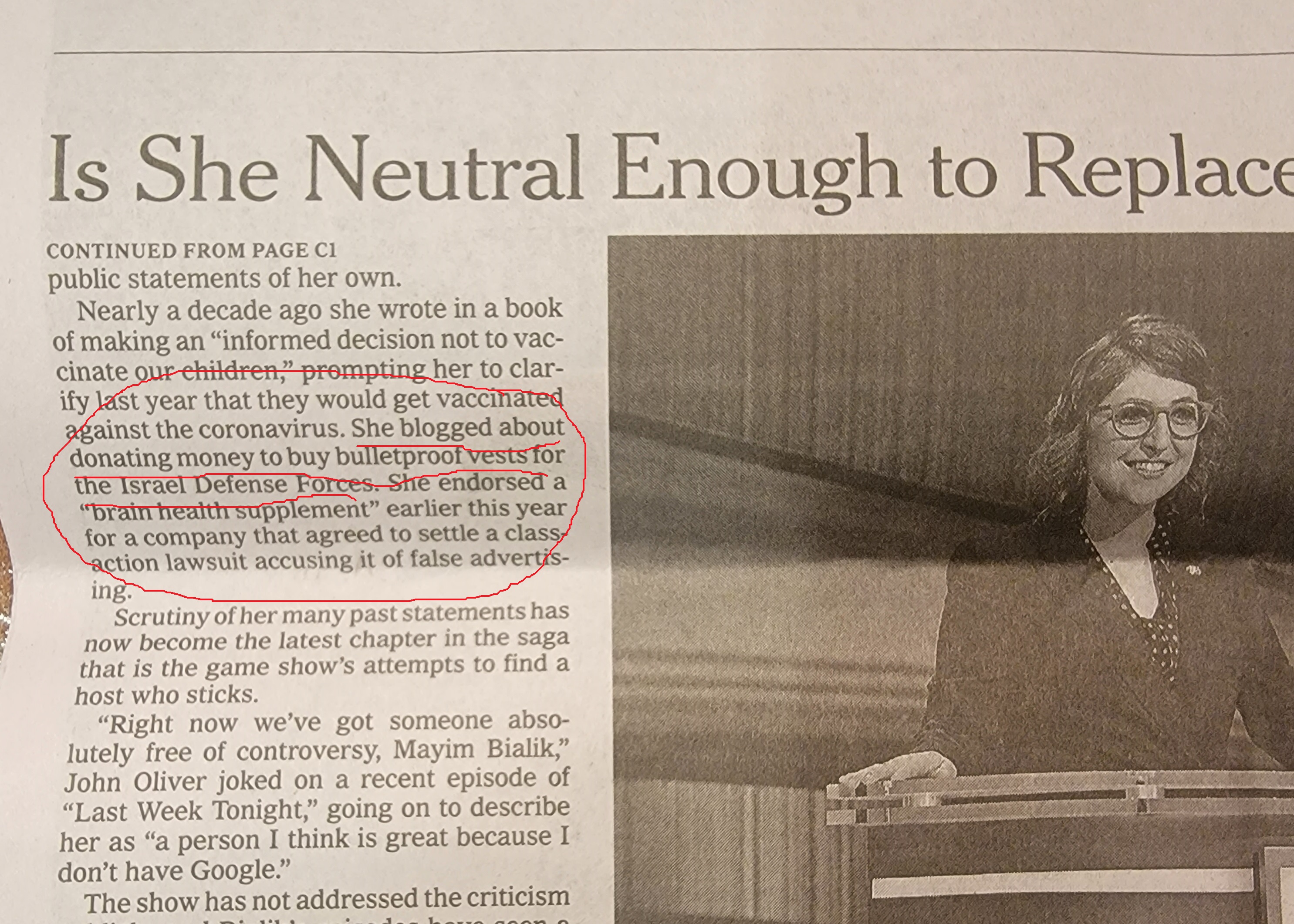
In a soft piece about considering the new host of the television show “Jeopardy,” the Times wrote that the Jewish actress Mayim Bialik was a difficult choice, as she has been involved in a number of controversial topics. Sandwiched between her decisions about not vaccination her children and promoting a health supplement that was sued over false advertising, the opinion-paper f/k/a newspaper wrote “she blogged about donating money to buy bulletproof vests for the Israel Defense Force.“
New York Times on October 13, 2021 called donations for bullet proof vests to Israel “controversial”.
When the Times reported on the far-left’s votes against Israel’s defenses, it was covering an event. Now the Times made clear its own identical opinion as the anti-Israel extremists: Israelis should not have protection and should be vulnerable to assailants from Gaza, Iran and elsewhere.
The spectacle of Congress voting to replenish the Iron Dome funding was heart-breaking. Voting to replenish the interceptor missiles that saved hundreds – if not thousands – of civilians in Israel was a no-brainer, but nine members of Congress thought that any support of Israel was too much.
Democratic leadership noted that their eight anti-Israel colleagues (there was one Republican that also voted to block the funding) were a small minority and the vast majority of Democratic members of congress voted in favor of defensive support. The leadership insisted that those who pointed out the fracturing of the party were trying to inflate the radicals.
But polls of American civilians show that the left-wing has already pulled away from Israel.
In June 2021, a AP-NORC poll showed the left was pushing the administration for greater support of Palestinians over Israelis. Three times as many (47% to 15%) liberal Democrats as Conservative Republicans thought that the United States is too supportive of Israel. Three times as many (61% Conservative to 17% Liberals) thought that the US wasn’t supportive enough of Israel.
The same poll showed the opposite in relation to support of Palestinian Arabs. Eight times as many (58% Conservatives to 7% Liberals) think the US is too supportive of Palestinians, while seven times as many (62% Liberals to 9% Conservatives) thought the US should devote more support to Palestinian Arabs. To lay that out more directly, 62% and 47% of Liberals think the US should be more supportive of Palestinians and less supportive of Israel, respectively. That’s in sharp contrast to 61% and 58% of Conservatives who think the US should be more supportive of Israel and less supportive of Palestinians.
A University of Maryland poll held around the same time yielded similar results with different questions. Regarding the May fighting between Israel and Gazans, ten times as many Democrats as Republicans blamed Israel for the violence (34.8% Democrats to 3.7% Republicans). Conversely, seven times as many Republicans as Democrats blamed the Palestinians (59.1% Republicans to 8.1% Democrats). Not surprisingly, seven times as many Democrats than Republicans (43.7% to 6.3%) want the US to apply more pressure on Israel, including withholding aid. Many more Republicans (49.0%) prefer applying pressure including withholding aid on the Palestinians than Democrats (8.5%). Independents were much more neutral on the issue.
These poll results show a very different dynamic than argued by Democratic politicians. The far-left (and growing) fringe of their party is becoming more anti-Israel. This makes it easier for the leaders of deep blue districts to vote against Israel in concert with their base.
The redistricting that is occurring around the country based on the 2020 census will certainly change Congress at the next election. It will also likely produce a large increase in the anti-Israel voices in congress.
Rep. Rashida Tlaib (MI) and Rep. Ilhan Omar (MN), leading anti-Israel voices in Congress
Turkey has been descending into one of the most intolerant and dangerous promoters of terrorism under the leadership of Recep Tayyip Erdogan for several years, but the United Nations seems intent on blessing this particular brand of anti-Semitism and barbarism.
Turkish President Tayyip Erdogan in Sochi, Russia September 29, 2021. (photo: Sputnik/Vladimir Smirnov/Pool via REUTERS)
Consider the country’s treatment of journalists. Turkey has jailed 312 journalists since 2016, the most in the world, 38% more than second worst, China.
Erdogan promotes blood libels against Jews. In May 2021, he said that the “Jewish Prime Minister” in Israel’s “greatest pleasure” was killing Palestinians because it “is part of their nature” as “they are only satisfied by sucking blood.” The United States senate quickly issued a bill condemning “Turkey’s President Recep Tayyip Erdogan’s invocation of the blood libel myth, which has historically been used to justify violence against Jews.”
The anti-Semitic slurs are consistent with Erdogan’s desire to kill Jews. The country was granting citizenship to members of the political-terrorist group HAMAS which the European parliament noted would allow them to set up a base in Turkey and freely travel, affording them “greater freedom in planning attacks on Israeli citizens around the world.“
Turkey’s crimes are not confined to only being against Jews. Turkey’s military invaded Syria in 2018 and continues to control Afrin, home to thousands of Kurds. The Kurds used to account for 96 percent of Afrin’s population and has now been driven down to 25 percent as Turkey has turned the area into a haven for Syria’s Islamic population fleeing the war zones. Turkey treats the minority group as pariahs inside Turkey as well, and has extended its oppressive reach against them and Yazidis until today. A number of senators have urged U.S. President Biden to “forcefully condemn President Erdogan’s escalating efforts to disband the country’s largest pro-Kurdish political party,” as Erdogan continues to purge non-Islamists from the region.
Remarkably, none of this seems to irk the leader of the United Nations.
On September 20, 2021, UN Secretary General Antonio Gutteres issued a proclamation praising Turkey as the UN General Assembly gathered to meet. Guterres said:
“Turkey is engaged across the spectrum of our work, as we deal with challenges from the climate crisis to long‑standing threats to peace and security. I am personally familiar with enormous generosity of Turkey and Turkish host communities towards refugees. I offer my sincere appreciation for your support to people in need of protection.
“The number of people fleeing wars, violence, persecution and human rights violations is at record levels. I count on Turkey to continue doing its utmost, with the support of the international community. This is an act of solidarity that concerns us all.
“Peacemaking is another critical dimension of our work. I welcome Turkey’s consistent support to our mediation efforts, including by co-chairing the Group of Friends of Mediation — one of our most important tools to reduce, manage and end conflict.
“I would also like to take this opportunity to highlight the leadership of His Excellency, Volkan Bozkir, as President of the of the seventy-fifth session of General Assembly. We have been fortunate to rely on him through a difficult year.
“I look forward to our continuing close cooperation with the Government and people of Turkey, and wish you many years of productive work in the new Turkish House. Thank you.“
Gutteres had no similar comments for any other countries’ efforts on behalf of refugees.
The head of the United Nations singled out for praise an anti-Semitic, authoritarian regime which crushes free speech and minority rights during the latest gathering of world leaders. It is a clear indication that the extremist Islamist factions have assumed control of the global body.
By the eleventh chapter of the Bible, it appeared that mankind had reached perfection. United in time, place and purpose, the whole world appeared ready to accept the word of God. Yet God rejected this model of the human race, and instead opted to give his holy texts to a sliver of the world in entirely inverted circumstances. The message embedded in the choice is as timeless as it is important.
The Tower of Babel and the State
About 300 years after God destroyed the world in the flood, “the entire earth was of one language and uniform in words.” They assembled together in “a valley in the land of Shinar” and decided to make bricks to “build ourselves a city and a tower with its top in the heavens to make ourselves a name, lest we be scattered upon the face of the earth.” (Genesis 11:1-4)
This Tower of Babel was an incredible accomplishment. Ten generations – from Noah through Abraham – lived in this city and tower. The people were not just “of one language” but coordinated in a common goal. To a modern reader, this situation appears too good to be true – mankind working constructively to build a place where everyone could live together. It seems so aspirational that it puzzles the reader as to why God was upset and said “Lo! they are one people, and they have one language, and this is what they have commenced to do? Come let us descend and confuse their language, so that one will not understand the language of his companion’. And the Lord scattered them from upon the face of the earth and they ceased building the city.” (Genesis 11:6-8)
To appreciate God’s objection, biblical commentators compared this generation to that of the flood.
The Bible states that God destroyed the world in the flood because of “חָמָֽס” (Genesis 6:11) which is translated as ‘robbery’ by Rashi and the Ramban. While at first, robbery doesn’t seem so terrible a crime worthy of destroying a world, it does invite a reader to imagine the nature of such society.
If the world operates on the basis of theft – that the ownership of personal property has no inherent meaning – people prioritize stealing over work. In such environment, a person will invest his or her efforts in how to take the fruit, cattle or spouses of their neighbor rather than engaging in the actual work of cultivating such things. There would be no effort in saving or developing anything as it could be stolen, making people live for the day rather than invest in the future. Such a world cannot mature nor endure.
The society that built the Tower of Babel had a different notion about personal property. Rather than one person stealing another’s belongings for themselves, they collected it for the state. Rabbi Joseph Soloveitchik said “the generation… had a strict political code. The were not weakened by abundance [like those in the Flood]…. They were aggressive in undertaking, bold in design, and arrogant in execution. The ideology of Marxism as interpreted by Lenin and Mao Tse Tung could not have been better portrayed than in these verses.”
Rabbi Solveitchik combined two principles in his critique of this society – one led by an authoritarian leader and one based on Socialism. He criticized this society that “tried to create a new social world order. In order to realize this ideal, they destroyed individual freedom, dictating to everyone what to do and how to live.” People can see this at play today in the alt-left’s efforts to institute a new social order under the marketing banner of the common good as it advocates for “canceling” those who break with their orthodoxy while they attempt to redistribute personal property.
Rampant robbery for personal gain that existed before the Flood was obsessed with the indulgence of living in the moment and needed to be wiped out as it destroyed the possibility of long-term development. The seizing of personal property for the state during the Tower of Babel, needed to be disrupted as well. God had previously directed Noah and his children to “be fruitful and multiply upon the earth” three times (Genesis 8:17, 9:1 and 9:7) and instead they constrained themselves to a small valley, thereby limiting their progeny and directed their efforts to building man-made structures rather than cultivating the land for personal use.
God “came down” (Genesis 11:7) to this authoritarian socialist society and did not see an ideal society worthy of receiving his holy words, and decided to “confuse their language” and “scattered them from there upon the face of the earth, and they ceased building the city.“
Which makes one consider the society that actually did receive the Torah.
The Tower of Babel and Mt. Sinai
God handed the Ten Commandments to a very different society in a very different place. Mount Sinai and the Tower of Babel could not be more different:
Mount Sinai
Tower of babel
Natural mountain
Man made structure
Located in remote desert away from people
Center of the world with all humanity
In the afterglow of the Exodus and destruction of Egyptian army
In the shadow of the destruction of every living thing in the Flood
Only Moses ascended the mountain and the Israelites barred from approaching it
The entire world inhabited the tower
God “descended” to Mt. Sinai to see a man he had spoken to before who had followed his command
God “descended” to find a society which ignored the direction he had given to some of them (Noah and his children)
Laws given to a single man to teach to a single tribe over time
Laws not given to the entire world at a moment in time
That tribe was scared and acting out, looking for leadership as the commandments were being given to Moses
The world was working seamlessly in concert, building their man-made city and tower which didn’t need a God as it reached the heavens via the work of its own hands
When God dispersed mankind in the year 1996 after Creation, He set in place the ability for humanity to follow his command to “be fruitful and multiply upon the earth” but simultaneously made engaging with everyone more difficult, as God’s preference for speaking to one person at a time would require multiple prophets to interact with local communities and tribes, even as the miracles would capture the attention of the whole world.
As noted above, God opted to give the Ten Commandments to a people who were just freed from slavery and eager for leadership and a new society. This was in sharp contrast to the people on the Tower of Babel who may not have been receptive to taking upon themselves the word of God, having seen the impacts of global devastation. Consider that they decided to build their city and tower in a valley. They were highly confident in their own abilities to reach the skies, almost as a further insult to God as they didn’t want any advantage from the natural world.
The Shortened Life
The dispersion had ramifications beyond the change in language, the abandonment of the tower and setting in motion the establishment of nations around the world. The lifespans of people dropped considerably as well.
Peleg, a descendant of Shem, died during the dispersion. Curiously, he was either named with prophesy as the name was derived from the Hebrew word for dispersion, or he was renamed at his death כִּ֤י בְיָמָיו֙ נִפְלְגָ֣ה הָאָ֔רֶץ (Genesis 10:25).
Peleg died when he was 239 years old, considerably less than his father, grandfather and great grandfather who were 464, 433 and 438 years old, respectively. The reduction of 225 years of Peleg’s life relative to his father is the numerical equivalent of the word scattered in Hebrew “הֱפִיצָ֣ם” (Genesis 11:9). From this day on, the lifespan of people continued to decline – all the way to 120 years old, the lifespan of Moses, the great teacher of the Torah.
There are people today – like Senator Bernie Sanders and the Democratic Socialists – who view the idea of collective global action on behalf of a powerful state that shuns religion as an ideal to be pursued. The Bible clearly instructs otherwise, as conveyed in the short story of global unity at the Tower of Babel.
“The universe is a pretty big place. If it’s just us, seems like an awful waste of space.”
– Carl Sagan (1934-1996)
For thousands of years, people thought of themselves as the center of the universe. People believed that they were the most sophisticated animal and assumed that Earth was the only planet to house life, let alone intelligent life.
Religions encouraged such beliefs. The story of Genesis made humans the pinnacle of God’s creation and center of His plan, as the master of all other life forms. As late as the early 17th century, when Galileo posited that the Earth rotated around the sun, not the other way ’round’, the Catholic Church called him a heretic, banned his books and sentenced him to prison.
Religion appeared vain, anchored in self-absorption, and in opposition to science.
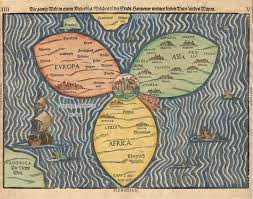
Map of world with Jerusalem in the center by Heinrich Bunting (1581)
As science became widely accepted over the following hundreds of years, people came to appreciate how small the Earth is in a remote edge of the galaxy. Mankind shifted from writing mythology about Gods in the stars, to scripting stories of alien life traversing the universe. Man seemingly embraced science and eschewed religion.
But people remained equally as arrogant.
Beyond the wave of science fiction books and movies over the past sixty years, sci-“fact” shows like the new “UFO” documentary have considered that aliens from other planets have come to Earth. The guise of awe for the unidentified flying objects at first conveyed humbleness in considering that humans are neither alone nor the center of the universe. Yet that premise fell completely flat. What kind of unbridled arrogance must someone have to believe that in the vastness of space, an alien managed to find earth and visit that one special person. Such remarkable conceit!
A profound faith in either religion or science could mask the same egotism with a different veneer of humility.
Carl Sagan, an astronomer and popular author about space strongly believed in science and of life on other worlds, and also believed in religion. He once said that “Science is not only compatible with spirituality; it is a profound source of spirituality.” Despite the appreciation for both belief and science, he nevertheless acknowledged the issue with fundamentalism in his book ‘Contact‘ and how religion and science could be at odds for those with profound faith.
At its worst, profound religion acts as a cudgel, enabling those who believe they speak with divine authority to dictate demands. Deep faith facilitates massacres like the Christian and Muslim crusades as well as the Inquisition.
This stands in sharp contrast in humble faith. Humble religion serves as a guide for people to act towards one another with kindness. The belief in a powerful God who judges people’s seen and unseen actions is designed to shepherd society with humbleness as a check on power.
Faith can act as rein or a weapon. It depends on whether it is embraced with humility or conceit.
Jews have often been accused of arrogance as they believe that much of the bible is particular and not universal. Yet it is a unique monotheistic religion in believing that all people can ascend to heaven: Jews need to follow 613 commandments while non-Jews only need to follow the seven Noahide Laws related to universal morality. That is why Judaism does not try to convert people as their souls do not require “saving.”
Judaism encourages a humble faith in God and science, pursuing both knowledge and coexistence.
The notion that there is a dichotomy between religion and science is widely touted and deeply false. The divide is between profound faith and humble faith. The latter will serve to the betterment of all mankind.





 First One Through