Purim is a great fun Jewish holiday: a mashup of Halloween and St. Patrick’s. Why hasn’t it caught on?
Purim is a great fun Jewish holiday: a mashup of Halloween and St. Patrick’s. Why hasn’t it caught on?
Summary: Obama’s anger at Israel’s Netanyahu was about Netanyahu’s anger at White House policy on Iran. All of the other excuses that Obama threw out proved inaccurate. However, Obama’s actions have introduced a partisan split over Israel into DC politics.
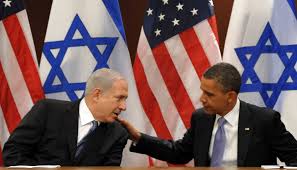
Netanyahu and Obama
US President Obama took umbrage with Republican House Speaker John Boehner’s invitation to Israeli Prime Minister Benjamin Netanyahu to speak to a joint session of Congress. Obama aired a number of reasons, which all proved to be red herrings:

President Clinton and Israeli PM Shimon Peres,
Before Israeli elections in 1996
Israel and the United States have been strong allies regardless of the party in the White House. Israel’s relationship with Bill Clinton (D) was much better than with George HW Bush (R); and better with George W Bush (R) than with Barack Obama (D). There is no benefit or desire for an Israeli leader to choose one party over the other as Netanyahu reiterated in his remarks in the US in March 2015. The dynamics of particular leadership personalities play a role in the tone, but not the substance of the overall relationship between all of the elected US parties in government and the Jewish State. Netanyahu and Obama have dealt with each other for six years where at times they’ve agreed or disagreed on a variety of issues; in each case, the parties in Congress maintained their support of Israel.
At this moment, Netanyahu strongly disagrees with Obama’s position in the Iranian nuclear negotiations. It happens to be that Republican leadership also disagrees with the Obama administration. It was solely on that topic that Netanyahu spoke to a joint session of Congress – a major “existential” issue of direct significant impact on Israel.
The difference in opinion about a particular policy does not mean that Netanyahu or Israel now prefer Republicans to Democrats, nor should it mean that elected Democrats or Republicans should treat Netanyahu or Israel any differently. However, the Obama administration made the claim that this was partisan politics, and kept members of the administration from meeting with Netanyahu and asked Democratic party members to stay away from the address, thereby creating a partisan issue.
That may very well have been the goal of Boehner. But the Democrats seemed all too willing to take the bait and insult Israel and Netanyahu by snubbing him. Democrats decided that a distorted idea of party loyalty was more important than hearing the concerns of an ally that has been threatened with annihilation by the very country with which the administration is creating a pathway for nuclear weapons.
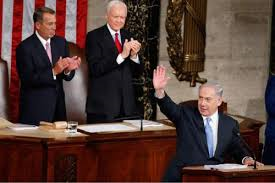
Netanyahu addressing Congress about Iranian nuclear weapons,
March 2015
The gulf in the support of Israel between the right and left of the American public is not new. Republicans support Israel by almost a 2-to-1 ratio compared to liberals around the country. Liberals support opening warmer relations with Muslim countries by over a 2-to-1 ratio over conservatives. But those statistics are in the general population of the United States. Obama has now brought that partisanship into the legislative branch of government in D.C. itself. At the administration’s urging, 58 Democrats boycotted Netanyahu’s speech to Congress. No Republicans missed the address.
Perhaps Obama used Netanyahu’s speech to pivot the party into a closer position with his loyal base of liberal Americans. If so, the implications for Israel will be very negative.
The only silver lining to the shattered red lines of Iran’s nuclear program will likely be that the Palestinian Arabs might return for peace talks with Israel as they will never have such an advocate in the White House as President Obama. What price will Obama make Israel pay? How much will it matter in the coming nuclear tinderbox of the Middle East?
Related First.One.Through articles:
On accepting invitations: https://firstonethrough.wordpress.com/2015/02/09/on-accepting-invitations/
Liberal preference for fairness and conservatives preference for safety: https://firstonethrough.wordpress.com/2015/03/01/the-gap-between-fairness-and-ramifications-wmds-in-iraq-and-iran/
Obama’s Iranian red line: https://firstonethrough.wordpress.com/2014/11/24/obamas-iranian-red-line/
Summary: As the world negotiates with Iran about their nuclear program, it is worth remembering lessons from Syria’s nuclear plant in 2007.
In September 2007, something significant happened in the Middle East. While the details were very murky as the news reports were cryptic, it was clear that a major event came-and-went. Over the following months and years, more information emerged about Syria’s nascent nuclear program and Israel’s attack that destroyed it.

Syrian nuclear reactor, 2007
Failure to Detect
Syria began to investigate the feasibility of a nuclear program in the 1990s and by the mid-2000s it was building a nuclear facility with the help of North Korea. The facility was being constructed roughly 100 miles from the Iraqi border. During its construction, hundreds of thousands of American troops were busy a few miles from the construction site during the Iraq War. Many reconnaissance missions repeatedly flew over the Syrian site, but US intelligence failed to detect that Syria had embarked on plans to build a weapon of mass destruction. For years.
The New York Times stated that “the Americans were somewhat blindsided…. By their own account, they…only identified the plant at Al Kibar, named for the nearest town, after they received photos of the interior of the plant last spring from Israel… But even this victory [of destroying the plant], some experts note, raises questions about the [CIA]’s focus. The reactor was built within 100 miles of the Iraqi border yet never identified even though the administration was searching for any form of such arms programs in Iraq…. Graham Allison, a Harvard professor and author of “Nuclear Terrorism,” who was in Washington on Thursday to testify about Iran’s nuclear program [said] ‘if you can build a reactor in Syria without being detected for eight years, how hard can it be to sell a little plutonium to Osama bin Laden?’”

Location of Syria’s nuclear plant
The Power of Pride
The incident of the secret nuclear facility remained quiet considering the enormity of both its construction and destruction. Not surprisingly, the Syrians wanted to keep the plant hidden as they saw what Israel did to Iraq’s nuclear reactor in 1981. Israel’s silence on its actions against Syria was a calculated move on the part of Israeli Prime Minister Ehud Olmert.
Israel refused to broadcast its strike out of fear that doing so would provoke Syrian President Assad to respond with an attack on Israel. By maintaining silence, Olmert hoped he could allow Assad an escape from reacting to his bruised pride from the crushing setback of Israel’s destroying his plan to become the first Arab nuclear power.
Indeed, the news reports that emerged from Syria about the event were inconsistent. Some reports stated that Israeli planes entered Syrian airspace and were forced to flee due to Syrian fire. Later, the Syrian government said that Israeli planes did enter its airspace, but the warplanes only hit an empty military building. As such, there was no need for an immediate large-scale confrontation with Israel. War averted.
Lessons for the Iranian Nuclear Program
DETECTION: The United States administration is actively negotiating with Iran about the extent to which Iran could build nuclear power. Early reports on the negotiations indicate that the terms would necessitate an examination of the Iranian facilities to make sure that they would not migrate an energy program towards nuclear weapons. However, as the Syrian reactor incident makes clear, inspections are flawed. The US’s track record about bad intelligence of Iraq developing a nuclear weapon must also be considered.
Further, consider that the Iranian facilities (that are known) are spread all over the country. This agreement may enable Iran to operate those current facilities freely. If the US failed to identify the building of large facilities over many years, can the world really be sure it can make a thorough accounting of the thousands of centrifuges and the fissile materials warehoused inside many buildings spread around the country? The Obama Administration essentially has conceded that it cannot, so it will rely on Iran to show them what they have: “Without an agreement we don’t have any of this insight into Iran’s nuclear program.”
In other words, the current working agreement is to let the fox guard the chicken coop.

Iranian nuclear research facility
PRIDE: The second lesson from Operation Orchid, as the Israeli bombing mission was known, was the significance of Arab pride. Israel understood that Syrian pride would have demanded a large response to the Israeli attack. By its keeping its role and the target silent, Israel avoided a large scale war.
The secrecy surrounding Israel’s own nuclear program is for the same purpose. If Israel’s Arab neighbors would publicly acknowledge the existence of their enemy having nuclear weapons, they would demand WMDs as well. By maintaining an undeclared nuclear program, the arms race in the Middle East never occurred.
That will now change.
Iran’s development of nuclear power, and the world’s tacit approval of it will force other players in the region such as Saudi Arabia to seek nuclear weapons. The very public nature of these discussions do not permit the Saudi Kingdom to swallow their pride. People will assume that a quiet side deal was made to allow Iran to get nuclear weapons, or Iran will obtain them against the terms of the agreement. Regardless, approving a nuclear program for Iran will commence an arms race in the most volatile region in the world.
Related First.One.Through articles:
The gap between fairness and safety: https://firstonethrough.wordpress.com/2015/03/01/the-gap-between-fairness-and-ramifications-wmds-in-iraq-and-iran/
Obama’s Iranian red line: https://firstonethrough.wordpress.com/2014/11/24/obamas-iranian-red-line/
Murderous governments of the Middle East: https://firstonethrough.wordpress.com/2014/08/01/murderous-governments-of-the-middle-east/
Obama dancing with the Asteroids: https://firstonethrough.wordpress.com/2014/11/14/dancing-with-the-asteroids/
Summary: There can be a large gap between perceived fairness and ultimate safety. Liberals seem to prefer the moral value of the former, while conservatives value the comfort in the latter.
Liberals on Iraq
Many liberals in the United States love to attack former President George W. Bush for his decision to go to war in Iraq. The president acted on bad information that Iraq was involved in the attacks on the US on 9/11/01, and then doubled-down on flawed intelligence which claimed that Iraq was building weapons of mass destruction (WMDs). America engaged in a very costly war in terms of lives, cost and credibility based on that bad information.
As a presidential candidate, Barack Obama campaigned to pull American troops out of Iraq because he thought the war was wrong, and when he became president, he fulfilled that pledge. Not long after the last US troops left Iraqi soil, the terrorist group Islamic State/ISIS filled the vacuum left by America’s absence. In the wake of several thousands of murdered people, Obama is now weighing how deeply to reengage in Iraq to combat the demons his actions helped create.
Liberals on Iran
In a related policy, the liberal-minded Obama is in the process of enabling the Islamic State of Iran to become a threshold nuclear power. In Obama’s worldview, it is difficult to validate why the US, Pakistan and seven other countries should have nuclear weapons and Iran shouldn’t.
Obama obsesses over “inequality” and fairness in society and also believes that all countries consider themselves to be exceptional. In a “fair” world of complete equality, the liberal position of equal entitlement prevents Obama from negotiating forcefully against the Iranian regime that desires to enter the pantheon of nuclear states.

Obama on Iran Negotiations
As such, Obama concluded that he will allow Iran to develop nuclear weapons and use the negotiations as an opportunity repair ties with Iran that have been combative since the 1979 Iranian revolution.
Conservatives on Ramifications
While most conservatives will agree that the war in Iraq was a mistake, they argue that the decision to completely high-tail out of Iraq was a more tragic mistake. Abandoning the country left a power-vacuum which was filled by the Islamic State. Iraq became lawless and is now a foundation state for jihadists. Obama’s decision further destabilized the country, which has produced terrible security outcomes in the Middle East, the US and the world.
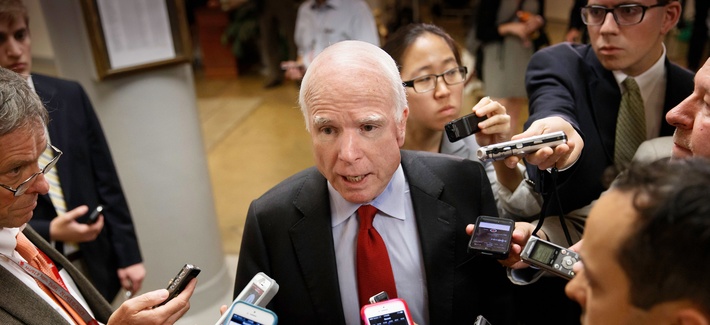
Senator McCain speaking against Iraq pullout
Conservatives believe that Obama’s “soft” negotiations with Iran will similarly have terrible ramifications for global security.
The ramifications of enabling Iran to get nuclear weapons will likely either lead to Israel attacking Iran, or initiating an arms race in the volatile Middle East. So much for Obama’s desire to have a world with fewer nuclear weapons. The only party to have fewer nukes will be the US while human rights-abusing countries such as Iran and Saudi Arabia would be on their way to being able to cause global destruction as one considers a world of nuclear terrorism.
Conservatives are less worried about the double-standards of who gets nuclear power today if it leads to greater stability tomorrow. Liberals, on the other hand, focus on being fair today and are less fixated on the ramifications tomorrow.
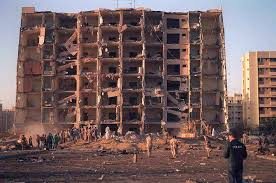
Iranian bombing of Khobar Towers killing 19 Americans,
June 1996
Lessons in Safety from Experience
It would be worthwhile for Obama to consider “unfair” laws in the US. Many laws and policies are deliberately biased to counter-balance experience related to safety.
These laws and accepted biased corporate policies are in place because of experience. People under 25 get in more car accidents than older people, so the car rental companies charge them a bundle because of the perceived risks, even if the renter is a great driver. Similarly insurance companies charge all drivers of Mercedes convertibles more, which has led to police charging those drivers four times as many traffic tickets.
Seat belt laws and helmet laws are in place because they save lives. Many studies have shown the drop-off in fatalities due to these laws, which (literally) restrict a person’s freedom. State laws prevent under-age (sometimes 20 or 19) people from consuming alcohol because it helps save lives.
These are just a few examples of where society assesses risks based on historic outcomes. They exist everywhere including health insurance companies charging more to smokers than non-smokers. While a particular smoker may live much longer than a non-smoker, society draws certain conclusions based on past behavior and history.
History serves as the basis for making policies that improve safety.
Iran is not just another country
There are Islamic countries such as Pakistan that have nuclear weapons. There are repressive regimes such as China with nuclear weapons. However, the world has not seen a state sponsor of terrorism (such as Qatar) obtain a weapon of mass destruction.
The history of Iran and current statements from the government make it a dangerous player on the world stage. Endorsing Iran’s building the most powerful weapons in the world puts the entire planet at risk..
There were no WMDs in Iraq and America should not have gone to war. But Obama’s abandoning Iraq to reverse a bad decision ignored the reality of the existing paradigm. His decision to be fair had terrible ramifications for regional peace.
Enabling Iran to get WMDs ignores the actions of that government. Obama’s deep belief in equality cannot be allowed to jeopardize global safety.
Related First.One.Through articles:
Obama’s Iranian Red Line: https://firstonethrough.wordpress.com/2014/11/24/obamas-iranian-red-line/
Obama’s foreign policy: https://firstonethrough.wordpress.com/2015/01/27/obamas-foreign-policy/
Obama dancing with the asteroids: https://firstonethrough.wordpress.com/2014/11/14/dancing-with-the-asteroids/


 First One Through