From Exile to Excellence: The Jewish Doctor Who Founded the Paralympics

The modern Paralympic Games began far from the grandeur of an Olympic stadium. Their origin lies on the grounds of a British hospital, shaped by the vision of Ludwig Guttmann, a Jewish refugee physician who transformed both medicine and sport.
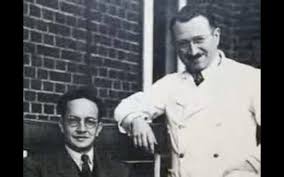
Ludwig Gutmann (1899-1980)

Guttmann was born in 1899 in Breslau, then part of Germany. He rose to prominence as a neurologist specializing in spinal cord injuries. With the rise of Nazism, Jewish professionals were pushed from academic and medical institutions, and Guttmann lost his post as antisemitic laws narrowed the space for Jewish life. During the “Kristallnacht” violence of 1938, he reportedly used his hospital authority to admit Jewish patients and shield them from arrest. Soon after, he fled Germany with his family and rebuilt his career in Britain.

In 1944, the British government asked him to lead a new spinal injuries unit at Stoke Mandeville Hospital. At that time, severe spinal cord injury often led to early death. Patients were confined to beds, vulnerable to infection, and frequently treated as beyond recovery. Guttmann rejected that assumption. He believed survival required more than medical stabilization. It required discipline, ambition, and restored self-respect.

He introduced sport as a core part of rehabilitation. Archery, wheelchair polo, and organized competition became structured therapy. Training cultivated strength and focus. Competition rebuilt identity. Patients who had been defined by injury began to see themselves as athletes preparing for events.

On July 29, 1948, the same day the 1948 Summer Olympics opened, Guttmann organized a small archery competition for sixteen wheelchair athletes on the hospital grounds. He called it the Stoke Mandeville Games. The symbolism was intentional. As Olympians competed in London, injured veterans competed at Stoke Mandeville. Each demonstrated excellence within their arena.

The event became annual and soon attracted international participants. In 1960, following the 1960 Summer Olympics, Rome hosted what is widely recognized as the first official Paralympic Games. A hospital initiative had grown into a global movement.
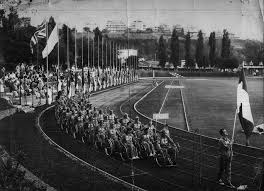
1960 Rome Paralympics

Guttmann’s work carried deeper resonance because of the era he had survived. Nazi racial ideology had targeted Jews and people with disabilities as unworthy of life. The regime’s euthanasia program murdered tens of thousands of disabled individuals before the broader genocide unfolded. As a Jewish physician forced into exile, Guttmann understood the danger of systems that ranked human worth by race or physical capacity.
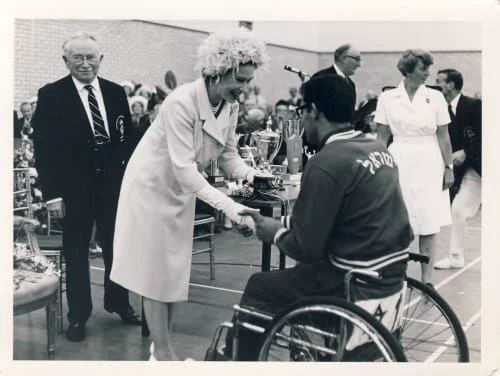
The opening of Stoke Mandeville Stadium by Her Majesty the Queen in 1969

His response was constructive and public. He placed disabled athletes on fields of competition and invited the world to witness their performance. Strength, in his framework, was measured by discipline and achievement rather than conformity to an imposed ideal.

Britain recognized his contributions. He became a citizen in 1945, was appointed an Officer of the Order of the British Empire in 1950, and was knighted in 1966 as Sir Ludwig Guttmann. Within medicine, he is regarded as the founder of modern spinal injury treatment. Within sport, he is honored as the father of the Paralympic movement. During major Games, particularly the 2012 Summer Paralympics, his story has been prominently commemorated.

Today the Paralympics stand as one of the world’s largest sporting events, watched by millions. Their origin traces back to a Jewish refugee doctor who believed that dignity could be restored through competition. From the trauma of exile emerged an institution that reshaped how the world understands disability, excellence, and human worth.

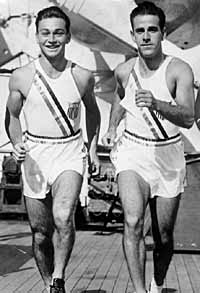
Berlin 1936: When Racism and Antisemitism Shared the Track

The story of the 1936 Summer Olympics is usually told as a duel between tyranny and talent.

  • Adolf Hitler builds a showcase for Aryan supremacy.
  • Jesse Owens wins four gold medals.
  • The German hateful ideology collapses.

But Berlin was more complicated. The Games revealed two prejudices at once: Nazi racial doctrine and American racism and antisemitism. While very different in scale and intensity, both were present on both sides of the Atlantic.

Two Jewish-American sprinters – Marty Glickman and Sam Stoller – were expected to run the 4×100 relay. Yet hours before the race, they were removed from the lineup and replaced by Owens and Ralph Metcalfe.

The official explanation was tactical: field the fastest possible team. The United States won gold in world-record time.

Yet the context was unavoidable. Glickman and Stoller were the only two Jewish runners on the U.S. track squad. Nazi Germany had already stripped Jewish athletes of meaningful participation. Their removal ensured that no Jewish athlete would stand on the Berlin track podium.

Glickman later said:

“I’ve always believed that we were taken off the relay team because we were Jews.”

Stoller observed:

“The only two Jews on the team were replaced.”

No archival proof confirms American coordination with Nazi officials. But antisemitism did not need a written agreement to operate. In the 1930s, American universities maintained Jewish quotas. Elite institutions limited Jewish membership. Prejudice was structural, even if unofficial.

Berlin exposed it.


Owens and Segregated America

Owens’ victories shattered Nazi racial mythology in the stadium but did not dissolve racial barriers in America.

The popular tale claims Hitler snubbed Owens. Owens himself redirected the accusation:

“Hitler didn’t snub me—it was our president [Franklin D. Roosevelt] who snubbed me. The president didn’t even send me a telegram.”

Owens continued:

“I wasn’t invited to shake hands with Hitler, but I wasn’t invited to the White House to shake hands with the President either.”

And when he returned home:

“After those stories about Hitler snubbing me, I had to live under segregation.”

In Berlin, Owens stayed in the same hotel as white teammates. In parts of the United States, he entered through separate doors.


Two Systems, One Lesson

Nazi Germany codified antisemitism and racism into law and would soon escalate that hatred into genocide. While the United States did not operate extermination camps, it did operate segregated schools, restricted neighborhoods, Jewish quotas, and closed clubs.

The differences in scale and brutality were enormous. The presence of prejudice in both societies was real.

One of those hatreds remains embedded in American history, while the other has been buried.

The common narrative that Owens and Team America gave a big middle finger to Hitler’s Germany in the 1936 Olympics by showcasing Black talent is incomplete. In many ways, the real lasting insult and pain was to Jews, not Nazis.

Israeli Olympians get their #IsraeliLivesMatter Moment

In the global language of sport, there is a grand opera called the Olympics every few years. The world’s greatest compete and perform on the world stage for glory and entertainment.

In 1972, politics and poisonous hatred entered the forum, and 11 Israeli champions of sport were murdered by Palestinian Arab terrorists.

For over 40 years, two wives of the slain athletes fought for a moment of remembrance for their husbands. The head of the International Olympic Committee (IOC) refused. This week that changed. Or did it?

On August 3, 2016, before the opening of the games in Rio, Brazil, the new IOC President Thomas Bach inaugurated the Place of Mourning, which will now be a feature at every Olympics, with two stones from ancient Olympia encased in glass.  Bach said at the opening “Today, the inauguration of the Place of Mourning give us the opportunity to remember those that have passed away at the Olympic Games.”

He then read the names of ALL people who died at the Olympics – not just the murdered Israeli athletes.  The role call included Nodar Kumaritashvili, who died on the eve of the Vancouver 2010 Olympics in an accident in the sliding centre.

And so politics entered the Olympics arena once again.

Palestinian Arabs objected to the memorial of the slain Israelis, just as many Arab countries refuse to recognize the existence of Israel, and their athletes refuse to compete against Israeli athletes.

So the IOC compromised on the request of the Israeli widows who had fought for decades for an appropriate memorial, by remembering them in a mass grave.  The slain Israelis were no longer unique.  They were not singled out and murdered by terrorists.  The Israeli athletes were simply victims of their passionate competition, not terrorism.

The IOC recognized the Israelis only as athletes in an #AllLivesMatter moment. At the Olympics, it is JeSuisAthletes, not JeSuisIsraeli.  The dead are the dead and we mourn them all.

However, the Israelis did not get the chance to compete.  They did not die on the field, competing in the sports they loved.  They were taken hostage as they slept in their beds.  They were not seized as athletes, but as Israelis. These victims were individuals who came into the Olympic tent to compete with their fellow athletes, but the IOC failed to protect them.

The wives of the slain Israelis were happy that the IOC did not forgot their husbands and other members of the Israeli delegation. It has been a very long journey for them.

Yet it is disappointing that the best the IOC could muster was “AllAthletesMatter.


Related First.One.Through articles:

My Terrorism

How to recognize an event, without admitting complicity:  Austria’s View of Kristallnacht

Black Lives Matter Joins the anti-Israel “Progressives” Fighting Zionism

Memory and Responsibility in Germany

Subscribe YouTube channel: FirstOneThrough

Join Facebook group: FirstOne Through  Israel Analysis