Due to the pro-Israel backlash about Ben & Jerry’s announced decision to stop selling ice cream in the West Bank/area east of the Green Line (EGL), the two founders penned an opinion piece in the liberal opinion paper, The New York Times on July 29, 2021. Here is a review.
Ben & Jerry comment: “We are the founders of Ben & Jerry’s. We are also proud Jews. It’s part of who we are and how we’ve identified ourselves for our whole lives. As our company began to expand internationally, Israel was one of our first overseas markets. We were then, and remain today, supporters of the State of Israel.“
FirstOneThrough review: Sounds reasonable. The duo is asserting that they are proud to be both Jewish and supporters of Israel so everything that follows must be read in that light. Meaning, this is what they want readers to believe are opinions of pro-Israel Jews.
B&J: “But it’s possible to support Israel and oppose some of its policies, just as we’ve opposed policies of the U.S. government. As such, we unequivocally support the decision of the company to end business in the occupied territories, which a majority of the international community, including the United Nations, has deemed an illegal occupation.“
FOT: B&J say they oppose lots of U.S. policies BUT THEY STILL SELLS ICE CREAM IN THE US. Double-standards, anyone? Further, while it is true that “a majority of the international community” views Israeli Jews living in EGL as “Illegal,” it’s also a fact that most of the world considers homosexuality to be illegal. Are B&J really going to use international standards to decide what is a progressive value?
B&J: “While we no longer have any operational control of the company we founded in 1978, we’re proud of its action and believe it is on the right side of history. In our view, ending the sales of ice cream in the occupied territories is one of the most important decisions the company has made in its 43-year history. It was especially brave of the company. Even though it undoubtedly knew that the response would be swift and powerful, Ben & Jerry’s took the step to align its business and operations with its progressive values.“
FOT: Progressives say that climate change is the most important issue of our lifetimes and B&J proudly supports environmental issues. Yet these two men proclaimed that boycotting the West Bank because Israel has held off annexing it, in the hope of trading some of it for an enduring peace with local Arabs is “one of the most important decisions the company has made.” I guess B&J’s long list of progressive issues really aren’t that important.
B&J: “That we support the company’s decision is not a contradiction nor is it anti-Semitic. In fact, we believe this act can and should be seen as advancing the concepts of justice and human rights, core tenets of Judaism.“
FOT: In what orbit is objecting to Jews living and praying somewhere – let alone in their holy land – advancing human rights, and not anti-Semitic? B&J should re-read the bible to understand that the land of Israel is a core tenet of Judaism.
B&J: “Ben & Jerry’s is a company that advocates peace. It has long called on Congress to reduce the U.S. military budget. Ben & Jerry’s opposed the Persian Gulf war of 1991. But it wasn’t just talk. One of our very first social-mission initiatives, in 1988, was to introduce the Peace Pop. It was part of an effort to promote the idea of redirecting 1 percent of national defense budgets around the world to fund peace-promoting activities. We see the company’s recent action as part of a similar trajectory — not as anti-Israel, but as part of a long history of being pro-peace.“
FOT: The company opposed US wars but still sells ice cream throughout the United States, but uniquely decided to boycott the West Bank. This is not consistent at all. A parallel move would be to sell a new ice cream flavor – maybe with halavah and dates called “Abraham’s Twins” – and to donate part of the proceeds to schools and organizations that promote peace and coexistence.
B&J: “In its statement, the company drew a contrast between the democratic territory of Israel and the territories Israel occupies. The decision to halt sales outside Israel’s democratic borders is not a boycott of Israel. The Ben & Jerry’s statement did not endorse the Boycott, Divestment and Sanctions movement.“
FOT: As the two surely know, the issued statement was not approved by its independent board, which did not include the statement about Israel. The last sentence was inserted by Unilever as the board actually wanted a boycott of all of Israel.
B&J: “The company’s stated decision to more fully align its operations with its values is not a rejection of Israel. It is a rejection of Israeli policy, which perpetuates an illegal occupation that is a barrier to peace and violates the basic human rights of the Palestinian people who live under the occupation. As Jewish supporters of the State of Israel, we fundamentally reject the notion that it is anti-Semitic to question the policies of the State of Israel.“
FOT: It is not “anti-Semitic to question the policies of the State of Israel,” but it is anti-Semitic to boycott the State of Israel in a complete double standard. The company does not boycott the US where it objects to many policies nor does it boycott China, Turkey, Morocco, India, Pakistan, Russia, Ukraine, Azerbaijan or many other countries which have disputed territory. The “perpetuation” of the Arab-Israeli dispute is because the Palestinians have rejected Israeli offers time and again, not because Israel never made any offers to make peace.
B&J: “When we left the helm of the company, we signed a unique governance structure in the acquisition agreement with Unilever back in 2000. That structure is the magic behind both Ben & Jerry’s continued independence and its success. As part of the agreement, the company retained an independent board of directors with a responsibility to protect the company’s essential brand integrity and to pursue its social mission.“
FOT: Anti-Semitism is not a “social mission” and the boycott of Israel is illegal in many jurisdictions so the board acted outside of its authority. Will this board that advocates for “defunding the police” stop selling ice cream in cities that don’t slash police budgets? The board is in favor of expanding voting rights so will it get engaged in vote harvesting which is considered illegal in many states? Being in favor of peace means promoting peace through legal activities. The board is not advancing peace and taking illegal actions.
B&J: “We believe business is among the most powerful entities in society. We believe that companies have a responsibility to use their power and influence to advance the wider common good. Over the years, we’ve also come to believe that there is a spiritual aspect to business, just as there is to the lives of individuals. As you give, you receive. We hope that for Ben & Jerry’s, that is at the heart of the business. To us, that’s what this decision represents, and that is why we are proud that 43 years after starting an ice cream shop in a dilapidated gas station in Burlington, Vt., our names are still on the package.“
FOT: The piece ends as it began with innocuous statements that have nothing to do with the insidious actions taken by the board.
A Ben & Jerry’s ice-cream delivery truck is seen at their factory in Be’er Tuvia, Israel July 20, 2021. (Photo: REUTERS/Ronen Zvulun)
Progressive Jews like Ben & Jerry have endorsed Iran, the leading state sponsor of terrorism which calls for the destruction of Israel, to have a legal pathway to nuclear weapons, and wants that Islamic State to be able to freely ship such weaponry to Hamas in an un-blockaded Gaza and Hezbollah in Lebanon. It should therefore not surprise anyone that the far-left would stop selling ice cream to Israelis in bomb shelters.
Ben & Jerry are boycotting the Old City of Jerusalem, the holiest location for Jews, while they preach that they are both proud Jews and supporters of Israel who are taking action to advance a core tenet of Judaism. The two may not only be guilty of double standards, but lack a basic understanding of Judaism, as they encourage the whole world to engage in the BDS movement to rid the holy city of Jewish presence once more.
There is an emerging fight going on about Ben & Jerry’s sudden decision to stop selling ice cream in what it calls the “occupied Palestinian territories.” One side has called it anti-Semitic while the other defends the company and its parent, Unilever, from the charge stating that not deciding to sell a product in the OPT but continuing to do so in Israel cannot be called anti-Semitic as it differentiates between Israel and the West Bank/ Judea and Samaria.
While this sounds like a niche and irrelevant subject – about selling ice cream! – the discussion and decisions made on this topic are important for the broader review of the boycott, divestment and sanctions (BDS) movement. As dissected and reviewed below, the Ben & Jerry’s board engaged in a boycott of the West Bank (and likely Israel) in concert with its far-left progressive followers but likely outside of its agreement with Unilever. Other companies will be taking note of the fallout.
The Ben & Jerry’s Boardand Mission
B&J was acquired by Unilever in 2000 with a clause in the purchase agreement that allows the ice cream maker to retain its own independent board to preserve “Ben & Jerry’s social mission, brand integrity and product quality, by providing social mission-mindful insight and guidance to ensure we’re making the best ice cream possible in the best way possible.” The term “social mission” is a progressive catch-all that covers a wide range of activities. The three primary categories of values detailed on the company’s website are “human rights and dignity,” “social and economic justice” and “environmental protection.” The company pursues each of these items through a progressive lens which directs the company to use capitalism to the benefit of all, to protect the environment as best it can, and “support nonviolent ways to achieve peace and justice.”
These are clear and worthwhile missions for the company and within its rights to run a company as it sees fit. But any company working with a mission statement as its guide – and Ben & Jerry’s in particular, as this independent board takes actions BASED on the clause in its acquisition agreement that it can pursue its “social mission” – cannot do anything that it wants and just claim it as a “social mission.” Some important criteria to review:
is there really a social mission behind the action
is the action being taken an internal or external concern to the company
is the action itself legal and moral
While B&J was acquired with the proviso that it’s social mission is at the discretion of its independent board, these questions are critical for Unilever to review as to whether the board acted within its rights to boycott the OPT.
The Board Boycott and Intent
Before delving into each of these points, it is important to review what was and wasn’t said by B&J.
On July 19, 2021, B&J issued a statement which read:
“We believe it is inconsistent with our values for Ben & Jerry’s ice cream to be sold in the Occupied Palestinian Territory (OPT). We also hear and recognize the concerns shared with us by our fans and trusted partners.
We have a longstanding partnership with our licensee, who manufactures Ben & Jerry’s ice cream in Israel and distributes it in the region. We have been working to change this, and so we have informed our licensee that we will not renew the license agreement when it expires at the end of next year.
Although Ben & Jerry’s will no longer be sold in the OPT, we will stay in Israel through a different arrangement. We will share an update on this as soon as we’re ready.”
The statement makes clear that its “values” make it difficult to see its product in the “OPT.” It differentiates the OPT from Israel and states in the last line that it will continue to sell ice cream in Israel.
But the B&J board never authorized the last sentencethat it will remain in Israel. The board subsequently released a statement that “The statement released by Ben & Jerry’s regarding its operation in Israel and the Occupied Palestinian Territory (the OPT) does not reflect the position of the independent board, nor was it approved by the independent board.” The sentence was added solely by Unilever without B&J knowledge. The chair of the B&J board, Anuradha Mittal, was incensed by the statement that the ice cream will continue to be sold in Israel and said “I am saddened by the deceit of it. This is not about Israel; it is about the violation of the acquisition agreement that maintained the soul of the company. I can’t stop thinking that this is what happens when you have a board with all women and people of color who have been pushing to do the right thing.“
Mittal specifically wanted no mention of Israel in its statement, just that it is boycotting the “Occupied Palestinian Territory,” presumably meaning the area east of the Green Line (EGL). She seemed poised to rally minorities to her defense describing her situation as pitting “women and people of color” against a conglomerate, deflecting the conversation from her values and actions.
B&J’s website showcases its board members and notes that Mittal’s primary social cause is “Land and Indigenous Rights.” Her resume led with a note that she is “founder and executive director of the Oakland Institute, is an internationally renowned expert on development, human rights, and agriculture issues.“
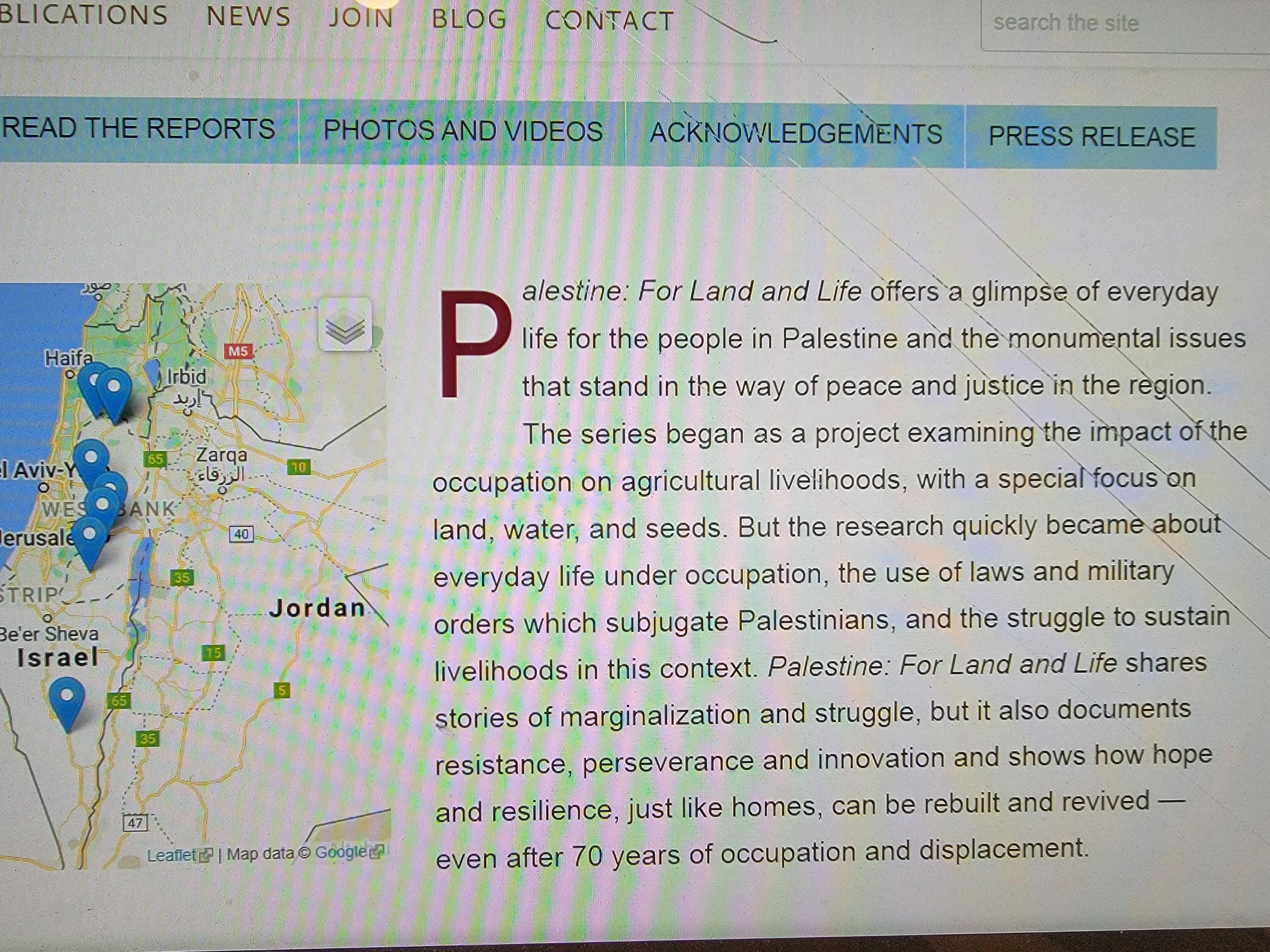
The Oakland Institute website covers a number of topics including “Palestine.” It refers to “research” published by Mittal on “Palestinian resistance & resilience 70 years after the Nakba & 100 years after the Balfour Declaration.” It includes a map regarding places of such “resistance” which includes areas in Israel.
The Oakland Institute website founded by the board chair of Ben and Jerry’s, refers to Palestine and occupation with locations inside of Israel.
Mittal’s references to the “Nakba” in 1948 and Balfour Declaration in 1917 (each well before there was a land called the “West Bank” in 1967) are part-and-parcel of her objection to the inclusion by Unilever of a statement regarding operating in Israel. Her position is seemingly that all of Israel and Israeli territory is “Occupied Palestinian Territory.” That is why she was alarmed by Israel’s “downgrading Arabic as an official language,” (nothing to do with the West Bank) and efforts by Congress “that would criminalize the nonviolent Boycott, Divestment, and Sanctions (BDS) campaign against Israel and Israeli settlements,” (note the inclusion of Israel.)
The B&J board’s statement was vague in verbiage as to whether OPT meant just the West Bank or the entire area known as Palestine in 1917, allowing mainstream progressive groups to jump to the defense of B&J on the premise that this action was just a non-violent “social mission” fighting against Israel’s “military occupation” of the West Bank, and cheered by the radical left and jihadi extremists who consider ALL of Israel to be under occupation.
What Constitutes a Social Mission
Is opposing the existence of a Jewish homeland a valid social mission?
That is the current mindset connecting jihadists, progressives and the alt-right today.
The anti-Zionists were birthed in the Arab and Muslim worlds in 1917 at the Balfour Declaration. The alt-right joined the cause in earnest during the reign of Nazi Germany which collaborated against “the shared… enemy [of world Jewry] and joint fight against it and creating the strong base uniting Germany and freedom-seeking Arabs around the world,” as Heinrich Himmler wrote to the Palestinian Grand Mufti of Jerusalem in 1943. The toxicity spread at the United Nations as more Arab and Muslim countries were admitted and effectively passed the “Zionism is Racism” resolution in 1975. While that resolution was rescinded in 1991 due to the efforts of the United States, it was reintroduced to the world at the Durban Conference in 2001, just before the jihadi attacks on America on 9/11. With the Zionism-is-Racism smear once again in vogue and the progressive wing of intersectionality pushing active anti-Racism initiatives, Anti-Zionism got incorporated under the same banner by necessity.
Is anti-Racism a social mission? Most likely. If one believes that “Zionism is Racism” it follows naturally that anti-Zionism is a social mission too.
Lost in the logic is recognizing the false premise of the “Zionism is Racism” mantra. The notion that Jews should be able to live throughout their holiest land where they have thousands of years of history is a matter of simple human rights. The dream of having independence and sovereignty in the land is no longer a “debatable political philosophy” (to quote Keith Ellison, a progressive politician) but a reality. Arguing against Zionism today is a call to dismantle the sole Jewish State, an anti-Semitic urge.
Anti-Semitism is not a social mission. At least, not for any decent human being or organization.
Internal / External Social Mission
The social mission of a company often helps it build its brand, empower employees and the community in which it operates and serves. The choices are therefore important.
Some experts suggest avoiding politics, niche causes and charisma-fueled social missions, while stressing issues like the environment, local community involvement and charity.
Ben & Jerry’s did not follow this advice and always made its political leanings known. It’s current focus areas include a host of progressive issues including: criminal justice reform; voting rights; racial justice; LGBT rights; climate justice; campaign finance reform; and refugee rights.
The company actively engages in some of these things as a matter of how it runs the company, for example making products in an environmentally-friendly way. In other situations, it tries to inform people about a topic – like criminal justice reform – with articles on its website and directing people how to register to vote.
The company is not shy about getting involved in controversial topics like “Defund the Police,” where it argues that Minneapolis disbanding its police department “is a great start.”
Some topics, like abortion, do not make it onto its website, perhaps to avoid alienating about 40% of America. Still, it signs onto letters in advertisements that criticize abortion restrictions.
So with such history of activism outside the walls of the company’s business, it should not be a surprise that the company would wade into the Arab/Muslim-Israeli conflict.
The question is, what is its position? Does it seek coexistence and peace? Does it advocate for a one state, two state or three state solution? Does it want to see the end of Israel as a Jewish State?
Ben & Jerry’s has operated in Israel since 1987, even before the First Intifada. It has distributed ice cream throughout Israel and EGL/West Bank over this time, even during the waves of Palestinian terrorism and wars over the past 20 years. This suggests that the company has (or at least had) no issue doing business in the Jewish State or its territories.
Anuradha Mittal joined the B&J board in 2008, the same year she founded the Oakland Institute. Her publications there covered many countries including Ethiopia, Sri Lanka, Cambodia and Sierra Leone. Some publications were highly critical of the U.S. Bush Administration for using the War on Terror to cut aid to some poor countries. She wrote that “the U.S. threatened to sever humanitarian aid to the people of Palestine for exercising their right to vote.” Well, maybe not for the act of voting but for voting overwhelmingly for Hamas, a US designated terrorist organization which killed over a thousand people. She skipped that part but added “Alarmed by its [Hamas’s] victory, President Bush announced to his Cabinet that he will not support a Palestinian government made up of Hamas. The U.S. has put pressure on other international donors to follow similar action with the intention of bankrupting the future Hamas-led Palestinian Authority,” and added her concern that “nearly one-half of all Palestinians already live below the poverty line…. and cutting off aid would push the Palestinian territories into chaos.” She tacitly advocated for the US to support a government run by a Palestinian political-terrorist group.
That article which covered the broad War on Terror was an outlier and Mittal did not devote much time to the Arab/Muslim-Israeli conflict at the Oakland Institute until 2017 when she became alarmed at the election of Donald Trump and his pro-Israel positions. It seems that despite B&J operating in Israel for 30 years, the idea of taking action against Israel really came to the front of her mind as U.S. policy began to favor Israel more explicitly.
Is the Action Legal or Moral
As discussed above, the promotion of peace and coexistence is a noble social mission. Actions to advance that mission could include donating to schools and organizations that facilitate dialogue and working together. Ben and Jerry’s donates to numerous causes and there is no shortage of groups (mostly in Israel) which seek to develop a harmonious future which would be happy beneficiaries of the company’s funds but the company specifically excludes donating to international organizations.
In contrast, there are actions that do not advance peace and coexistence such as supporting a ban on Jews living alongside Arabs in the West Bank and in eastern Jerusalem. The denial of Jewish history and connection to the land is not only anti-Semitic but harms the ability for the people to live together as it falsely portrays Jews as foreigners. Promoting a status quo which prevents Jews from praying at their holiest location is a simple denial of basic human rights.
The question comes back to what is the underlying “value” that the board is seeking to promote and is the subsequent course of action, legal and moral.
The board clearly feels that the United States needs to improve a lot in areas like police reform, refugee and LGBT rights, not to mention those of indigenous Americans. Yet B&J continues to manufacture and serve ice cream in these non-perfect lands. It runs its business as a profit-oriented company, selling its products in all 50 states, while articulating methods in which it believes the country can improve. It comments on its values and continues to sell ice cream.
The company has done the opposite in regards to Israel. There is no stated message anywhere on the B&J site about its objection to the state and how it is “inconsistent” with its values. It just published the July 19 statement above that it was going to stop conducting business in the “occupied Palestinian territories.” It did this, with the full knowledge – and perhaps hoping – that various states and countries which have laws banning the boycott of Israel and its territories would take action against the company to elevate the discussion globally.
If the company is against serving its products in disputed territories then it should say so and take similar actions in Cyprus/Turkey, Kashmir/India/Pakistan, Tibet/China, Western Sahara/Morocco and other locations as a new corporate policy and live with the ramifications of doing so. I cannot imagine that Unilever would allow B&J to take such actions of severely hurting the company’s business, which must fall outside the spirit of their agreement.
Israel did not annex the territory it took in a defensive war against Jordan (which itself, had illegally annexed the land in 1950), with the exception of the eastern half of Jerusalem which had been ethnically-cleansed of its Jews under Muslim Arab rule. Israel has withheld annexation in the hopes of arriving at a land-for-peace arrangement which has been consistently rejected by the Palestinians. To penalize Israel and/or the people living in the territory for holding out the hope of reaching an enduring peace goes beyond being illegal in many jurisdictions to being simply asinine.
Ben & Jerry’s board is headed by someone who seemingly thinks all of Israel is occupied Palestinian territory and believes the US should support the popular political-terrorist group Hamas. She is now taking aim at Israel and its territories in full knowledge that such action is considered illegal in many jurisdictions despite the company not taking similar actions in other disputed lands (which also do not incur financial repercussions). Further, while decrying a long list of problems in the United States, B&J continues to operate and sell its products here, but in contrast, it never says anything about the Arab/Muslim-Israeli conflict and then suddenly announces its intention to boycott the region.
The shroud of a social mission does not provide a shield from the accusations of inconsistency, double-standards and poor business judgment, and a global progressive company joining the BDS movement does not miraculously christen anti-Zionism as a “value” for a either a person or a company.
The fallout from the B&J boycott is in the early days and may yet claim the chair of its board.
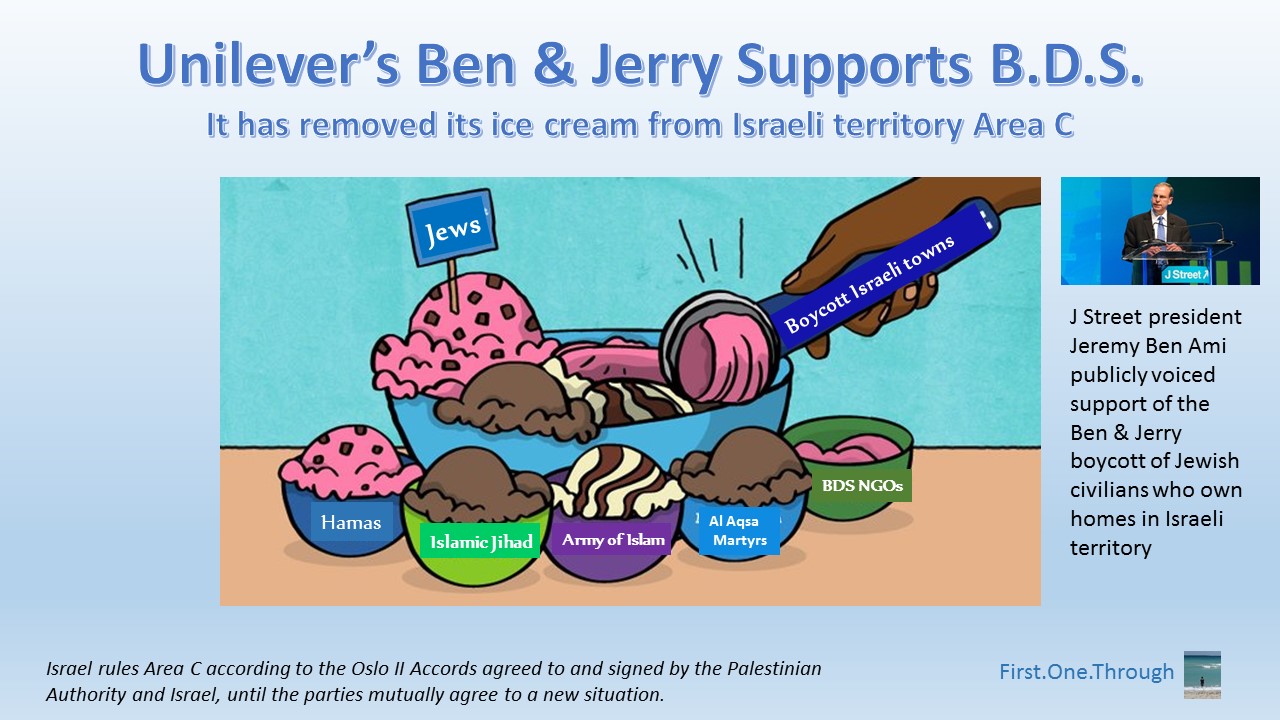
The pro-Israel community is livid about Ben & Jerry’s decisions to ban the sale of its ice cream in the Israeli territories of Area C and to not renew its affiliation with the distributor who sells the ice cream in Israel. Kosher stores around the world are removing the ice cream from its shelves and pro-Zionists and human rights activists are considering boycotting Unilever (the conglomerate which owns Ben & Jerry’s) products.
But not J Street. Jeremy Ben Ami congratulated Ben & Jerry’s on the move:
J Street President @JeremyBenAmi said that @benandjerrys was drawing “a principled and rational distinction between commercial transactions in the State of Israel & those in the territory it occupies.”
Far left extremist rabbis and synagogue presidents proudly affiliate with the organization while members sit in silence and assume that if their religious leaders support the group which bills itself as “pro-Israel”, then actions advocated by J Street like boycotting Israel and giving Iran a legal pathway to nuclear weapons, must be the pro-Israel thing to do.
It is time for Israel supporters to show J Street and its backers the door before they advance truly dangerous initiatives to a feckless administration and susceptible organizations which might believe they actually speak for the Jewish community.




 First One Through