
Antisemitism came bursting onto the American scene these last years. Jews were murdered. Synagogues were attacked. Jewish students were stalked, doxxed, and targeted by name. Schools and workplaces became hostile terrain.
And at that moment—when antisemitism crossed unmistakably from speech into violence—Jewish New York Congressman Jerry Nadler responded with the Antisemitism Response and Prevention Act.
ARPA was framed as action. In reality, it was an exercise in evasion. While Jews were being assaulted and killed, Nadler urged Congress to study, track, and administratively manage antisemitism—while carefully avoiding the standards already designed to confront it.
The United States already had a playbook, the International Holocaust Remembrance Alliance (IHRA) working definition, adopted precisely because it reflects how antisemitism functions in the modern world. IHRA recognizes what recent victims already knew: antisemitism today often arrives wrapped in ideological language—through demonization of Israel, denial of Jewish self-determination, and collective punishment of Jews for the actions of the Jewish state.
That clarity made IHRA inconvenient to some. It required institutions to draw lines. ARPA was drafted to move in the opposite direction.
“this bill [H.Res 1449 to use IHRA definition of antisemitism] threatens to chill constitutionally protected speech.” – Rep. Jerry Nadler (D-NY)
Instead of reinforcing enforcement under existing civil-rights law and a recognized definition, ARPA handed discretion to federal agencies. Antisemitism would be assessed holistically. Guidance would follow. Coordination would improve. Standards would remain flexible.
But flexibility is a luxury for bystanders, not for targets.
“the IHRA definition is plainly unconstitutionally vague.” – Rep. Jamie Raskin (D-MD)
Mainstream Jewish organizations understood the consequence immediately. Ambiguity does not restrain institutions that already fail to act. Universities that tolerated harassment would gain new procedural defenses. Administrators could claim compliance while Jewish students were chased from quads and classrooms. The more antisemitism intensified, the slower the response would become.
That is why opposition to ARPA came from the center of Jewish communal life, groups like Jewish Federations and the AJC. Their message was blunt and grounded in reality: Jews were being attacked under existing law. The failure was enforcement, not definition. Weakening standards while violence increased was not caution—it was retreat.
Support for ARPA came largely from groups more concerned with preserving far-left wing ideological space around anti-Israel activism than with confronting antisemitism as it actually manifested. In their calculus, the risk of over-enforcement mattered more than the fact that Jews were being targeted, assaulted, and killed. The alt-left preferred to cast their lot with CAIR in falsely labeling the IHRA definition as a gag order.
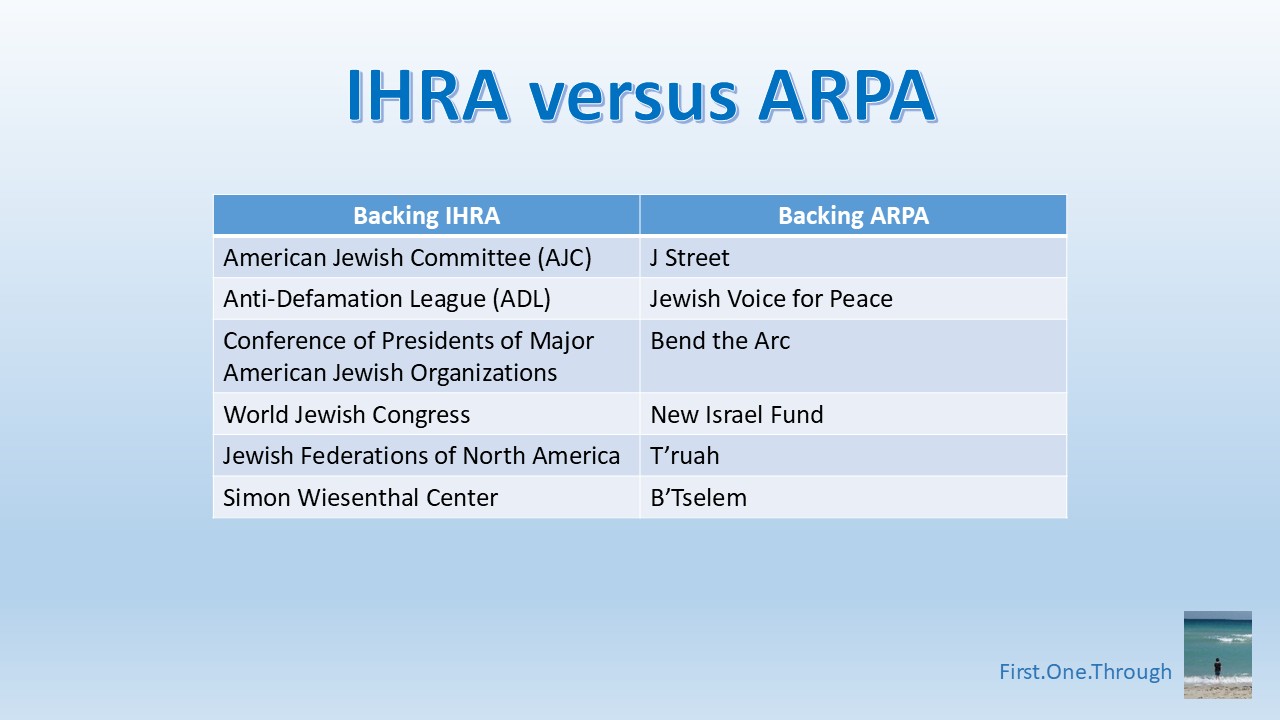
Congress eventually pivoted—toward strengthening Title VI enforcement and reaffirming IHRA—quietly conceding the obvious. When antisemitism turns violent, clarity protects lives. Process protects institutions.
“I share the concerns of groups like Jewish Voice for Peace, Bend the Arc, B’Tselem, Amnesty International, and the ACLU that the IHRA definition of antisemitism will be used to stifle dissent and chill free speech, especially Palestinian human rights advocacy. The resolution also does not recognize that the fight against antisemitism is connected to our fight against Islamophobia, racism, white nationalism, and all other forms of hate.” – Rep. Rashida Tlaib (D-MI)
ARPA will stand as a reminder of a grim truth: at a moment when antisemitism demanded resolve, left-wing Jews chose ambiguity and cozying to antisemites, rather than defense.

 First One Through