Ten Good Men

This weekend, March 13, 2020, will witness the first weekend without an Orthodox Shabbat minyan in Westchester County NY in probably 150 years, as the coronavirus pandemic hit this community very directly. It is so severe, that the National Guard is being deployed in New Rochelle. Other shuls around the state, country and world are also canceling their organized services.

Quarantine zone in New Rochelle, NY, with the Young Israel of New Rochelle at center

The concept of at least ten men gathering for prayer together is considered to originate in Genesis 18, where Abraham argues with God to spare the cities of Sodom and Gomorrah from destruction.  In verse 23, Abraham asks God “Will You sweep away the innocent along with the guilty?” He proceeds to argue that a large city should be spared if there are 50 good people living there. When God agrees, Abraham pushes further to lower the threshold to 45, then 40, 30, all of the way down to 10 people at which point he stops. He seemed to acknowledge that the minimum viability for a city is ten good people.

Sages used this story as the foundation to decide on a quorum and instituted a policy of ten men over the age of thirteen to be the baseline for a minyan where certain prayers and activities could take place, such as reading from the Torah.

But this week – the week after the holiday of Purim which saw the world turned upside down 2,400 years ago – is witnessing the flipping of a minyan on its very foundation. Whereas Abraham called for ten good men to save a city, the pandemic is prohibiting ten good men from assembling together. While the lack of ten doomed two cities, hundreds and thousands of good people are getting sick and under quarantine.

When Abraham argued with God to save Sodom and Gomorrah, he did not ask if ten people were assembled in one place together; he just cared that there was a decent number of righteous people living in the area. So we ask and pray today, at a time when people are not able to congregate at their synagogues but must daven at home, may God realize the breadth and depth of good and righteous people living in our towns and bring peace and health to everyone.


Related First One Through articles:

Abraham’s Hospitality: Lessons for Jews and Arabs

Kohelet, An Ode to Abel

The Loss of Reality from the Distant Lights

Ruth, The Completed Jew

Subscribe YouTube channel: FirstOneThrough

Join Facebook group: Israel Analysis and FirstOneThrough

Defeating Haman’s Big Ten Sons and Modern Antisemitism

The Book of Esther has a protagonist and antagonist with clear pedigrees. The protagonist, Mordecai is introduced in chapter 2, verse 5 as:

“In the fortress Shushan lived a Jew by the name of Mordecai, son of Jair son of Shimei son of Kish, a Benjaminite.”

The antagonist of the story, Haman, similarly has his legacy laid out in chapter 3, verse 1:

“Some time afterward, King Ahasuerus promoted Haman son of Hammedatha the Agagite; he advanced him and seated him higher than any of his fellow officials.”

Each person is tied back to their father and further to show the essence of the person and family. Mordecai’s roots are in the tribe of Benjamin, the tribe abutting the Jewish holy capital city of Jerusalem. It is the tribe whose descendants came from Jacob’s (Israel’s) favorite son.

For his part, Haman is a descendant of the King Agag, the king of Amalek (Samuel 1, Chapter 15). Some generations before the story of Esther, a fellow member of Mordecai’s tribe of Benjamin, King Saul, failed to kill King Agag as directed by the Samuel the Prophet. The Amalekites were deemed forever evil, as the nation which attacked the Jewish people as they walked in the desert hundreds of years earlier, between slavery in Egypt and freedom in their promised land in Israel (Exodus 17).

The lineages of Mordecai and Haman are an essential part of the story. Two nations in Exodus faced off, with a powerful Amalek nation attacking a weaker Jewish one, followed by two kings in Samuel 1 where the stronger Jewish king failed to kill the king of Amalek. This current story is yet a further rung down ladder, with important laymen facing off. At this time, a respected Jew without real power confronts an anti-Semite with power due to his proximity to the king.

In this third chapter, the descendants of Benjamin and the Children of Israel thoroughly defeat the descendants of Agag and Amalek with the help of the Persian king.

But is there a fourth chapter to the saga? Is the Book of Esther the conclusion of the generational battles between Israel and Amalek with the killing of Haman?

The Jewish scribes give us a clue.

The megillah, the Book of Ether, is uniquely read twice a year. It is the the only one of the five megillot that is read from a parchment like the Torah itself, and has a blessing recited before it is read. As such, the physical writing instructs the listener as much as the words.

Esther chapter 9, reveals how the ten sons of Haman are murdered after their father is killed. Scribes write the names of the murdered progeny in a unique manner:

The name of each son is written with extra large letters and each name is distinct and separated from all other words on the page. It is the only time in the story that their names are even mentioned, and after they are, the text resumes its regular style print stating

“the ten sons of Haman son of Hammedatha, the foe of the Jews. But they did not lay hands on the spoil.”

The ten sons of Haman are not tied to royalty, the King Agag, as was their father; they are simply tied to the legacy of a notorious anti-Semite. That is the summation of what defines them.

These ten Jew haters were killed by the local Jews themselves (Esther 9:5) and not by royal edict as was the case for their father Haman. While they once appeared larger-than-life for the once weak Jews, the common Jews gathered strength to defeat not royalty, but mere Jew-haters.

The battles between the Children of Israel and Amalek had four chapters: between nations, between kings, between powerful laymen and ultimately between regular people. The Book of Esther tells the story of chapters three and four, and is read twice to make sure we internalize the message of defeating antisemitism: recognize that it is neither supreme or legal by royal decree. It is just Jew-hatred which comes in various sizes and shapes, all of which must be vanquished.


Related First One Through articles:

Taking the Active Steps Towards Salvation

When Power Talks the Truth

Purim 2020, Jewish Haikus

Purim 2019, The Progressive Megillah

Subscribe YouTube channel: FirstOneThrough

Join Facebook group: Israel Analysis and FirstOneThrough

Purim 2020, Jewish Haikus

While the format of a traditional haiku is seventeen syllables in a 5/7/5 format, for this Purim, I have decided to use the Jewish chai’ku which has 18 syllables in an escalating 5/6/7 format, with some license.


I don my costume
The latest from Disney.
Rabbi’s grandson wears the same.

Her name Hadassah
Later called Queen Esther
First of Her Name, Breaker of Chains.

We all hear “Haman”
The groggers fall silent
My stomach growls, loudly.

The good guys triumph!
How unusual. Ah,
Not written in Israel.

Megillah two times
Yet Chanukah has none!
Al Ha’nissim inequality.

Diaspora Purim
Large meal and much drinking
Why only a single day?

Mishloah Manot
Only need two items
But don’t want label “cheap friend.”

Stale Hamantashen
Clearly weak store-bought fare
I rummage to find homemade.

Yes, I like muhn
A single day a year
A sweeter poppy bagel.

Two weeks trapped inside
Called for “Calm” Purim shpiel.
What day is Purim Sheni?


Related First One Through articles:

Purim 2019, The Progressive Megillah

Purim 5776/ 2016 Poem

Related First One Through video:

Subscribe YouTube channel: FirstOneThrough

Join Facebook group: Israel Analysis and FirstOneThrough

Chanukah and Fighting on Sabbath

Shuls, Jewish schools, community centers and kosher supermarkets have become battlegrounds in the United States over the past few years, much as they have been in the rest of the world for a long time. The spike in violent hate crimes against Jews has dwarfed those committed against any other group with recent murders in Pittsburgh, PA, Poway, CA and Jersey City, NJ.

Jewish communities all over the country are debating how to respond.

In 2015, New York City managed to push through a bill over the objections of several progressive politicians and organizations, to reimburse private schools – including Jewish day schools – for their security forces. That effort may have saved dozens of lives.

Synagogues are now debating whether they need to hire police officers to guard their houses of worship, or at least have people within the community be on alert, perhaps armed.

Many synagogues have turned to a group called the Community Security Service (CSS), which has been actively working with Jewish communities around the country for several years to help them prevent and prepare for emergency situations. As stated on their website:

“CSS provides a wide range of security services at no cost to the Jewish community. From securing thousands of events every year to helping secure facilities, we are the community security experts. Our teams are part of the community, trained by the community, here to protect the community, acting as a key force multiplier for law enforcement. CSS thrives to preserve our way of life and respect Jews from every walk of life. Our organization is supported by Jewish leaders, organizations, and law enforcement. Through our organization, the Jewish community receives the highest level of security training, our teams become the eyes and ears of the community, partnering up with law enforcement to help secure our community in an undisruptive, seamless way.”

Yet even with the training of the CSS and the spike in deadly attacks, many rabbis remain uncomfortable with Jews carrying weapons or using radios on the Sabbath, as it is considered a prohibited activity on the holy day.

It is therefore worth recounting the story of Chanukah, at least a particular one of the lesser known stories.

While many people are familiar with the story of the Maccabees defeating the Syrian-Greeks in battle and purifying the Temple of their pagan rituals, not all of the battles went well. As recounted by Josephus (37CE – 100CE), the Jewish historian in The Antiquities of the Jews in Book 12, Chapter 6, after the priest Matthias began the revolt, he and his sons fled into the desert:

“Many others did the same also; and fled with their children and wives into the desert; and dwelt in caves. But when the King’s generals heard this, they took all the forces they then had in the citadel at Jerusalem, and pursued the Jews into the desert. And when they had overtaken them, they, in the first place, endeavoured to persuade them to repent, and to choose what was most for their advantage; and not put them to the necessity of using them according to the law of war. But when they would not comply with their persuasions, but continued to be of a different mind, they fought against them on the sabbath day: and they burnt them, as they were in the caves, without resistance; and without so much as stopping up the entrances of the caves. And they avoided to defend themselves on that day, because they were not willing to break in upon the honour they owed the sabbath, even in such distresses. For our law requires that we rest upon that day. There were about a thousand, with their wives and children, who were smothered, and died in these caves. But many of those that escaped, joined themselves to Matthias, and appointed him to be their ruler. Who taught them to fight, even on the sabbath day; and told them, that “Unless they would do so, they would become their own enemies, by observing the law [so rigorously,] while their adversaries would still assault them on this day; and they would not then defend themselves: and that nothing could then hinder, but they must all perish, without fighting.” This speech persuaded them. And this rule continues among us to this day; that, if there be a necessity, we may fight on sabbath days.

Over 2,100 years ago, Jews observed the Sabbath to such a degree that they allowed themselves to be slaughtered rather than put up any resistance. More men, women and children died during one of the first Sabbaths of the Maccabean revolt, than died at Masada 200 years later. But few remember the story.


Judas The Maccabee Defeats His Enemies,
painting by Julius Schnoor von Carolsfeld (1794-1872)

During this Chanukah which is celebrated against a backdrop of terrible violence against Jews, let us remember all of the stories of the holiday, and make sure that every Jewish place of worship is completely prepared to handle any situation which may arise.

Wishing you a happy and very peaceful Chanukah.


Related First.One.Through articles:

Today’s Inverted Chanukah: The Holiday of Rights in Jerusalem and Judea and Samaria

What Kind of Hate Kills?

Covering Racism

Where’s the March Against Anti-Semitism?

The New York Times All Out Assault on Jewish Jerusalem

I See Dead People

The War Against Israel and Jewish Civilians

I Understand Why the Caged Jew Sighs

The Reform Movement’s Rick Jacobs Has no Understanding of Tolerance

The Holocaust Will Not Be Colorized. The Holocaust Will Be Live.

Calls From the Ashes

Subscribe YouTube channel: FirstOneThrough

Join Facebook group: FirstOne Through Israel Analysis

The Loss of Reality from the Distant Lights

On the fourth day of creation God set the Sun and Moon in the sky. Placed millions of miles from the Earth, the Sun did more than allow life to exist on the planet; it allowed time to be measured in seconds and seasons.

The distance between Earth and Sun changes throughout the year bringing warmer and colder weather, and the rotation of the Earth produces evolving shadows from the sunlight which enables people to tell time. As the seasons and time of day change, our views of the world around us also change. One minute the item before us may be almost black. The next it could be purple, followed by blue and red then brown. Our senses take in the natural world, and its constant evolution.

The mountains of Las Vegas at 6:16, 6:20, 6:23, 6:29 and 6:45am
(photos: First.One.Through)

The moon and stars also enable mankind to chart its path during the night. The various natural sources of light enable people know where they stand in time and place.

Man’s Ever-Encroaching Light and Lit Content

Man was able to harness and control some of nature’s light in developing and using torches and lanterns over thousands of years. However, it was in 1878 with the creation of the first light bulb that mankind began to change the essence of how we see the natural world.

It its first decades of existence, light bulbs illuminated its immediate surroundings. The light bulb first lit up a circumference of several feet and then, as the power grew, it illuminated even larger areas. But in 1927, the very nature of man’s light changed, as it also became the focus of attention with the creation of the television. No longer was man’s light used only to appreciate the natural world; it was used as a replacement to the natural world. Man’s light became embedded with its own truth.

For decades, that source of light and content remained roughly eight to ten feet from our eyes. That abridged space still afforded our eyes the ability to incorporate some other items in our peripheral vision. But the distance would continue to shrink over time, as would our incorporation of the natural world.

The first computers came to corporations in the 1960’s and individuals began to acquire them in the 1980’s and 1990’s, bringing the lit screens just two to four feet from our eyes. The distance would shrink again in the 21st century, as smartphones with luminous screens were welcomed into the hands of the masses, shrinking the space between our eyes and the screens to just one to two feet. Now, with the advent of virtual reality goggles, all space has disappeared.

AT&T’s vision for new virtual reality games based on its DC characters

The distance which had afforded us the space to see God’s creations has been eliminated. The natural world is shut out in favor of man-made reality.

Man’s Reality: The Destruction of Time and of Man

For centuries, mankind did not only use the sunlight to tell the time of day, it understood the nature of how the world changed based on the sunlight.

In the 1890’s French artist Claude Monet painted a series of paintings of the Rouen Cathedral at different times of day. While the subject of the church’s facade remained constant, Monet changed the color scheme based on the lighting of the sun. In doing so, each work of art was inherently time-stamped. A viewer understood whether the painting of the church was from the morning, during the day or at sunset, based on the palette of colors.

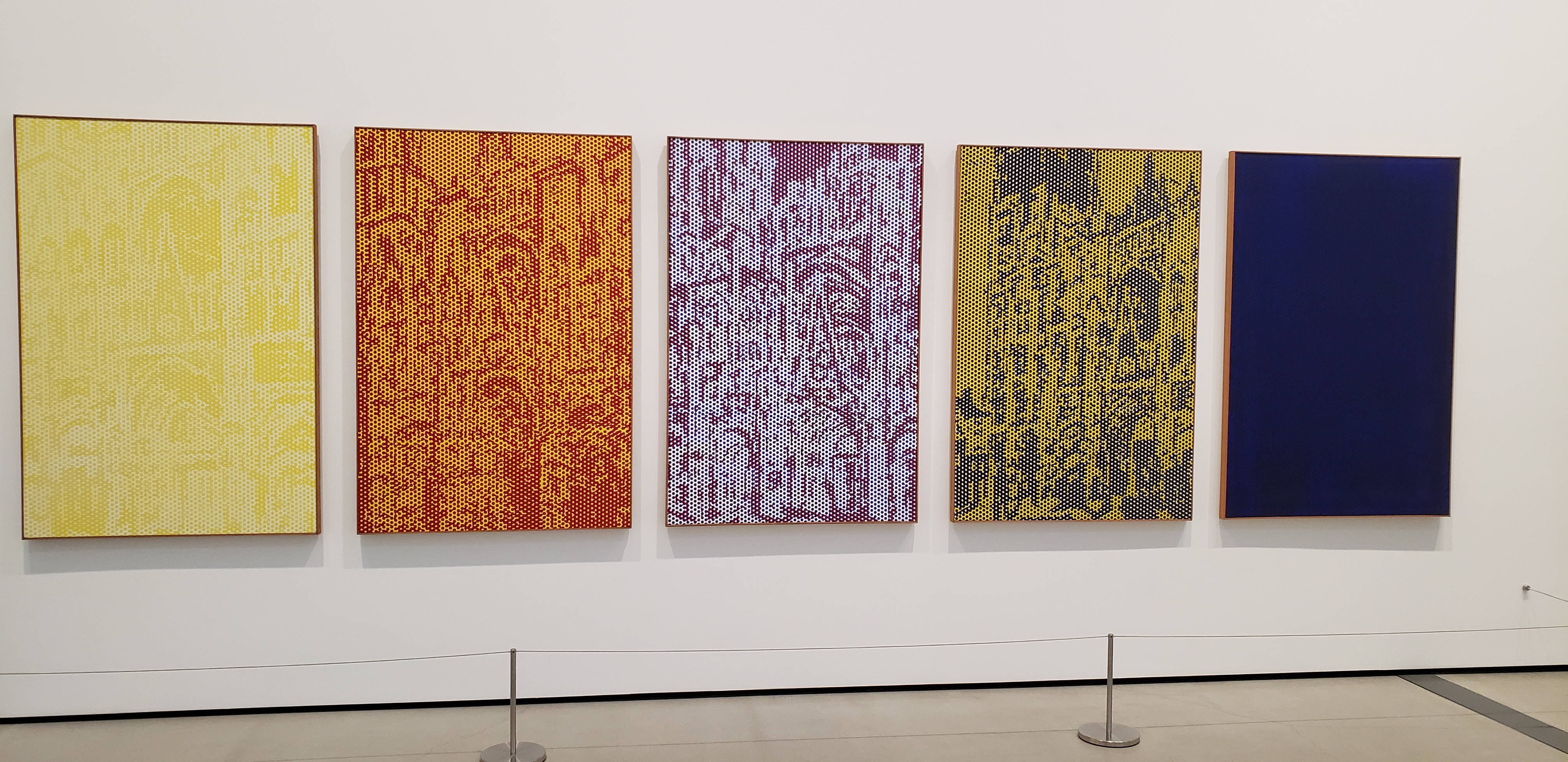
In the 1960’s, pop artist Roy Lichtenstein recreated the Monet series in his own style.

Roy Lichtenstein’s Rouen Cathedral series at The Broad
(photo: First.One.Through)

The various colors used by Monet designed to show the cathedral under different lighting conditions in moments of time was replaced by Lichtenstein into uniform sets of color. Lichtenstein’s yellow Rouen no longer conveyed daytime, his red was not sunset and his navy could not be considered night. The pop artist eliminated the element of time, as color was just meant as color, available in any and all shades.

Lichtenstein’s style also replaced Monet’s varied and emotional brushstrokes with machine-like circles. While he painted the artworks by hand, Lichtenstein gave his artwork a poster-like, mass produced cold feeling.

In just 70 years, man migrated from personal, emotional expressions of how sunlight influenced the world around us, to art which minimized both time and man’s own unique creativity.

The “Triumph” of Man’s/ Computer’s Virtual Reality

Until roughly 2008, the use of the internet ran roughly along working hours as people logged into their computers at work. However, with the ubiquity of connected cellphones and tablets, data consumption during the morning and evening hours – all of the way until 11:00pm – has now matched, and in some cases surpassed, data usage at work. People are consuming video content during all of their waking hours, and doing it at closer and closer distances to their eyes.

Technology is eliminating the physical space which enables us to absorb God’s natural world, as we allow ourselves to be ensnared by man’s manufactured reality. While the circling sun let us know that time moved on, the digital lights blind us of those same lost moments.

The sad loss of reality afforded by God’s distant lights will be rapped in the future by an avatar during a cinematic sequence in a virtual reality game. And alas, the masses will never understand the reference, as they parry the poetry to pursue additional precious points.


Related First.One.Through articles:

The Hidden Side of the Moon

The Relationship of Man and Beast

The Descendants of Noah

The Journeys of Abraham and Ownership of the Holy Land

The Jewish Holy Land

Subscribe YouTube channel: FirstOneThrough

Join Facebook group: Israel Analysis and FirstOneThrough
The Descendants of Noah

After God destroyed most of the world in the flood, He promised that He would never use water to destroy all living things again. After that covenant, the three sons of Noah – Shem, Cham and Japheth – embarked on settling the world anew:

שְׁלֹשָׁ֥ה אֵ֖לֶּה בְּנֵי־נֹ֑חַ וּמֵאֵ֖לֶּה נָֽפְצָ֥ה כָל־הָאָֽרֶץ׃

These three were the sons of Noah, and from these the whole world branched out. (Genesis 9:19)

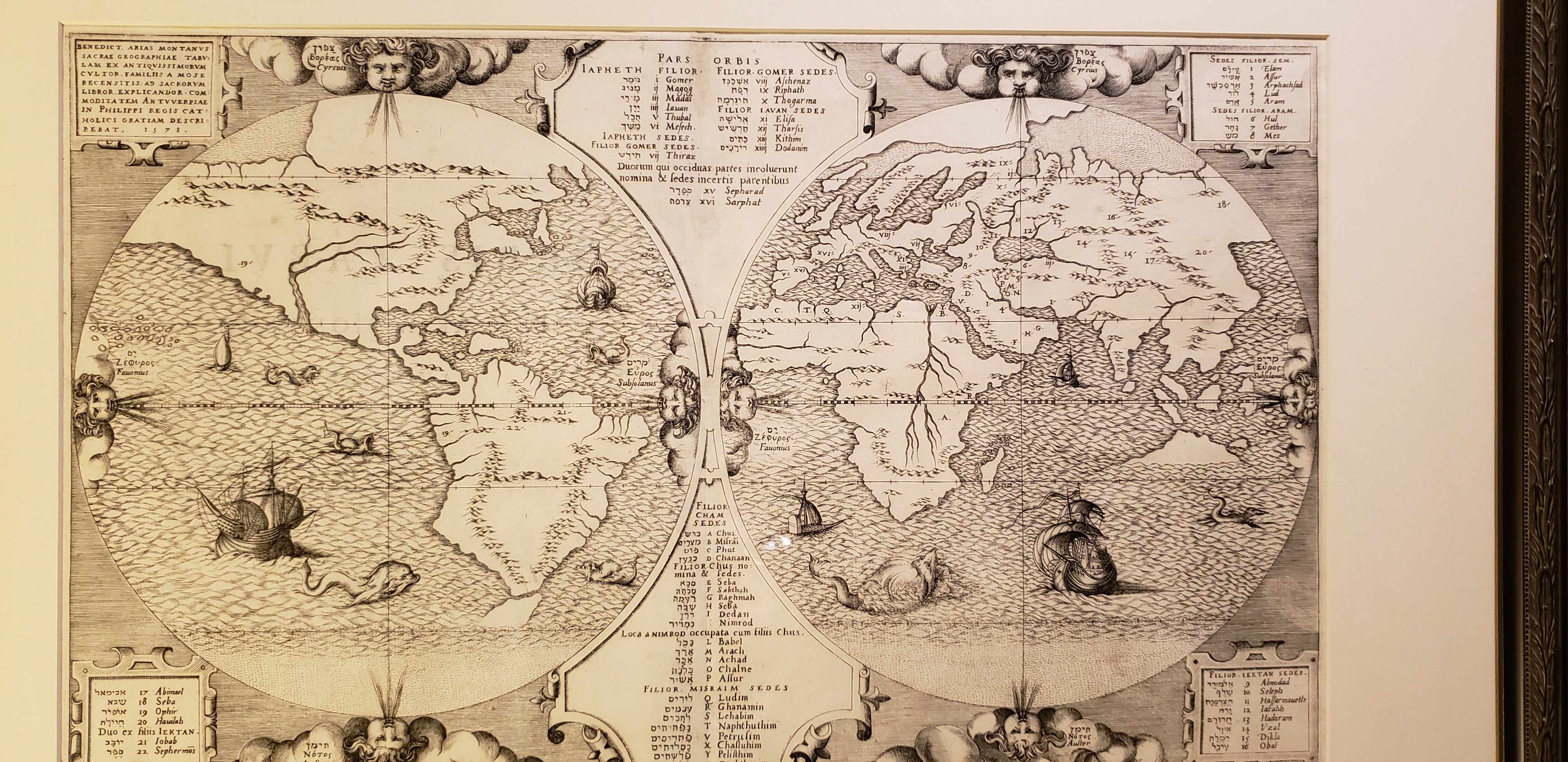
Genesis 10 relayed the descendants of the three sons and early bibles sought to educate people where each of those children settled by including maps inside the bound volumes. The most famous of these was one completed by a Benedectine Monk named Arias Montanus in the 16th century.

Benedict Arias Montanus Sacrae Geographiae Tabulam ex Antiquissimorum Cultor (1571)

Benito Arias Montanus (1527-1598) was born in Spain and entered the priesthood around 1559 where he gained a reputation as an important biblical scholar. In 1568, he was commissioned by King Phillip II to supervise a new polygot (multi-language) bible which would become part of the king’s scholarly volumes on the bible. This work was to replace the first “Royal Bible” completed by the Escorial Library in 1514.

Written in Hebrew, Greek, Latin and Syriac, and printed in Antwerp between 1569 and 1573, the polygot bible caused a stir. Montanus was reported to the Spanish Inquisition for purportedly giving preference to the Jewish rabbinic reading of the scriptures. His trial lasted several years and the Inquisition was finally convinced by the biblical scholar Juan de Mariane that Montanus’s interpretation of the text did not contradict Catholic dogma, acquitting him in 1580.

Montanus’s world map above shows the descendants of Shem, Cham and Japheth in Hebrew and Latin. Japeth’s sons are listed in the center of the map in Roman numerals; Shem’s sons are listed on the right side and indexed with numbers, while Cham’s sons are indexed with letters.

Japhet’s sons are portrayed as covering Europe. Sepharad is located in modern Spain, Sarphat is placed in France and Yavan in Greece – just like the modern Hebrew names for those countries. The lone exception is Madai who is placed in modern Iran. Biblical scholars consider Madai to be connected to the ancient Persian people of Medes.

Cham’s sons are placed throughout the Middle East and Africa, stretching from modern Iran to Morocco and Kenya. Mizrayim and Pelishtim are both located in northern Egypt, while Canaan is found in modern Jordan.

The children of Shem, from whom Abraham and the Jewish people are descended, were placed on the map from eastern Europe, Iraq and Kuwait eastward over China and Russia with a land bridge to the Americas. In a fascinating placement, Montanus placed Ophir both in modern-day California and Peru. It is a curious placement because Ophir was the city from which King Solomon imported gold to the Jewish Temple in Jerusalem (1 Kings 10:11). While it was known at this time that the Aztecs in Mexico had considerable gold, gold was not discovered in California for another 275 years.


The descendants of Noah scattered over the planet as described in Genesis 11:31, “according to their families, their languages, their lands and their nations.” They are part of the opening of the bible, before the text narrows its focus to the foundation of the Jewish people relocating from modern Iraq to modern Israel in the story of the Jewish patriarch, Abraham. Much like the nations of the world, the Jews would establish their nation in their land with their own language as descendants of their families’ ancestors of Abraham, Isaac and Jacob.


Related First.One.Through articles:

The Relationship of Man and Beast

The Journeys of Abraham and Ownership of the Holy Land

Abraham’s Hospitality: Lessons for Jews and Arabs

The Jewish Holy Land

Ruth, The Completed Jew

Kohelet, An Ode to Abel

Subscribe YouTube channel: FirstOneThrough

Join Facebook group: Israel Analysis and FirstOneThrough

Kohelet, An Ode to Abel

The book of Kohelet, Ecclesisates, always struck me as a peculiar portion to read on the holiday of Sukkot. The Sukkot holiday is described in Jewish prayers as “Zman Simchateynu,”‘ meaning the “time of our happiness.” Yet the book of Kohelet does not inspire such emotions.

From its opening sentences, the author appears intent on giving us full warning about the dark philosophical lesson to be shared over twelve chapters:

דִּבְרֵי֙ קֹהֶ֣לֶת בֶּן־דָּוִ֔ד מֶ֖לֶךְ בִּירוּשָׁלִָֽם׃

The words of Koheleth son of David, king in Jerusalem.

הֲבֵ֤ל הֲבָלִים֙ אָמַ֣ר קֹהֶ֔לֶת הֲבֵ֥ל הֲבָלִ֖ים הַכֹּ֥ל הָֽבֶל׃

Utter futility!—said Koheleth— Utter futility! All is futile!

King Solomon, the wisest man in the world who built the holy Jewish Temple in Jerusalem, declared that “everything is futile and without meaning.” Quite a jarring and alarming sentiment. If someone of his intellect, who ruled the united kingdom of Israel at its peak can state that everything is pointless, what should an average person believe? How is such a sentiment to be read and internalized on the happy holiday?

In chapter after chapter, Solomon laid out that every human effort and emotion is for naught. Labor (1:3), beauty (1:8), wisdom (1:13-16), laughter (2:1-2), building projects (2:4-6), amassing wealth (2:7-11) are fleeting and without substance or longevity:

“10 I denied myself nothing my eyes desired; I refused my heart no pleasure.
My heart took delight in all my labor, and this was the reward for all my toil.
11 Yet when I surveyed all that my hands had done and what I had toiled to achieve, everything was meaningless, a chasing after the wind; nothing was gained under the sun.”

A man with all the wisdom, power and wealth a person could ever imagine had reached the conclusion that his efforts amounted to nothing. His existence was but a whiff of air.

So a reader is left empty. Sitting in synagogue seats on a Sabbath morning during Sukkot, a person squirms and pivots from Zman Simchateynu, a time of happiness, to depression. Is the true message of the season less about surviving the Day of Judgement at Yom Kippur the week before, to internalizing the temporary nature of life, like the huts Jews live in today during the holiday to commemorate the tents which Jews lived in during their forty years wandering from Egypt to Israel, and the pillar of cloud which God placed to protect them (Exodus 13:20-22)? Hooray, we live! But so what?

Such thoughts are depressing and stand at odds with the sentiment of the holiday. One must imagine that the rabbis who advocated reading Kohelet on Sukkot may have had another message for people to extract from Solomon’s words.

Solomon’s Intent

It is possible that the wise king was simply being modest in Kohelet or did not want to be the focus of the world’s envy regarding his status and accomplishments. It is also conceivable that Solomon was so wise that he was able to see into the future and saw that the kingdom which he ruled would soon be torn apart and that the Temple which he built would one day be destroyed.

“הֲבֵ֧ל הֲבָלִ֛ים אָמַ֥ר הַקּוֹהֶ֖לֶת הַכֹּ֥ל הָֽבֶל׃

Utter futility—said Koheleth— All is futile!” (12:8)

But there is another point worth considering.

The Jewish calendar is arranged so that Kohelet is always read publicly a few days before the Torah is finished and restarted on Simchat Torah. The Torah concludes with the end of Jewish wandering and entering the promised land of their forefathers, paired with the opening stories of the bible relaying the creation of the world and mankind.

Finishing the bible and restarting it has been a cycle which Jews have continued for thousands of years, rereading the first thousands of years of Jewish history over and again.

That history had ups and downs with heroes and villains. In restarting the Torah, Jews have a moment to connect to the stories of their favorite characters. Perhaps it was Noah who saved mankind from the destruction of the flood, or Abraham, the original monotheist, or Joseph who saved the world from starvation or Moses who took the Jewish people out of bondage.

The bible is replete with people who helped form the Jewish people into the nation which would enter their holy land by the end of the Torah. Each had a hand in crafting the character of the people.

That excitement about retelling the stories of the biblical forefathers who charted the history of the Jews is seemingly directly counter to Solomon’s Kohelet message. Solomon wrote that everything is meaningless, but we read the bible and conclude otherwise: people make a big difference.

King Solomon’s message may be more nuanced than our plain reading of Kohelet.

Consider that King Solomon had a different hero than most of us who are pulled by the classic narratives of champions and leaders. His hero was seemingly a more simple person whose only mark was worshiping God wholeheartedly. That person’s name covers the entire book of Kohelet: Abel.

Much is lost in the translation from Hebrew, as “הֶ֙בֶל֙” in Genesis is not transliterated as Hevel but translated as “Abel”, and in Ecclesiates it is translated as “futile” or “meaningless.” However, in Hebrew, the words are identical.

We know little of  הֶ֙בֶל֙/Abel other than he was a shepherd and offered the best of his flock to God for an offering (Genesis 4:4). God accepted the offering and Abel was killed by his brother shortly thereafter. Unlike King Solomon, הֶ֙בֶל֙/Abel had no wife or children, no riches or possessions. We never even learn about any of Abel’s emotions like his family members who were embarrassed (Adam and Eve) or angry (Cain). הֶ֙בֶל֙/Abel simply watched sheep and made an offering to God.

And that was the totality of his life.

For Solomon, הֶ֙בֶל֙/Abel’s name will forever live in its purest form, while his murderer will forever be marked as a villain who could not escape his secret crime.

ט֥וֹב שֵׁ֖ם מִשֶּׁ֣מֶן ט֑וֹב וְי֣וֹם הַמָּ֔וֶת מִיּ֖וֹם הִוָּלְדֽוֹ׃

A good name is better than fragrant oil, and the day of death than the day of birth.” (Kohelet 7:1)

Solomon ended Kohelet with a clear message:

וְיֹתֵ֥ר מֵהֵ֖מָּה בְּנִ֣י הִזָּהֵ֑ר עֲשׂ֨וֹת סְפָרִ֤ים הַרְבֵּה֙ אֵ֣ין קֵ֔ץ וְלַ֥הַג הַרְבֵּ֖ה יְגִעַ֥ת בָּשָֽׂר׃

A further word: Against them, my son, be warned! The making of many books is without limit And much study is a wearying of the flesh.

ס֥וֹף דָּבָ֖ר הַכֹּ֣ל נִשְׁמָ֑ע אֶת־הָאֱלֹהִ֤ים יְרָא֙ וְאֶת־מִצְוֺתָ֣יו שְׁמ֔וֹר כִּי־זֶ֖ה כָּל־הָאָדָֽם׃

The sum of the matter, when all is said and done: Revere God and observe His commandments! For this applies to all mankind:

כִּ֤י אֶת־כָּל־מַֽעֲשֶׂ֔ה הָאֱלֹהִ֛ים יָבִ֥א בְמִשְׁפָּ֖ט עַ֣ל כָּל־נֶעְלָ֑ם אִם־ט֖וֹב וְאִם־רָֽע׃

[סוף דבר הכל נשמע את־האלהים ירא ואת־מצותיו שמור כי־זה כל־האדם]

that God will call every creature to account for everything unknown, be it good or bad. The sum of the matter, when all is said and done: Revere God and observe His commandments! For this applies to all mankind.” (12:12-14)

Solomon wrote many books during his lifetime and his father, King David, wrote many psalms. But for Solomon, those don’t really matter. At this time of year, the Jewish people are once again about to read together about their foundation story: the central canon of Judaism, the Five Books of Moses. It is the nation’s time to connect to its ancestors.

Kohelet is not read on Sukkot as a way of adding to the happiness of the holiday; it is the preamble to the Torah to consider the way our ancestors lived and how to model our lives. For the rabbis concerned that people will be drawn to the biblical kings and warriors, leaders and builders, the call to read the text through a prism of connecting to God was captured best in Solomon’s Kohelet.

Solomon’s wisdom is summed up with a simple solitary suggestion: to revere God. Every other action or emotion is inconsequential.

A good name lives forever in a story which is read forever. For King Solomon, the purest person who focused solely on God and nothing else was הֶ֙בֶל֙.


Related First.Oe.Through articles:

“Cast thy bread upon the waters”

The Relationship of Man and Beast

Ruth, The Completed Jew

Taking the Active Steps Towards Salvation

A Sofer at the Kotel

The Jewish Holy Land

Abraham’s Hospitality: Lessons for Jews and Arabs

Subscribe YouTube channel: FirstOneThrough

Join Facebook group: Israel Analysis and FirstOneThrough

Bilhah and Zilpah Get Their Due

A satire.

Rabbi Jonina Jett finished the last refrain of her song and put the guitar down alongside the holy ark which held the temple’s two torahs. She fixed her pink and white tallit which had slipped down her black leather jacket and moved towards the microphone to address the one hundred or so worshipers.

Her congregation at Sisters of Tikkun Olam in California were used to passionate sermons from their outspoken life minister, but she was clearly more agitated that Saturday morning.

“My dear sisters,” Rabbi Jett began, “today is World Population Day, the day when we all must speak loudly about the real threat of the human population growing wildly out of control. It is a growing risk which has exacerbated climate change and threatens our planet and our very existence.”

She paused to survey her lesbian Jewish parishioners. A few began to nod in agreement, so she leaned in a bit more.

“Bernie Sanders told the world the truth: that we need to think about radical population control to save our world. It is the very essence of tikkun olam, repairing the damage that we have caused.” The very mention of Sanders brought the whole congregation together and everybody nodded in agreement. A few womyn even clapped.

“We are not living in the totalitarian world of “The Handmaid’s Tale” where almost everybody is infertile! It’s the very opposite, where only a few of us holy sisters are taking action with our bodies and choosing to NOT have children while much of the world falls under the weight and might of the patriarchy!” Pay dirt. The call of “patriarchy” brought the crowd to its feet.

Her point made, Rabbi Jett pivoted the speech.

“Yes, yes! We have taken responsibility for our lives and our planet! Each of us has acted in noble ways in our homes. But today I want to talk to you about something we should do as a community, right here in our sanctuary, in our liturgy. I want all of you to open your prayer books to the Amidah, the silent prayer.”

The audience became a congregation again and took their seats, flipping open the prayer books until the found they right page.

“Decades ago, feminist and progressive rabbis altered the opening lines of this central prayer to add the names of the matriarchs of Judaism: Sarah, Rebecca, Leah and Rachel. They broke with the mold of a male-dominated history and connection to God. But they did not do enough.” Becoming emotional, she cleared her throat and took a sip of water before continuing.

“Like all of you, I have watched “The Handmaid’s Tale” several times. I have been shaken to my core at a world that actually does NOT seem so different from our own. A world where women’s bodies are treated as possessions, in which society decides the fate of our beings and our offspring. We must all internalize that this dystopian world is not just a creation of fiction, but has basis in fact. In our own religion.

“Our own matriarchs and patriarchs used women as breeding machines. Four of the twelve tribes were brought into this world by the handmaidens of Rachel and Leah. One-third of the Jewish people.” She paused to let the point sink in. “And we have erased these mothers. Their bodies are not buried in Hebron. We do not speak their names.

“But they have names, and it is time to recognize the dark side of our history.

“There is a pen in front of each of you and I want you to take it and write the names of ‘Bilhah and Zilpah‘ right after our treasured matriarchs. These women are part of our story too. We owe it to them, to the modern day sexual slaves around the world, and to ourselves to remember them each and every day.”

As the congregation dutifully inscribed their prayer books, Rabbi Jett removed her jacket and showed everyone the new tattoos of “Bilhah” and “Zilpah” inked in Hebrew letters on her left forearm. “Let us never forget our fellow women, or we will be doomed to follow their fate.”

While her face was cold and determined, Rabbi Jett smiled to herself as she watched her flock follow her lead mouthing the names of “Bilhah’ and ‘Zilpah’.


Related First.One.Through articles:

The Religious Denominations Take on Diets

New Group, ZOFLAT, Takes on Shift in Modern Orthodoxy

Shavuot the Community Slept Late

Chag Kasher v. Sa’meach

Anyone Working in October?

Subscribe YouTube channel: FirstOneThrough

Join Facebook group: Israel Analysis and FirstOneThrough

Ruth, The Completed Jew

On the holiday of Shavuot which celebrates the giving of the Torah, we read the story of Ruth. It is, at first glance, a particularly strange choice. Why would Judaism, which has a prohibition against marrying a Moabite (Deuteronomy 23:3) use the story of a marriage to a Moabite, on any holiday, let alone one of the three festivals of pilgrimage, and the one devoted to the giving of the laws?

Peoplehood, Land and Religion

The three festivals represent three parts of the collective Jewish nationhood as told in the five books of Moses:

  • Passover tells the story of Jews becoming a nation, a single people. While they entered Egypt as a single family of 70 souls, they left Egyptian bondage as a people numbering 600,000 men. Their vast numbers yet common experience of slavery and freedom bound them together as a singular nation.
  • The holiday of Sukkot, Tabernacles, represents both the travels and protection of the Jews as well as their final destination in the land of Israel.
  • And the third of the festivals, Shavuot, is about religion. God gave the Jewish people the 10 Commandments on this day, just seven weeks after leaving Egypt.

These three elements are critical to understanding the nature of of the the Jewish people. At the most fundamental level, any Jew is part of the Jewish people, whether or not they observe the commandments in the Bible or live in Israel. A religious Jew who lives in the diaspora or a secular Jew living in Israel appreciate two of the three aspects outlined in the Bible. And a Jew who lives in Israel and observes the Torah’s commandments covers all three elements.

Which brings us to why the Book of Ruth is read on Shavuot. Other than Abraham, the patriarch of Judaism who came to the holy land hundreds of years earlier, she is the only person in the Bible who takes upon all three elements upon herself.

Ruth told her mother-in-law Naomi (1:16-17):

וַתֹּ֤אמֶר רוּת֙ אַל־תִּפְגְּעִי־בִ֔י לְעָזְבֵ֖ךְ לָשׁ֣וּב מֵאַחֲרָ֑יִךְ כִּ֠י אֶל־אֲשֶׁ֨ר תֵּלְכִ֜י אֵלֵ֗ךְ וּבַאֲשֶׁ֤ר תָּלִ֙ינִי֙ אָלִ֔ין עַמֵּ֣ךְ עַמִּ֔י וֵאלֹהַ֖יִךְ אֱלֹהָֽי׃

But Ruth replied, “Do not urge me to leave you, to turn back and not follow you. For wherever you go, I will go; wherever you lodge, I will lodge; your people shall be my people, and your God my God

בַּאֲשֶׁ֤ר תָּמ֙וּתִי֙ אָמ֔וּת וְשָׁ֖ם אֶקָּבֵ֑ר כֹּה֩ יַעֲשֶׂ֨ה יְהוָ֥ה לִי֙ וְכֹ֣ה יֹסִ֔יף כִּ֣י הַמָּ֔וֶת יַפְרִ֖יד בֵּינִ֥י וּבֵינֵֽךְ׃

Where you die, I will die, and there I will be buried. Thus and more may the LORD do to me if anything but death parts me from you.”

Ruth accepts becoming part of the Jewish people, travels with Naomi back to Bethlehem in the Jewish holy land, and accepts the Jewish God. Ruth, more than any person in the Bible, represents the essence the three pillars of the Jewish Nation. It is for that reason that she was given the honor of being the great grandmother of King David, who united the Jewish people in a single kingdom with Jerusalem as its capital.


Related First.One.Through articles:

Abraham’s Hospitality: Lessons for Jews and Arabs

Taking the Active Steps Towards Salvation

A Seder in Jerusalem with Liberal Friends

Here in United Jerusalem’s Jubilee Year

The Jewish Holy Land

Today’s Inverted Chanukah: The Holiday of Rights in Jerusalem and Judea and Samaria

The Nation of Israel Prevails

Subscribe YouTube channel: FirstOneThrough

Join Facebook group: FirstOne Through Israel Analysis and FirstOneThrough

On Heretics and Slanderers

Judaism’s primary daily prayer has two common names in Hebrew, called the Amidah (because a person stands for the prayer), and the Shmoneh Esrei (which means “18” for the 18 blessings in the prayer). However, in reality, the Shmonesh Esrei has 19 blessings, as an additional one was added about 1900 years ago.

The nineteenth blessing was added by Jewish sages due to divisions within Judaism around the 2nd century CE. The background story resonates in some format today.

The Introduction of the 19th Blessing

After the destruction of the Second Temple in Jerusalem in 70CE, the traditional model of Temple service was terminated. In its stead, rabbinic Judaism as outlined by the Pharisees, began to take root as the new established norm. It included traditions such as the Oral Law, which became codified in the Gemara or Talmud.

A competing group, the Sadducee sect, did not believe in the Oral Law and rejected the Pharisees’ Gemara. In reaction to that rejection, according to the Gemara in Berakhot 28b and 29a, Rabban Gamliel, the leading rabbi of the 2nd century, considered how to minimize the influence of the Sadducee sect within the Jewish community. In an attempt to keep the Sadducees from infiltrating the minds and hearts of the nation, he had a new blessing composed against these “heretics” to be inserted into the Shmoneh Esrei. As detailed in Berakhot, the goal of inserting the new blessing in the primary prayer was that Sadducees would not join in such service which cursed their efforts, and would disassociate themselves from the community. How could a person stand in prayer with a community that was reciting blessings that cursed them?

Interestingly, the Gemara did not offer a more straightforward explanation of the blessing: that Jews wanted the efforts of these heretics to fail and were collectively rejecting their views of Judaism.

Here is the prayer, as translated in Orthodox prayer books today:

וְלַמַּלְשִׁינִים אַל תְּהִי תִקְוָה. וְכָל הָרִשְׁעָה כְּרֶגַע תּאבֵד. וְכָל אויְבֵי עַמְּךָ מְהֵרָה יִכָּרֵתוּ. וְהַזֵדִים מְהֵרָה תְעַקֵּר וּתְשַׁבֵּר וּתְמַגֵּר וְתַכְנִיעַ בִּמְהֵרָה בְיָמֵינוּ. בָּרוּךְ אַתָּה ה’, שׁובֵר אויְבִים וּמַכְנִיעַ זֵדִים:

And for slanderers may there be no hope; and may all wickedness be destroyed instantly and may all Your enemies be cut down quickly. Quickly uproot, smash, and cast down the arrogant sinners and humble them quickly in our days. Blessed are You, O Lord, Who breaks enemies and humbles arrogant sinners.

Today, the prayer is normally translated to be against as “slanderers” rather than “heretics” as intended 1900 years ago. The difference is significant in terms of intention, but perhaps less meaningful in terms of population, as discussed below.

Heretics

The notion of condemning “heretics” was religion-oriented. These people were “enemies” of God, distorting His laws. They stood against God and were “arrogant sinners,” a corrupting force against organized and unified religious practice.

Seen from today’s perspective, heretics may mean people like “Jews for Jesus.” They are people who nominally state they are within the Jewish community but espouse views that are not in concert with Judaism. As opposed to Christianity, Islam, Buddhism and other religions which are viewed as completely distinct from Judaism and therefore neither addressed nor condemned, the blessing targets missionaries within the Jewish fold who seek to distort and undermine rabbinic Judaism.

Slanderers

While heretics are enemies of religion, slanderers are enemies of the people.

Two thousand years ago, the Pharisees and Sadducees did not only split on religious matters, but also on political ones. While the Pharisees delved into the meaning and application of Oral Law, the Sadducees were more politically-oriented. The Sadducees conspired and worked with the Romans, reporting on fellow Jews. They leveraged influence not just for their own benefit, but to undermine and harm fellow Jews.

In modern times, slanderers could mean Jewish groups like “Jewish Voice for Peace.” This organization actively seeks to wage an economic war against all Jews living in the eastern part of the Jewish homeland and much of Israel as well. Another is “J Street” which actively lobbied the US Obama Administration to label Jews living in the Old City of Jerusalem and the “West Bank” as “illegal,” pushing passage of UNSC Resolution 2334.

Orthodox versus Non-Orthodox Prayer Books

The 19th prayer against heretics/slanderers found above is as printed in Orthodox prayer books today. This blessing has been deleted from the Shmoneh Esrei in Reform synagogues. There are a few possible reasons for the active deletion.

Reform Jews may have deleted the blessing as they did not want prayers to include condemnation of fellow Jews. Perhaps they sought a more positive spiritual experience during the prominent prayer service.

It is also possible that some of the editors of the Reform prayer books believed that the blessing was taking aim at themselves as either heretics or slanderers.

The concern regarding heresy is that Reform Judaism broke from thousands of years of rabbinic Judaism in many facets, including believing that the Bible was written by a human, not God, and that the definition of “who is a Jew” is not limited to matrilineal descent but could be passed down from a Jewish father as well.

As it relates to slander, the leading rabbis of the Reform movement are active in groups like Jewish Voice for Peace, J Street, T’ruah and many others that publicly call out Israel on the global stage. While they believe they are striving to hold Israel to a high standard, there is no question as to their criticizing fellow Jews. Knowing that the 19th blessing was composed by Orthodox rabbis who were trying to enforce conformity and control, deleting the blessing could have been an attempt to free themselves of traditional constraints.

Whichever reason, the Orthodox (and still the Conservative branch of Judaism) is in the minority in keeping the blessing, as the Reform, Reconstructionist and Jewish Renewal branches of Judaism have deleted it. The non-Orthodox branches are the largest in the United States and do not fear being marginalized like the Sadducees of 1900 years ago. They have their own synagogues and do not need to pray in the handful of Orthodox shuls where the blessing against heretics is recited.

Israel Today

In Jerusalem, there is a cemetery on Emek Refaim Street that is run by a group affiliated with Jews for Jesus. They consider themselves proud advocates for the Jewish State, but also seek to convert Jews.

Mural from the wall above the cemetery in Jerusalem’s Emek Refaim Street
showing scenes from the Bible
(photo: FirstOneThrough)

While Israel allows all religions to operate openly within its borders, it prohibits missionary work. The heretics who run the cemetery know this, and are careful with how they distribute their literature, walking a fine line of sharing information while avoiding proselytizing.

The Jewish State has also begun to take a more forceful response to slanderers and those that actively seek to harm Israel and Israelis. Specifically, groups like Code Pink and Jewish Voice for Peace which lobby governments to sanction Israel and boycott goods are being stopped from entering the country.

It is likely not a coincidence that the government of Israel has begun to act against slanderers, and the fact that the Chief Rabbinate of Israel is a political creature which only has Orthodox rabbis. Orthodox Judaism seeks a protective fence around religious practice and the Jewish people, and the rabbis have no issues calling out people who break from the insular fold and bring in external political forces to harm Israeli Jews. A theoretical office of the Chief Rabbinate which included all of the other branches of Judaism would likely not only redefine who is a Jew and the types of marriages that could be practiced in Israel, it would also likely greet Code Pink with a welcome banner at the airport.


There is a gap in the Jewish people, just as there was thousands of years ago: there are those that believe in traditional rabbinic Judaism and those that reject it. There are those that seek to slander and malign fellow Jews to the world and those that condemn such actions.

The Sadducees of 2,000 years ago ultimately faded away, while the rabbinic Judaism of the Pharisees became the established norm. Yet over the last few hundred years, new branches of Judaism emerged which initially only challenged the traditional rabbinic view of Judaism, and now confronts fellow Jews as well. It is the Sadducees Redux.

The divide within Judaism is not new; it was just dormant. The schism manifests itself when the Jews have power to control their own destiny, as opposed to 1900 years when they were helpless minorities scattered around the world. The questions for today are whether the Pharisees (Orthodox) or Sadducees Redux (Non-Orthodox/ Progressives) will prevail in defining the future of the Jewish people, and whether they will destroy themselves and the Zionist experiment in the process.


Related First.One.Through articles:

The Non-Orthodox Jewish Denominations Fight Israel

The Reform Movement’s Rick Jacobs Has no Understanding of Tolerance

Rick Jacobs’ Particular Reform Judaism

A Basic Lesson of How to be Supportive

Unity – not Uniformity – in the Pro-Israel Tent

An Orthodox Rabbi at the Capitol

For Liberals, It’s Israelis, Palestinians, and Indifference

Denying Entry and Citizenship

Subscribe YouTube channel: FirstOneThrough

Join Facebook group: FirstOne Through Israel Analysis