
Libertarian Validation and Absolution

Everybody likes to count.  Everyone wants to matter.

In the United States, people are raised from childhood believing that their opinions are worthwhile, and that their votes are both sacred and important.  Americans are taught that there are many countries which deprive their people of the right to vote, and indeed, that even the US itself deprived many of its own – specifically women and blacks – such right for much of the nation’s history.

So as the presidential election comes just every four years, people contemplate how they will use their special rights in this remarkable country.

Theoretically.

The Shame of the American No Vote

In reality, the United States has a terrible record of showing up to vote.  In the 2012 presidential election, even though 8 million more people were eligible to vote than in 2008, 5 million fewer showed up at the voting stations.  The 57.5% voting turnout choosing between the incumbent Democratic President Barack Obama and Republican Mitt Romney was embarrassing.

Compare that voter turnout to other democracies:

  • Australia 94%
  • United Kingdom 72% (2016 EU referendum)
  • Germany 71%
  • Canada 68% (2015)

The Pew Research center considered the US voting history weak compared to developed countries according to an August 2016 report.  Many Americans do not even register to vote, and many have concluded that the US system of deciding winners based on the electoral college makes the vote in their state meaningless. Consequently, they don’t show up to cast their ballot on election day.

And that was the history in the USA when people were actually excited about the candidates.

The Only Protest: Voting the Libertarian Party

In the 2016 presidential contest, Americans are told that they must choose between a candidate they loathe and a candidate they despise. On the Democratic side, the career politician Hillary Clinton is running on a troubled history as Secretary of State, at a time when people want change in D.C. On the Republican side, Americans are certainly seeing change – every day – from an unpredictable real estate mogul who claims to be able to “make America great again” by making everyone feel bad all of the time.

As described in “Magnifying the Margins, and the Rise of the Independents,” the two main US political parties continue to shrink every year.  Democrats now account for 30% of the electorate and registered Republican are only 26%.  Meanwhile, Independents are 43%, significantly more than either of the two so-called major parties.

But the current political process benefits the entrenched, the incumbents, the powerful and the famous. They are the ones who get the media attention, endorsements and center stage. Most Americans have never even heard of Gary Johnson, the Libertarian presidential candidate.
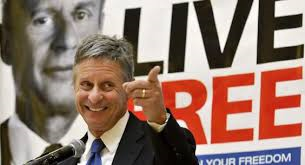
gary-johnson
Libertarian presidential candidate Gary Johnson

Make no mistake, Johnson is also a flawed candidate. But it doesn’t matter.

He cannot win.

When people think their vote really matters, they do not want to have responsibility for electing a deeply flawed leader.  But staying away from the polls in a gesture of protest is no protest at all, despite what George Will claims. It is resignation and retardation to a dishonorable past when people were prohibited from voting.

You pay taxes. Get up and vote!

If someone honestly feels strongly about voting for either Clinton or Trump, by all means, vote for that person; that’s what a free society and elections are all about.

However, if someone despises both candidates – particularly in deeply red or blue states where their vote really doesn’t matter at all – it is extremely important to lodge a protest by voting for the Libertarian party, the only party based on the principles of America’s founding fathers: liberty for all.

Voting for the Libertarian party in 2016 is the only way to simultaneously validate that your vote matters, and absolve you of the responsibility and embarrassment of electing either Clinton or Trump.

If you want change, make it happen. As a famous founding father said:

“Shall we acquire the means of effectual resistance by lying supinely on our backs and hugging the delusive phantom of hope, until our enemies shall have bound us hand and foot? Sir, we are not weak if we make a proper use of those means which the God of nature hath placed in our power.

-Patrick Henry (1736-1799)


Related First.One.Through articles:

Political Pinatas: Populist Greed Meets Populist Anger

If You Want to Take Money out of Politics, Liberal Leaders Suggest Voting for Trump

Michael Bloomberg Talks to America about Marrying a Prostitute

Subscribe YouTube channel: FirstOneThrough

Join Facebook group: FirstOne Through  Israel Analysis

Goodbye Moon

After ten years, the United Nations is finally saying goodbye to its leader, Secretary General Ban Ki Moon.  Good riddance.

goobye-moon3

Ban Ki Moon’s tenure as head of the United Nations was riddled with failures. Over the past ten years, he:

  • oversaw the spread of terrorism globally, including ISIS, al-Shabab, Boko Haram, Al Nusra and Ansar al-Dine to name a few
  • watched civil wars consume countries and claim over half a million lives in countries including Syria and Yemen
  • observed a new state join the UN, South Sudan, only to quickly become a failed state
  • ran an organization with billions of dollars in corruption and kickbacks
  • did nothing as the UN Human Rights Council only singled out Israel at every turn
  • encouraged the Palestinian Authority to be recognized as a state by UNESCO, skipping key terms of agreements between Israelis and Palestinian Arabs
  • promoted the terrorist group Hamas to become part of a united Palestinian government
  • presided over a United Nations force that was accused of raping the very civilians they were supposed to protect
  • oversaw the largest refugee crisis since WWII swarm over Europe, as his failures led millions of people to flee the Middle East and North Africa region

Ban Ki Moon’s disgraceful tenure as head of the United Nations may not be completely his fault. The UN has been an anti-Semitic corrupt organization for several decades, dating back at least to Kurt Waldheim, a former Nazi who led the UN from 1972 to 1982, when the UN passed the “Zionism is racism” resolution.  Maybe Ban Ki Moon was trying to keep up.

On October 6, 2016, the UN General Assembly was presented with Former Portuguese Prime Minister Antonio Guterres as the new UNSG.  For the past ten years, he headed the UNHCR refugee agency.  One hopes that he understands the difference between actual refugees and SAPs, and can lead the world in a new peaceful direction.

It would be a welcome change.


Related First.One.Through articles:

Ban Ki Moon Stands with Gaza

Ban Ki Moon Has No Solidarity with Israel

The United Nations’ Ban Ki Moon Exposes Israeli Civilians

The United Nation’s Ban Ki Moon is Unqualified to Discuss the Question of Palestine

What’s “Outrageous” for the United Nations

UN Comments on the Murder of Innocents: Henkins

The UN Fails on its Own Measures to address the Conditions Conducive to the Spread of Terrorism

The UN is Watering the Seeds of Anti-Jewish Hate Speech for Future Massacres

The Only Religious Extremists for the United Nations are “Jewish Extremists”

The United Nations’ Adoption of Palestinians, Enables It to Only Find Fault With Israel

The UN Can’t Support Israel’s Fight on Terrorism since it Considers Israel the Terrorists

UN Comments on the Murder of Innocents: Itamar and Duma

UN Concern is only for Violence in “Occupied Palestinian Territory,” not Israel

The United Nations “Provocation”

UN Press Corps Expunges Israel

Subscribe YouTube channel: FirstOneThrough

Join Facebook group: FirstOne Through  Israel Analysis

The New York Times Op-Ed on Jews and the Oslo Accords, 1993

Almost 23 years after the Oslo Peace Accord was signed in September 1993, one of its architects and champions, Israeli statesman Shimon Peres, died at 93 years old in Jerusalem, Israel. As detailed in “Every Picture Tells a Story: Goodbye Peres,” the New York Times chose not to honor the Israeli leader, even as the paper repeatedly calls for a two-state solution for the Israeli-Arab Conflict.

So consider the NYT Op-Ed back on September 17, 1993, just after the Accords were signed and the major opinion makers weighed in on the agreement.

20160922_211852
New York Times Op-Ed
September 17, 1993

A.M. Rosenthal (1922-2006)
Winner of the Pulitzer Prize

A.M. Rosenthal wrote about the ‘Holocaust Syndrome“, where he lamented the pessimism coming from “Jews, Israeli and American” about the ultimate outcome of the Oslo agreement. Rosenthal was sad that it was becoming fashionable for Jews to echo sentiments that were most typically heard from Israel’s enemies.

The “Holocaust Theory” advanced a notion from “deep pessimism, fear and defensiveness arising out of the Holocaust. No matter how strong the country [Israel]became, they trusted no one, relied only on arms, saw themselves perpetually as victims who had to act defensively instead of a free people determining their own destiny.”

To believe the Holocaust syndrome theory is to believe what Israel’s worst enemies say – that it was Israelis who brought a half-century of war between Jew and Arab.”

Rosenthal dismissed that idea completely. He reviewed the history that those “shtetl Jews were ready to share Palestine with Arabs from the beginning. The Arabs refused,” and launched pogroms and wars both from within Israel and without to destroy the Jewish State. Rosenthal had no patience for Jews that were cynical about the chance for peace:

There is a mental malady that afflicts Israelis and other Jews but it is not the Holocaust syndrome. It is the tendency to confuse hope for the future with present reality….Israelis are not catatonically traumatized, curled up in a defensive ball seeing enemies everywhere. They can get up in the morning, work, raise families, make love, make peace or war, distinguish friend from foe and how to deal with each.”

“Pray for peace but add another prayer for truth upon which it depends.

Amazing words that resonate today as much as they did when they were written.

Anthony Lewis (1927-2013)
Two-time winner of the Pulitzer Prize

Anthony Lewis’s post was called “The Crux of the Deal,” and was optimistic about Oslo.  He believed that each party’s self-interest would compel the parties forward.

For Palestinian Arabs, Lewis wrote that Arabs preventing terrorism would lead eventually to “establishing a Palestinian state.”  Lewis was too optimistic.

The years after the 1993 Oslo Accords were followed by hundreds of terrorist attacks by Palestinian Arabs, and by the end of the interim Oslo II Accords in 2000, Yasir Arafat (fungus be upon him) rejected the contours of the Palestinian state and launched another war against Israel.

Lewis missed another point: that the Arab-Israel Conflict was key to stability in the Middle East.

Lewis wrote: “Success would be a key to reducing tensions in the entire Middle East, and reducing the threat of the two radical states that have denounced the agreement: Iran and Iraq.” Lewis could not foresee America’s toppling of Iraq – and then abandoning it – and the turmoil that would pour out of Syria, Yemen, Sudan and Libya.

The cause-and-effect theories of Lewis 23 years ago proved completely wrong:

  • Israel has been able to prosper despite regional turmoil. It has done so by focusing on building businesses and technology surrounded by its strong defenses
  • It was Palestinian leaders self-interest that has dictated events and marred the prospects of peace, as they enriched themselves, maintained their “lofty” titles and avoided confrontations with fellow Arabs in the cause of peace

Self-interest may indeed be a motivator for all players in the region.  However, it would appear that Lewis was too optimistic about Palestinian Arab leadership caring more about their constituents than themselves.

Alexander Schindler (1925-2000)
Leader of the Reform Judaism Movement

Alexander Schindler described himself as “an unreconstructed dove,” in his editorial “Memo to a Hawk.” He relayed how he was worried about Likud leader Menahem Begin coming to power in 1977 and what he would do to the chances of peace.  But Schindler gave Begin a chance “and he did not disappoint.”  Schindler urged politically conservative Jews to give Yitzhak Rabin and the Oslo Accord that same chance.

Schindler argued that that moment in history – 1993 – was the best time to advance peace in the region:

“It is now that the American Government’s role as guarantor of the peace is unaffected by cold war concerns. It is now that the Arab powers understand that the real threat they face is not the steady achievements of Zionism but the rampaging golem of Islamic fundamentalism. It is now that the influx of Jews to Israel from the former Soviet Union has upset the demographic contest the Palestinians had expected to win.”

Schindler gets an interesting score on predicting the future.

  • Total Miss: In 2016, the cold war is very much alive and affecting the region, as Russia takes an active role in Syria, with missiles and migrants flowing out of the region unabated.
  • Spot on: Many people did not appreciate the threat of the “rampaging golem of Islamic fundamentalism” until 9/11/2001, but Schindler did.
  • Mixed: the demographic time bomb that Yasir Arafat hoped to use to conquer Israel is still believed in some corners, and dismissed in others.

The dreamer of peace believed in the peace process, and understood the threat of Islamic fundamentalism.  However he never considered his logic that Islamic fundamentalism existed everywhere else in the Middle East except among Palestinian Arabs.


In 2016, on the eve of the Jewish New Year, world leaders came to pay their respects to a leader of the Israeli people, and a man devoted to the Oslo peace process.  As people consider Peres’s legacy over the past 70 years in public service and his persistent optimism that peace would come to the region, review the caution and optimism at the dawn of the peace process launched in Oslo, and where we are today.

For the New York Times, the lack of peace between Israel and Palestinian Arabs has nothing to do with Islamic fundamentalism, the cold war, the influx of Russian Jews, the corrupt Palestinian Arab leadership or the civil wars raging in the region. For the Times and many liberal Jews, it continues to be a hawkish Israeli government that continues to repeat the “Holocaust Syndrome.”

Perhaps it is time for everyone to re-read the prescient words and warning of A.M. Rosenthal: beware the “mental malady that afflicts Israelis and other Jews but it is not the Holocaust syndrome. It is the tendency to confuse hope for the future with present reality….Pray for peace but add another prayer for truth upon which it depends.


Related First.One.Through articles:

An Inconvenient Truth: Palestinian Polls

The Israeli Peace Process versus the Palestinian Divorce Proceedings

The Only Precondition for MidEast Peace Talks

“Peace” According to Palestinian “Moderates”

Subscribe YouTube channel: FirstOneThrough

Join Facebook group: FirstOne Through  Israel Analysis


Every Picture Tells a Story: Goodbye Peres

The “Every Picture Tells a Story” series has exposed the long history of the New York Times in using its pictures and captions to portray Israelis as militant occupiers and Palestinian Arabs as victims.  However, one would imagine that the paper would rally behind one of its heroes: the liberal Israeli statesman and winner of the Nobel Peace Prize, Shimon Peres. But at the funeral of Peres, the Times once again dismissed the Israeli leader and promoted the Palestinian Arabs.

Consider first the coverage by the conservative newspaper the Wall Street Journal:

20161001_194726
Cover of the Wall Street Journal, Saturday October 1, 2016

The top half of the front page contained three pictures from the funeral of Shimon Peres, two of which portrayed the Israeli flag-draped coffin of the esteemed leader. The pictures were of: the honor guard carrying the coffin of Peres; Israeli Prime Minister shaking hands and welcoming acting-President of the Palestinian Authority Mahmoud Abbas; and US President Barack Obama with a somber expression placing his hand on the coffin.

The caption of the picture read:

HONORED: Members of a Knesset guard carry the flag-draped coffin of the late Israeli statesman Shimon Peres; Israel Prime Minister Benjamin Netanyahu greets Palestinian Authority President Mahmoud Abbas; and President Barack Obama takes a moment.”

The Wall Street Journal led with the word “honored” of the “late Israeli statesman.” It showed world leaders like Obama and Netanyahu considering the Israeli leader. It led the entire collage with a bold header “World Leaders Say Farewell to Israel’s ‘Biggest Dreamer.‘”

A respectful farewell by the paper indeed.

Contrast that with the New York Times picture and caption.

20161001_194737
Cover page of New York Times October 1, 2016

On the bottom half of the front page was a single picture. It featured no Israeli flags. It did have Israeli Prime Minister Netanyahu or US President Obama.

It featured Mahmoud Abbas, front-and-center.

The caption read:

“Mahmoud Abbas, the Palestinian president, center, at the funeral of Shimon Peres on Friday.”

Not only did the caption pay no homage to Peres, it focused squarely on “the Palestinian president.”  But there is no country of Palestine recognized by the United States or Israel. Abbas is simply the acting-President of the Palestinian Authority, whose term expired close to eight years ago.

The title of the article stated: “World Leaders Gather to Mourn Peres, and Possibly His Dream.” Is a reader to infer that Abbas is a world leader? That he’s the president of a country? That Peres ended life as a failure?

It is both remarkable and frightening that a paper that theoretically loved the liberal Israeli leader, would opt to belittle him as their eulogy.

Or perhaps this was yet another declaration of the NYT, that the Jewish State never deserves a tribute.


Related First.One.Through articles:

Every Picture Tells a Story, the Bibi Monster

Every Picture Tells a Story: Versions of Reality

Every Picture Tells A Story: Only Palestinians are Victims

Every Picture Tells a Story: The Invisible Murdered Israelis

Every Picture Tells a Story: Arab Injuries over Jewish Deaths

Every Picture Tells a Story- Whitewashing the World (except Israel)

New York Times’ Lost Pictures and Morality for the Year 2015

Every Picture Tells a Story, Don’t It?

Subscribe YouTube channel: FirstOneThrough

Join Facebook group: FirstOne Through  Israel Analysis