The Polite Jihadist

Zahra Billoo of CAIR once warned American Muslims to beware of “polite Zionists.” People who show up at interfaith events, bake challah with their neighbors, and fight for civil rights—but who, she insists, cannot be trusted because they believe Jews have a right to live and pray in their ancestral homeland. That was her definition of danger: Jews who smile, volunteer, and advocate for coexistence, but who also believe Israel has a right to exist. They are your “enemies.”

It was an extraordinary moment of inversion. The Jewish community—disproportionately involved in interfaith coalitions, civil-rights causes, racial-justice marches, refugee aid, and social-service work—was cast as a threat not for what it does, but for what it believes: that Jews, like any people, have the right to be sovereign in their own homeland. Billoo called that racism. And too many institutions nodded politely.

So it is fair to ask: Do Jews have to be wary of “polite jihadists”?

Smiling Zohran Mamdani

We are told by Muslim groups to fear polite Zionists, yet tiptoe around the reality of polite jihadists—individuals who wrap hard supremacist doctrines in soft rhetoric and a smile. People who reject violence in press releases but openly support ideologies that cast non-Muslims as infidels; who promote frameworks in which Jews and Christians may live only as tolerated second-class subjects (dhimmis) under Islamic rule; who embrace the idea that Islam should dominate the world, politically and spiritually; who speak of “justice,” but envision a future in which non-Muslims are either subordinate or erased.

These are not fringe concepts. They are hardwired into the foundational texts and invoked by extremists to justify their worldview. And while many American Muslims reject them entirely, groups like CAIR have repeatedly platformed leaders who traffic in these supremacist ideas—even while presenting themselves as civil-rights organizations.

If believing that Jews should be allowed to pray at their holiest site is “racist,” what is believing that Jews must never pray there at all?
If supporting Jewish sovereignty is “extremism,” what is supporting an ideology that grants Jews survival only as second-class subjects?

America has a long-standing standard for hate groups: organizations that demonize entire populations, promote supremacist ideologies, or justify violence or domination over others. The KKK fell into that category because it portrayed African Americans, Jews, and Catholics as existential threats who must be controlled, excluded, or eliminated.

What, then, do we do with organizations whose leaders insist that Jews who support Israel are untrustworthy; who describe the world in terms of Muslim purity versus Zionist contamination; who excuse jihadist violence as “resistance”; who call Jewish self-determination a racist ideology; who propagate doctrines in which non-Muslims must accept inferiority or die?

Is that not the definition of a hate ideology?

The United States is finally on the cusp of declaring the Muslim Brotherhood a terrorist group. It is long overdue, an action which many Muslim-majority countries have taken.

But what about CAIR?

CAIR is invited into coalitions, corporate trainings, universities, government initiatives, and interfaith events—despite leadership that routinely defames Jews and normalizes Islamist supremacy. If the KKK wrapped itself in the language of “civil rights,” it would still be disqualified. Supremacy does not become acceptable because it quotes scripture or wears a suit.

The polite jihadist is far more dangerous than the polite Zionist—because one seeks coexistence, while the other seeks dominance.

America needs to stop pretending it cannot tell the difference.

I am a Zionist. A Deep Zionist. An Amazed Zionist. A Loud Zionist.

I am a Zionist through and through, on level after level.


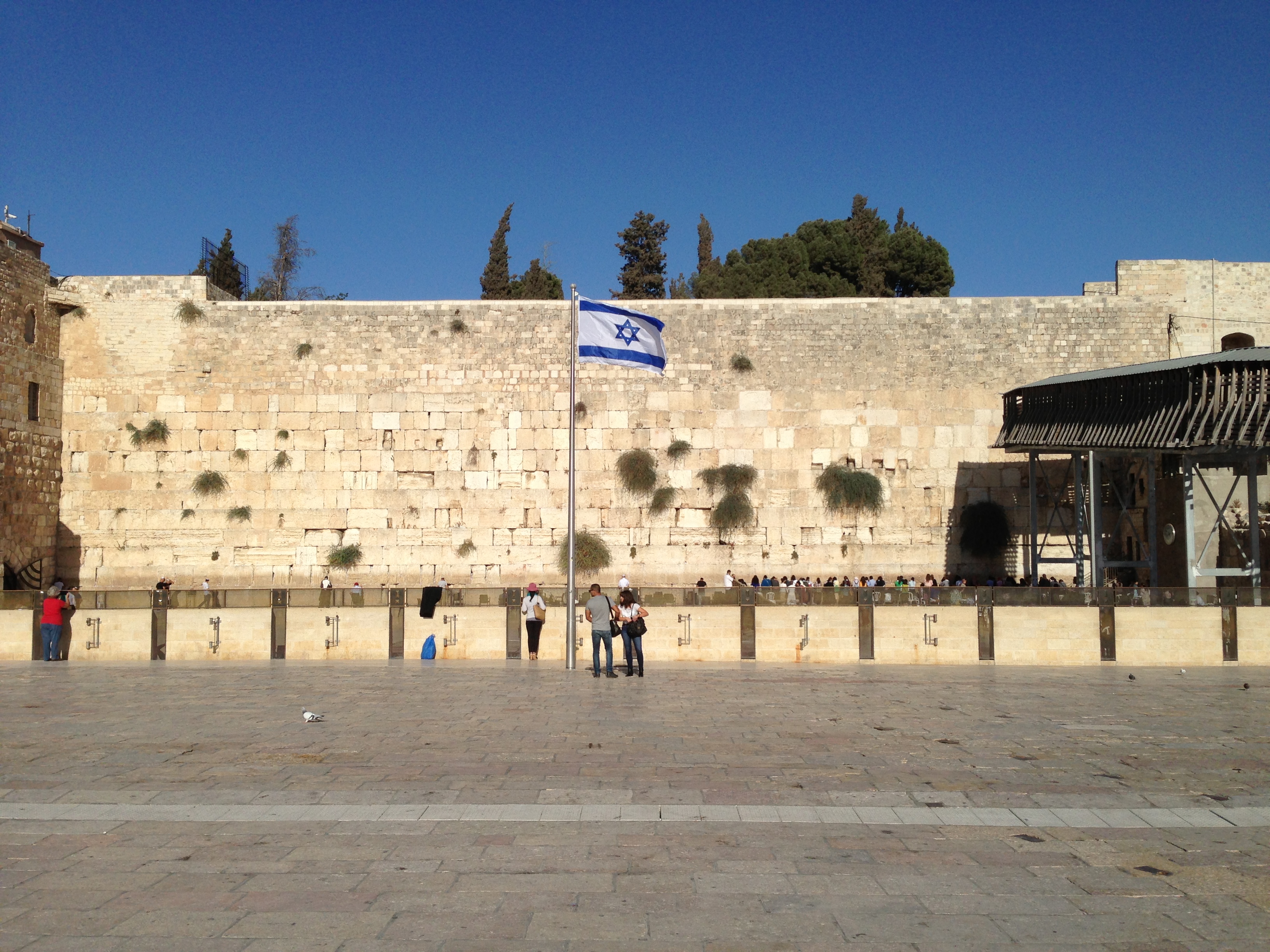
The Israeli flag at the Western Wall
(photo: First.One.Through)

I am a Zionist because I believe that the Jewish people have a right to self-determination in their homeland.

I am a deep Zionist because I know that no other religion has a connection to land like Jews. Only the Jews believe that God gave them a small parcel of land for an inheritance. The Jewish religion is the only religion that has distinct laws that can only be kept while in the Jewish holy land. The Jews invented the very notion of “holy land,” and have prayed facing Jerusalem for thousands of years.


A sign in Israel about the biblical commandment of Shmita
(photo: First.One.Through)

I am an amazed Zionist because I marvel at what the Jewish people have been able to do in just a few decades: to absorb millions of immigrants; to fend off hostile neighbors; to develop a thriving democracy; to lead the world in science and technology; and in efforts to forge a new era of peace, forgave a nation (Germany) that tried to eradicate them, and handed over their holiest location (the Jewish Temple Mount) to a hostile people that had banned Jews from even visiting the site.

I am an aggressive Zionist because I have internalized the history of Jews in their holy land. I have seen the Arab and Muslim world reject the very existence of the Jewish State and war against it repeatedly. I have read the polls that the Palestinians are the most anti-Semitic people in the world, that voted for the Hamas terrorist group to a majority of their parliament with the most vile anti-Semitic charter ever written, and that elected a Holocaust denier as a president that pays people to murder Israeli Jews and then celebrates their “accomplishments.”

I am a loud Zionist because I see how many people ignore and distort reality. How the United Nations can pass resolutions that ignore the 4000-year history of Jews in Israel, how universities and organizations apply unique and double standards for Israel and call out to boycott and strangle the only Jewish country.

I am a real world Zionist. I understand that Israel – like every country in the world – is not perfect. But I accept its imperfections and try to help it make improvements by working WITH the country, not against it.

I am an optimistic Zionist. I believe that countries and companies from around the world will be drawn to Israel’s intellectual capital, strong economy and stable currency that are built on the rule of established laws. The virtuous cycle of investment and trade will lead to stronger and stronger political relations and widespread peace.

I am an eternal Zionist. I have been one since before I was born and will remain one long after I’m gone.


Related First.One.Through articles:

The Arguments over Jerusalem

Israel: Security in a Small Country

Related First.One.Through videos:

God is a Zionist (music by Joan Osbourne)

Israel’s anthem is Hope (music by Enya)

Subscribe YouTube channel: FirstOneThrough

Join Facebook group: FirstOne Through Israel Analysis

The Journeys of Abraham and Ownership of the Holy Land

One of the most famous cartographers in the world was Abraham Ortelius (1527-1598). Appointed as cartographer to King Phillip II of Spain, the religious Christian Flemish cartographer is credited with creating the first world atlas called “Theatrum Orbis Terrarum” or “Theatre of the World.” The atlas was originally printed in 1570 and became one of the most popular books of its time and resulted in a few printings. In total, there were 178 plates amounting to approximately 730,000 printed copies of the various maps.

In addition to the maps printed in the atlas, Ortelius also produced “Parergon” maps of interesting places. These “classical” maps were produced by Ortelius himself, as opposed to some maps in “Theatrum” which were adopted from other cartographers. The 56 such plates produced roughly 143,000 printed maps.

One of the maps of the Parergon was called “Abrahami Patriarchae” which chronicled the life of the biblical patriarch Abraham. The first map was printed between 1590 and 1595 (975 copies made) with a second plate produced 1592-1624 (2925 copies made). The map shows the journey and life of Abraham with an inset map of his journey from Ur to Canaan, as well as 22 medallions of significant life events. The map highlights Ortelius’s gift as cartographer, artist and historian.

Ortelius
Abrahami Patriarchae Peregrinatio et vitae, 1592

Some notable medallions in the map are detailed below which underscore the belief that God gave Jews the holy land:

  • Medallion 6. Genesis 13: 14-15 “The Lord said to Abram after Lot had parted from him, “Look around from where you are, to the north and south, to the east and west. 15 All the land that you see I will give to you and your offspring forever.”
  • Medallion 10. Genesis 15: 17-21 “17 When the sun had set and darkness had fallen, a smoking firepot with a blazing torch appeared and passed between the pieces. 18 On that day the Lord made a covenant with Abram and said, “To your descendants I give this land, from the Wadi of Egypt to the great river, the Euphrates— 19 the land of the Kenites, Kenizzites, Kadmonites, 20 Hittites, Perizzites, Rephaites, 21 Amorites, Canaanites, Girgashites and Jebusites.”
  • Medallion 12. Genesis 17:3-8 “Abram fell facedown, and God said to him, “As for me, this is my covenant with you: You will be the father of many nations. No longer will you be called Abram; your name will be Abraham, for I have made you a father of many nations. I will make you very fruitful; I will make nations of you, and kings will come from you. I will establish my covenant as an everlasting covenant between me and you and your descendants after you for the generations to come, to be your God and the God of your descendants after you. The whole land of Canaan, where you now reside as a foreigner, I will give as an everlasting possession to you and your descendants after you; and I will be their God.
  • Medallion 18. Genesis 21: 27-31 (ownership of Beersheba) “27 So Abraham brought sheep and cattle and gave them to Abimelek, and the two men made a treaty. 28 Abraham set apart seven ewe lambs from the flock, 29 and Abimelek asked Abraham, “What is the meaning of these seven ewe lambs you have set apart by themselves?” 30 He replied, “Accept these seven lambs from my hand as a witness that I dug this well.” 31 So that place was called Beersheba, because the two men swore an oath there.
  • Medallion 20. Genesis 23: 19-20 (ownership of Hebron) 19 Afterward Abraham buried his wife Sarah in the cave in the field of Machpelah near Mamre (which is at Hebron) in the land of Canaan. 20 So the field and the cave in it were deeded to Abraham by the Hittites as a burial site.”

This map was made by a religious Christian, not a Jew. Many evangelical Christians and others that believe in the Old Testament firmly hold that while the holy land may be holy to all of the monotheistic faiths, the land itself is God’s gift to Jews. Indeed, God is the original Zionist.