The Two Witnesses of Vayelech

In Vayelech, as Moses nears the end of his life, he does not leave the Israelites with swords, maps, or battle plans.
He leaves them two witnesses.

“…so that this song may be for Me a witness against the children of Israel.” (Deut. 31:19)

“Take this Book of the Torah… and place it beside the Ark… and it shall be there as a witness against you.” (Deut. 31:26)

Two witnesses. One to sing. One to see.

The Private Witness: A Song to Internalize

The first witness is the Song of Moses.
It is not carved in stone or locked in a chest.
It is taught to the people, meant to be recited, memorized, carried in the heart and on the lips.

A song reaches places that statutes cannot.
It does not merely command; it shapes the soul.
It reminds each individual of the covenant — in good times and in hardship — and demands that a person take responsibility for his or her own faithfulness.

This witness lives in the quiet spaces of life, where no physical judge or priest is watching.
It whispers: “You know what is right. Act accordingly.”

The Public Witness: A Testament to See

The second witness is the Torah scroll.
It is set beside the Ark, in the very center of the national camp.
It is the visible, enduring reference point — the community’s constitution.

While the song stirs the conscience, the scroll sets the standard.
It unites the people under a single covenantal banner, a guide to which the entire nation can point and say:
“This is who we are. This is what we have pledged together.”

Two Responsibilities, One Blessing

Vayelech teaches that the covenant’s blessing flows only when both witnesses are honored:

  • The private witness — internalizing the principle, carrying it daily.
  • The public witness — keeping the community anchored to the same course.

A society that prizes the public witness alone risks becoming a hollow bureaucracy.
A society that trusts only the private witness descends into scattered individualism.

Blessing comes from both: each person singing the song of covenantal responsibility,
and all together respecting the scroll that binds the nation.

The Enduring Lesson — and a Voice from Rabbi Sacks

Rabbi Lord Jonathan Sacks captured this dual dimension of covenant beautifully:

“Covenant is more than law. It is law internalized, turned into song.
We need the public voice of law and the private voice of conscience, for only together do they sustain a free society.”
— Rabbi Lord Jonathan Sacks, Covenant & Conversation: Deuteronomy, Parashat Vayelech (2008)

On the eve of entering the Land, Moses anchored Israel’s future not in military tactics but in responsibility.
The first step toward national blessing was not conquest but character — personal and collective.

The Song calls us to self-discipline.
The Scroll calls us to shared fidelity.

When we heed both — the witness in the heart and the witness before the eyes — we walk the road of blessing.
Ignore either, and the covenant frays.

That is the enduring message of Vayelech: A people’s future depends on individuals taking responsibility for themselves and on the community staying the course together.
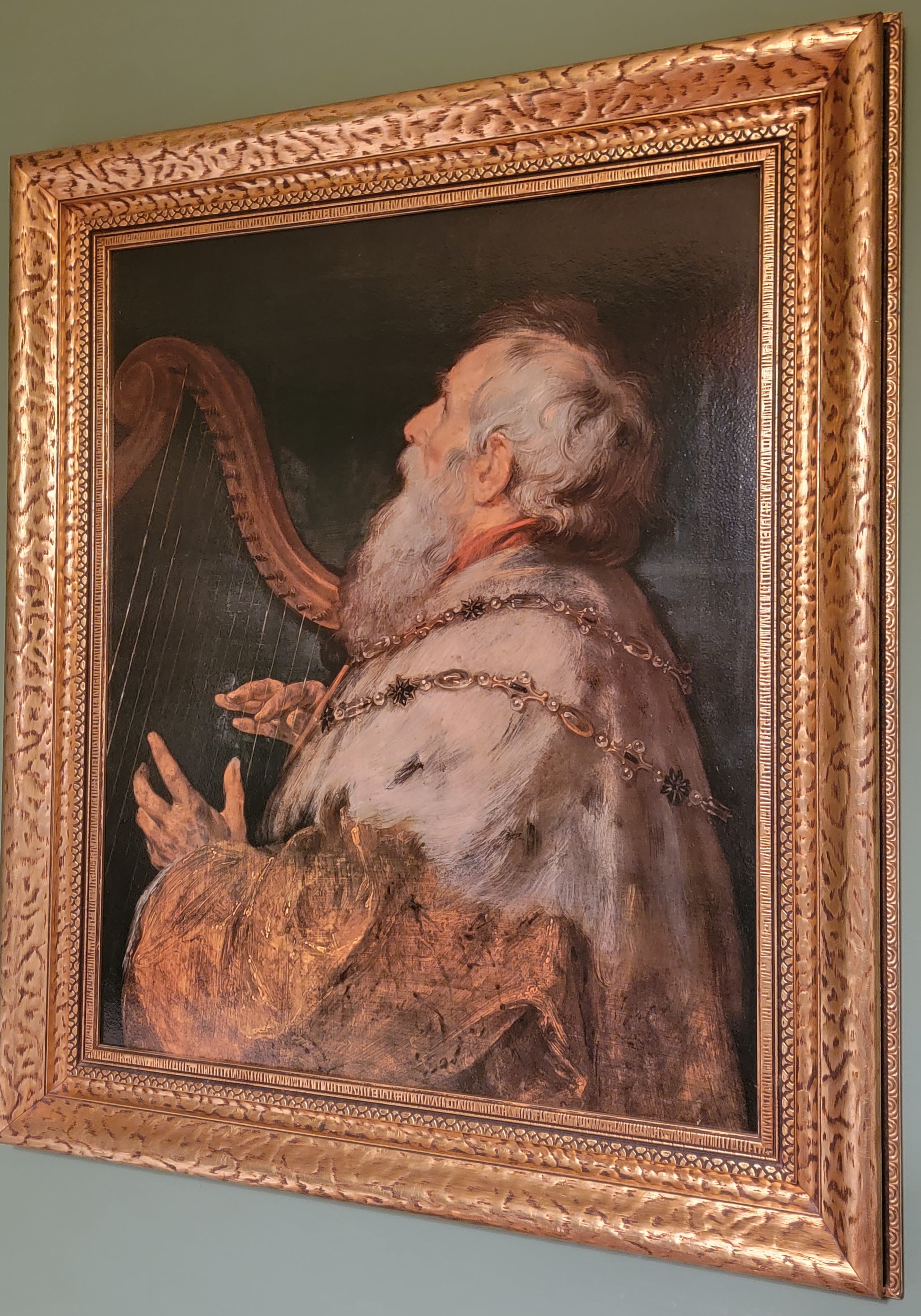
Peter Paul Rubens (1577 – 1640), “King David Playing the harp”

Ki Tavo: From Wandering to Rooted

When the Torah commands the farmer to bring his first fruits, it does not let him talk about his soil or his labor. Instead, the ritual begins: “My father was a wandering Aramean…” (Deuteronomy 26:5) The commentators note that gratitude is not complete without memory. To thank God for the harvest, one must first recall that the Jewish story began in exile and slavery. Only against that backdrop does the basket of figs become miraculous.

Later in the same parsha (Deuteronomy 28:4), the Torah turns to blessings and curses. If Israel listens to God, “Blessed shall be the fruit of your womb, the fruit of your soil, and the fruit of your livestock.” If not, those very fruits will wither. Here too, fruit is not agricultural output — it is covenantal currency.

Put together, the two passages form a cycle. The first fruits ceremony roots gratitude in memory: remember that you were once landless and fruitless. The blessings and curses tie the future of fertility to obedience: remember that your continued abundance is not guaranteed.

And notice where this all happens: Jerusalem. The farmer did not simply thank God in his vineyard or whisper gratitude in his kitchen. He carried his produce up to the city, presented it at the Temple, and declared his history publicly. Jerusalem was not just a capital; it was the beating heart of Jewish memory and faith. The fruits gained meaning when they were placed before God in the city chosen for His name.

The Old City of Jerusalem including the Jewish Temple Mount

This is why the prophets, the rabbis, and Jewish history itself encircle Jerusalem. The city is not peripheral to Judaism — it is central. It is where private labor becomes national testimony, where agriculture becomes covenant, where the wandering Jew becomes rooted in a people’s eternal home.

To this very day, Jews sing at their wedding the verses of Psalms 137:5-6: “If I forget you, O Jerusalem, let my right hand wither; let my tongue stick to my palate if I cease to think of you, if I do not keep Jerusalem in memory even at my happiest hour.” Jerusalem is bound in memory, that same memory that reminds us of our history, our promise, our obligations.

Today, too, the Jewish people encircle Jerusalem. Jews bring their “first fruits” to the city not only in the form of produce, but through aliyah, prayer, innovation, and sovereignty. Just as in ancient days, the city transforms personal blessings into collective covenant.

And yet, the world still questions that rootedness. Governments refuse to recognize Jerusalem as Israel’s capital. Diplomats condemn the building of homes in areas like E1 — the very corridor that links Jerusalem to the rest of the land, enabling Jews from north, south, east, and west to come to their eternal city.

Ki Tavo reminds us that Jerusalem cannot be negotiable. To encircle it, to build in it and around it, is not a matter of politics but of foundational principle. Without Jerusalem at the center, our fruits risk becoming mere produce, and the people risk becoming wanderers once more.

Elevation From God’s Gifts

Let us go up at once and possess it, for we are certainly able to overcome it.”
Calev ben Jephunneh, Numbers 13:30

With these words, Calev silenced the people who had just heard a fearful and pessimistic report from the other spies about the Promised Land. Ten of the twelve tribal representatives had returned from their tour of the Promised Land with tales of giants, fortified cities, and certain defeat. But Calev stepped forward — not merely with courage, but with conviction. “Let us go up at once,” he said. His words were not rash; they were rooted in faith.

Calev’s words “a’lo na‘aleh” were directional with spiritual intent. He was ready to ascend — not just to a higher elevation from the low points of the Jordan Valley, but to a higher calling. He didn’t deny the physical challenges highlighted by his fellow leaders, but he refused to let it override the spiritual promise of God’s gift.

God later singles out Calev, saying:

“But My servant Calev, because he had a different spirit with him and followed Me fully, I will bring him into the land to which he came, and his descendants shall inherit it.”
Numbers 14:24

A different spirit. God didn’t simply praise Calev’s bravery or loyalty. He pointed to Calev’s spirit — a divine quality within him that was distinct from the others. The Hebrew “ruach acheret,” suggests that Calev’s soul orientation was unique. It wasn’t just that he had faith — it’s that his spirit was attuned to God’s gifts and was willing to challenge the majority. That spirit led his body, not the other way around.

The contrast with Korach in a later story could not be starker. Korach, who led a rebellion against Moses and Aaron, was driven by status, jealousy, and material concerns. The Torah notes that “the earth opened its mouth and swallowed him, his household, and all their possessions” (Numbers 16:32). His physical attachments — both metaphorically and literally — dragged him into the ground.

In Judaism, man is not a duality of body versus spirit. The two are in dialogue, and one always leads. When the spirit leads and is drawn toward God’s gifts, it lifts the body with it. When the spirit is enticed by the physical, the body becomes dominant — and man falls.

God gave the Jewish people two primary gifts: the Land of Israel and the Torah — one is sanctified space, the other divine wisdom. Both require spiritual alignment to appreciate and receive. That’s why moving to Israel is still called aliyah, literally “going up.” It is not a political migration but a spiritual elevation. Studying Torah is described not as absorbing information but as learning — an intellectual and moral ascent, a rising above the mundane.

This understanding helps explain one of the most paradoxical modern realities: Israel is one of the happiest countries in the world. Despite being under near-constant threat, despite global condemnation and internal conflict, Israelis report remarkably high life satisfaction. Even more remarkable, Haredi Jews — who often live below the poverty line and avoid modern comforts — report even higher levels of happiness.

Why? Because they are immersed in both of God’s gifts: the land and the Torah. They are not simply physically located in Israel; their spirits are aligned with its divine purpose. Their joy is not circumstantial — it is directional. It flows from a life where the spirit leads, where God’s gifts are not just received but cherished.

Kotel after the rain (photo: First One Through)

Calev’s legacy is not just a historical footnote. It is a call to action. It is a message to challenge the masses who want to abandon God’s gifts, and both elevate and be elevated by God’s special blessings.

Related:

The Year 2023: Entry To The Holy Land (April 2023)

The Cultural Appropriation of the Jewish ‘Promised Land’ (August 2020)

The Jewish Holy Land (May 2016)

The Journeys of Abraham and Ownership of the Holy Land (October 2015)

Jews At The Center But Not The Focus

Praying At The Jerusalem Great Synagogue

The Jerusalem Great Synagogue is one of the grandest synagogues in the world. On holidays and sabbaths, it typically has a magnificent choir which enhances prayer services. In July 2024, when Rosh Hodesh, the new month of Tamuz fell on Shabbat, the synagogue decided to have a special choir with prayers full of songs by a 50-person choir consisting of many young boys.

The Jerusalem Great Synagogue, July 2024

Shabbat Rosh Hodesh involves reading from two torah scrolls, rather than a single torah on a regular Sabbath. On this special sabbath, two men raised the torahs at the conclusion of the particular readings and sat holding the holy scrolls as Moshe Lion, the mayor of Jerusalem read the haftorah before a packed synagogue.

Before the torahs were returned to their places in the ark, the large choir came down from their podium and encircled the bima, the center of prayers in the heart of the synagogue. The two men holding the torahs rose, and the entire congregation with them, as the cantor and choir sang two special blessings, one for the government of Israel and one for the Israeli Defense Forces.

With the backdrop of the ongoing war, the choir used a variety of melodies in singing the two blessings, including Hatikvah, the Israeli national anthem, and Lu Yehi, a contemporary song of longing to arrive at the end of all wars.

For twenty minutes the choir sang the songs with the congregation’s participation. Many cried as both old and young thought about many family members who were serving in the armed forces to combat enemies in Gaza and Lebanon. Hundreds of people gathered in the centers of Israel, of Jerusalem, and of the Great Synagogue but hearts and minds were elsewhere.

A Wedding In The Jerusalem Forest

The next day a wedding was held in the Jerusalem forest. The sun was setting as the bride and groom took their places under the chuppah, the wedding canopy. Family and close friends gathered before them, watching the young couple sanctify their union.

The Jewish ritual of presenting a ring, reading the ketubah and reciting seven blessings were complete, but the happy couple was not ready to celebrate. First a friend took the microphone to recite a chapter of Psalms for the soldiers and families impacted in the current war. Everyone recited the lines responsively, and then all sang Im Eshkachech Yerushalyim, If I forget thee, Jerusalem.

The groom then crushed a glass beneath his feet, symbolizing the still unbuilt holy city of Jerusalem, before turning to hug his bride.

Groom ready to crush glass symbolizing the ongoing incompleteness of Jerusalem

Two men in a synagogue and a bride and groom under a canopy, stood at the center of attention, yet their focus was elsewhere. Thinking of young soldiers at the battlefront, hostages held in captivity and the unbuilt Temple, Jews turn their consciousness outward to the larger community beyond those present.

The focus of the Jewish gaze ultimately extends beyond line of sight.

Related articles:

Singing of Joy and Jerusalem on Foreign Land (December 2021)

Humble Faith (October 2021)