A Review Of Israel’s Judicial “Reasonableness” Decision

The media has told you how to feel about the passage of an Israeli law to remove the Supreme Court’s ability to override the government’s decisions. No outlet has taken the effort to educate its readership about the issue, opting to broadcast emotions.

Left-wing articles describe “controversial changes” by the “far-right government to weaken the judiciary” which “pushes the country toward authoritarianism,” an action which will “transform Israel’s already flawed democracy into a kind of system that no longer deserves the name.” Such sentiments can be found in NPR, Vox and The New York Times.

Right-wing articles noted that Israeli “Prime Minister Benjamin Netanyahu’s government was negotiating compromises” to the “judicial reform bill” and was “defying months of protests,” as it quoted Israeli lawmakers who celebrated that the new law “reducing the reasonableness standard shows governance.” These quotes come from Fox, The Wall Street Journal and Israel’s Arutz Sheva.

Below is an effort to inform people about the law so people can possibly arrive at their own conclusion about it, rather than follow their preferred horde, an action very much encouraged by traditional media, even as it slams social media of being the true instigator of group think in an echo chamber.

The Israeli Judiciary And British “Unreasonableness” Standard

Israel has a set of Basic Laws which includes one establishing the judiciary in 1984, 36 years after the country was founded. The Israeli courts had existed beforehand, with a significant basis of its system stemming from British law, as the region had been administered under the British Mandate from 1924 to 1948. Included within British law was the notion of “unreasonableness” as to whether legislation and regulations were compatible with constitutional rights.

In 1948, when Israel declared itself a new state, England was debating rules regulating children under fifteen years old being allowed to go to the movies on Sunday, with or without parents, an already controversial action as laws at that time generally prohibited the opening of cinemas on what was viewed as a holy day. The case of ASSOCIATED PROVINCIAL PICTURE HOUSES, LIMITED v. WEDNESBURY CORPORATION considered three main items regarding a court over-ruling a law: 1) was there authority to enact such law, especially for local courts; 2) did the governmental authority consider all relevant matters in arriving at such law; and 3) did the authority “nevertheless come to a conclusion so unreasonable that no reasonable authority could ever have come to it.”

In 1984, when Israel was passing its judicial basic law, the “Wednesbury unreasonableness” standard was equated with “irrationality,” in which a decision “is so outrageous in its defiance of logic or of accepted moral standards that no sensible person who had applied his mind to the question to be decided could have arrived at it.”

In other words, the standard set an extremely high bar for overturning a ruling which was properly considered.

Israeli Court’s “Reasonableness Standard”

Israeli courts essentially followed the “extreme unreasonableness” standard of the British system and rarely overturned laws. That began to change in the 1990s under Aharon Barak, who served as a member of the court from 1978 to 1995 and as its president from 1995 to 2006. He took a more activist approach, writing in 2002 that “the judge of a supreme court is not a mirror. He is an artist, creating the picture with his or her own hands. He is “legislating”—engaging in “judicial legislation.” Judicial creativity—judicial legislation—is natural to law itself. Law without discretion is a body without a spirit. Judicial creativity is part of legal existence. Such creativity—“judicial lawmaking”—is the task of a supreme court.”

Judges fear that public confidence in the judiciary will be affected if the public discovers the truth…. The public has the right to know that we [judges] make law and how we do it; the public should not be deceived.

Israeli Supreme Court President Aharon Barak, 2002

In a country with no constitution, an activist court had and has watered down the “extreme unreasonableness” standard to a subjective personal “reasonableness approach.” While sometimes the two methods would reach the same conclusion (a politician jailed for tax fraud should not be the Finance Minister), in many other cases, the court could and has overreached and interfered with approved legislation.

the main question is not “if,”-it is not–“do judges of the
supreme court make law”; the main question is “how.”

Israeli Supreme Court President Aharon Barak, 2002

The Controversy On “Reasonableness” Is About Values

The arguments against the Israeli court’s reasonableness standard are not new. Supreme Court Justice Noam Sohlberg wrote a lengthy article a few years ago suggesting that its usage needed moderation. Had some proposal been put forward at that time, there likely would have been no uproar about amending it back to something closer to the British extreme unreasonableness standard.

The current controversy of the Knesset’s Constitution, Law and Justice Committee move to change the situation stems from two main dynamics: Netanyahu being under criminal investigation, and the far-right nature of the today’s parliament.

There is a fear that if Netanyahu weakens the court, he will be able to escape prosecution. He will fortify his position in power with loyalists whom he buys off with feeding their passions, without an external check on his authority.

The anger about Netanyahu is exacerbated by the secular Israeli fear of the religious and nationalist blocks. Barak’s remaking of the Supreme Court was based on his liberal values which he saw in a liberal country. Two decades on, the 25th Knesset includes the Religious Zionist Party which won 14 seats and two other ultra-Orthodox parties which won 18 seats. Secular Israelis fear that the country’s values have turned more conservative, and that same court which Barak crafted to reflect liberal values in society, will now echo conservative values.

Courts are not representative bodies, and it will be a tragedy if they become representative. Courts are reflective bodies; they reflect the basic values of their system.

Israeli Supreme Court President Aharon Barak, 2002

The various protests for and against the law have much less to do with amending the provision which has long been viewed as too far-reaching for a polarized society, and about the changing composition of Israel.

Compromises And Next Steps

The Knesset passed a law on July 24 to get rid of the reasonableness doctrine, as the opposition walked out of the room screaming “shame!” and refused to vote. A natural compromise would have been to go back to the extreme unreasonableness standard which was the Israeli policy pre-Barak.

The Council of Foreign Relations wrote that the Kohelet Policy Forum, which drafted the initial version of the judicial reforms, suggested only using reasonableness for administrative rulings and not government decisions. Former MK Natan Sharansky said “I believe that on the question of human rights, the last word has to be with the judges, and on questions of policy the last word should be with the Knesset.”

The judge learns about the basic values of his or her legal system from the aggregate national experience, from the nature of the political system as a democracy, and from understanding the basic concepts of the nation.

Israeli Supreme Court President Aharon Barak, 2002

Another possible compromise could have been to have any override by the Supreme Court occur only with a super-majority opinion. There are countless other ideas which could be attempted.

A critical component of the reform is yet to come, and considers how Supreme Court judges are elected. The current system essentially allows sitting liberal judges to select their replacements, which is deeply flawed by any reasonableness standard. A credible court should have both liberal and conservative views represented and each should base their opinions on laws, not personal opinions.

Beyond the immediate judicial reforms, the brouhaha should lead all Israelis to conclude that the country must have a constitution. While Israel’s founders may have felt that the nascent state was too fragile to constrain certain actions, 75 years on, the nation is strong militarily and economically, and will be stronger socially if there are laws which represent and protect all its citizens.

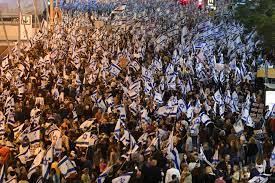
Protests about judiciary reform in Tel Aviv, March 2023

Related articles:

Israel Teaches The World About Democracy

Israel, the Liberal Country of the Middle East

It’s the Democracy, Stupid

Yeshiva University – And Modern Orthodoxy – Are Non-Binary

Israel Teaches The World About Democracy

The streets of Israel are teeming with hundreds of thousands of people protesting the proposed changes to the country’s judicial system. It is a global lesson in democracy.

An Education About The Supreme Court

The current protests are not about the price of cottage cheese (there actually was such a protest in Israel!), raising the age of retirement (as in France), or about changes to police enforcement (as in the USA), but about how the country’s Supreme Court is elected and functions. Something seemingly so nuanced and esoteric as to be beyond the interest of the masses, yet they’ve come out to protest for weeks and months to argue for compromise.

The proposed five changes are seemingly small but the impact is potentially large. As people delve into the details, they are getting a civics lesson about the checks-and-balances that maintain a healthy democracy.

Elections

The bedrock of democracy is the rights of citizens to elect their leaders. Israel is so focused on the will of its citizens, it remarkably held five elections in four years! It sounds preposterous, especially in the middle of the illiberal Middle East which has leaders for life with either no or sham elections.

Israel obviously did not do this intentionally, as governments are intended to sit for several years. However, the country’s parliamentary system enables coalition members to withdraw and thereby dissolve its majority position. In slim majority coalitions, a single upset member of parliament can bring about a collapse of the majority and calls for a new election. The Prime Minister can do little about it, other than negotiate, beg and plead to keep his coalition together.

Israeli citizens watch this theater in real time, and get to choose the next chess pieces to place on the board. It is a thoroughly engaged, active – and yes, oftentimes dysfunctional – democracy. As Winston Churchill said “No one pretends that democracy is perfect or all-wise. Indeed it has been said that democracy is the worst form of Government except for all those other forms that have been tried from time to time.”

Despite the flux and hysteria, the people of Israel voted in peace and the transition of power happened without violence.

Checks and Balances

The Kohelet Policy Forum which drafted the proposed changes to the country’s judicial process, is just as sensitive to the checks-and-balances of power as those protesting the changes. Those for and against the rules do not want any branch of the government to have unlimited control of society. An election won is not a certificate to overhaul every aspect of society and civil protection, and unelected judges chosen by unelected officials should not be able to trump laws and the government willy-nilly.

Both the protestors and those backing the judicial overhaul are debating a crucial principle of creating and maintaining a healthy society.

Majority Rule And Protection Of Minorities

The democratic process of choosing a government via elections is meant to empower the will of the majority of voters. However, it is a liberal democracy that enshrines protections of the minority through laws.

Israel has many groups who could be considered minority groups. Israeli Arab citizens number about 1.6 million and about 2 million including those with permanent residency status. There are about 160,000 Ethiopian Jews and 1.3 million ultra Orthodox Jews. They got to vote and make their concerns heard, and also count on the legal system to protect their basic rights.

Which is part of the interesting dynamic in Israel. The country does not have a constitution and relies on Basic Laws for fundamental rights and protections. People are appreciating the role of the parliament and judiciary in such a situation, and considering whether enacting a constitution would be beneficial.

Peaceful Protests

Israelis of all walks of life have made their feelings known. Professional lawyers, doctors and bankers rallied in squares. Laborers and workers blocked highways. Military personnel refused to serve. CEOs took their monies out of the country.

All peacefully.

Tens of thousands of Israelis protest against the government’s judicial overhaul moves, in Tel Aviv on March 4, 2023. (Gili Yaari/Flash90)

This is in sharp contrast to the so-called ‘Arab Spring’ protests in neighboring Arab countries.

In Egypt, 846 people were killed in protests, which saw the head of the country get thrown out and put in jail, followed by an election in which the people chose a radical Islamist, who was in short order thrown out of office by the military.

Reporters run for cover during clashes between Muslim Brotherhood supporters of Egypt’s ousted president Mohamed Morsi, and police.(photo: MOSAAB EL-SHAMY/AFP/GETTY IMAGES)

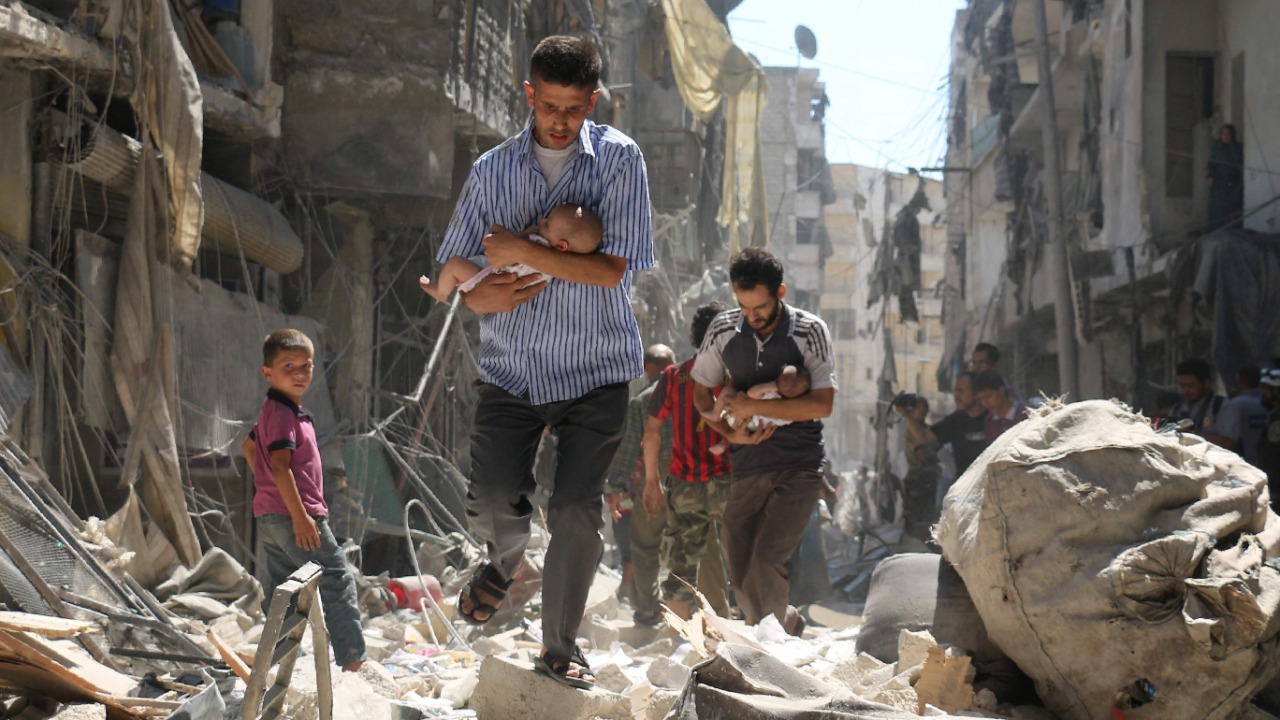
In Syria, the protests led to a brutal crackdown by its leader with over 2,500 people killed in the first months. It soon turned into a full civil war with over 500,000 killed and many millions displaced internally in Syria and as refugees abroad.

Syria men carrying babies in Aleppo, Syria in 2017 (photo: AFP)

In Yemen, 2,000 civilians were killed in the first few months of their protests, which became a proxy war between Iran and Saudi Arabia once the ruler fled the country. The estimate of the dead now stands at 150,000. It has become the world’s worst failed state.

The violence continued throughout the Arab world, including in Tunisia (estimated 338 dead), Sudan (over 200), Bahrain (120) and Saudi Arabia (24). In Libya, the United States helped the rebels kill its leader, and the resulting tumult has led to as many as 20,000 killed. The country is now a haven for terrorist groups including ISIS and al Qaeda.

In the middle of this Middle Eastern firestorm of anger and bloodshed, the Jewish State has sit ins, fighting for the rule of law while protecting and believing in it.

What can be more democratic than: open, fair and repeated elections; the smooth transition of power from one government to the next; ensuring checks-and-balances in the government; and the ability to protest peacefully to those in power?

Israel is giving a basic civics lesson to the entire world about the importance and mechanics of proper courts of justice, the seventh of the Noahide Laws. It should be proud.

Related articles:

Israel, the Liberal Country of the Middle East

Nakba 2: The Victory of a Democracy

In Israel, the Winner is… Democracy

The Baker and Government Doth Protest Too Much

Liberal’s Protest Bubble Harms Democracy

It’s the Democracy, Stupid

The Democratic Party of No Takes on the Supreme Court

There was a time when bipartisanship had a place in Washington, D.C., especially as it related to nominations to the Supreme Court.

In July 1993, Democratic President Bill Clinton nominated Ruth Bader Ginsberg to be an Associate Justice on the Supreme Court. She was approved unanimously by both the Democrats and Republicans on the Judicial Committee, even though she was – and continues to be – an extreme liberal in her rulings.

The following year in July 1994, Bill Clinton nominated Stephen Breyer to be an Associate Justice. Like Bader Ginsberg, he was approved by an 18-to-0 margin. Every Republican approved his nomination.

All of that changed a decade later under a Republican administration.

When Republican President George W. Bush nominated Stephen Roberts in September 2005 to be Chief Justice, he was only approved by a 13-to-5 margin. All ten Republicans on the committee approved him, but only three of eight Democrats approved the nomination (Patrick Leahy of Vermont; Herb Kohl of Wisconsin; and Russ Feingold of Wisconsin).

Samuel Alito’s January 2006 nomination was even more contentious. While all ten Republicans approved his nomination, none of the eight Democrats voted in favor of him. Zero percent.

The Republicans have never uniformly voted against Democratic presidential Supreme Court nominees including Sonia Sotamayor in July 2009 (6-to-1 against) and Elana Kagan in July 2010 (6-to-1 against). But the Democrats would be absolutists and do it again under Republican President Donald Trump in April 2017, with all nine Democrats opposing Neil Gorsuch.

The Democratic Party of No has promised to take a similar stance for the replacement for Justice Anthony Kennedy. Left wing-radical Senator Elizabeth Warren has been calling on Republicans to vote against an “extremist” Trump nominee. Quite a bizarre and telling comment from an extreme liberal senator and after Justice Gorsuch proved himself to be a more moderate than either Bader Ginsberg and Sotamayor.


Senator Elizabeth Warren

The Democrats have become so disoriented in the far left fringe, that even moderate Conservatives are considered unacceptable extremists. Democratic President Barack Obama noted that his party had run off the rails after the 2016 presidential loss saying that “Democrats are characterized as coastal liberal latte-sipping politically-correct out-of-touch folks.” It is not a characterization. It has become a fact.

Here are the Democratic members of the Judiciary Committee (and their GovTracks ideological score, with 0.0 being the most extreme liberal, 0.5 being a perfect moderate and 1.0 being a full conservative) who will consider the nominee to replace Justice Kennedy:

  • Diane Feinstein (0.18)
  • Patrick Leahy (0.23)
  • Dick Durbin (0.17)
  • Sheldon Whitehouse (0.19)
  • Amy Klobuchar (0.38)
  • Christopher Coons (0.39)
  • Richard Blumenthal (0.16)
  • Mazie Hirono (0.18)
  • Cory Booker (0.21)
  • Kamala Harris (0.14)

As seen above, almost all of the Democrats on the committee are extreme liberals with the exceptions of Senator Chris Coons of Delaware and Senator Amy Klobuchar of Minnesota. They are the the keys to a rationale bipartisan review of the Supreme Court nominee. Contact Senator Coons and Senator Klobuchar to let them know of your desire to have a thoughtful – not knee-jerk – review of this most important position.

“I am part of First.One.Through, a group of people dedicated to a thoughtful and honest review of issues in the hopes of bettering our society.

I am writing in regards to your role on the Judiciary Committee. Republicans have NEVER unanimously rejected a Democratic president’s nominee, while the Democrats have done that for each of the last two Republican nominees. I ask that you fight the extreme liberal wing of the Democratic Party of No and give a thoughtful hearing to the Supreme Court nominee. My sincere thanks.”


Related First.One.Through articles:

I Love 5-to-4

Magnifying the Margins, and the Rise of the Independents

Liberal’s Protest Bubble Harms Democracy

Libertarian Validation and Absolution

In The Margins

A Deplorable Definition

American Hate: The Right Targets Foreigners, The Left Targets Americans

Subscribe YouTube channel: FirstOneThrough

Join Facebook group: FirstOne Through Israel Analysis


Weddings are Religious Affairs

On December 5, 2017, the United States Supreme Court will hear a case, Masterpiece Cakeshop, Ltd. v. Colorado Civil Rights Commission.  The court will decide whether a baker has the right as a matter of religious freedom to not create a customized wedding cake for a homosexual couple, or whether turning down such clients is a matter of discrimination against gays.

Colorado baker Jack Phillips

The case will have Americans confront an issue that it has been pressing in the wrong direction for many years: the government should have NO ROLE in weddings, even while it maintains documents on marriages. The government should limit its involvement to a single legal document as to the selection of a civil partner and no more.

Judeo-Christian Society versus Freedom of Religion

American politicians have long stated that the country’s laws were based on the ethics and morals of Judeo-Christian teachings. But while American laws were established with such inspiration, a fundamental principle of American society is the separation of church and state. Nothing can be made more clear than the very first amendment in the Bill of Rights:

“Congress shall make no law respecting an establishment of religion, or prohibiting the free exercise thereof; or abridging the freedom of speech, or of the press; or the right of the people peaceably to assemble, and to petition the Government for a redress of grievances.”

The core of this amendment is that US laws cannot infringe on a person’s practice of their religion.

Religious Limits on Marriage

There are some laws found in the Bible that limit certain relationships, including bans on incest and homosexuality. For the first two centuries of America’s existence, the law of the land followed the Judeo-Christian ban on these two marriages. However, due to American society’s more accepting attitude towards homosexual relationships, the Supreme Court ruled that states could not prohibit gay marriages in June 2015. The ban on marriages between family members still remain.

The US lawsuit that brought about the legalization of marriage was filed because of American law that prevented the plaintiff, Jim Obergefell, from putting his name on the death certificate of his late husband. He was completely correct in being outraged that US law prevented him from doing so.

But our society has been making the wrong arguments in its defense of gay marriage, in advancing a bad set of arguments forcing a baker to create a cake against his religious sensibilities.

Religious Ceremonies versus Civil Documents

The US legal system uses many civil documents, including birth certificates, death certificates and marriage certificates. They are simple legal notices that must be filed to keep an appropriate record of people in the United States.

Anyone should be free to fill out these documents in a manner that fits their personal beliefs without ANY intervention by the government. That means that the government cannot object to someone naming their child Mohammed any more than two women filing a marriage certificate. (The government should also be prohibited from banning a civil union between siblings or close family members, which it still does).

Put simply, it should not be up to the government to put its Judeo-Christian founding above the principle of a separation of church and state.

In a similar vein, the government should not be able to infringe on people’s practice of religion.

Just as the government should not be allowed to ban the practice of circumcision (the Jewish custom of a bris when the boy is eight days old), it cannot interfere in a wedding ceremony.

Bris/Baptism/Wedding versus Civil Documents

There are certain life events that are religious in nature, where the participants use a priest or rabbi to officiate the ceremony. They often hold the event in a church or synagogue and invoke God’s name and recite prayers. Baptisms and weddings are such occasions.

US laws do not much care about the nature of the religious ceremony. While a priest may declare the couple to be man-and-wife, the legal system still requires a civil marriage certificate to be filed. It is that legal document that falls under the government’s purview, not the wedding itself.

Similarly, a rabbi may name a child in the synagogue at a child’s bris. But the parents must still fill out paperwork in the courts declaring the child’s legal name.

Ceremony and Party Participants

Should everyone be compelled to participate at a bris? Of course not. A photographer should not be compelled to take pictures at a bris just because she takes pictures at baptisms.

Should a baker be forced to design a custom wedding cake for homosexuals or an incestuous couple which goes against his religious beliefs? Absolutely not. It is every vendor’s right to not actively engage in a religious service to which he doesn’t subscribe.

In the case of Masterpiece Cake, the baker made clear that he would sell any ready made item in the store to any person who walked in, regardless of sexual orientation. However, Colorado law compelled him to design and create a cake against his religious beliefs. While that activity does not reach the level of a priest officiating the ceremony, it stands well above the electric company’s providing power to the event. The latter is “blind” to the religious ceremony, and the activity would be identical if the event were a convention. The baker crafts his cake for the ceremony.

Thomas Jefferson wrote in the Virginia Statute for Religious Freedom: “no man shall be compelled to frequent or support any religious worship, place, or ministry whatsoever.” The converse is just as true, that no person should be compelled to violate their religious beliefs.

To actively compel a person to engage in a religious practice – and a wedding ceremony is a religious practice – is wrong. And overturning the Masterpiece Cake Colorado ruling would have no impact on homosexual couples filing for government-approved civil unions.

It is time to clearly delineate between religious ceremonies and legal documents, and to give both gay people and those that have religious objections to gay marriage the freedoms they all deserve.


Related First.One.Through article:

The Baker and Government Doth Protest Too Much

Leading Gay Activists Hate Religious Children

Black People are Homophobic

Pride. Jewish and Gay

Subscribe YouTube channel: FirstOneThrough

Join Facebook group: FirstOne Through  Israel Analysis