Religious liberty is not complicated. It does not require panels, frameworks, or warnings about artificial intelligence. It requires clarity.
The right to choose your faith. The right to practice it as you see fit. The right to pray openly, in your way, at your holy places. The right to walk away from it—without fear, without punishment, without death.
This is not a modern reinterpretation. It is the original standard.
In 1948, in the aftermath of a world war that exposed the catastrophic consequences of state control over belief and identity, the United Nations adopted the Universal Declaration of Human Rights. At its core sat Article 18, crafted with precision that set religious freedom as a benchmark of human rights.
“Everyone has the right to freedom of thought, conscience and religion; this right includes freedom to change his religion or belief, and freedom, either alone or in community with others and in public or private, to manifest his religion or belief in teaching, practice, worship and observance.” – UN Declaration of Human Rights, Article 18
Change it. Practice it. Live it.
That was the UN at its founding: defining principles meant to bind nations, not accommodate them.
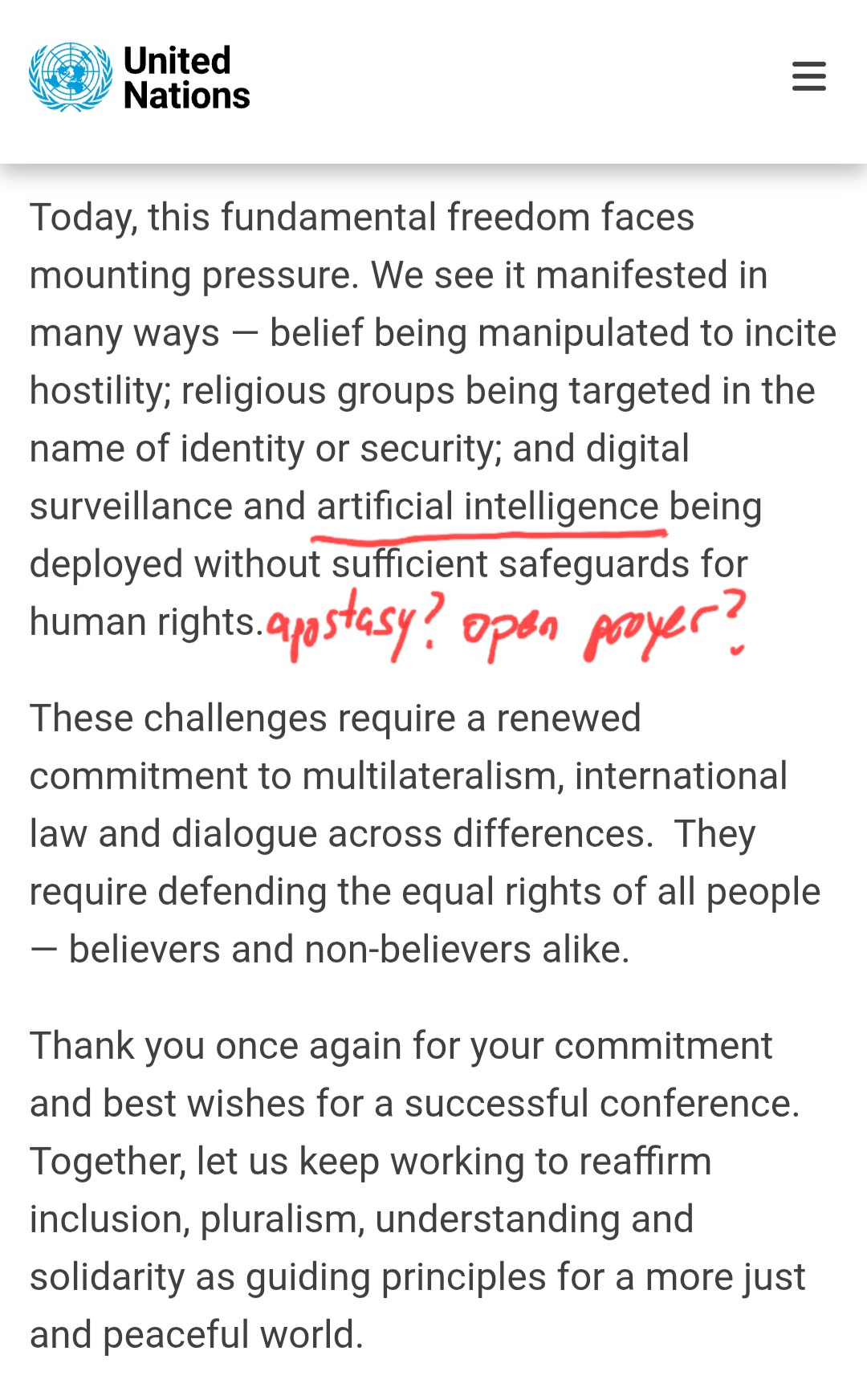
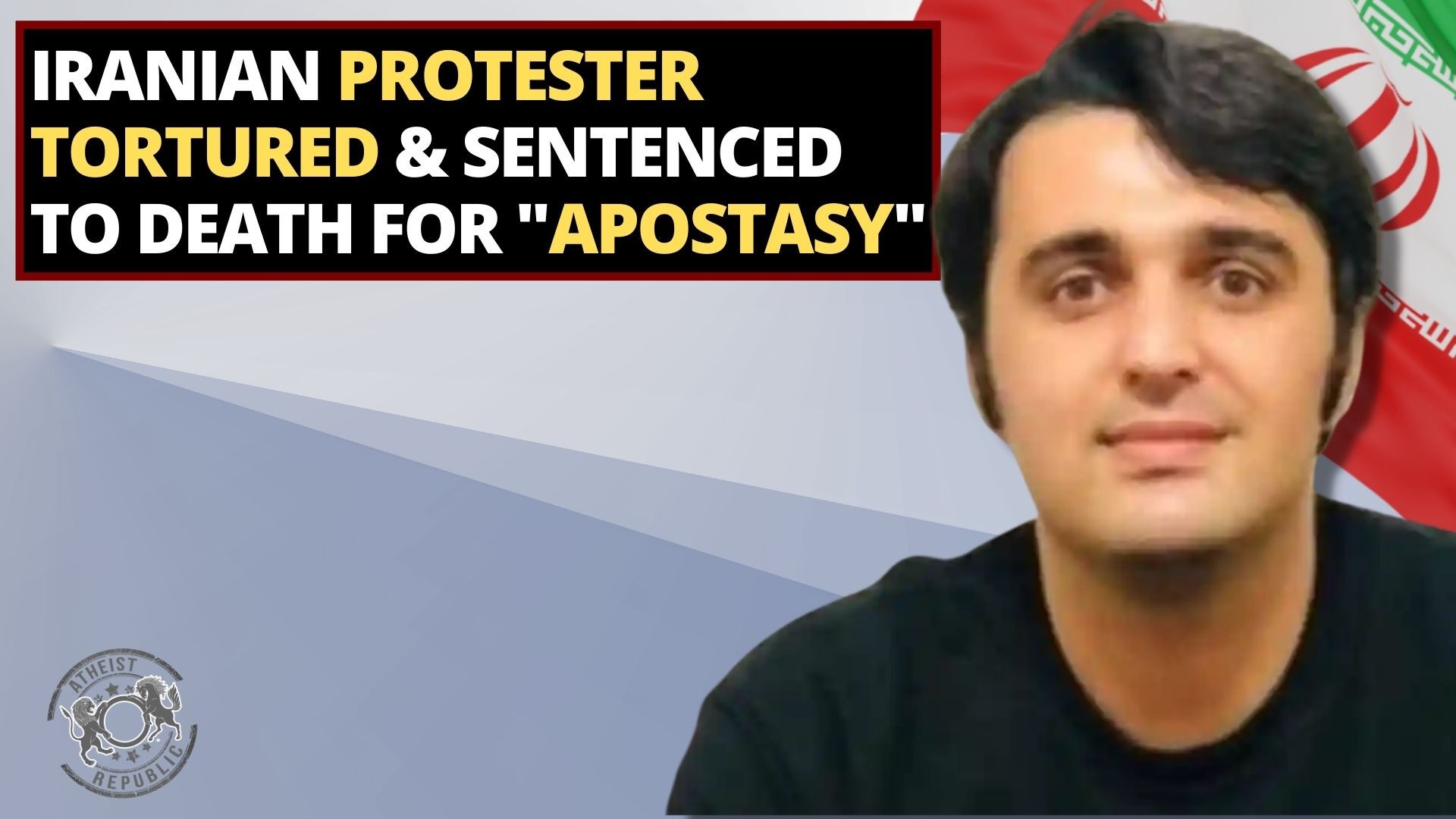
If the speech had stayed anchored to Article 18, the omissions would have been impossible to ignore: apostasy treated as a crime, in some places a capital one; the right to convert denied in law; and access to holy sites restricted where it is most visible and most contested, to Jews on the Temple Mount in Jerusalem.
These are not edge cases. They are direct contradictions of the standard set in 1948.
They went unmentioned.
The reason is not subtle. The United Nations that wrote Article 18 was asserting principle in the shadow of catastrophe. The United Nations that speaks today operates at the consent and behest of large voting blocs. Many of those blocs come from the Global South, including dozens of Muslim-majority states that reject the core of Article 18 where it matters most: the right to change religion and the expectation that religious access should be reciprocal.
Within that reality, the boundaries of acceptable language narrow.
No mention of apostasy laws. No mention of capital punishment for conversion. No mention of restricted prayer where it cuts closest to the principle.
So the language adapts. The sharp edges of Article 18 are rounded into generalities that everyone can endorse, including those who, in practice, deny them. The result is a version of “religious liberty” that survives as rhetoric while its substance is negotiated away.
This is not an evolution of human rights. It is a retreat from them.
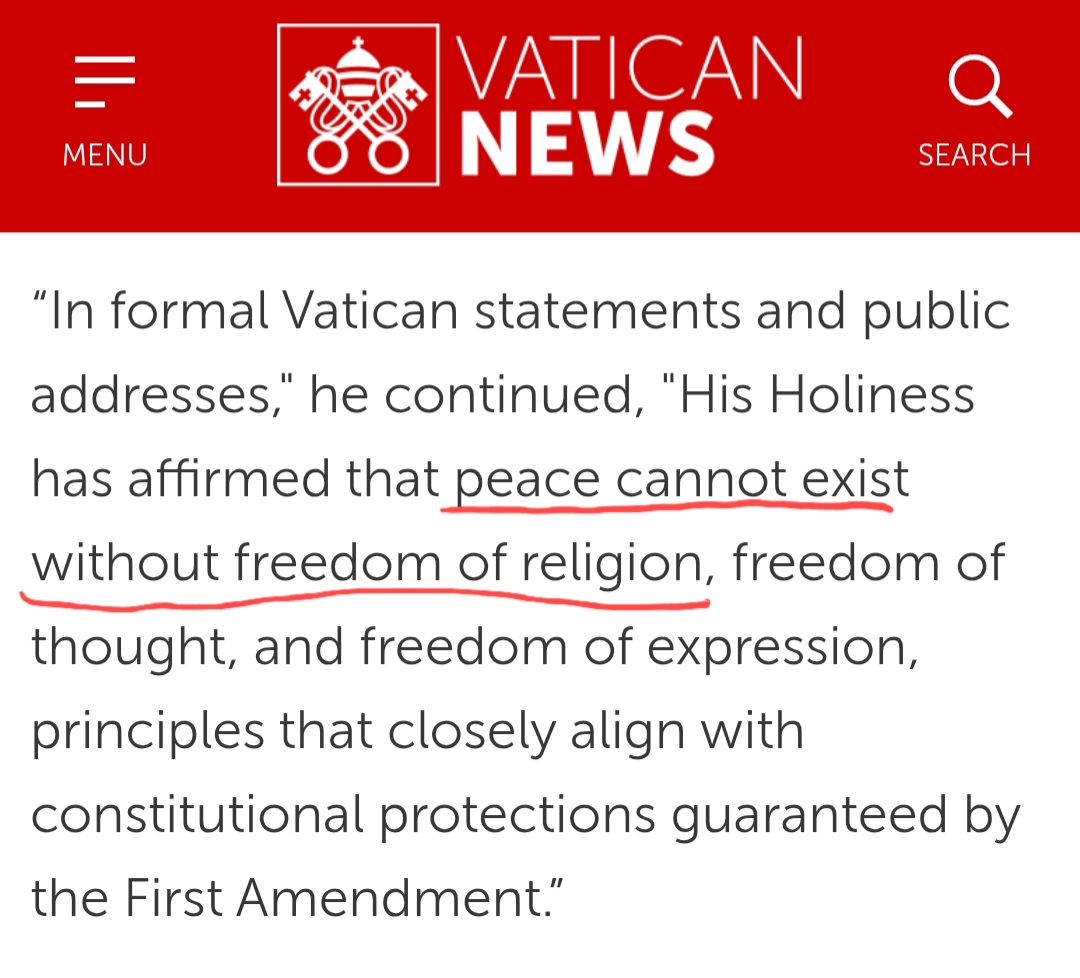
The United Nations once set a standard that stood above politics. Today, it reflects the ugly politics of those who sit within it. And as the Pope will tell you, there can be no peace without religious liberty. Ergo, the UN has become one of the primary sources of discord and violence in the world today.
On October 28, 2011, Lord Jonathan Sacks, the Chief Rabbi of England, came to New York City and sat with Rabbi Meir Soloviechik at Yeshiva University. Their hour long talk touched on Lord Sacks’ book The Home We Build Together, and the role of religion in society, focusing on the United States and the United Kingdom, in particular.
Chief Rabbi Lord Jonathan Sacks Speaks at Yeshiva University with Rabbi Meir Soloveichik, October 2011
In the opening remarks (3:10), Rabbi Soloveichik shared a story about Senator Joseph Lieberman, who once observed that on Simchat Torah, Jews dance with the Torah in the streets with joy, yet often fail to carry that Torah into the world during the rest of the year. It was a reminder that religion cannot remain confined to ritual but must be brought into society.
Lord Sacks followed with a story of his own. Prime Minister Tony Blair once teased him that he had reached the “boring part” of the Hebrew Bible—the lengthy passages about the building of the Mishkan (Tabernacle). Why, Blair asked, does the Torah devote hundreds of verses to it, compared to just 34 for the creation of the universe?
Lord Sacks replied:
Prime Minister, it is not difficult for an omniscient, omnipotent, infinite God to create a home for human beings. But for finite, fallible human beings to create a home for the infinite God, that is difficult.
The Mishkan, Sacks explained, was not just architecture—it was a project that united the people. More than what God does for us, it is what we do for God that transforms and binds us together. “If you want to take this diverse, fractured culture of Britain and turn it into a united nation,” Sacks said, “you have to get them to build something together.”
Rabbi Soloveichik and Lord Sacks went on to describe that the decline of religious life and secularization of Europe was tied to fewer children being born. A self-centered focus weakens families, weakens faith, and weakens society. In contrast, raising children—caring for someone more than oneself—provides both the foundation of belief and the roots of charity: “having somebody whose life you care about more than yourself, that could actually be the foundation of faith for many of us.”
Washington (D.C.) and Rembrandt
Nearly fourteen years later, on September 8, 2025, U.S. President Donald Trump held an event at the Museum of the Bible in Washington, D.C. He invited members of the newly established (May 1, 2025) Religious Liberty Commission to hear how he was advancing the centrality of religion in American public life. He said “When faith gets weaker, our country seems to get weaker. When faith gets stronger… good things happen for our country…. To have a great nation, you have to have religion.”
One of the members of the Presidential Committee on Religious Liberty is Rabbi Meir Soloveichik. He was unable to attend the speech by the president in Washington because he was giving a day long-lecture in New York City at the home of Mem and Zalman Bernstein and the Metropolitan Museum of Art for the Tikvah Fund about art, religion and western society.
Rabbi Solveichik focused on Rembrandt’s two versions of the Sacrifice of Isaac. He contrasted Abraham’s devotion to God’s command to offer his son Isaac, to the investment of love and devotion he had made in his son. The angel broke the conflict, and with it, the end of human sacrifice which was prevalent in the world at that time. From this point onward, belief in a higher power could be accompanied by protecting and investing in our children.
Religion, Children and Western Democracy
It made for an interesting sermon triptych connecting religion, children and western values: Lord Sachs, Rabbi Soloveichik and President Trump all emphasized that religion has the power to strengthen ourselves, our families, our communities and our nation.
In Lord Sacks book, The Great Partnership, published in June 2011, right before his talk at YU, he wrote:
My argument has been that contrary to the received narrative, freedom has been better served in the modern world by a religious vision rather than a secular one. The Abrahamic vision, with its insistence on the non-negotiable dignity of the human person and the importance of protected space – the families and communities that make up civil society – where relationships are not based on power, saved England and America from the worst excesses of the revolutionary politics that cost tens of thousands of lives in France and tens of millions in Russia….
Abrahamic politics, by contrast, is politics with a human face, the politics that knows the limits of power, as well as the transformative effect of free persons freely joining together to make social institutions worthy of being a home for the divine presence. Abraham politics never forgets that there are things more important than politics, and that is what makes it the best defense of liberty.”
That is the motion before Western democracies: can humble faith as embodied in “Abraham politics” lead our different faiths to help build a cohesive society of respect and growth.
Concluding Circle
The discussion of religion and democracy is being advanced passionately today because it feels abandoned.
According to Lord Sacks, democracy under secularism preached intersectionality which yielded segregation and isolationism. Rabbi Solveichik responded that “a Mayflower of persecuted religions might leave England and Europe to come to safer shores [like America].” For his part, President Trump established the Religious Liberty Commission to deal with such matters, with the first group’s term ending on July 4, 2026, on the nation’s 250th anniversary.
So it was fitting that Rabbi Soloveichik should end his talk to the Tikvah Fund, a group whose motto is “Advancing Jewish Excellence and Western Civilization through Education & Ideas,” before Emanuel Leutze’s Washington Crossing the Delaware, while President Trump was concluding his remarks in Washington, D.C.
Rabbi Soloveichik at the Metropolitan Museum of Art, September 2025
In the 1851 painting, the future president of the United States stood aboard a boat filled with a diverse crew, readying to end the rule of England and break with the British monarchy and Church of England, to establish a new democratic state in 1776. Nearly 250 years later, the Chief Rabbi of England, the president of the United States, and the rabbi leading the oldest synagogue in the United States were championing the importance of religion in strengthening democracies everywhere. A quiet revolution to return to the foundations of faith to help build a more perfect union.
When new United States member of the House of Representatives Ilhan Omar came into Congress, she was afforded the opportunity to wear her religious head covering, a hijab, onto the House floor as a result of a recent change in House rules. Since 1837, a rule had been in place that prohibited the wearing of any hats in the chamber, but the House opted to make accommodations for people who wore head coverings for religious reasons.
There was a time when wearing hats indoors was considered uncouth and disrespectful of the institutions. Many places still ask people to remove their hats during the recitation of the national anthem or upon entering a church. These are customs that come from Christian Europe that do not necessarily square with everyone’s thoughts on what does and does not show proper respect.
The Hijab
Many Muslim women wear a variety of head coverings depending on religious practice and custom. Some, like Omar, wear the hijab which covers their hair. Others put on a full veil covering the entire face and body, called a burqa. In their culture, these are signs of religious modesty.
Rep. Ilhan Omar in a hijab
There are other people in the world who find the hijab and burqa problematic and a sign of the repression of women.
In France, a devoutly secular society, there is a ban on wearing anything outwardly religious in universities. The country even went so far as to ban the wearing of modest swimsuits, “burkinis,” on the beach, all in the name of “secularism.”
Denmark recently joined other European countries in banning the full face covering of the burqa for the professed reason of public safety. The rationale seemed to pass the smell test of rationality for many, even though the law specifically carved out the wearing of facial covering for the purpose of combating cold weather. I guess public safety takes a hiatus in the winter.
The smug Europeans covered themselves in a porous fig leaf which any Adam could clearly see through: the governments were passing laws to bar Muslims from openly practicing their religion in a manner they saw fit. The Europeans passed laws which did not impact their own Christian sensibilities and way of life, while curbing religious freedoms of non-Christians, as way of keeping the alt-right and alt-left from protesting the new laws.
While the Christian alt-right was happy to stem the flow of Muslims into their countries, the secular alt-left and liberals favored the bans arguing that hijabs and burqas were based on discriminatory practices against women, the same way that female genital mutilation is a religious practice fomented by men against women. As such, they rationalized their bigotry that banning the head covering is actually freeing women from oppression.
The western mind is seemingly incapable of imagining that a woman would want to choose to cover her hair and live a religious life under her own terms.
The same is true for prostitution.
Prostitution
The oldest profession has progressed very little.
It is perhaps not surprising that very religious and conservative countries like Sudan do not only prohibit prostitution and homosexuality, but they also sentence the offenders to a gruesome public death. However, it is remarkable that so few western countries have taken the liberating approach to legalize prostitution. Among the handful which have legalized the profession are New Zealand, Australia, Austria, Bangladesh, Belgium, Netherlands, Denmark, Germany, Greece, Brazil and Colombia.
By legalizing prostitution (and outlawing “pimping” where a third party controls how and where one works) prostitutes are able to avail themselves of the protection of law enforcement. The benefits are multiple: human trafficking drops; protection for women (who dominate the industry) increases; and tax revenue for the state is created.
Yet there remains a bias in many western minds – including very liberal ones – that there is no way that a woman would consider having sex for money freely. The industry was born at a time when women were viewed as chattel and as second class members of society. Somehow pornography and massages pass muster, but sex-for-money passes a bright line.
For many westerners, prostitution is like a hijab: an insulting practice that denigrates women. They adamantly refuse to consider or acknowledge that many women freely CHOOSE to live in a manner which doesn’t fit into their own conception of a proper society.
Governments should be very cautious in dictating societal norms and accepted behavior, and instead focus on ensuring a world in which people have the liberty of living a life of their own choosing in safety. If a woman wants to wear a hijab – I say, go on sister. If a woman wants to be a prostitute – laws should enable it to be done safely.
Let’s not assume we know what’s best for women by outlawing liberal sex-for-money or conservative religious head-covering. Women should be afforded the freedom to pursue happiness in a manner of their choosing.



 First One Through