
There are moments when language has to carry more than meaning. It has to carry memory. It has to carry consequence. When the subject is the death of Jesus and the role of Jewish leadership in that story, every word is loaded with two thousand years of fallout.
That is the backdrop to a recent homily reported by Vatican News, where the Pope recounts how members of the Sanhedrin planned to put Jesus to death and frames the decision as a political calculation rooted in fear.
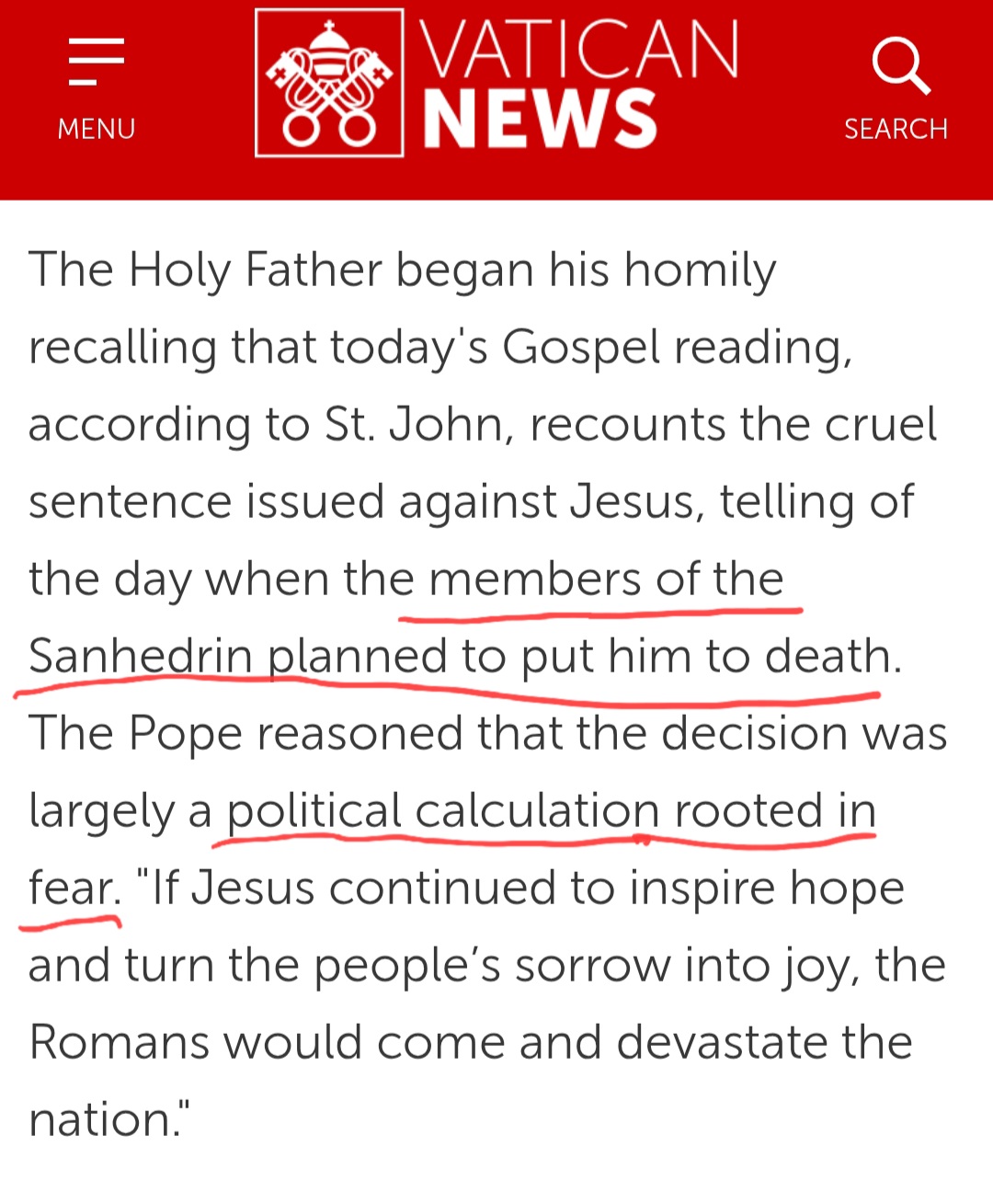
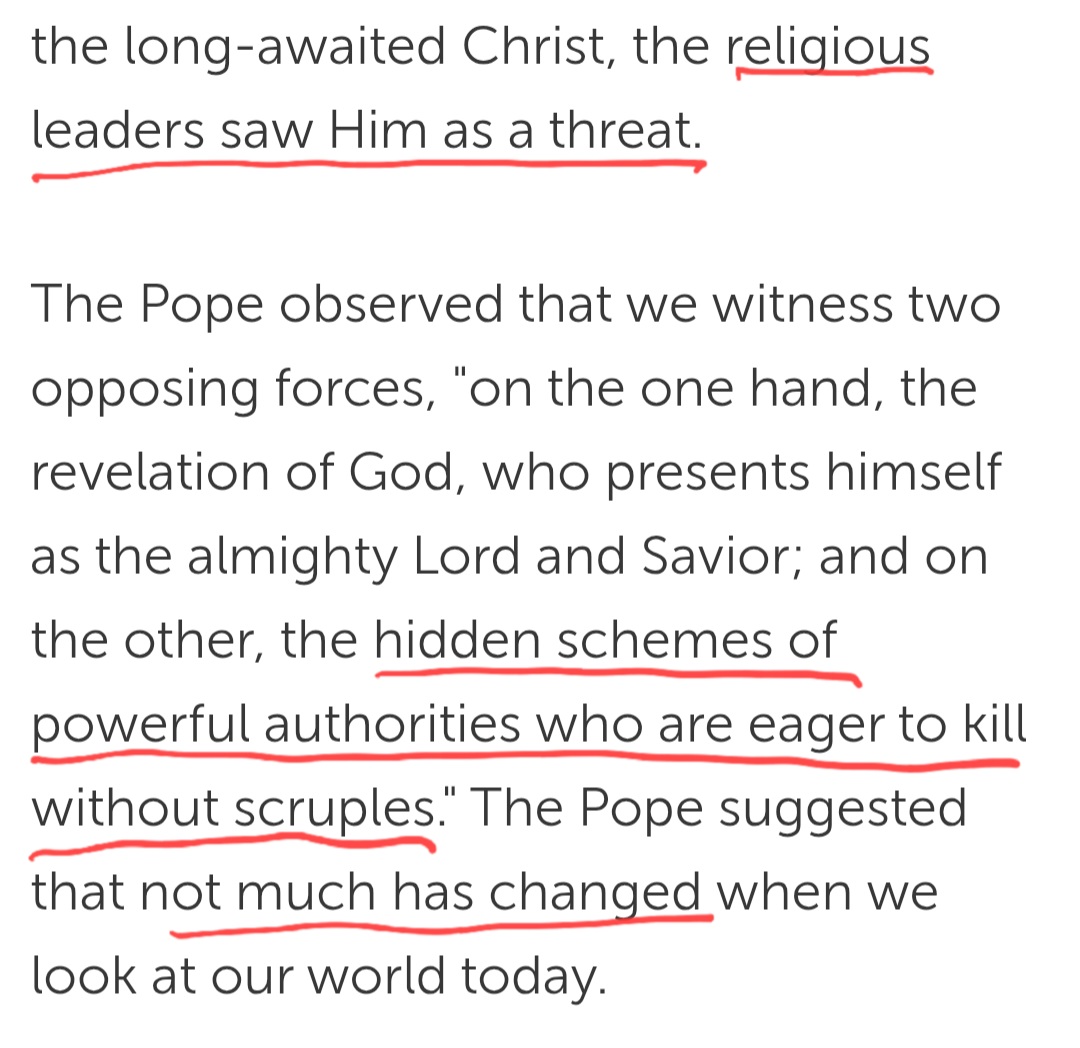
On its face, this is familiar terrain. The Gospel of John tells that story. The Pope emphasizes fear, power, and the instinct of leadership to preserve order when threatened. He broadens the lesson, warning about “hidden schemes of powerful authorities” and concluding that not much has changed when we look at the world today. It is a universal moral frame, the kind clergy have used for centuries to draw a line from ancient texts to modern behavior.
But this is not a normal moment, and that is not neutral language.
We are living through a surge in antisemitism that is not subtle, not isolated, and not theoretical. Jews are being targeted in cities, on campuses, and online. The State of Israel is being recast in mainstream discourse as uniquely illegitimate, even genocidal. The old accusations have not disappeared. They have been updated, rebranded, and redeployed. In that environment, the space between what is said and what is heard narrows dangerously.
The Catholic Church knows this better than anyone. For centuries, Christian teaching around the Passion narrative fed the idea that Jews, as a people, bore responsibility for the death of Jesus. That charge—deicide—did not stay in theology. It moved into law, into mobs, into expulsions and massacres. It became part of the architecture of antisemitism in Europe.
The Church confronted that history in Nostra Aetate, a landmark statement of the Second Vatican Council. The declaration made clear that Jews as a whole, then or now, cannot be blamed for the death of Christ. That was not a minor clarification. It was a doctrinal line drawn after catastrophe, an effort to shut down a pattern of interpretation that had proven lethal.
Successive Popes understood what that required in practice. Pope John Paul II did not rely on implication. He spoke directly, repeatedly, calling Jews “our elder brothers” and making visible gestures that reinforced the message. Pope Benedict XVI went further in precision, arguing explicitly that references to “the Jews” in the Gospel of John describe a specific leadership group, not a people across time. They closed interpretive doors because history showed what happens when those doors are left ajar.
That is why the current language matters. “Religious leaders saw Him as a threat.” “Hidden schemes of powerful authorities.” “Not much has changed.” None of these phrases, standing alone, violates Church teaching. None explicitly assigns blame to Jews today or draws a line to the modern State of Israel. But they operate in a space that has been misused for centuries, and they leave enough room for that misuse to return.
In a different era, that looseness might pass without consequence. Today, it does not. The categories are too easily mapped by those already inclined to do so. “Religious leaders” becomes “rabbis and synagogues.” “Powerful authorities” becomes a stand-in for Jewish power, whether the government of Israel or leaders in the Jewish diaspora. “Not much has changed” becomes an argument for continuity from the first century to the present. And in a climate where Israel is already being portrayed as a moral outlier among nations, the slide from scripture to contemporary politics is not a leap. It is a small step.
This is not about intent. The Pope is speaking in a long Christian tradition of drawing moral lessons from the Passion. The emphasis on fear and political calculation is, in fact, a move away from older, more dangerous framings. But intent does not control reception, especially when the subject has such a charged history.
The standard here cannot be whether the words are technically defensible. It has to be whether they are tight enough to prevent foreseeable distortion.
Because the distortion is not hypothetical. It is already happening in the broader culture. Jews are being pushed out of public spaces, treated by default as representatives of a state and a government they may or may not support, whether they live there or not. Israel is singled out in ways that strip context and complexity, recast as uniquely evil in a world that has no shortage of brutality. In that environment, any rhetoric that can be bent toward those narratives will be bent.
The Church has done the hard work of confronting its past. It has the doctrine. It has the precedent. What it needs, in moments like this, is the discipline to match.

 First One Through