In the world of archaeology, there is nothing as prized as finding something in situ, meaning in its original place. The location helps provide archeologists with clues as to the surroundings’ age and usage, who lived in that location and the nature of society. Once an item moves, critical details of the environment are lost forever.
From that moment, the provenance is often a curiosity. Who owned the item and for how long? How did it come to find its way into this collection or that museum and what happened to the artifact over this time? These matters are often used to prove the subject’s authenticity, by tracing it back without interruption to the point of discovery.
When it comes to works of art (rather than archeological finds), provenance is less of a curiosity. Experts and viewers mostly focus on the art itself as well as the artist. The visual and message are the primary matters, not the journey of the art onto a museum’s wall.
Yet there are stories too remarkable to ignore. Sometimes the provenance is as much of the subject as the art itself, even reorienting the very perception of the artwork to modern viewers.
A Dutch Masterwork, As Seen By A Jew, A Nazi And Complicit Government
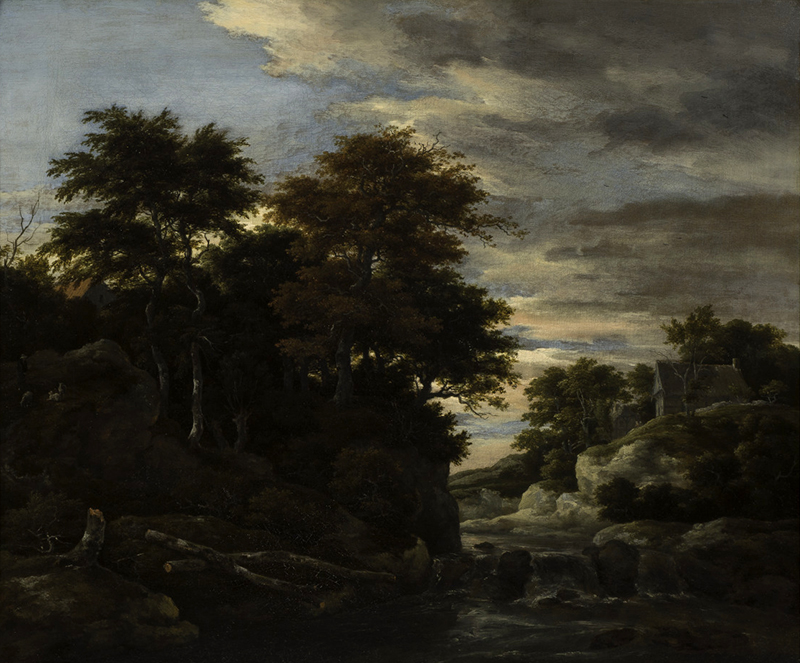
Consider the painting A River Landscape with a Waterfall (1660) by Jacob van Ruisdael (1628-1682).
Van Ruisdael was considered among the greatest landscape painters of the Dutch Golden Age. While his peers Johannes Vermeer (1632-1675) and Rembrandt (1606-1669) mostly painted people, Van Ruisdael painted scenes of nature.
In A River Landscape with a Waterfall, we see the artist’s work with contrasts. The right side of the painting is illuminated by the setting sun, with a solid house on a hill set under clouds. To the left is dark scene in the shadow of the sun. Broken branches lay on the rocks and a hint of a house protrudes from the standing leafy trees. A barely perceptible person makes his way towards that house before sunset. A stream separates the two sides of the painting with a small waterfall.
This is one of many waterfall paintings by Van Ruisdael during the middle of his life. Of them all, this one is the most serene, with the title’s inclusion of “river” and “waterfall” seemingly an exaggeration of a modest calm landscape.
The story of the painting’s journey to the Phoenix Art Museum where it is exhibited today was anything but calm.
In the mid-1930s, the painting came into the collection of Jacques Goudstikker (1897-1940), a Jewish Dutch art dealer who was among the foremost collectors of Old Master works. When the Germans invaded the Netherlands in May 1940, Nazi military leader Hermann Göring confiscated Goudstikker’s collection. Over the course of the war, Göring is estimated to have amassed over 4,000 works of art. Most of the art was taken from France, including from the Rothschild family. Goudstikker’s collection made up a sizable part of the non-French collection, as he was partial to landscapes and the Old Masters.

As the war started, Goudstikker fled Holland with his wife and one year old son. They first went to England and then caught a boat to the United States. On the ship to America, Jacques accidentally walked into an open hatch and plummeted to the ground below, dying instantly. His wife and son made it to America without him.
At the end of the war, the Dutch government confiscated the looted Nazi art. Most of the paintings did not find their way back to the rightful owners as there were few notes about the provenance of each work. However, because Goudstikker was a leading arts dealer, he had ledgers with each work, including this Van Ruisdael painting. Despite the clear markings on the back of the painting with Goustikker’s seal, and Goustikker’s wife and family showing records of being the proper owners, the Dutch government would not release the painting to the family until 2002, 57 years later. The family sold the painting in 2007 to a doctor in Phoenix, Arizona who donated it to the Phoenix Art Museum in 2022, where it hangs today.
During World War II, private art collections like Goustikker’s were often seized by the Nazis, while those from public museums were better able to protect the most prized works.
To mark the 80th anniversary of the liberation of the Netherlands, the Mauritshuis public art museum in The Hague is having an exhibition until June 29, 2025 called “Facing the Storm – A Museum in Wartime.” It relays the efforts taken by the museum to hide its most valuable art from the Nazis. As described by the museum, “The exhibition will devote attention to the travels of Vermeer’s Girl with a Pearl Earring during the war. The Mauritshuis had a bombproof ‘art bunker ’ in which it would store all its masterpieces overnight, bringing out a few – including the Girl – during the day…. During the course of the war, the most important works of art were taken to the various ‘National Storage Facilities’, where they remained until the war ended. During this time, the gallery walls at the Mauritshuis were a sorry sight, lined as they were with empty frames.” During some of the public showings during the war, Hitler featured his personal paintings and his book Mein Kampf alongside the museum’s Dutch masters.

There was a split dynamic between public and private museums as well as viewing art during the day and night during the war in Holland. Private collections were seized and public collections were hidden at night. When collections made it to the light of day, they were used as propaganda for Dutch residents and the enjoyment of Nazi officers who were able to walk the streets freely. Empty frames were like the disappeared Jews of Holland, perhaps hidden away like Anne Frank and her family, or shipped to Nazi concentration camps for liquidation.

The background story and provenance of the Van Ruisdael painting is very much part of viewing the painting today. The pastoral scene of light and darkness owned by a Dutch Jewish family on the eve of World War II was seized – and enjoyed – by Nazi criminals. After the defeat of the Nazis, the Dutch government held onto the artwork and would not return it to the Jewish family which had to flea across the ocean to survive the Holocaust, even as the man who owned the painting did not survive.
To view the painting with such knowledge, the stream becomes an ocean which the Goudstikker family crossed to save themselves. They left their open, illuminated and public house on a hill for an unknown future. Indeed, Jacques’ untimely death during the journey is like the broken branches in the foreground of the painting.
The home and art the Goudstikkers left behind became a showcase for Nazi propaganda, like the house on the right side of the painting enjoying the full setting sun and completely exposed to the world. The dark left side of the painting are the works of art and the Jews of Holland who were hidden and transported to death camps, or perhaps they were lucky to leave the war early like the Goudstikkers, attempting to find a new uncertain home across the ocean. And even when they made it safely to the other side, did they get to enjoy their freedom, or were they fighting for their basic rights and property, such as against the Dutch government who would not surrender their art?
A painting made in the 17th century can be understood anew hundreds of years later because of its provenance. Journeys can shape the subject.
That is most certainly true of Jews, especially on Passover.
Passover Seder As Seen By A Guest
It is a tradition for hundreds, if not thousands of years to invite someone to a Passover seder. Inviting a guest unfamiliar with the story of the Jewish Exodus from Egypt over 3,000 years ago – especially for meals that do not have any children present – provides an opportunity to tell the story of the Jewish journey from slavery to freedom, and from Egypt to the Jewish Promised Land.
The seder uses a Haggadah, a standard text used by Jews around the world, which not only discusses the Exodus, but prior generations telling the story of the Exodus on Passover. The seder is both a story FROM 3,000 years ago at the point of origination, as well as the journey of that story over the intervening years until today.
The guest at the seder is not only learning about ancient Jewish history but seeing and hearing the provenance of that history.
A person can read the bible at any time of year to get a clinical understanding of the Exodus from Egypt. However, to sit at a seder is to see the redemption of Jews in a new light, incorporating the journeys they have taken over the centuries.
The story of the Exodus and the journey of Jews for millenia are too remarkable to ignore. Viewing both simultaneously is the magic of Passover, a gift for everyone attending a seder.
Related articles:
When Our History Begins (December 2022)
The Haggadah as Touchstone for Harmony (April 2022)
Prayer of The Common Man, From Ancient Egypt to Modern Israel (January 2021)
The Jews of Jerusalem In Situ (April 2019)
The Beautiful and Bad Images in Barcelona (March 2019)
Delivery of the Fictional Palestinian Keys (May 2015)


 First One Through