Marc Chagall (1887–1985) returned again and again to the image of Jacob’s Ladder throughout his long life. But his 1973 rendering, painted near the end of his days, stands apart. It is visually explosive—layered, dissonant, and urgent.
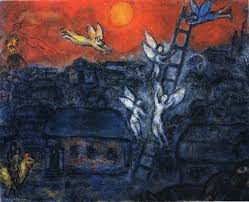
The moment one sees it, the eye is pulled upward to an orange sun burning at the top center. At that height, the sky should glow with daylight yellows. Instead, the sky is red, a communist-red firmament. And the town below, which should be illuminated by that sun, sits in unnatural midnight blue.
Something is wrong in this world. This is not a window into serenity; it is a scene of foreboding.
That imbalance is profoundly Chagall. Born in the Jewish shtetls of the Russian Empire, he fled early waves of antisemitism. He lived through the destruction of European Jewry and spent his career painting ghost-towns of a shattered civilization. But he also painted the biblical narratives that shaped Jewish imagination. In this canvas, he fuses those worlds—eternal story and fragile reality—into a single warning.
At the center of the darkened town rises a ladder stretching into the sky. Three white angels punctuate the blue shadows, announcing that this is Jacob’s dream. Yet Chagall departs from Genesis: the ladder doesn’t stretch into the heavens and all the angels are not identical. Instead, the ladder is held in place by a blue angel, while a second, yellow angel reaches for it from the red sky above.
This ladder has competing destinations.
The blue angel, painted in the same hues as the town, embodies the pull of entrapment—those who cannot or will not flee their circumstances. In 1973, when Chagall painted this work, Soviet Jews were locked inside a system that barred their departure and suppressed their identity. The blue angel is not hostile; it is immovable. It represents the status quo, the path of staying even as danger grows. It is the sleeping Jacob at the bottom of the painting pondering the outcome of fleeing while laying immobile.
The yellow angel, by contrast, belongs to the daylight that should have filled the sky. It symbolizes clarity and escape. Beneath it, at the bottom-left, a mother and child ride a yellow rooster—Chagall’s emblem of dawn, deliverance, and a new beginning. Above them, nearly hidden in the deep blue, a quiet procession of Jews slips toward a safer horizon.
This is Jacob’s dream retold by a man who watched Jews flee the Russian Empire, flee Europe, flee the infernos of the 20th century. It is a ladder that offers a way out—if one chooses the right direction. It is there on Jacob’s face, the yellow glow of peaceful escape.
The October 8 Jews
Today, a new group is dreaming of climbing Chagall’s ladder: the October 8 Jews.
These are the Jews who woke the day after the October 7 massacre not only to the horror in Israel, but to the celebrations of that horror across Western cities. They heard the chants of “Globalize the intifada!” and “There is only one solution—intifada revolution!” echoing at major universities, boulevards, and civic squares. They watched crowds revel in Jewish fear, justify kidnapping, rape, and murder as righteous “resistance,” and proclaim open season on Jews everywhere.
Suddenly, the Western Jew realized that the ground beneath his feet might no longer be stable.
He now lives between Chagall’s two angels. Does he cling to the familiar town—the blue angel of inertia, habit, and misplaced trust? Or does he follow the rooster, the yellow angel, toward a place where Jewish existence is not conditional, tolerated, or revocable?
In the early 20th century, Jews fled the USSR and Europe for the United States and the Land of Israel. Today the destinations remain, but the calculus has changed. The Jewish state is stronger than ever—and simultaneously the focal point of global vitriol. Safety and danger now sit braided together.
The Ladder Still Stands in the Center of Town
Chagall painted Jacob’s Ladder for those who knew safety can vanish overnight. His warning now belongs to us. On October 6, Jews believed they lived in stable towns; on October 8, they saw the sky had been red for years. The chants weren’t metaphors, the mobs weren’t marginal, and the threats weren’t theoretical. The blue angel of normalcy had held the ladder while danger gathered in plain sight.
So the question becomes stark:
Will Jews try to reclaim trust in places that celebrated their terror—or follow the mother and child on Chagall’s yellow rooster toward the only light that doesn’t depend on someone else’s tolerance?
For a century, Jewish survival has meant movement: away from the USSR, away from Europe, away from every place that insisted Jews stay quiet and endangered. The October 8 Jew must decide whether today is any different.
In Chagall’s vision, only one angel leads to dawn.
The ladder still stands. The choice is ours.

 First One Through