
There is something striking about Parshat Vayikra.
Just weeks after the drama of Exodus – splitting seas, revelation at Sinai, a nation coming into being – the Torah seemingly turns inward. The focus shifts to offerings, detail, repetition, and discipline. It feels quieter, but far more demanding.
Because the Torah is no longer telling the story of a history of a people. It is shaping the inner life of a person and framing a community.
Korban: The Work of Drawing Close
The word korban comes from the Hebrew word karov, to draw close.
This is the Torah’s language for repairing distance. Every lapse in judgment, every compromise, every moment we fall short creates space between who we are and who we are meant to be. That distance accumulates. It dulls awareness. It reshapes identity over time.
Korban is the act of closing that gap through deliberate engagement.
The Offering as Mirror
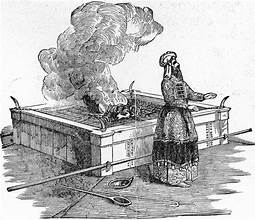
The individual places hands on the offering before it is brought forward. The gesture is direct and personal.
The animal reflects the instinctive layer of the self: of impulse, appetite, anger, ego. The act forces recognition: this energy exists within me. It must be directed, refined, elevated.
The fire on the altar becomes the mechanism of transformation. What is raw is lifted. What is uncontrolled is shaped into something purposeful.
Responsibility leads to possibility.
Atonement Requires Engagement
Vayikra establishes a system built on participation. Atonement unfolds through action, awareness, and presence.
A person must recognize the failure, step toward it, and engage with it. That process creates movement. It slows the instinct to gloss over mistakes and replaces it with something more durable: change that is earned.
The Hidden Becomes Visible
As important, korbanot were not private moments.
They took place in the open, at the center of the community. A person brought an offering in full view; sometimes for something no one else knew, a failure that could have remained hidden.
That public act carries a dual force. It is a form of confession. It acknowledges that private actions shape a public self.
It also reshapes how we see each other. Everyone comes forward. The composed, the successful, the admired, all stand at the same altar. They, too, confront failure. They, too, seek repair.
The system dismantles the illusion of perfection and replaces it with something far more stable: a community built on shared imperfection and ongoing effort.
The World We Built Instead
Today, we have constructed the opposite system.
Our lives are increasingly public, yet carefully edited. Success is broadcast. Struggle is concealed. Identity becomes something managed rather than lived.
Platforms reward the appearance of control, clarity, and achievement. Failure is filtered out. Weakness is reframed or hidden entirely.
The result is a quiet distortion.
People begin to believe that others are living more complete, more resolved lives. The gap between appearance and reality widens. Struggle becomes isolating rather than connective.
In a world like this, growth becomes harder. Without visibility, there is less accountability. Without shared imperfection, there is less permission to confront what is broken.
The Measure Is Intent
The mincha, the simple grain offering, carries the same weight as more elaborate offerings.
A handful of flour stands beside an animal offering because the Torah measures sincerity. The system resists performance and centers intention, reinforcing that what matters is the internal work, not the external display.
The Real Offering
At the center of Vayikra is a simple idea: the offering is the self, refined over time.
The challenge today is not understanding that idea. It is living it in a world that encourages concealment over confrontation.
Vayikra describes a life where people engage their shortcomings directly and are willing to be seen in that effort. The question that remains is whether we can build lives that allow for that kind of honesty again.

 First One Through