Joseph, Yusuf and the Stories We Tell

The story of Joseph is the longest sustained personal narrative in the Bible. It is a life told end-to-end—youth and jealousy, betrayal and exile, moral clarity under pressure, reversal of fortune, and reconciliation. Jews have lived inside this story for millennia and drawn from it lessons about love misdirected, loyalty earned, leadership forged, and fate revealed only in retrospect.

It begins, uncomfortably, at home.

Jacob’s overemphasis on Joseph—his public favoritism, symbolized by the coat of many colors—fractured the family. It was not Joseph’s dreams alone that enraged his brothers, but the hierarchy their father imposed. Love, unevenly expressed, curdled into resentment. That resentment escalated to violence. The brothers nearly killed Joseph, then sold him into slavery, persuading themselves that exile was mercy.

And yet, the terror of the pit became the opening move in a larger design. Joseph’s descent—into slavery, into prison, into obscurity—ultimately saved thousands from starvation, including the very brothers who betrayed him. The Torah insists on an uncomfortable truth: human cruelty can coexist with divine purpose, without being excused by it.

Over time, the transformation that matters most occurs not in Joseph, but in Judah. The brother who once proposed selling Joseph later rises to moral leadership. Faced with the potential loss of Benjamin, Judah offers himself instead. Ultimatelty, kingship does not emerge from brilliance or dreams, but from responsibility and loyalty. Judah learns what Jacob failed to teach early: leadership is love with a wide visual field.

But this is not the only Joseph story in the world.

Yusuf and Zulaykha: A Different Emphasis

In Islamic tradition, Joseph is Yusuf, and his story unfolds with different texture and purpose. The Qur’an (Surah Yusuf) adds layers absent from the biblical text. Where the Bible does not even name Potiphar’s wife, Islamic tradition gives her a name—Zulaykha—and an entire inner life.

Her attraction to Yusuf begins as physical longing, but in later tradition becomes a spiritual ascent. Love itself is refined—from desire for beauty to yearning for the divine. This is not biography alone; it is allegory.

Persian culture preserved these layers visually, through extraordinary manuscript art that does not merely illustrate scripture but interprets it.

One remarkable manuscript—now on display at the Grolier Club from the collection of the Jewish Theological Seminary (until December 27, 2025)—shows Joseph cast into a well. The details are arresting. Joseph has lost not only his coat of many colors, but his hat and shoes as well—status stripped away piece by piece. The brothers even drop rocks down on him.
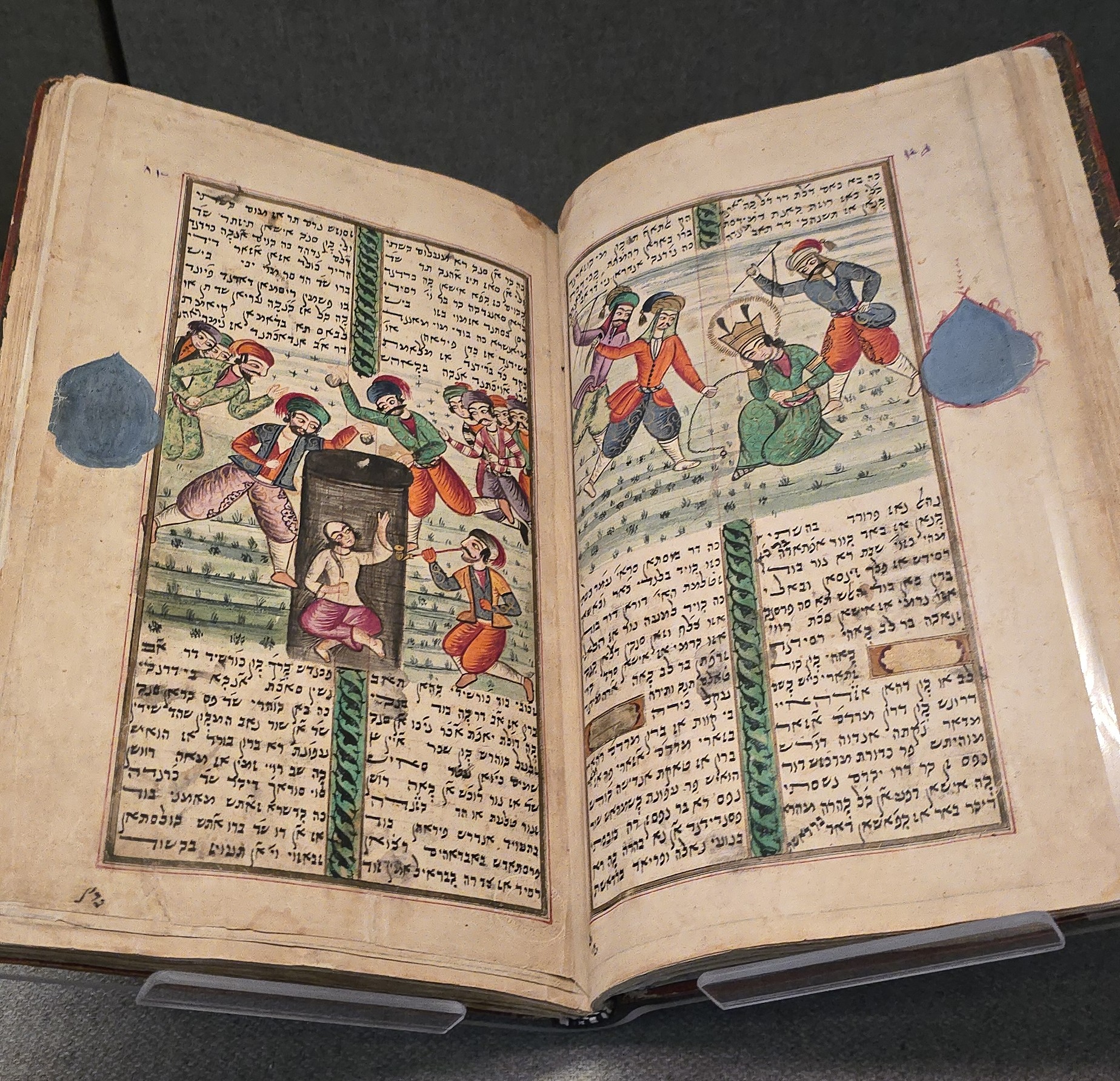
Story of Yusuf and Zulaykha from Mashhad, Iran in 1853 by the Jewish scribe Eliyahu ben Nisan ben Eliyahu Gorgi. Digitized entire manuscript can be viewed here

One figure stands apart in the drawing. At the bottom of the scene, a brother sits almost contemplatively. His hands alone are painted with henna, marking higher status. He smokes a long çubuk (copoq)—a dry-tobacco pipe, not the classic Persian water-based hookah—an unsettling detail as Joseph languishes in a dry well below. The image quietly foreshadows hierarchy, survival, and reversal. Even in betrayal, the future is being seeded. This must be Judah, on the side of the well with his five brothers from mother Leah, who is destined to help Joseph out of the pit and rise to fame himself.
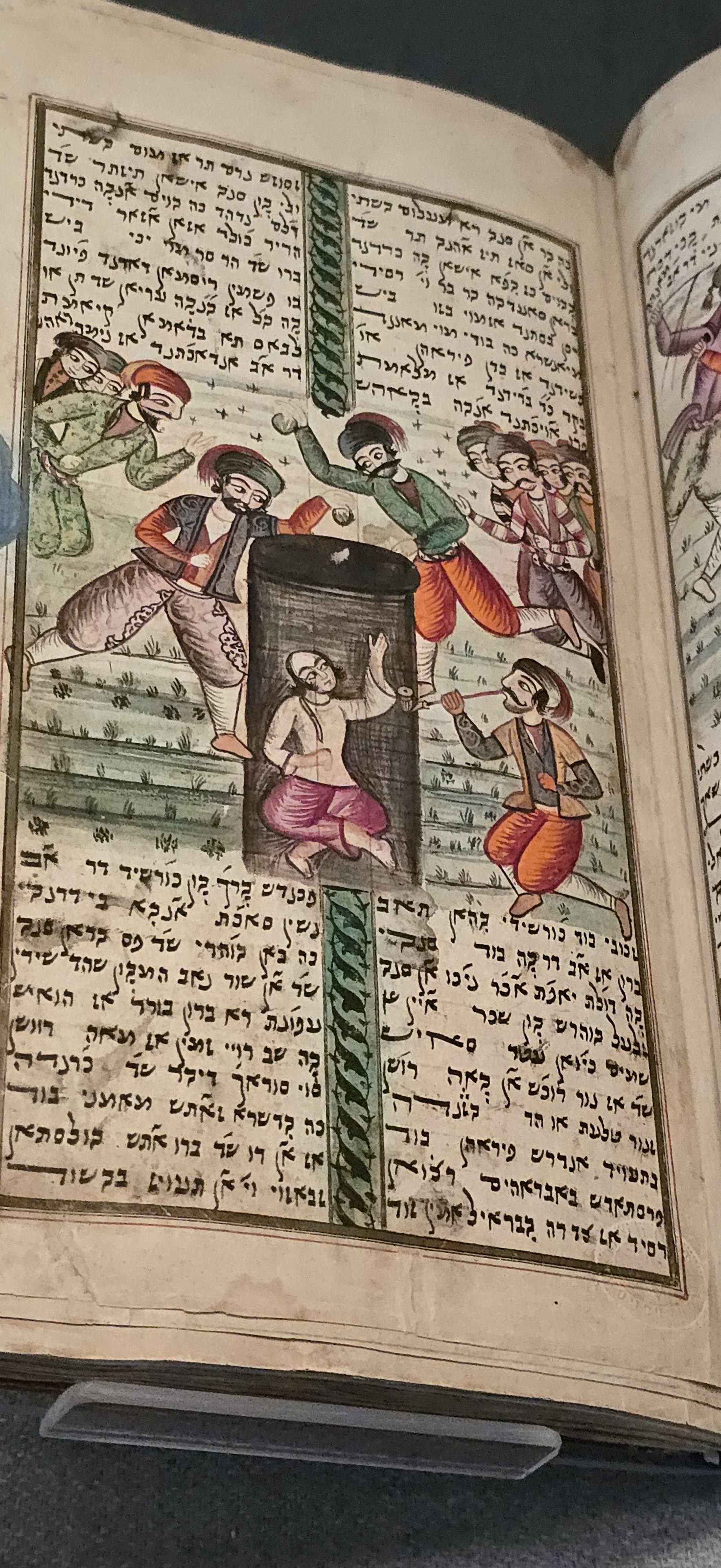
One brother seems to connect at the same level of Joseph – at a low point in this story but will rise to fame later in life: Judah

Other images in the Yusuf cycle go further still in the manuscript. Women cut themselves upon seeing Joseph’s beauty (image 70 from Surah Yusuf 12:31). Zulaykha is said to lose her sight from longing for him (image 128). Beauty becomes dangerous, overwhelming, transformative. The Islamic tradition does not deny desire; it seeks to discipline and redirect it.
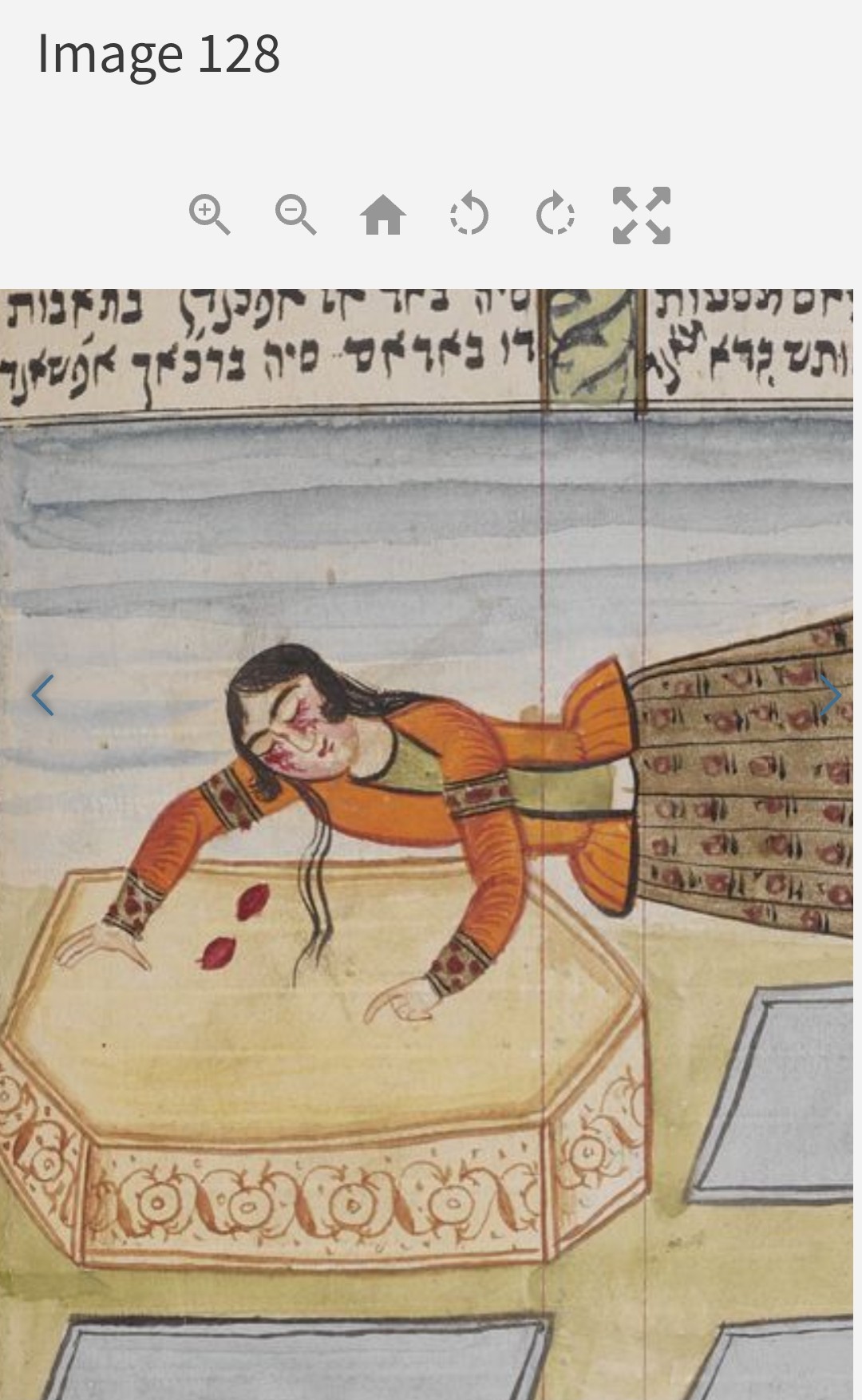
Zulaykha losing her sight at the end of the story is one of the versions transmitted through the ages

Two Traditions, One Origin

For Jews, Joseph’s story is about dreams and reversals, exile and return, family rupture and national survival. For Muslims, Yusuf’s story adds a meditation on beauty, temptation, and love’s ascent toward God. The Islamic telling emerged nearly two thousand years after the Jewish forefather lived. It is not wrong; it is different.

What matters for us today is that these differences did not need to fight. The stories coexist without trampling on the other.

The same characters—Jacob, Joseph, the brothers—carried distinct lessons without cancelling one another. No one is frozen forever as a villain. Jacob loved poorly but learned. The brothers failed catastrophically but changed. Judah rose. Sacred storytelling, at its best, refuses to eternalize blame.

That restraint is precisely what feels absent today.

Stories, Power, and the Present

The Holy Land, sacred to both Jews and Muslims, is no longer widely treated as a shared inheritance, but as a zero-sum possession. Hamas openly declares that Jews will be wiped out. Clerics in parts of the Islamic world speak in timelines of Jewish disappearance due to their being “enemies of world peace.” This is not interpretation; it is incitement. It rejects the Joseph model, in which history bends—slowly and painfully—toward survival, accountability, and reconciliation rather than annihilation.

And yet, Islamic civilization itself offers another precedent. Islam historically made room for Jewish continuity—absorbing biblical figures, preserving Jewish prophets, and allowing traditions to dovetail rather than collide. Yusuf did not replace Joseph; he walked alongside him. Zulaykha did not negate Potiphar’s wife; she deepened the moral inquiry. Reverence did not require negation.

That capacity still exists.

If Joseph teaches anything durable, it is that sovereignty, survival, and holiness are not insults to one another. Jews returning to and governing their homeland need not be read as a theological defeat for Islam. They can be understood, instead, as another chapter in a long, shared story—one that does not deny difference, but refuses extermination as destiny.

The question is whether we choose that inheritance again.

The Karma of the Children of Israel

The second book of the Pentateuch is called “Exodus” in English but called “Names” in Hebrew due to the opening lines. In reviewing the first ten sentences of the book, there is seemingly a deeper message about the names themselves.

וְאֵ֗לֶּה שְׁמוֹת֙ בְּנֵ֣י יִשְׂרָאֵ֔ל הַבָּאִ֖ים מִצְרָ֑יְמָה אֵ֣ת יַעֲקֹ֔ב אִ֥ישׁ וּבֵית֖וֹ בָּֽאוּ׃

These are the names of the sons of Israel who came to Egypt with Jacob, each coming with his household:

רְאוּבֵ֣ן שִׁמְע֔וֹן לֵוִ֖י וִיהוּדָֽה׃

Reuben, Simeon, Levi, and Judah;

יִשָּׂשכָ֥ר זְבוּלֻ֖ן וּבְנְיָמִֽן׃

Issachar, Zebulun, and Benjamin;

דָּ֥ן וְנַפְתָּלִ֖י גָּ֥ד וְאָשֵֽׁר׃

Dan and Naphtali, Gad and Asher.

וַֽיְהִ֗י כָּל־נֶ֛פֶשׁ יֹצְאֵ֥י יֶֽרֶךְ־יַעֲקֹ֖ב שִׁבְעִ֣ים נָ֑פֶשׁ וְיוֹסֵ֖ף הָיָ֥ה בְמִצְרָֽיִם׃

The total number of persons that were of Jacob’s issue came to seventy, Joseph being already in Egypt.

וַיָּ֤מָת יוֹסֵף֙ וְכָל־אֶחָ֔יו וְכֹ֖ל הַדּ֥וֹר הַהֽוּא׃

Joseph died, and all his brothers, and all that generation.

וּבְנֵ֣י יִשְׂרָאֵ֗ל פָּר֧וּ וַֽיִּשְׁרְצ֛וּ וַיִּרְבּ֥וּ וַיַּֽעַצְמ֖וּ בִּמְאֹ֣ד מְאֹ֑ד וַתִּמָּלֵ֥א הָאָ֖רֶץ אֹתָֽם׃ (פ)

But the sons of Israel were fertile and prolific; they multiplied and increased very greatly, so that the land was filled with them.

וַיָּ֥קָם מֶֽלֶךְ־חָדָ֖שׁ עַל־מִצְרָ֑יִם אֲשֶׁ֥ר לֹֽא־יָדַ֖ע אֶת־יוֹסֵֽף׃

A new king arose over Egypt who did not know Joseph.

וַיֹּ֖אמֶר אֶל־עַמּ֑וֹ הִנֵּ֗ה עַ֚ם בְּנֵ֣י יִשְׂרָאֵ֔ל רַ֥ב וְעָצ֖וּם מִמֶּֽנּוּ׃

And he said to his people, “Look, the nation of the sons of Israel is too numerous for us.

הָ֥בָה נִֽתְחַכְּמָ֖ה ל֑וֹ פֶּן־יִרְבֶּ֗ה וְהָיָ֞ה כִּֽי־תִקְרֶ֤אנָה מִלְחָמָה֙ וְנוֹסַ֤ף גַּם־הוּא֙ עַל־שֹׂ֣נְאֵ֔ינוּ וְנִלְחַם־בָּ֖נוּ וְעָלָ֥ה מִן־הָאָֽרֶץ׃

Let us deal shrewdly with them, so that they may not increase; otherwise in the event of war they may join our enemies in fighting against us and rise from the ground.”

Genesis 1:1-10

The first sentence opens with calling Jacob by his changed name “Israel” before switching to his birth name “Jacob.” The text then lists all of the names of Jacob’s sons and subsequently pivots back to “Israel” after Joseph and his brothers died. At the end of the section, not only does the text pivot to using “sons of Israel” to include women and later generations but the new king in Egypt goes further in calling them a “nation of the sons of Israel.”

There is clearly more to appreciate in the names employed.

Birth Names of Human-Tension

The names given to the Jewish forefathers are explained inside the text in Genesis with some rationale given of how the parents felt at the time of the baby’s birth. Often, the names portend events in the future.

Consider how Sarah laughed when she heard she was going to have a child (Genesis 18:12) and then later Abraham named him Isaac (Genesis 21:3) after the Hebrew name for laughter. Sarah seemingly approved of the name (Genesis 21:6) only to soon witness Isaac’s half-brother Ishmael making fun of him (Genesis 21:8). Isaac’s name was an omen of things to come or perhaps served as the catalyst for how people perceived him. Maybe both.

One can see the impact of names when reading about Jacob’s eldest son, Reuben. Born to an unloved wife, Leah, Genesis 29:32 describes one of the saddest baby-namings in the Bible: “Leah conceived and bore a son, and named him Reuben; for she declared, “It means: ‘The LORD has seen my affliction’; it also means: ‘Now my husband will love me.’” How that name must have weighed on Reuben! To carry a name that shows his mother was unloved! With Leah’s sister as another wife and two handmaids also producing half-brothers, the family dynamic was extremely difficult. When his mother’s sister Rachel died years later and Jacob opted to still not enter Leah’s tent but that of Bilhah, Rachel’s handmaid, Reuben was apoplectic and raped Bilhah (Genesis 35:22).

The bible is deliberately silent on Jacob’s reaction to the event, stopping the story mid-sentence and starting a new paragraph with “Now the sons of Jacob were twelve in number.” Seemingly, Reuben is not punished by his horrific act and remained part of the collective twelve sons. Perhaps Jacob acknowledged that it was Reuben’s obligation to fight for the honor of his spurned mother, maybe even uniquely among Leah’s six sons, as he bore the name of desperate love.

Jacob himself was named by his mother Rebecca for the contentious relationship he would have with his brother Esau. In Genesis 25:23, God told Rebecca that two nations were struggling inside her womb and she named Jacob in Genesis 25:26 because he was clutching the heel (ekev in Hebrew) of Esau. This highly fraught relationship continued for years until an angel renamed Jacob in a night struggle, seemingly redoing the struggle in Rebecca’s womb. This time, Jacob came out on top but instead of clutching the heel of the winner, he incurred a permanent limp. As the victor, he was renamed Israel (Genesis 32:29) “for you have striven with beings divine and human, and have prevailed.” It was only at this point, stripped of a name that carried the significance of brotherly-confrontation, that Jacob met with Esau who had come to meet him with a 400-person army. Peace prevailed.

Karma of the Nation of Israel

After reviewing the nature of how parent-given names influenced the lives of the biblical forefathers, we can take a fresh look at the opening sentences of Exodus in a different manner.

From the middle of the first sentence through the sixth, the Bible names Jacob and his sons by their parent-given names with Joseph separated from everyone – twice. First, he is described as already living in Egypt and then specifying his death while not listing any other deaths in the family. Seemingly this fits the narrative to come, that a new Egyptian king did not know Joseph. A casual reader would infer that the new king did not know how Joseph saved the entire region from starvation and made Egypt into a rich and powerful nation.

But such a linear reading could have been accomplished without starting and closing the section with the name “bnai Yisrael,” at first being the sons of Jacob, then the extended family and ultimately entire nation of Israel.

The birth-named middle section is a family set upon itself. As sons of Jacob, they were dysfunctional to an extreme: Joseph’s brothers sold him into slavery after throwing him into a pit; the sons lied to their father that Joseph was dead; Reuben raped his half-brothers’ mother. The list goes on. This family of Jacob was a quarrelsome bunch, quite distinct from Joseph whose position was established in Egypt. The Egyptians tolerated the sons of Jacob only because of – and under the control of – Joseph.

Joseph Lowered Into The Well By His Brothers, by Peeter Sion (1620-1695)

When Joseph died and a new king arose, it was not so much that the new king no longer appreciated what Joseph did for Egypt as much as he no longer saw a small fragmented family under the control of an Egyptian prince. Instead, the “sons of Israel” had become generations and ultimately a “nation of the sons of Israel,” large and no longer under the control of a reliable Egyptian. As alarming, this rag tag group had a blessed name, meaning that it will prevail in dealing with “beings divine and human.” This unnerved the new king.

She’mot, the Book of Names, is not only a story of how a family became a nation, but how such family matured beyond individual names of personal conflict to realize the full-potential of its divine name.


Related First One Through articles

The Nation of Israel Prevails

The Jewish Holy Land

Abraham’s Hospitality: Lessons for Jews and Arabs

Subscribe YouTube channel: FirstOneThrough

Join Facebook group: Israel Analysis and FirstOneThrough

Not Remembering, Forgetting and Never Knowing

While the Bible is one of the oldest texts in history, it contains important lessons about memory and history within its own stories.

One of the great episodes in the book of Genesis was about Joseph interpreting dreams for a baker and cup-bearer while they all sat in prison. Joseph correctly interpreted the dreams of both people, with the baker ultimately being killed while the cup-bearer was returned to his position in court. In exchange for his services, Joseph only asked that the cup-bearer remember him so that he could also gain his freedom: “Only remember me, when it is well with you, and please do me the kindness to mention me to Pharaoh, and so get me out of this house.” (Genesis 40:14)

But the cup-bearer did not do as Joseph asked: “Yet the chief cupbearer did not remember Joseph, but forgot him.” (Genesis 40:23)

The text above is seemingly redundant. Why state that the cupbearer both “did not remember” Joseph and then again “forgot him”?

Was this dynamic a precursor for the story of Joseph played out years later, when Joseph was forgotten again after he died? “Now there arose a new king over Egypt, who did not know Joseph.” (Exodus 1:8)

Not Remembering versus Forgetting

Not remembering someone is seemingly not a malicious act. A person could not be remembered because of other activities which gathered more attention or because the person was simply not present.

As opposed to not remembering which is a passive act, forgetting is an active verb. It suggests a willful desire to not recall a person or action.

In the world of social media, not remembering could be akin to not thinking of someone because they didn’t post anything for some time. Forgetting someone would be closer to unfriending the person. The former is a momentary occasion that comes from a lack of stimuli, whereas the latter comes from deliberate dismissal.

In the Bible story, the cupbearer may have not remembered Joseph because he was busy attending to Pharaoh. However, the forgetting of Joseph may have been a deliberate disregard for Joseph because he had nothing to offer anymore. Only when the cupbearer heard of Pharaoh’s dreams and had a chance to gain his master’s good graces, was Joseph actively recalled. Forgetting was tied to self-absorption and selfishness.

Not Knowing

One could perhaps forgive the new king of Egypt for not knowing Joseph as relayed in the beginning of Exodus. If two people never met – perhaps because they lived in different generations – there was obviously no ill will, just circumstances.

But the introduction of Exodus tells us not to be so casual in the reading of the new king not knowing Joseph.

Exodus 1:1 “These are the names of the sons of Israel who went to Egypt with Jacob, each with his family.” The bible had just ended Genesis with a full accounting of the children of Jacob; why list them here?

Rashi states that it was because the children of Jacob were dear to God and therefore worth remembering, even when deceased. Other commentators say that the extra word “names” in the sentence conveys that their reputations continued to live on.

If that is so, how could it be that Joseph – more famous than any of Jacob’s sons – who had saved Egypt and the entire Middle East from famine a generation earlier, could not have been remembered by the new Egyptian king? Did the prior generation passively not remember and actively forget the efforts of Joseph just like the cupbearer? It seems unfathomable that such events and good deeds could have been easily forgotten. The “not knowing” seemingly was connected to active disinformation to disassociate Joseph from Egypt’s success through the famine. Perhaps the new Egyptian king sought to elevate the reputation of himself and his family by rewriting history.

The Bible tells us right after the new king’s unfamiliarity with Joseph, that the Israelites were viewed with suspicion and then enslaved. Historic allies became enemies. People who had lived together side-by-side were suddenly in a hierarchical ecosystem.

When the cupbearer forgot Joseph, a single person forgot a single person’s actions, and the repercussion was that Joseph remained in prison. However, when the actions of Joseph saving all of Egypt were wiped from memory, the entirety of the Jewish people became enslaved.

The situation of denying history with horrible consequences continues today.

Jews in Israel Today

The history of Jews in Israel is not only being forgotten, it is being rewritten.

Over the past few decades, the Arab and Muslim world have been very active in denying and recasting Jewish history.

  • Holocaust denial. The leaders of Iran and the Palestinian Authority have taken a variety of approaches in denying the deliberate slaughter of 6 million Jews in Europe, ranging from denying that the event happened to arguing that Zionists plotted with the Nazis to enable the creation of a Jewish State in Palestine (yes, that was the essence of Mahmoud Abbas’ doctoral thesis).
  • The Jewish State was founded in reaction to the Holocaust. In a curious bit of mind-bending, the same people that deny the Holocaust existed, argue that the world gave Palestine to the Jews out of guilt. The 3,500 years of Jewish history is ignored as are the modern international laws of 1920 and 1922 (which predate the Holocaust), explicitly laying out the history of Jews in Palestine and reestablishing their homeland.
  • No Jews lived in Israel. The Arab and Muslim world deny that Jews have any history in Israel. They have gone to such lengths as to hold up the United Nations from putting on a display showcasing Jews’ 3,500 year history in Israel.
  • There was Never a Temple in Jerusalem. Yasser Arafat and various members of the Arab and Muslim world have denied the existence of the two Jewish Temples on the Temple Mount in Jerusalem.
  • Jerusalem is a Muslim city. The city of Jerusalem (both eastern and western) has had a Jewish majority since the 1860s. You’d have a hard time knowing that from the consistent lies that Jerusalem is losing its “Arab character.”
  • Palestinians are Canaanites. Beyond denying Jewish history, Palestinian leaders have tried to rewrite their own history, stating that Palestinians are descendants of Canaanites who predate Abraham’s arrival in Israel, even though Arabs only arrived en masse to Israel in the 7th century (the descendants of ancient Canaanites are actually Lebanese). More “Palestinian” Arabs arrived during the British Mandate 1922-1948, than Jews, from countries including Iraq and Egypt.

These are not examples of “not remembering” or forgetting, but much more aggressive deliberate denials of history. And the aim of the Jew-haters is clear: cement the position that Jews are interlopers and foreign colonialists in Arab land. That is the revised history which they want people to know.

The Arab and Muslim countries use their vast numbers – over 1.6 billion people and over 50 countries – to change Jewish history at the United Nations and in school textbooks where they are in power.

  • UN resolutions refer to the Jewish Temple Mount by an Arabic name
  • UN agency resolutions claim that Israel is changing the Arab character of Jerusalem
  • UN resolutions condemn Israel for changing the Muslim character of Jewish sites such as the Cave of the Jewish Patriarchs in Hebron and the Tomb of Rachel in Bethlehem

As the eradication of Jewish heritage and history takes root, the next generation of millennials have begun to look at Jews in Israel with disgust. Why are all of these Jews in Arab land? Like Pharaoh in ancient times, they do not know the long and deep history of Jews in the holy land. For the millennials and progressives, those “facts” are stories of fantasy only believed by Evangelical Christians and far-right Orthodox Jews. The only history they know and accept is presented by AJ+ and those backed by Arab and Muslim money funneled into their universities.

Corrective Course

For those who care about history – and remembering actual history – there are a number of actions to take:

  • Insert the word “Jewish” into the Sites. Whether it’s on road signs or maps, whether it’s the Cave of the JEWISH Patriarchs or the JEWISH Temple Mount, reinforce history, be clear that these have always been Jewish sites.
  • Mark HISTORIC dates of Israel’s cities, not just modern ones. It is wonderful to celebrate Jerusalem Day in June on the anniversary of Jerusalem being reunited. But why not celebrate the day that King David took the city 3,000 years ago; mark Hebron Day when Abraham bought the Cave of Machpelah to bury his wife Sarah.; Jericho Day, for when Joshua conquered the first city when the Jews came back to their Promised Land; etc.
  • Teach Tanakh in schools. Jewish Day Schools barely teach the stories of the prophets. Only 18 of the 54 parshas in the Torah have a haftorah which includes a section from the historical accounts described in Joshua, Judges, Samuel I & II and Kings I & II. And these short sections are often ignored by people when read on Sabbath. Young and old Jews need to better understand their own history and should read the stories together with maps laying out where the events took place.
  • Endow Israel Studies programs at universities. Iran and Saudi Arabia are funding universities throughout the United States. It is no surprise that the schools getting multi-million dollar gifts for Persian studies like UC Berkeley and Princeton, also have many anti-Israel professors. It is time to have more than three American universities with strong Israel studies programs.
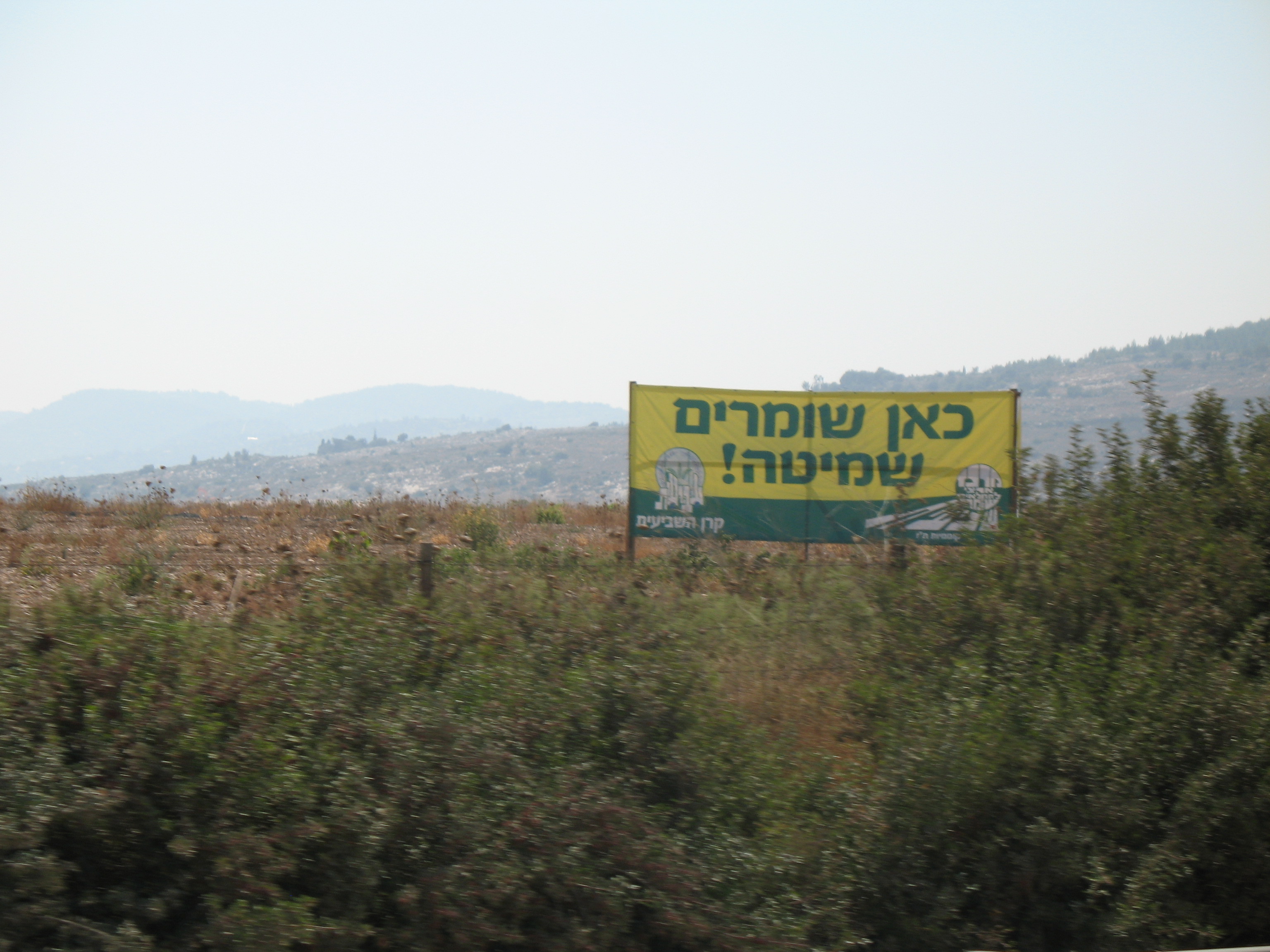
  • Observe Judaism in Israel. The Bible commands Jews – at a minimum a Jewish king – to write a sefer Torah, so have a permanent sofer, a Torah scribe, at the Kotel or at the City of David just south of the Jewish Temple Mount where Kings David and Solomon had their palaces. Replace the siren that marks the entry of Sabbath and Jewish holidays with the sound of a shofar from the same loudspeakers. Mark every field that observes shmita with a large sign, including the verses from the bible declaring such law. etc.

The United States and other countries can also take actions:

Reject any UN Resolution out of hand that does not:

  • mention the “Jewish Temple Mount” when referencing the “Al Aqsa Compound”
  • note that Jerusalem has had a Jewish majority since the 1860s whenever it discusses the “Arab character of Jerusalem”
  • Refer to the region as “Judea and Samaria” whenever it refers to the “West Bank”
  • Comment that the Jordanians and Palestinians ethnically cleansed Judea and Samaria and the eastern part of Jerusalem in 1949, in any resolution which accuses Israel of committing “ethnic cleansing”

Arab and Muslim nations have waged an assault on Jewish history, and the alt-left have become willing disciples. People who care about truth, Jews and Zionism must counter this affront with a comparable campaign to remember and not forget the long and remarkable history of Jews in the Jewish holy land.


Related First.One.Through articles:

The Cave of the Jewish Matriarch and Arab Cultural Appropriation

The Countries that Acknowledge the Jewish Temple May Surprise You

Squeezing Zionism

Iran’s New Favorite Jewish Scholars

The UN’s Disinterest in Jewish Rights at Jewish Holy Places

The New York Times Inverts the History of Jerusalem

The New York Times will Keep on Telling You: Jews are not Native to Israel

Losing the Temples, Knowledge and Caring

In Defense of Foundation Principles

Related First.One.Through video:

Judea and Samaria (Music by the Foo Fighters)

10 Ignored Facts about Jews and Muslim Populations in Israel (Music by Seal)

Who are the Palestinians (Music by The Who)

Subscribe YouTube channel: FirstOneThrough

Join Facebook group: FirstOne Through Israel Analysis