Chagall’s Ladder and October 8 Jews

Marc Chagall (1887–1985) returned again and again to the image of Jacob’s Ladder throughout his long life. But his 1973 rendering, painted near the end of his days, stands apart. It is visually explosive—layered, dissonant, and urgent.
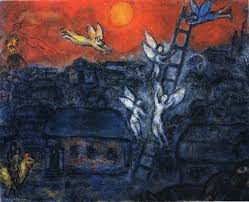
The moment one sees it, the eye is pulled upward to an orange sun burning at the top center. At that height, the sky should glow with daylight yellows. Instead, the sky is red, a communist-red firmament. And the town below, which should be illuminated by that sun, sits in unnatural midnight blue.

Something is wrong in this world. This is not a window into serenity; it is a scene of foreboding.

That imbalance is profoundly Chagall. Born in the Jewish shtetls of the Russian Empire, he fled early waves of antisemitism. He lived through the destruction of European Jewry and spent his career painting ghost-towns of a shattered civilization. But he also painted the biblical narratives that shaped Jewish imagination. In this canvas, he fuses those worlds—eternal story and fragile reality—into a single warning.

At the center of the darkened town rises a ladder stretching into the sky. Three white angels punctuate the blue shadows, announcing that this is Jacob’s dream. Yet Chagall departs from Genesis: the ladder doesn’t stretch into the heavens and all the angels are not identical. Instead, the ladder is held in place by a blue angel, while a second, yellow angel reaches for it from the red sky above.

This ladder has competing destinations.

The blue angel, painted in the same hues as the town, embodies the pull of entrapment—those who cannot or will not flee their circumstances. In 1973, when Chagall painted this work, Soviet Jews were locked inside a system that barred their departure and suppressed their identity. The blue angel is not hostile; it is immovable. It represents the status quo, the path of staying even as danger grows. It is the sleeping Jacob at the bottom of the painting pondering the outcome of fleeing while laying immobile.

The yellow angel, by contrast, belongs to the daylight that should have filled the sky. It symbolizes clarity and escape. Beneath it, at the bottom-left, a mother and child ride a yellow rooster—Chagall’s emblem of dawn, deliverance, and a new beginning. Above them, nearly hidden in the deep blue, a quiet procession of Jews slips toward a safer horizon.

This is Jacob’s dream retold by a man who watched Jews flee the Russian Empire, flee Europe, flee the infernos of the 20th century. It is a ladder that offers a way out—if one chooses the right direction. It is there on Jacob’s face, the yellow glow of peaceful escape.

The October 8 Jews

Today, a new group is dreaming of climbing Chagall’s ladder: the October 8 Jews.

These are the Jews who woke the day after the October 7 massacre not only to the horror in Israel, but to the celebrations of that horror across Western cities. They heard the chants of “Globalize the intifada!” and “There is only one solution—intifada revolution!” echoing at major universities, boulevards, and civic squares. They watched crowds revel in Jewish fear, justify kidnapping, rape, and murder as righteous “resistance,” and proclaim open season on Jews everywhere.

Suddenly, the Western Jew realized that the ground beneath his feet might no longer be stable.

He now lives between Chagall’s two angels. Does he cling to the familiar town—the blue angel of inertia, habit, and misplaced trust? Or does he follow the rooster, the yellow angel, toward a place where Jewish existence is not conditional, tolerated, or revocable?

In the early 20th century, Jews fled the USSR and Europe for the United States and the Land of Israel. Today the destinations remain, but the calculus has changed. The Jewish state is stronger than ever—and simultaneously the focal point of global vitriol. Safety and danger now sit braided together.

The Ladder Still Stands in the Center of Town

Chagall painted Jacob’s Ladder for those who knew safety can vanish overnight. His warning now belongs to us. On October 6, Jews believed they lived in stable towns; on October 8, they saw the sky had been red for years. The chants weren’t metaphors, the mobs weren’t marginal, and the threats weren’t theoretical. The blue angel of normalcy had held the ladder while danger gathered in plain sight.

So the question becomes stark:

Will Jews try to reclaim trust in places that celebrated their terror—or follow the mother and child on Chagall’s yellow rooster toward the only light that doesn’t depend on someone else’s tolerance?

For a century, Jewish survival has meant movement: away from the USSR, away from Europe, away from every place that insisted Jews stay quiet and endangered. The October 8 Jew must decide whether today is any different.

In Chagall’s vision, only one angel leads to dawn.

The ladder still stands. The choice is ours.

Intent and Action: Jacob, Cain, and the Burning Question of Worthy Offerings

From the earliest chapters of the Hebrew Bible, we encounter a recurring theme: human beings trying to reach God through offerings. Noah offers thanks after the flood (Genesis 8:20–21). Abraham builds altars wherever he senses God’s presence (Genesis 12:7–8, 13:18). And in the first tragic sibling story, Cain and Abel each bring a gift to God—hoping to be seen, heard, loved (Genesis 4:3–5).

The Torah gives us the parameters of worthiness: a true offering rises.

Abel’s gift from the firstlings of his flock is accepted—traditionally understood as being consumed in heavenly fire (Genesis 4:4). It ascends upward like smoke from a perfectly tended sacrifice. Cain’s offering—of lesser quality—remains inert. No ascent. No connection. It is not merely ignored; it is a theological dead end, carrying the terror that one’s prayers may not only go unanswered, but may reflect back one’s own internal inadequacy.

That anxiety, that existential dread, echoes generations later across the Parshas of  Toldot and VaYeytze.

Isaac’s Consuming Blessing

Jacob, urged by his mother, disguises himself as Esau in an elaborate plan to secure Isaac’s blessing (Genesis 27:6–29). Isaac eats the carefully prepared meal and, in a moment echoing the sacrificial imagery of Cain and Abel, pours out a blessing so full that when Esau arrives moments later, Isaac declares he has nothing left (Genesis 27:33–36). It was an all-consuming offering. Nothing remains.

Esau’s reaction mirrors Cain’s ancient rage. Spurned, overshadowed, convinced the divine pipeline has bypassed him, Esau vows murder (Genesis 27:41). The pattern repeats: the rejected one turns violent against the brother whose offering has “risen.”

Jacob’s Panic: A Blessing Built on Lies?

And so Jacob flees at his mother’s urging – that same person who had directed him deceive his father. Jacob runs both from Esau’s wrath and from the unbearable question gnawing at his soul (Genesis 27:42–45).

Was his mother’s plan a failure?
Did he truly deserve his father’s blessing?
Was it legitimate if it was obtained through deception?
Was he the new Abel—accepted and uplifted—or Cain, offering something that looked fine on the outside but was internally rotten?

Jacob had already exploited Esau’s hunger to purchase the birthright (Genesis 25:29–34), then deceived his own blind father to secure the blessing (Genesis 27:15–23). He must have wondered whether the blessings he secured, built on trickery, would end like an unburnt sacrifice—never rising, never accepted, destined to collapse under their own falsehood. Perhaps this moment was not a perfect echo of the sacrifices to God by Cain, but marked by the intentions and actions between people, with the uncertainties and fragility such interactions forever carry.

Was Isaac’s blessing a dead letter?

The Ladder: When Heaven Answers the Question

Then comes the dream at Bethel.

A ladder planted on earth, its top reaching into the heavens, with angels ascending and descending (Genesis 28:12). A strange image on its face. Many divine characters at a single time and place, moving in remarkable choreography.

The angels rising—those are the offerings, the intentions, the gifts Jacob has made, confused and imperfect though they may be. They ascend like the smoke of Abel’s sacrifice. And the very same angels descend—carrying blessing back down. Not new angels. The same ones. The same act, the same intention, returning in kind.

This is the divine reply Jacob so desperately needed:
Your offering was accepted. Your intent was seen. Your blessing stands.

Marc Chagall’s Jacob’s Ladder (1973)

Jacob Wakes with Calm

Jacob awakens transformed: relieved, inspired, grounded (Genesis 28:16–17). He WAS afraid. No longer. He understands the dream not as a prophecy of future events but as confirmation that his past actions—flawed in execution but upright in intention—had been received as a worthy offering.

So Jacob does what his ancestors always did in moments of divine clarity: he offers something back to God, establishing that site as sacred and vowing a vow of service and eternal charity (Genesis 28:18–22).

The Lesson: Intent Rises

The Torah’s message from Cain to Jacob is not that action is irrelevant. Far from it. But action without intention is inert—like Cain’s cold, unrisen offering. Intention, even wrapped in human imperfection, can ascend and draw God’s response.

Jacob’s ladder teaches that what rises from the heart returns as blessing. The smoke goes up; the angels come down. The offering is accepted; the blessing is confirmed.

Intent and action. Purity and performance.
That is the spiritual physics the Torah reveals—first in a field with two brothers, and then on a lonely night with a frightened man who finally learns he is worthy.

Jacob – And Esau’s – Ladder

One of the most famous stories in the Book of Genesis is about Jacob’s ladder with angels ascending and descending. The famous biblical commentator Rashi (1040-1105) said that the angels going up were tied to the holy land and had to leave Jacob as he journeyed to live with his uncle Laban outside of the land. The angels coming down were new angels who would accompany Jacob while he lived outside of the holy land.

Jacob’s Ladder by Frans Francken II the Younger (1581-1642)

I would like to share an alternative interpretation: the angels on the ladder represent Jacob’s relationship with Esau.

There is no tool that connects hands and feet like a ladder. Both are required to go up as well as to come down. If several people are on a ladder at one time, hands and feet would likely be touching.

That is a reference to Jacob. His name literally came from his act of holding onto the heel of his brother Esau at their births. “Jacob” stems from the Hebrew word for heel, “akeb” (Genesis 25:26):

וְאַֽחֲרֵי־כֵ֞ן יָצָ֣א אָחִ֗יו וְיָד֤וֹ אֹחֶ֙זֶת֙ בַּעֲקֵ֣ב עֵשָׂ֔ו וַיִּקְרָ֥א שְׁמ֖וֹ יַעֲקֹ֑ב וְיִצְחָ֛ק בֶּן־שִׁשִּׁ֥ים שָׁנָ֖ה בְּלֶ֥דֶת אֹתָֽם׃

The clutching of the heel in the world’s first recorded twins set the primogeniture battle for the ages.

Birthright

There are two stories of Jacob angling to take the birthright from Esau. First, Jacob operates on his own and trades food with a hungry Esau for the birthright (Genesis 25:29-34). Years later, as their father Isaac wasn’t likely to abide by the earlier exchange between the brothers, Jacob acts at the urging of his mother Rebekah to trick Isaac into giving the special blessing intended for Esau to himself. Esau was so distraught by this action, that he swore he would kill Jacob, forcing Jacob to flee to live with Laban. (Genesis 27:1-21).

Jacob had the dream of angels on the ladder while he was fleeing from Esau. Jacob was not sure whether he had the advantage of the blessing or was a hunted man. On the ladder, the person higher up is only ahead while ascending; the elevated person actually trails the person below him when they are all descending.

The story of Jacob clutching Esau’s leg finally comes to a close when Jacob returns to the holy land. In Genesis 32:25-33, Jacob wrestles a man/angel who dislocates Jacob’s hip. As the angel breaks free he blesses Jacob by changing his name to Yisrael:

וַיֹּ֗אמֶר לֹ֤א יַעֲקֹב֙ יֵאָמֵ֥ר עוֹד֙ שִׁמְךָ֔ כִּ֖י אִם־יִשְׂרָאֵ֑ל כִּֽי־שָׂרִ֧יתָ עִם־אֱלֹהִ֛ים וְעִם־אֲנָשִׁ֖ים וַתּוּכָֽל׃

“Said he, ‘Your name shall no longer be Jacob, but Israel, for you have striven with beings divine and human, and have prevailed.'”

Jacob/Israel, together with his wives and children, are then able to meet with Esau with his 400-person army, no longer carrying the weight of the contest. After they meet, Jacob gets affirmation from Gd about moving beyond the Jacob-Esau heel connection in Genesis 35:9-13.

וַיֹּֽאמֶר־ל֥וֹ אֱלֹהִ֖ים שִׁמְךָ֣ יַעֲקֹ֑ב לֹֽא־יִקָּרֵא֩ שִׁמְךָ֨ ע֜וֹד יַעֲקֹ֗ב כִּ֤י אִם־יִשְׂרָאֵל֙ יִהְיֶ֣ה שְׁמֶ֔ךָ וַיִּקְרָ֥א אֶת־שְׁמ֖וֹ יִשְׂרָאֵֽל׃

Gd saying to him, “You whose name is Jacob, You shall be called Jacob no more,
But Israel shall be your name.” Thus he was named Israel.

וַיֹּ֩אמֶר֩ ל֨וֹ אֱלֹהִ֜ים אֲנִ֨י אֵ֤ל שַׁדַּי֙ פְּרֵ֣ה וּרְבֵ֔ה גּ֛וֹי וּקְהַ֥ל גּוֹיִ֖ם יִהְיֶ֣ה מִמֶּ֑ךָּ וּמְלָכִ֖ים מֵחֲלָצֶ֥יךָ יֵצֵֽאוּ׃

And God said to him, “I am El Shaddai. Be fertile and increase; A nation, yea an assembly of nations, Shall descend from you. Kings shall issue from your loins.

וְאֶת־הָאָ֗רֶץ אֲשֶׁ֥ר נָתַ֛תִּי לְאַבְרָהָ֥ם וּלְיִצְחָ֖ק לְךָ֣ אֶתְּנֶ֑נָּה וּֽלְזַרְעֲךָ֥ אַחֲרֶ֖יךָ אֶתֵּ֥ן אֶת־הָאָֽרֶץ׃

The land that I assigned to Abraham and Isaac I assign to you;
And to your offspring to come Will I assign the land.”


Jacob’s view of himself was tied to his name which conveyed a pursuit of his brother and his blessing. Once he broke free of that pursuit – together with a limp and a new name – Israel was able to accept that he was the heir to the blessings Gd bestowed upon his forefathers.

The angels on the ladder in Jacob’s dream were not geofenced protectors of Jacob but a reflection of his link with Esau, together with confusion of his actions. Esau would always be older and above him on the ladder, but descending and on the ground in the holy land, Jacob/Israel was entitled to the blessings and inheritance.

Related articles:

Jacob’s Many Angels and Vayetze Jews (December 2023)

The First Dreamer Foreshadowed The Life Of Joseph (December 2022)

The First Dreamer Foreshadowed The Life Of Joseph

The beginning of the world as told in the Jewish Bible is a remarkable story. It is a world that seemingly is infused both with the natural and super-natural, where God and man interact regularly: the world was built and then destroyed in a flood, save for Noah and his family, whom God directed to build an ark; Abraham pleads with God to save corrupt cities which are nevertheless pummeled with fire and brimstone.

In the middle of the physical interfacing between God and mankind as well as family drama, the Bible pauses for a few sentence to relay a mundane story. Jacob has a dream.

וַיֵּצֵ֥א יַעֲקֹ֖ב מִבְּאֵ֣ר שָׁ֑בַע וַיֵּ֖לֶךְ חָרָֽנָה׃ וַיִּפְגַּ֨ע בַּמָּק֜וֹם וַיָּ֤לֶן שָׁם֙ כִּי־בָ֣א הַשֶּׁ֔מֶשׁ וַיִּקַּח֙ מֵאַבְנֵ֣י הַמָּק֔וֹם וַיָּ֖שֶׂם מְרַֽאֲשֹׁתָ֑יו וַיִּשְׁכַּ֖ב בַּמָּק֥וֹם הַהֽוּא׃ וַֽיַּחֲלֹ֗ם וְהִנֵּ֤ה סֻלָּם֙ מֻצָּ֣ב אַ֔רְצָה וְרֹאשׁ֖וֹ מַגִּ֣יעַ הַשָּׁמָ֑יְמָה וְהִנֵּה֙ מַלְאֲכֵ֣י אֱלֹהִ֔ים עֹלִ֥ים וְיֹרְדִ֖ים בּֽוֹ׃ וְהִנֵּ֨ה יְהֹוָ֜ה נִצָּ֣ב עָלָיו֮ וַיֹּאמַר֒ אֲנִ֣י יְהֹוָ֗ה אֱלֹהֵי֙ אַבְרָהָ֣ם אָבִ֔יךָ וֵאלֹהֵ֖י יִצְחָ֑ק הָאָ֗רֶץ אֲשֶׁ֤ר אַתָּה֙ שֹׁכֵ֣ב עָלֶ֔יהָ לְךָ֥ אֶתְּנֶ֖נָּה וּלְזַרְעֶֽךָ׃…Jacob left Beer-sheba, and set out for Haran. He came upon a certain place and stopped there for the night, for the sun had set. Taking one of the stones of that place, he put it under his head and lay down in that place. He had a dream; a stairway was set on the ground and its top reached to the sky, and messengers of God were going up and down on it. And standing beside him was יהוה, who said, “I am יהוה, the God of your father Abraham’s [house] and the God of Isaac’s [house]: the ground on which you are lying I will assign to you and to your offspring… (Genesis 28: 10-13)

God had already directly given such promise to Abraham while he was awake. It is peculiar that God would choose an elaborate dream with angels on a ladder to convey the same message to Jacob in his sleep.

Jacob’s Ladder by Frans Francken II the Younger (1581-1642)

It is also a curiosity that people today are so fascinated by the story, even more than God talking directly to man. Perhaps it is because God no longer talks directly to people today, even as many of us dream, so we can relate to the story.

Or perhaps it is because Jacob’s dream is the foreshadowing of the life of the biggest character of Genesis, his son Joseph.

Three “Places”, Four Conditions

When the Bible writes about about Jacob’s dream, it repeats the Hebrew word מָּק֥וֹם three times in a single sentence, an oddity. While it can mean “place” it can also mean “God”. It is as though the narrator is telling us that something significant is about to happen, and it is location and God.

The dream is definitely dramatic. While the builders of the Tower of Babel tried to reach the heavens, Jacob actually got to “see” it. While man labored unsuccessfully for years to ascend, angels effortlessly went up and down.

And alongside the ladder was God himself. No one, not even his father and grandfather, had seem Him, but only heard His voice. Now Jacob had a new medium for his connection with God and he chose to concretize the event while awake.

וַיַּשְׁכֵּ֨ם יַעֲקֹ֜ב בַּבֹּ֗קֶר וַיִּקַּ֤ח אֶת־הָאֶ֙בֶן֙ אֲשֶׁר־שָׂ֣ם מְרַֽאֲשֹׁתָ֔יו וַיָּ֥שֶׂם אֹתָ֖הּ מַצֵּבָ֑ה וַיִּצֹ֥ק שֶׁ֖מֶן עַל־רֹאשָֽׁהּ׃ וַיִּקְרָ֛א אֶת־שֵֽׁם־הַמָּק֥וֹם הַה֖וּא בֵּֽית־אֵ֑ל וְאוּלָ֛ם ל֥וּז שֵׁם־הָעִ֖יר לָרִאשֹׁנָֽה׃ וַיִּדַּ֥ר יַעֲקֹ֖ב נֶ֣דֶר לֵאמֹ֑ר אִם־יִהְיֶ֨ה אֱלֹהִ֜ים עִמָּדִ֗י וּשְׁמָרַ֙נִי֙ בַּדֶּ֤רֶךְ הַזֶּה֙ אֲשֶׁ֣ר אָנֹכִ֣י הוֹלֵ֔ךְ וְנָֽתַן־לִ֥י לֶ֛חֶם לֶאֱכֹ֖ל וּבֶ֥גֶד לִלְבֹּֽשׁ׃ וְשַׁבְתִּ֥י בְשָׁל֖וֹם אֶל־בֵּ֣ית אָבִ֑י וְהָיָ֧ה יְהֹוָ֛ה לִ֖י לֵאלֹהִֽים׃…Early in the morning, Jacob took the stone that he had put under his head and set it up as a pillar and poured oil on the top of it. He named that site Bethel; but previously the name of the city had been Luz. Jacob then made a vow, saying, “If God remains with me, protecting me on this journey that I am making, and giving me bread to eat and clothing to wear, and I return safe to my father’s house— יהוה shall be my God. And this stone, which I have set up as a pillar, shall be God’s abode; and of all that You give me, I will set aside a tithe for You.”…(Genesis 28:18-21)

Jacob was awestruck by the event and anointed the rock-pillow he slept on during the dream, but then conditioned his faith in the real world. He asked God for four things to prove Himself before he would accept Him as his God, and then seemingly for God to truly establish his promise of the land for his inheritance.

These four requests set the tone for the remainder of Genesis.

Three Pairs of Dreams

Jacob, the first dreamer, would be followed by his son Joseph. While Jacob dreamed only once and doubted the veracity of what he saw, Joseph seemingly was confident about his two dreams.

Genesis 37:5-11 relays Joseph having a dream which he told his brothers about their sheaves bowing down to his, and then a second dream which he told his brothers and Jacob, of eleven stars, moon and sun bowing to him. While the brothers hated Joseph for the dream, Jacob considered it, as he knew about dreams himself but continued to be unsure whether to embrace a message told in such fashion.

וַיְקַנְאוּ־ב֖וֹ אֶחָ֑יו וְאָבִ֖יו שָׁמַ֥ר אֶת־הַדָּבָֽר׃ So his brothers were wrought up at him, and his father kept the matter in mind. (Genesis 37:11)

The second pair of dreams (Genesis 40) happened in Egypt, as Joseph listened to the dreams of two fellow prisoners, a cupbearer and a baker. This time, Joseph interpreted their dreams which accurately predicted the fates of the two men.

The third pair of dreams happened to Pharaoh (Genesis 41), which Joseph was brought in to interpret. While they had not proven accurate, they rang true to Pharaoh who immediately sought to take action based on Joseph’s interpretation. This is the first time – after seven dreams told by the Bible – that anyone took dreams to be an omen that must be addressed immediately. Perhaps it was because Pharaoh viewed himself like a God who could take complementary action to God’s will. Either way, it was in sharp contrast to the first dream of Jacob in which he conditioned accepting God’s word.

Jacob’s Four Conditions

While Jacob asked God to stay with him and protect him from harm, it was Joseph who really faced numerous life-or-death situations, and survived. From his brothers trying to kill him, sell him into slavery and being cast into an Egyptian dungeon, God stayed with Joseph and protected him from the spiral of events that started from Joseph’s sharing his first pair of dreams.

Jacob’s second condition was about food. That foreshadowed the baker and winemaker who relayed the second pair of dreams in the prison cells of Egypt.

Jacob’s third condition was clothing. After Joseph interpreted Pharaoh’s dream and gave him a plan for addressing the famine that was to come, Pharaoh put him in charge of all the land of Egypt and dressed him in the finest fashion.

וַיָּ֨סַר פַּרְעֹ֤ה אֶת־טַבַּעְתּוֹ֙ מֵעַ֣ל יָד֔וֹ וַיִּתֵּ֥ן אֹתָ֖הּ עַל־יַ֣ד יוֹסֵ֑ף וַיַּלְבֵּ֤שׁ אֹתוֹ֙ בִּגְדֵי־שֵׁ֔שׁ וַיָּ֛שֶׂם רְבִ֥ד הַזָּהָ֖ב עַל־צַוָּארֽוֹ׃ And removing his signet ring from his hand, Pharaoh put it on Joseph’s hand; and he had him dressed in robes of fine linen, and put a gold chain about his neck. (Genesis 41:42)

The three sets of dream correlate to Jacob’s first three conditions to internalizing God’s message in his dream. They represent a life for Jacob without Joseph present, as if his favorite son had become a dream. Jacob did not know whether Joseph was alive or dead, much like he wasn’t sure about the dream’s veracity. The three pairs of dreams were divinely inspired as alluded to at the very beginning of Jacob’s dream with the word מָּק֥וֹם appearing three times in one sentence.

Ultimately, the fourth condition, to “return safe to my father’s house,” was the reunion between Jacob and Joseph. When Jacob heard that Joseph was alive his spirit was awakened, as if from a deep sleep (Genesis 45:27). It was then that God reappeared to Jacob – at night again – to go to Egypt to reunite with his son and that God would return him to the promised land. (Genesis 46:1-4)

That action brought the entire family together, and had Jacob – now Israel – believe in God’s promise, setting the future for the children of Israel.

The first dreamer was awe-struck but doubted the dream’s authenticity, setting conditions to accept God. That action set in motion the life of Joseph and the history of the Jewish people.

Related articles:

3 1 4, Hebrew Pi

The Karma of the Children of Israel

The Descendants of Noah

The Place and People for the Bible

Humble Faith

Ten Good Men

The Journeys of Abraham and Ownership of the Holy Land

The Nation of Israel Prevails