Intent and Action: Jacob, Cain, and the Burning Question of Worthy Offerings

From the earliest chapters of the Hebrew Bible, we encounter a recurring theme: human beings trying to reach God through offerings. Noah offers thanks after the flood (Genesis 8:20–21). Abraham builds altars wherever he senses God’s presence (Genesis 12:7–8, 13:18). And in the first tragic sibling story, Cain and Abel each bring a gift to God—hoping to be seen, heard, loved (Genesis 4:3–5).

The Torah gives us the parameters of worthiness: a true offering rises.

Abel’s gift from the firstlings of his flock is accepted—traditionally understood as being consumed in heavenly fire (Genesis 4:4). It ascends upward like smoke from a perfectly tended sacrifice. Cain’s offering—of lesser quality—remains inert. No ascent. No connection. It is not merely ignored; it is a theological dead end, carrying the terror that one’s prayers may not only go unanswered, but may reflect back one’s own internal inadequacy.

That anxiety, that existential dread, echoes generations later across the Parshas of  Toldot and VaYeytze.

Isaac’s Consuming Blessing

Jacob, urged by his mother, disguises himself as Esau in an elaborate plan to secure Isaac’s blessing (Genesis 27:6–29). Isaac eats the carefully prepared meal and, in a moment echoing the sacrificial imagery of Cain and Abel, pours out a blessing so full that when Esau arrives moments later, Isaac declares he has nothing left (Genesis 27:33–36). It was an all-consuming offering. Nothing remains.

Esau’s reaction mirrors Cain’s ancient rage. Spurned, overshadowed, convinced the divine pipeline has bypassed him, Esau vows murder (Genesis 27:41). The pattern repeats: the rejected one turns violent against the brother whose offering has “risen.”

Jacob’s Panic: A Blessing Built on Lies?

And so Jacob flees at his mother’s urging – that same person who had directed him deceive his father. Jacob runs both from Esau’s wrath and from the unbearable question gnawing at his soul (Genesis 27:42–45).

Was his mother’s plan a failure?
Did he truly deserve his father’s blessing?
Was it legitimate if it was obtained through deception?
Was he the new Abel—accepted and uplifted—or Cain, offering something that looked fine on the outside but was internally rotten?

Jacob had already exploited Esau’s hunger to purchase the birthright (Genesis 25:29–34), then deceived his own blind father to secure the blessing (Genesis 27:15–23). He must have wondered whether the blessings he secured, built on trickery, would end like an unburnt sacrifice—never rising, never accepted, destined to collapse under their own falsehood. Perhaps this moment was not a perfect echo of the sacrifices to God by Cain, but marked by the intentions and actions between people, with the uncertainties and fragility such interactions forever carry.

Was Isaac’s blessing a dead letter?

The Ladder: When Heaven Answers the Question

Then comes the dream at Bethel.

A ladder planted on earth, its top reaching into the heavens, with angels ascending and descending (Genesis 28:12). A strange image on its face. Many divine characters at a single time and place, moving in remarkable choreography.

The angels rising—those are the offerings, the intentions, the gifts Jacob has made, confused and imperfect though they may be. They ascend like the smoke of Abel’s sacrifice. And the very same angels descend—carrying blessing back down. Not new angels. The same ones. The same act, the same intention, returning in kind.

This is the divine reply Jacob so desperately needed:
Your offering was accepted. Your intent was seen. Your blessing stands.
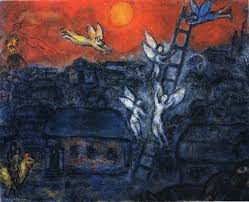
Marc Chagall’s Jacob’s Ladder (1973)

Jacob Wakes with Calm

Jacob awakens transformed: relieved, inspired, grounded (Genesis 28:16–17). He WAS afraid. No longer. He understands the dream not as a prophecy of future events but as confirmation that his past actions—flawed in execution but upright in intention—had been received as a worthy offering.

So Jacob does what his ancestors always did in moments of divine clarity: he offers something back to God, establishing that site as sacred and vowing a vow of service and eternal charity (Genesis 28:18–22).

The Lesson: Intent Rises

The Torah’s message from Cain to Jacob is not that action is irrelevant. Far from it. But action without intention is inert—like Cain’s cold, unrisen offering. Intention, even wrapped in human imperfection, can ascend and draw God’s response.

Jacob’s ladder teaches that what rises from the heart returns as blessing. The smoke goes up; the angels come down. The offering is accepted; the blessing is confirmed.

Intent and action. Purity and performance.
That is the spiritual physics the Torah reveals—first in a field with two brothers, and then on a lonely night with a frightened man who finally learns he is worthy.

Eikev, On Consequences

Parshat Eikev is about consequences. Love God and cherish the land, and there will be abundance. Turn away from them, and the blessings will vanish. It’s not just poetic scripture—it’s a binding principle embedded in Jewish destiny.

In 2005, Israel withdrew from Gaza, handing the Strip to the Palestinian Authority. The move was framed as a step toward peace, but Palestinians internalized a different lesson from the Second Intifada: violence works. Within two years, Hamas was elected to a majority of the Palestinian parliament, seized power in Gaza, and rockets became Gaza’s chief export.

The same pattern played out decades earlier. In 1967, Israel reclaimed eastern Jerusalem from Jordan in a defensive war and reunified the city. Yet, instead of asserting Jewish sovereignty on the Temple Mount—the holiest site in Judaism—Israel handed day-to-day control to the Islamic Waqf which banned Jewish prayer there. The Muslim world absorbed the message: Jews do not value their holy places as deeply as Muslims do.

These choices raise the uncomfortable question: do Jews truly love the land and God in the way Eikev commands? The Bible is not just a Jewish text. Billions of non-Jews around the globe read it. They know its covenantal clauses and its warnings. They understand—at least in their own terms—the consequences that befall Jews when we turn from God’s love and from the eternal heritage of the land. Some may even see themselves as agents in delivering divine justice.

God knows. The world knows.

It is time for Jews to internalize this truth. The Shema’s first line is often recited aloud with pride. But the second section (starting at Deuteronomy 11:13), with its stark outline of blessings for faithfulness and curses for betrayal, is whispered—if said at all. Perhaps it’s time to say it aloud, not just with our lips, but with our lives: affirming an unbreakable commitment to God and to the holiness of the land.

In Israel, that would be building homes in the area known as “E1,” cementing all of Jerusalem including the Temple Mount as integral to Israel. In the diaspora, it means putting mezuzahs on doorposts and wearing tefillin (11:18-20).

The Old City of Jerusalem including the Jewish Temple Mount/ Al Aqsa Compound

Consequences are not an abstraction in the Torah—they are the lived reality of Jewish history. Eikev’s message is as urgent now as it was on the plains of Moab.

Abraham’s Hospitality: Lessons for Jews and Arabs

The biblical portion of Vayera showcases stories of the patriarch Abraham welcoming strangers. The stories of Abraham’s hospitality became incorporated into the ways that the children of Abraham think of themselves today. However, the nature of the hospitality of Arabs (descendants of Abraham’s son Ishmael) and Jews (descendants of Abraham’s son Isaac) diverge in many ways.

Giovanni_Andrea_de_Ferrari_-_Abraham_and_the_Three_Angels
Abraham and the Three Angels
by Giovanni Andrea de Ferrari (1598-1669)

Man and God

Jewish perspective: Judaism prides itself in being a religion of actions, not faith. God gave the Jewish people 613 commandments to follow, some of which are active (make the Sabbath holy) and others that are passive (don’t kill). A division could also be made of laws between people (like murder) and those between man and God (like the Sabbath).

A casual observer of religions would imagine that laws about God would take precedence to laws about people.  The Jewish organization Limmud, posted an article about Vayera, which argued the opposite.

During the story of Vayera there was an encounter between Abraham and God. In the middle of the conversation, Abraham asked God to wait so he could welcome three strangers that were passing his tent. The author of the Limmud article, Jeremy Rosen argued that Abraham’s action taught Jews a lesson for today, “that however primary God is, there are certain types of human crises or obligations that are so important that one can actually tell God to wait. In the end religion must enhance our relationship with other humans.

Islamic perspective: The website “OnIslam” is dedicated to educating Muslims on a variety of subjects. An article on hospitality and the “joy of honoring others” made a clear effort to differentiate between the kind of hospitality that Muslims extend, and those of non-Muslims. The true concept of hospitality is not something that is widely practiced in most non-Muslim countries. For many non-Muslims, the entertainment of guests is of primary importance in many cases for worldly reasons only, not rooted in real hospitality for the sake of God. In Islam, however, hospitality is a great virtue that holds a significant purpose. Being hospitable to neighbors and guests can increase societal ties as well as unite an entire community. Most importantly, God commands Muslims to be hospitable to neighbors and guests. There is a great reward in doing so. Hospitality in Islam is multi-faceted and covers many different areas in addition to the hospitality that we show guests who visit our homes.”

In Islam, hospitality is performed because it is commanded by God. The act of hospitality may have benefits of creating communal harmony, but it is a derivative of the second degree. The primary obligation is to follow God’s command, and He commands all Muslims to be hospitable. God’s command leads man to action, and such action may, in turn, lead to friendship and social cohesion.

The difference in the approach of the religions is both subtle and significant. Judaism has a value system of helping others. Welcoming a stranger takes precedence to a direct conversation with God. In contrast, Islam focuses on obedience to God’s commands. Hospitality happens to be one of those commands and is therefore performed – within the bounds of religion.

Hospitality Today on a National Level

It is interesting to look at the nature of hospitality on a national level and how the one Jewish State handles hospitality compared to various Muslim countries (note that there are many Muslim countries, like Turkey, Malaysia and Indonesia, that are NOT Arab and descendants of Abraham).

Welcoming Refugees
Israel: Israel has an incredible record when it comes to welcoming Jews from around the world. Whether in bringing Jews that were persecuted in the Arab world in the 1950s, or Russian and Ethiopian Jews in the 1990s, Israel took in so many Jews from around the world, that they dwarf the number of European Jews who came to the country due to persecution in Europe during the 1930s and 1940s.

Those Moroccan, Yemenite, Ethiopian and Russian refugees received Israeli citizenship immediately. They got housing and job training. They had teachers to teach them a new language (Hebrew) and lessons about incorporating into a society that was completely foreign to their old way of living.

Arab/ Muslim Countries: The Middle East has witnessed a large number of wars and corresponding waves of refugees fleeing the battles. Many Arab countries did not welcome their fellow Arabs.

  • When Arabs left the British Mandate of Palestine to Lebanon and Syria in 1948-9, they were forced to live in refugee camps. They were not offered citizenship nor given an opportunity to have white color jobs. Those conditions continue for their children and grandchildren almost 70 years later.
  • When the PLO sided with Iraq when Iraq invaded Kuwait in 1991, Kuwait expelled roughly 360,000 Palestinians that were living there.  Fellow Arabs that were neighbors for 75 years were evicted en masse because of the actions of people hundreds of miles away.
  • Most recently, the millions of Arabs fleeing the civil war in Syria, and ISIS in Iraq have been shut out of the wealthy countries of Saudi Arabia; Qatar; Bahrain; United Arab Emirates and Kuwait.  Westerners may wonder how these oil rich countries are not embarrassed to refuse to welcome fellow Arabs, especially as Europe and America open its doors.  Only Lebanon, Jordan and Turkey (Muslim, but not Arab) have shown these refugees Islamic hospitality.

Welcoming “Others”
Israel: The phrase in the bible “love thy neighbor as thyself” (Leviticus 19:18) has been interpreted by various scholars as both a model for treating fellow Jews and for interactions with all of mankind.

  • When Israel declared independence in 1948, it granted 160,000 non-Jews citizenship.  When Israel reunited Jerusalem after Jordanian and Palestinian Arabs attacked it in 1967, it offered citizenship to all non-Jews.
  • When Menahem Begin became prime minister of Israel in 1977, he brought in and gave citizenship to roughly 300 Vietnamese people fleeing their country.
  • Today the country is grappling with how to deal with Eritrean and Sudanese asylum seekers as many Israeli Jews believe in the principal of hospitality, even while the government considers issues of safety.

Arab/ Muslim Countries: The Arab countries do very poorly in regards to their hospitality with non-Muslims.

  • When Jordan seized Judea and Samaria in 1949, it expelled all of the Jews in the area and forbade them from even visiting their holy sites in Jerusalem.
  • Today, Mahmoud Abbas has laws preventing the sale of any land by Arabs to Jews and has demanded a new country to be established devoid of Jews.
  • After Israel was founded, the Arab countries forced over 850,000 Jews to flee their homes where they had lived for generations.

Helping Others
Israel: Israel has a reputation of rushing to assist countries around the world suffering from natural disasters.  Whether from earthquakes in Turkey or Haiti or tsunamis in the Pacific Ocean, Israel is on the scene with disproportionate numbers with life-saving assistance.

Arab/ Muslim Countries: The Arab world typically does not send much assistance to countries in need.  That fact is surprising since it is a core tenant of Islam.  OnIslam states: “In Islam, hospitality extends well beyond the walls of the home. Being hospitable also means having good manners and treating others with dignity and respect. Hospitality can be applied to the greater community and Muslims must strive to help out whenever there is a time of need. Natural disasters, for example, often result in community turmoil as residents grapple with the aftermath. This provides Muslims with an excellent opportunity to pitch in, whether delivering hot meals to those affected or donating gently used items to someone who has lost everything.”

However, the Charities Aid Foundation did rank some Islamic nations among the most generous in the world, including: Malaysia; Indonesia; and Iran in the top 20.  However, none of those three countries is Arab.  Israel, the Jewish State, ranked number 32.


Abraham taught Jews and Arabs about the importance of hospitality.  Each group interpreted his acts of kindness through their respective prophets and teachers over the centuries, with Jews extracting a primary value of the kinship of men, while Muslims placed hospitality as just one of God’s commands to be observed.  Jews learned a life-lesson from Abraham; Arabs stifled that more human example and took the message of hospitality from the Quran.

The children of Abraham – the Jewish State and the Arab states – should all be mindful of the importance of hospitality in their dealings today.


Related First.One.Through artices:

The End of Together

Joint Prayer: The Cave of the Patriarchs and the Temple Mount

Subscribe YouTube channel: FirstOneThrough

Join Facebook group: FirstOne Through  Israel Analysis

Gimme that Old-Time Religion

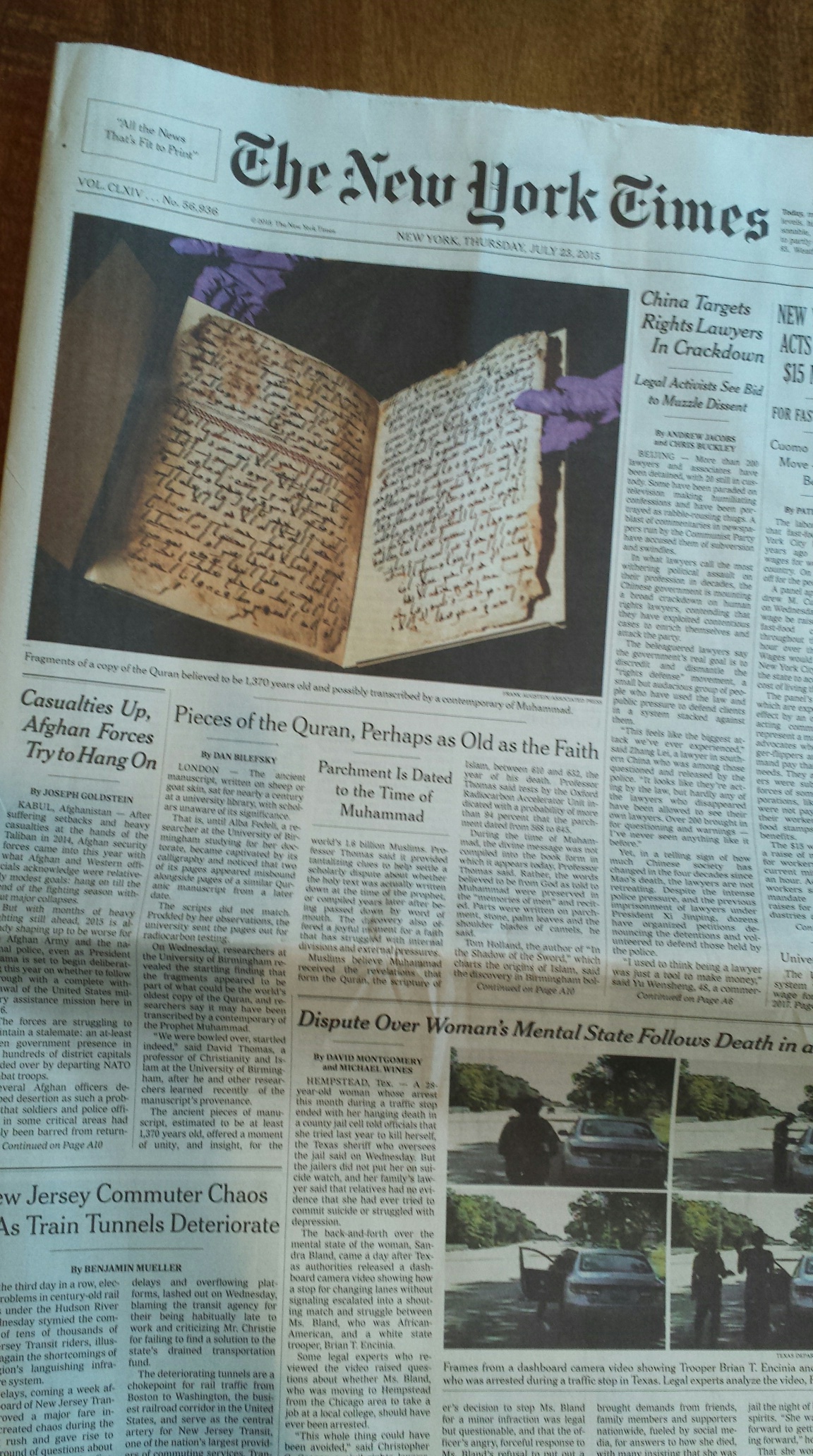
Two of the three main monotheistic faiths had amazing historical revelations in July 2015. If you read the New York Times, you only learned about one of them.

Quran

On a front page story with a large accompanying color picture, the New York Times relayed an incredible discovery: an old Quran that had been sitting on the shelves of the University of Birmingham, England for a century, was dated to around the year 600CE plus or minus 50 years.  That would make this version of the Quran the oldest manuscript in Islam.

20150724_072357
New York Times Front Page Story on Quran,
July 23, 2015

According to Islamic tradition, their prophet Mohammed received divine revelations and compiled the Quran sometime between 610 to 632CE. Religious scholars had debated whether the Quran was passed down in oral form for many generations after Mohammed’s death before ultimately being written down. If the text indeed was written down on the parchment when it was prepared (sometimes parchments were washed and reused, and carbon-dating only relates to the parchment but not the actual ink and text), it would answer that outstanding question.

The Hebrew Bible

Three days before the world heard about the dating of the oldest Quran, researchers uncovered one of the oldest texts of the Hebrew Bible, dating from around 500CE.

EinGediscroll1
Charred scroll from synagogue in Ein Gedi
(photo: Shay Halevi/Israel Antiquities Authority)

In the 1970s, the piece of a charred scroll was discovered in Ein Gedi in the Judean Desert. Only in July 2015 were researchers able to use the latest technology to decipher the damaged text to reveal sentences from the book of Leviticus. While older documents (by 500+ years) of the Hebrew Bible had been discovered not far from Ein Gedi, those documents were found hidden in jars within caves.  This scroll was found in the ancient synagogue of Ein Gedi, revealing the earliest discovery of a Torah scroll housed in a synagogue.

scroll-800x936
Text from the Ein Gedi scrolls
(photo: University of Kentucky)

Both of these stories are amazing in terms of history, religion and science.  It brings to mind an old gospel song: “Give Me that Old Time Religion!”

Yet the part “that’s NOT good enough for me” (to paraphrase the song) is the nagging question why the New York Times never misses an opportunity to slight Israel.  The discovery of one old religious treasure received front page attention (for Islam) but a text from 100 years earlier didn’t even get a passing mention (for Judaism).  Was it because the scrolls were found in the Judean Desert which further underscores the long history of Jews in the contentious Jordan Valley?

Why do you think the NYT mentioned only one of these stories?


Related FirstOneThrough articles:

When were Jews barred from living in Judea & Samaria?

Names and Narrative: The West Bank / Judea and Samaria

The Subtle Discoloration of History: Shuafat

Subscribe YouTube channel: FirstOneThrough

Join Facebook group: FirstOne Through  Israel Analysis