In Chayei Sarah, Abraham does something brave. When it’s time to find a wife for his son Isaac, he refuses to choose from the neighbors around him. These were the people he did business with, lived among, interacted with every day — but they did not share his values. So he sends his servant far away to find someone who does.
Abraham teaches us something simple and powerful: proximity is not loyalty. Geography is not identity. Values matter more than convenience.
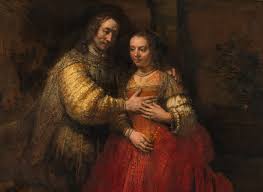
Rembrandt’s “The Jewish Bride,” (c. 1665) originally called “Isaac and Rebecca”
We are living this lesson now. In the last year, too many of us have watched people we assumed were “ours” turn their backs — classmates, coworkers, fellow Jews, even friends who share our politics. Being nearby doesn’t make someone trustworthy. Sharing a label doesn’t make them aligned. We’ve learned, painfully, that not everyone who sits next to us stands with us.
Abraham reminds us that it’s okay — even necessary — to choose our people carefully. To build relationships around courage and truth, not comfort or habit. To seek out the ones who show up for Jewish dignity when it’s hard, not only when it’s fashionable.
Isaac didn’t need a local partner; he needed the right partner. So do we.
Abraham once defended the wicked on the merit of the righteous few. Today, the world defends the wicked for the sake of evil masses.
The Moral Math of Vayera In Parashat Vayera, God tells Abraham that Sodom will be destroyed for its depravity. The city is beyond saving — cruelty is civic policy, justice a mockery. But Abraham does the unthinkable: he defends the wicked, not because he excuses them, but because he believes that within their city a few righteous might remain.
“Will You indeed sweep away the righteous with the wicked?” (Genesis 18:23)
Abraham bargains God down — fifty, forty-five, thirty, twenty, ten. If even one percent (population of Sodom estimated 1,000) righteous can be found, the city deserves another chance. Abraham’s plea becomes the Torah’s first moral equation: mercy for the many on the merit of the few. He argues for the wicked because of the righteous – or perhaps for only the righteous to be spared.
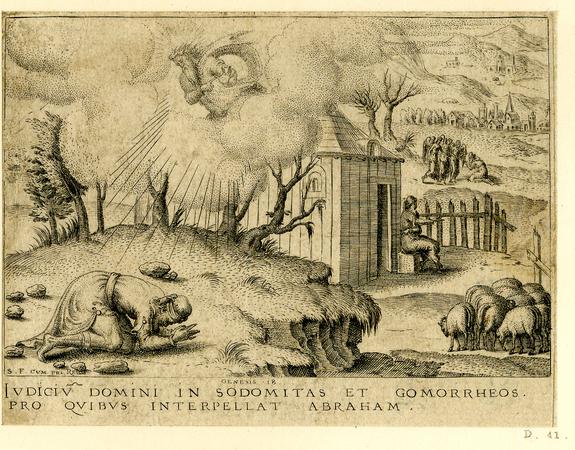
Abraham praying to God on behalf of the residents of Sodom and Gomorrah, by Étienne Delaune (1518-1583)
A Sordid Defense of Evil Four thousand years later, the moral logic has flipped. After the October 7 massacre — the torture, murder, and kidnapping of civilians — millions marched not to defend the righteous within Gaza, but to defend the wicked who carried out the atrocities. From London to New York, the cry was “Globalize the Intifada.” The United Nations would not even utter Hamas’s name.
They did not plead for ten good souls but glorified evil itself. Abraham argued for the guilty because he believed in goodness; today’s socialist-jihadists argue for the guilty because they despise Jews. That is not compassion — it is moral rot spreading far from the center of evil, infecting universities, newsrooms, and now city halls.
In Sodom’s time, no one defended depravity. Today, Genocide becomes “context.” Rape becomes “resistance.” Decapitation becomes “desperation.” Abraham fought for the 99 percent on the merit of the 1 percent righteous. Now we see millions fighting for the 75 percent wicked, based on the very actions of the depraved.
Nowhere is this clearer than in New York City — home to the world’s largest Jewish community — where activists chanting “Globalize the Intifada” and rape deniers will shape city politics. The descendants of Abraham are mocked as colonizers in their own synagogues and schools.
The Torah is silent on the punishment for those who aid and abet wickedness, but American law is not. The U.S. forbids “material support to terrorism.” Groups like CAIR face renewed scrutiny for Hamas ties; Students for Justice in Palestine has been banned from campuses for celebrating terror. Perhaps the law will finally catch up to those who glorify murder under the banner of justice.
Or New York City’s new mayor will bend and enforce the law to his own tune.
Abraham taught that one may plead for the wicked only on the merit of the righteous — never for the wicked in a moral void. The first is faith and mercy; the second, blasphemy and depravity. Today, we have lost the lesson, a moral stain on this generation.
The first words God ever spoke to the first Jew were not of comfort, but command:
“Go forth from your country, from your birthplace, and from your father’s house, to the land that I will show you.” (Genesis 12:1)
Abraham was told to leave everything that gave him safety — his home, his family, his people — and to walk alone to a foreign and unknown land.
That is the Jewish story. And it remains Israel’s story today.
Abraham Ortelius map “Journey of Abraham”, 1595
The Call to Walk Alone
Lech Lecha is more than a journey of geography; it is a test of courage. Abraham separated from a world that had lost its moral compass. He stood against the idols of his age.
Israel does the same now. The world pities the violent. It demands “restraint” from the victim and “understanding” for the murderer. Israel stands almost alone — mocked, pressured, condemned — for defending its people from those who glory in death.
Lech Lecha reminds us that holiness begins with separation. To follow conscience sometimes means turning your back on the crowd.
The Lonely Battle
When Abraham heard that his nephew Lot was taken captive, he didn’t wait for permission. He gathered a few hundred men and faced an army of kings. Outnumbered, he fought — and won.
That is Israel today. A small nation surrounded by hostile powers, fighting not for conquest but survival. Like Abraham, it refuses to wait for global approval before rescuing its own.
The Modern Lech Lecha
To stand alone is never easy. It is lonely, painful, and exhausting. But moral isolation is not failure — it is faith.
Abraham began our story by walking away from a world gone mad. Israel continues it by standing firm in one.
Lech Lecha — Go forth. Fight on. Even if you walk alone.
Abraham was now old, advanced in years, and ‘ה blessed Abraham in all things.
Abraham had just buried his wife and the Torah says that Abraham had everything. A strange phrase, as he just lost his spouse!
The Bible would then describe that Abraham sent out one of his trusted attendants to make sure that his son Isaac got a suitable spouse. The biblical commentator Rashi noted that the numerical value of the Hebrew word for with everything, בַּכֹּֽל, is the same as the numerical value in Hebrew of son, בֵּן. Rashi said that because God blessed Abraham with a son, Abraham needed to find him a wife.
Looking at the Haftorah section for the weekly portion of Chayei Sarah when this portion is read, could lead to a broader interpretation of this sentence.
The rabbis decided to match Chayeh Sarah with Kings 1, which starts with King David being very old. Sentences 1 to 4 describe David as being so old that he could not retain heat, so he was brought a young virgin who stayed with him to warm him. The passages were clear that the king was not intimate with her. A lot of detail to share that the king was very old and mostly stayed in bed.
The rest of the reading would describe King David setting Solomon to be his heir, instead of sons who competed for the role of king.
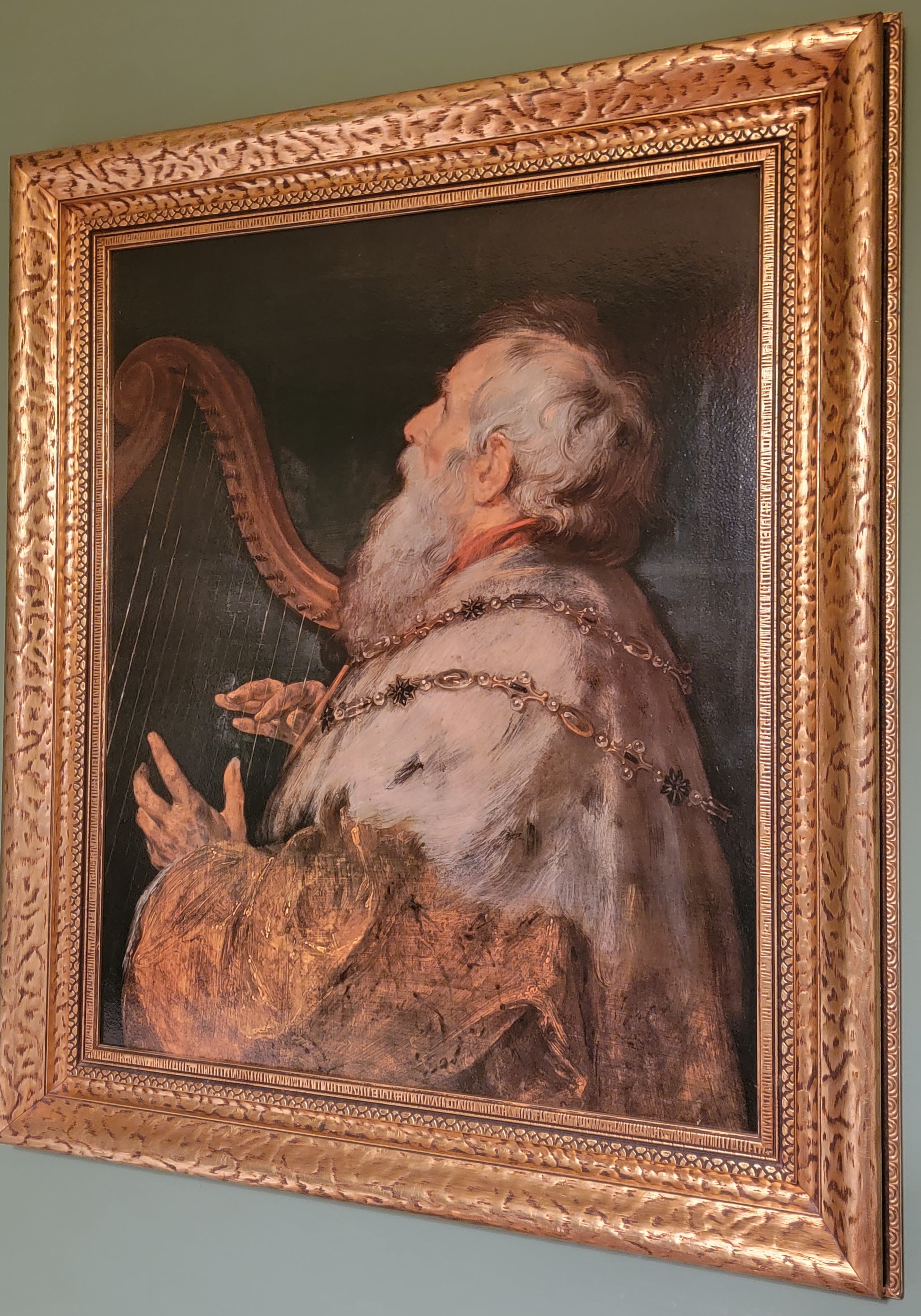
King David playing the Harp, by Peter Paul Rubens ca. 1616
The two biblical stories convey a message to be taken together.
As Abraham and King David approached the end of their lives, they had seemingly accomplished everything. They had finished having children and building their fortune. It was time to retire peacefully.
But they did not.
Abraham made sure that his son would marry an appropriate woman and be able to carry on the family’s good name. King David made sure the appropriate son would lead the kingdom.
The bible relates that each man did this when they were old and without an active companion. While they would have no more children – hence the bible making clear that the virgin brought to David remained a virgin – they still had an active role to play in directing their children and the course of Jewish history.
Rashi’s comment that Abraham had a son could be reread that Abraham was not going to have any more sons. He needed to focus on the future of the son he had.
It is a lesson for older people even today: you are more then just a link in a chain. The next generation continues to need your guidance to make sure important values and traditions are imparted.
There are millions of religious Christians who look at the founding of the State of Israel as a matter of divine will. One of the points of evidence they use is that the year of the founding of the state was 1948 in the Gregorian Calendar, commonly referred to as the Common Era. It was in that year in the Jewish Calendar – 1948 – that Abraham was born according to the Old Testament. Remarkably, after two thousand years of persecution and wandering, that the Jews would reestablish their homeland in that common year is considered too much of a coincidence. It is a sign from G-d.
It is therefore important to note this moment in time, 2023CE. As Israel celebrates its 75th anniversary milestone, it was in that year of the Jewish calendar, that Abraham entered the land of Canaan and G-d promised him and his descendants blessings and the land.
“יהוה said to Abram, “Go forth from your native land and from your father’s house to the land that I will show you. I will make of you a great nation, And I will bless you; I will make your name great, And you shall be a blessing. I will bless those who bless you, And curse the one who curses you; And all the families of the earth; Shall bless themselves by you. Abram went forth as יהוה had commanded him, and Lot went with him. Abram was seventy-five years old when he left Haran.”
Seventy-five years since the rebirth of the Jewish State, the country thrives while it continues to have challenges. It has remained stable and economically sound despite the mayhem in the surrounding countries. It has defeated its foes in battles repeatedly, and has forged peace treaties with several former enemies. It has managed to ingather millions of Jewish exiles from around the world, as it rekindled Hebrew into a common spoken language. It granted citizenship to non-Jews living in the land, in a unique forum of coexistence in the Middle East.
Abram was 48 years old at the time of the Great Dispersion from the Tower of Babel. He witnessed firsthand the ill effects of unanimity, and was part of G-d’s global directive towards particularism – in both language and place. At 75 years old, he was told to relocate, to a place already inhabited by others, to become the source of blessing for the entire world.
In 2023 of the Jewish calendar, the father of monotheism was not directed to conquer or convert the slightly more “indigenous” people (by 27 years) in the holy land, even as the land was soon to be promised to him, his son Isaac and the generations after him. Abram was to be an inspiration and a talisman for everyone. In that generation which broke the embraced orthodoxy of universalism, he embodied G-d’s will of particularism.
Today, in 2023 of the Common Era we live in a very tense world. People are divided, in part, because of technology that has enabled microtargeting of people with customized news and advertisements, couple with social media algorithms which keep people hyper-engaged. While fifty years ago everyone was basically fed the same media and news, now billions of people can consume and transmit whatever they want. While more satisfied with being fed unique content whenever they want, the hyper-particularism has left many isolated, angry and distrustful.
In considering the year 2023 both in the Jewish calendar and the Gregorian one, it is time to reset our thoughts on universalism and tribalism.
We don’t all need to think, dress or worship the same way. We must break with the notion of unanimity of position, and embrace a society of tolerance. That mean stop canceling, firing and unfriending people if they don’t share your opinions on critical race theory and transgenderism, or dislike the people you follow on Instagram. Allow space for unique attitudes, as long as they are not harmful.
The Bible tells us that Abraham left his “native land” to a land where he would become a focus of not just the local inhabitants but “all the families of the earth.” In today’s world of billions of isolated people, Jews and the Jewish State continue to demand global attention. It is an opportunity for a universalistic approach towards the particular: for the world to bless the Jews and receive G-d’s blessing in return.
A pretty simple formula for a better and happier world.
The ratio of a circle’s circumference to its diameter is represented in mathematics by the Greek lower letter Pi. To visualize this relationship, consider using a string to make a circle, and then straighten that string to run right across the circle through its center. The ratio of the length of the entire circle to that straight diameter line is pi, constant regardless of the size of the circle.
pi, or 3.14……
Beyond the geometry, people are drawn to this figure for other reasons. The number, when represented as a decimal goes on forever. People have used modern computers to take the number out to a trillion decimals! The first numbers 3.14159265359… are often abbreviated as 3.14.
Pi can also represent fertility. A circle is often used to represent women, such as in genealogy tables. Women were likely given the circle (as opposed to men who are denoted by squares) because of the roundness of their bellies while pregnant. Meanwhile, lines are used as a connection to spouses and offspring.
pedigree table, with women represented by circles
Pi represents the intersection of these ideas – women, generations, an infinite line and constancy. They all come together in the matriarchs of the Hebrew Bible.
Genesis 15:5 tells the story of God telling Abram that his descendants will be like the stars:
He took him outside and said, “Look toward heaven and count the stars, if you are able to count them.” And He added, “So shall your offspring be.”
Immediately after this story, Abram took Hagar, Sarai’s maid because Sarai was barren, and had a child with her. Some years later, Sarai (then Sarah) was able to have a child, Isaac. After Sarah died, Abraham took a third wife, Keturah, and had six children with her (Genesis 25:1-2).
Abraham’s son Isaac had only one wife, Rebecca. The Jewish people continued its lineage through Jacob who fathered children through four women: Leah, Rachel, Bilhah and Zilpah.
This is the beginning of the promise to Abraham to have offspring too numerous to count: he had children with three women, Isaac had children with one woman, and Jacob sired children with four women: 3 1 4. Hebrew pi is infinite and constant, just like God’s promise to Abraham.
The Jewish new year, Rosh Ha’shana, is celebrated as the anniversary of the birth of Adam, the first human. It also marks the beginning of the Ten Days of Repentance which culminates in Yom Kippur, the Day of Judgment for every Jew each year.
Around the world, Jews read a section of the Bible during the two days of Rosh Ha’ashana. On the first day, Genesis 21:1-34 is read telling the story of Abraham sending his son Ishmael out from his home, and on the second day, Genesis 22:1-24 is read, describing the near sacrifice of Abraham’s son Isaac.
The Torah readings seem like strange choices to mark the beginning of mankind. Why isn’t the story of creating Adam and Eve read on the first day and the story of the expulsion from the Garden of Eden on the second day to highlight the ramifications of sin to capture the essence of judgment? Those would be the obvious selections to mark history by recounting history.
The Bible readings direct us to not narrowly focus on history but on civilization.
While Adam and Eve were the parents of all humanity, they were deeply flawed. Their first two sons fought, with one killing the other. Their surviving sons and daughters committed incest as they populated the world. In reading the story of Genesis, one cannot find a single exchange between humanity’s original parents and any of their offspring. Adam and Eve were seemingly terrible role models for future generations.
The Torah portions of Rosh Ha’shana take on the issue of parenting. Abraham is directed by God to separate his fighting sons. At tremendous personal pain, Abraham sends off the older Ishmael with the promise that he will become a patriarch of a great nation. While Isaac remains with Abraham, God soon commands Abraham to sacrifice Isaac until He stays the execution at the last minute. In sharp contrast to the non-parenting exhibited by the world’s first parents, the father of the Arab and Jewish nations was actively – and painfully – involved with setting each of his sons on a path towards fathering nations.
The theme of how to live with family members is capped at the Yom Kippur mincha service. The very last Torah reading as the Day of Judgment comes to a close comes from Leviticus 18 which deals with forbidden sexual relationships, the majority of which surround family members. Like the readings on Rosh Ha’shana, Jews do not recount the obvious choice – in this case, the Ten Commandments – on their most solemn day; they review how to act in a constructive civilized manner with family in sharp contrast to mankind’s founders.
Jews mark the birth of Adam every year but refrain both from naming it “Adam’s Day” and recounting the family he created, and opt instead to map a course for a healthy thriving society.
This can serve as a template for how many Americans think about Columbus Day. Some people now consider the celebration of a man who was a poor leader as a terrible message for society. Others object to the European takeover of the Americas and choose to call the day “Indigenous People’s Day.”
That is self-righteous inanity.
Columbus’s landing in America was a momentous event for the world in which 99% of humanity was introduced to nearly one-third of the planet’s land mass. It forever changed the course of history.
The anniversary must be marked but, like Adam, not necessarily by idolizing the man. It should certainly not call out the “indigenous people” who did not alter the course of civilization. It is the land that must be considered at such time, not the people. Perhaps the correct name is “America Day” and should celebrate the incredible natural resources and beauty of the two continents.
Important events should be marked by their history and consecrated by the related timeless message, whether in regards to man or land.









 First One Through