Hamas does not rule Gaza against the will of its people. It rules because large numbers of Gazans want it to. Hamas articulates aims that many in Gaza accept: “armed struggle,” permanent war, and the eradication of Israel. This is not an imposed ideology. It is a shared one.
That reality is the reason the war has not ended.
Hamas refuses to disarm. It promises to fight again. It rejects coexistence as a moral crime. And Palestinian Arabs have not rejected Hamas. There has been no uprising, no mass refusal, no turning inward to say this has destroyed us and must stop. The tunnels remain. The rockets are rebuilt. The hostages were hidden in plain sight and with complicity.
The Arab world understands this. So does the Muslim world and international community, quietly if not publicly. No money will rebuild Gaza while Hamas governs. No state will guarantee security for a territory whose leadership is openly genocidal. Even those who chant Gaza’s cause from afar refuse to absorb the cost of dismantling its rulers. Words are cheap. Responsibility is not.
And so the world fractures.
One side insists Gaza deserves unlimited sympathy—stripped of agency, frozen as a permanent victim, absolved of all consequence. The other side sees a society that has embraced a war of annihilation and asks the world whether moral condemnation is not only justified, but necessary. This divide is not about compassion versus cruelty. It is about whether moral judgment still matters.
What cannot be sustained is the fiction that Gaza is merely trapped between Hamas and Israel. Gaza is trapped— by leaders and parents who have chosen martyrdom over future, ideology over life, and war over their own children’s survival.
That is where sympathy collapses.
Because the only people in Gaza whose moral claim is uncontested are the children—and they are being sacrificed by a society willing to place guns in schools, tunnels under bedrooms, and hostages among families. A society that teaches its children that nothing is nobler than dying for the cause of destroying the Jewish State.
Sympathy cannot be demanded for that choice. It can only be extended—narrowly, painfully—to those who never had one.
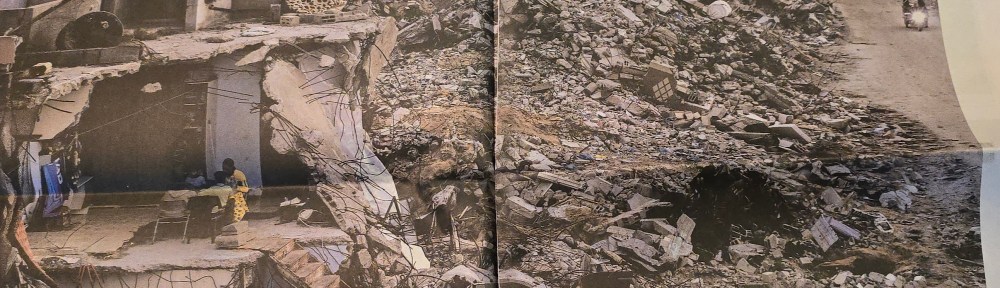
That is why the ritualized outrage of the West’s most powerful institutions now feels so hollow. Each year, The New York Times publishes its Year in Pictures, and the selection itself becomes an argument. In 2025, the year with the largest spike in antisemitism including several incidents of mass murder, there were no pictures of Jewish victims. Instead, page after page of Gaza: rubble, smoke, bloodied streets, dust-covered children. Destruction, repeated until it acquires the authority of inevitability. Israel appears only as force. Gaza appears only as suffering. Context is stripped away. Agency is erased. The camera becomes a verdict.

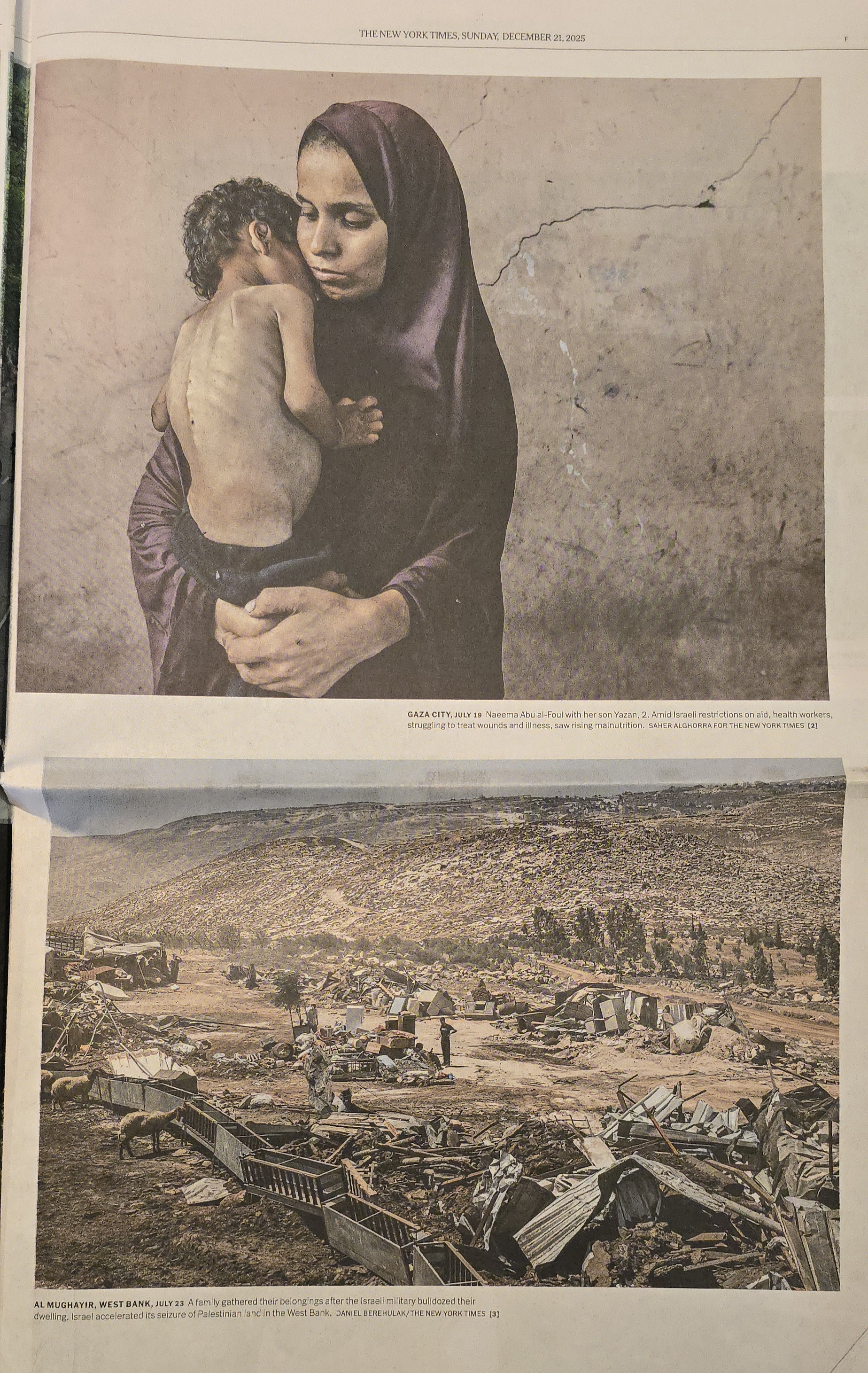

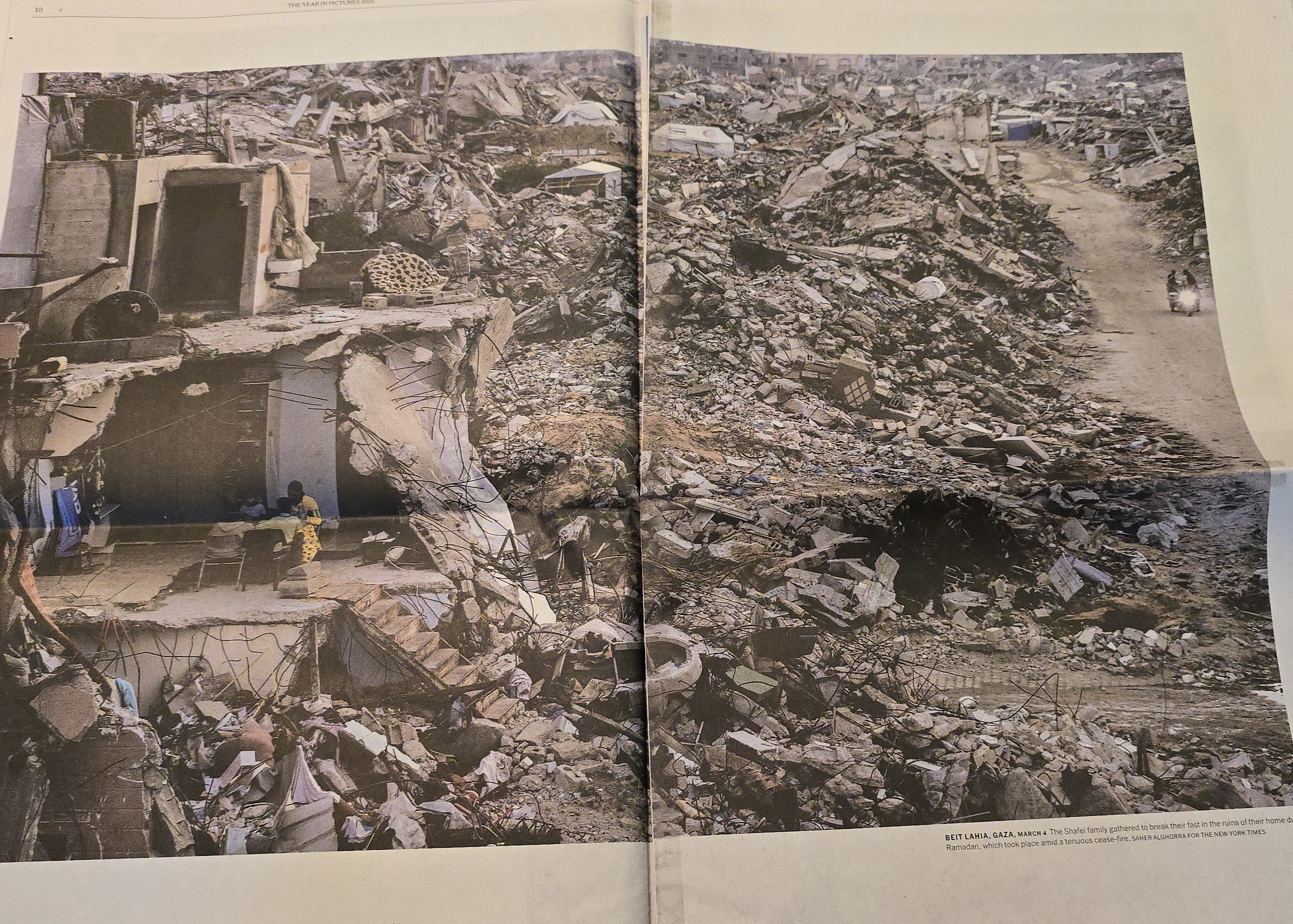
But the depravity lies not only in what is shown—it lies in what is omitted.
There are no photographs of Jewish life under siege: no police guards posted outside synagogues, no concrete barriers and metal fences erected around schools, no quiet images of fear normalized into daily routine. There are no frames of mourning for Jewish victims abroad, the couple shot in Washington, D.C., the arson at the home of the Jewish governor of Pennsylvania over Passover. No recognition of the global consequences of a war whose ideology has traveled far beyond Gaza. Violence against Jews outside Israel didn’t even make a footnote.

When Israeli hostages appear in the Times, they are reduced to a single visual trope: a large military helicopter, as if their captivity were a logistical problem rather than a crime. Even Jewish victims of Gazan atrocities are set against a large Israeli military. The human cost of hostage-taking is laundered into abstraction.

What does receive sympathetic attention are arrests—multiple images of pro-Palestinian demonstrators detained by police, framed as moral courage meeting state power. Advocacy for Israel’s destruction is softened into dissent. The pages preen about resistance while refusing to name what that “resistance” seeks to accomplish.
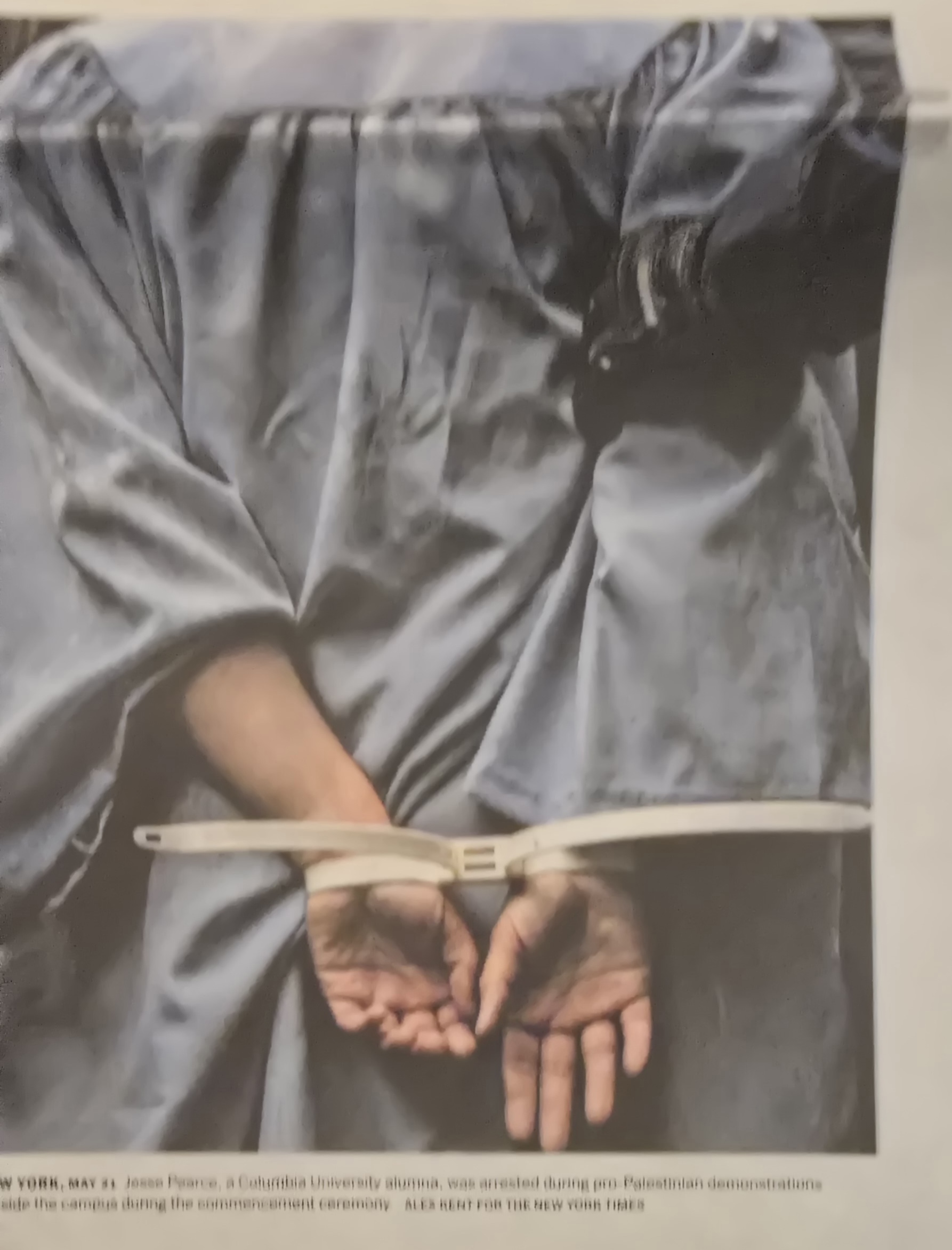

This is not journalism. It is moral choreography.
The pictures ask only one question—who suffered more?—while carefully avoiding the only one that matters: who chose this war? To launch it? To continue it? They do not show Hamas leaders refusing disarmament. They do not show weapons beneath nurseries. They do not show the ideological choice to sacrifice children for permanence of war.
In this telling, Israel becomes the aggressor by existing, and Gaza becomes sympathetic by persisting in annihilation. The refusal to surrender is recast as resilience. The willingness to sacrifice children is aestheticized as tragedy rather than condemned as crime. Sympathy is manufactured by amputating responsibility. The global anti-Israel advocates are embalmed in the moral light; Jewish victims disappear off the pages.
When the world’s most influential newspaper presents destruction without causation, suffering without choice, and death without ideology, it does not advance peace. It sanctifies perpetual war. It promotes a global blood libel. And it teaches readers that moral clarity is cruelty, while moral confusion is virtue.
The far-left media hopes that history will remember its curated selection of photographs and the modern moment will gather sympathy for the anti-Israel and anti-Jewish horde. Hopefully they are proved very wrong, and this time capsule will forever mark The New York Times for its profound antisemitism and moral depravity.
Related:
Every Picture Tells A Story: There Are No Genocidal Leaders In Iran, Just Fancy Women (November 2024)
Every Picture And Headline Tells A Story: Columbia’s Pro-Palestinian Students Are NOT Antisemitic (April 2024)
Every Picture Tells A Story: No Brutal Slaughter Of Israeli Civilians (October 2023)
Every Picture Tells A Story: Palestinian Terrorists are Victims (November 2020)
Every Picture Tells a Story: Anti-Semitism (February 2017)

 First One Through