American universities are in trouble.
Fewer people are going to college and graduate schools. Some of the drop-off relates to people having fewer children so the absolute number of people going to school has been declining. But the percentage of students going from high school to advanced degrees has also fallen considerably. Even in the years before the pandemic, the decline in high schoolers going to college dropped from 70% in 2016 to 63% in 2020. The figure dropped to 61.4% in 2023, with men being the most likely to skip college with only 57.6% opting for that education. The rates for Whites and Blacks were roughly the same at 59.9% and 59.6%, respectively, with Hispanics being lower at 51.8% and Asians surpassing every group at 84.7%. The overall impact can be seen in 2010 college enrollment of 10.2 million women and 7.8 million men, dropping to 8.9 million (-12.7%) and 6.5 million (-16.7%), respectively in 2021.
The reasons that most Americans are skipping college include a strong job market paying good wages, the desire to avoid college debt, people pursuing jobs that don’t require advanced degrees, and the ability to learn many skills online.
To address the declining enrollment, universities are taking many more international students. In the 2023/24 academic year, U.S. universities had over 1.1 million foreign students, a record. These students mostly came from the “Global South,” the emerging, principally non-White economies. The majority of students came from southeast Asia including India (331k), China (277k), Nepal, Vietnam, Bangladesh and Taiwan. No European country was in the top ten. The only countries in the top ten which are part of the Global North were South Korea and Canada. The countries with the largest spike in students over the past year were all from the Global South including Ghana (+45%), Bangladesh (+26%), India (+23%), Iran (+15%) and Nigeria (+13%).

The student exchange is not reciprocal. Only 280,000 Americans studied abroad and the majority (64%) went to Europe, with Italy, the United Kingdom, Spain, and France dominating the destinations. Two-thirds of those students identified as White.
The Americans abroad tended to go during their undergraduate years, spending just a few months away (only 2.4% went for a year). They tended to be women (67%), and studied business and management (20%) and social sciences (18%). This is in sharp contrast to international students coming to the United States who were typically graduate students pursuing a degree in STEM (science, technology, engineering and mathematics) at 56%.
The international students are older and come for longer periods of time. They often marry and have kids while pursuing their degrees, establishing a foothold in America, while Americans-in-Europe simply have a quick experience away from home.
The universities are very happy to have these paying students fill their classrooms which are being abandoned by Americans. In 2019 and 2020, 49% of all STEM master’s degrees and 57% of all STEM doctorate degrees were conferred to international students. The economics of running courses and an institution without half the students would have required eliminating courses and teachers, and perhaps shutting whole departments.
Technology companies want and need these skilled students as future employees. Google, Apple and Microsoft count on new STEM graduates to fill their ranks each year and lobby the government accordingly. Open Doors estimates that these international students contribute roughly $50 billion to the U.S. economy, or about $5,000 per student.
The U.S. government plays a heavy hand in all of this, not only seeking to salvage American university programs and building feeders to the American technology landscape, but on a political level as well.
Two situations highlight U.S. politics driving international students to these shores: Saudi Arabia and Israel.
As the United States ramped up pressure on the Islamic Republic of Iran regarding its nuclear program from 2007 to 2015, the U.S. sought to reassure its ally, the Kingdom of Saudi Arabia which is a foe of Iran. During those years, the number of Saudi students in American universities climbed from just a few thousand to over 61,000. The Saudi students learned courses like petroleum engineering to better extract and process oil, as well as nuclear physics to be able to build nuclear power on their own. Just after the nuclear agreement was signed, the number of Saudi students dropped significantly, down to under 15,000 in the 2023/24 academic year.

To highlight the insanity of the figures above, consider that there are roughly 5.5 million Saudis between the ages of 15 and 24. That means that the 61,287 Saudi students in American colleges in 2015/6 equalled one out of every 90 young Saudis studying in America. By comparison, the same calculation yields one out of 4,400 young people from Bangladesh and one out of 700 young Vietnamese studying in the U.S. Clearly the U.S. was trying to allay Saudi fears by delivering American technological know-how.
American politics playing out for international students from Israel is more explicit, and targets high school students, as long as they are Arabs.
On September 12, 2023, the U.S. embassy in Israel posted an advertisement that the U.S. State Department “is seeking a group of Arab citizens of Israel secondary school students to participate in a Study- in-the-USA initiative for high school students during the 2024-2025 school year.” (bold in original) It is backed by the YES Program Scholarship which gives “many countries with significant Muslim population an opportunity to study at American high schools and live with American host families for one academic year,” funding “all expenses in connection with the study tour including airfare, room and board, pocket money and most other costs.” It is part of the broad U.S. policy to make amends for the “War on Terror,” and selected only non-Jews from the Jewish State to learn in America.
The cherry-picking of certain types of international students demands a deeper exploration of the segments of the Global South that are in American schools.
The Global South has two principal regions as it relates to American immigrants: Latin America and everywhere else.
The United States was primarily populated by European migration from 1840 to 1920. World War I, the Great Depression and World War II stemmed immigration for several decades before it picked up with the 1965 Immigration and Nationality Act. Since that time, 49% of immigrants have come from Latin America and 27% from Asia. These groups are very different. The typical immigrant from Latin America had little formalized education (only 9% of Mexicans in the US in 2022 had a college degree). That compared to those from South Asia where 72% had a college degree, 55% from Central Asia and 49% from East and Southeast Asia.
Those coming from Latin America typically came for jobs not requiring a college degree while those coming from Asia came with degrees or obtained them at American universities.
The demographics between Latin America and Asia are also very different regarding religion.
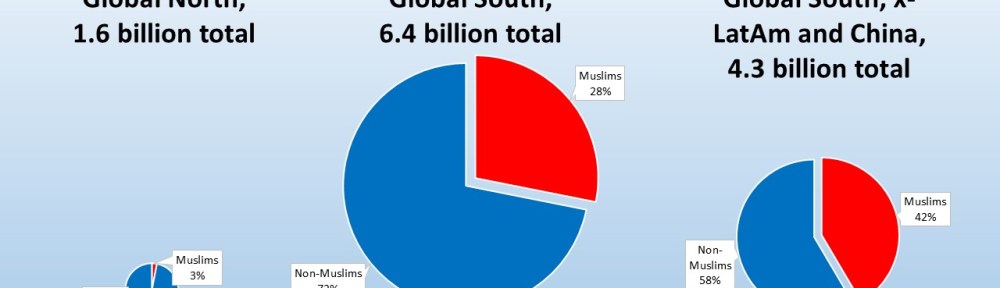
About 50 million Muslims live in the Global North which has a population of roughly 1.6 billion, or about 3% of the population. It is even lower in Latin America which has roughly 4 million Muslims out of a population of 665 million, or about 0.6%. That is is sharp contrast to roughly 1.8 billion Muslims living in the Global South with a population of 6.4 billion, or roughly 28%, or 31% x-Latin America. If one were to exclude China as well which has around 25 million Muslims, the Global South is over 41% Muslim (x-China and x-Latin America).

While China does not resemble much of the Global South in both religious demographics and not having a history of European countries on its soil, it is now in an aggressive competitive battle against the Global North for power. As such, China is leveraging its regional position alongside the Global South to wage a cultural and economic war against the West.
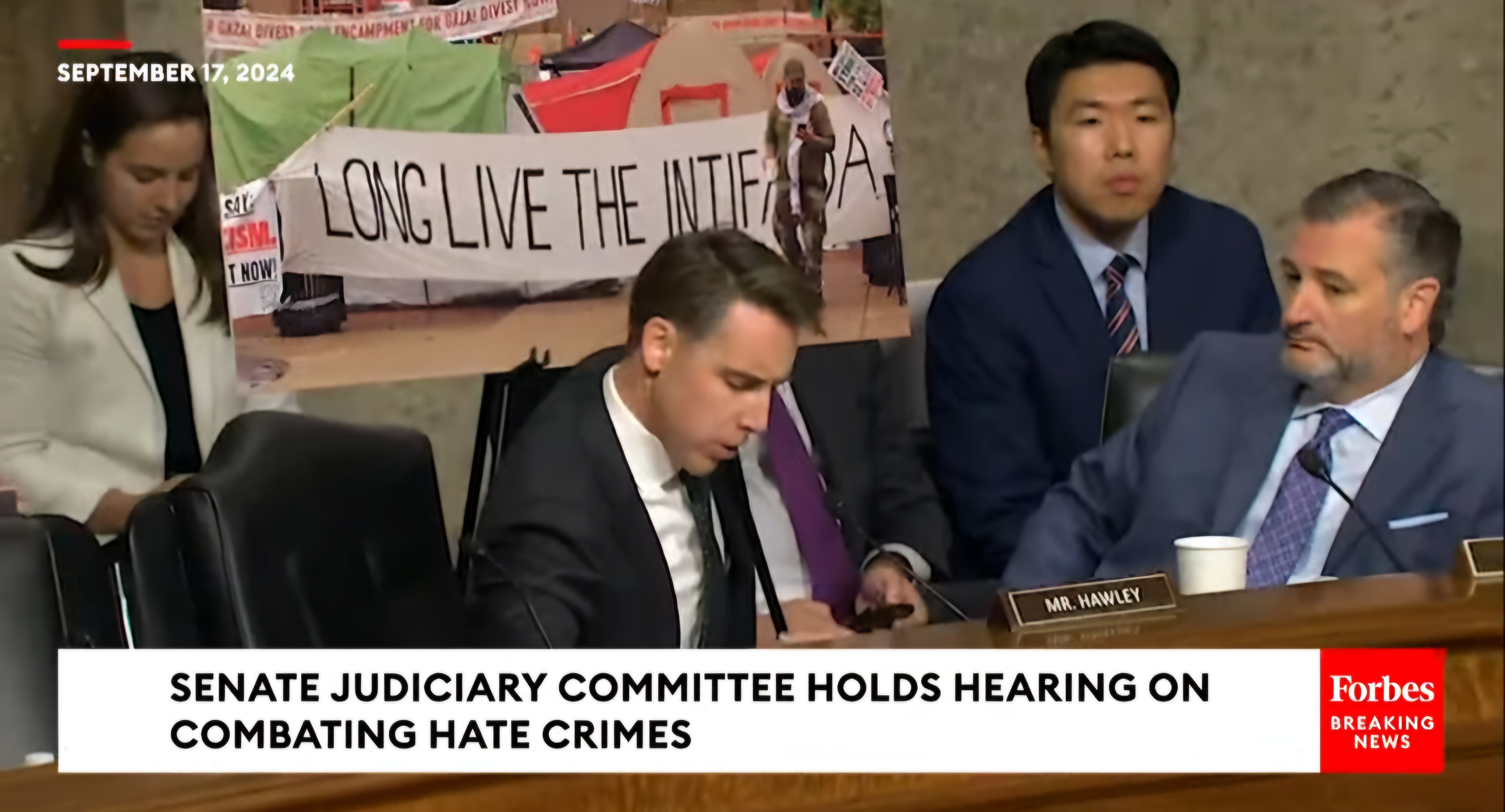
China and the Global South have advanced efforts to promote anarchy in the United States alongside far-left non-White movements like Justice Democrats. The calls to Defund the Police and Abolish ICE were designed to tear down walls of protection and flood the United States with people from the Global South. The chants to “Globalize the Intifada” on American campuses and streets are calls to dismantle Western civilization’s capitalism and support for the Jewish State, with a broad redistribution of wealth and power to the preferred people in the Global South.

When people in the Global North hear the chants of “Intifada,” they recognize the vile terrorism of Palestinian Arabs blowing up buses and pizza stores in the Second Intifada. However, the Global South considers it an Arabic term meaning “shaking off” the colonialism and imperialism of the West. The South’s overriding desire of taking on western civilization overwhelms the facts that Jews are indigenous to the land of Israel and that the Intifada is a premeditated violent attack on civilians. The Islamist Global South rallies to its coreligionists.

The population on America’s campuses does not resemble the rest of America. The disproportionate number of Asians and Muslims enrolled at America’s universities come from regions which are in active competition with the West, and embrace the Stateless Arabs from Palestine’s (SAPs) jihadi war against the Jews. The universities which enroll the international students of the Global South, attempt to tie them with American minority groups whose ancestors originated from those regions. Remarkably, a cause like Black Lives Matter which has nothing to do with the Global South, becomes hitched to the Israeli Defense Forces.
These international students principally come to a few states led by California, New York, Texas, Massachusetts, Illinois and Pennsylvania. It is not a coincidence that Department of Education’s Office for Civil Rights is launching an investigation against 60 colleges and universities which principally are located in those states.
The declining enrollment at American universities has led to them being taken over by international students from Asia and Africa. This has led directly to antisemitism on campuses and in the streets. It was true before the October 7 massacre and has only accelerated since then.

Americans and the Global North are watching the initial battles of the Global South on the beachheads of American universities and are dumbstruck. The West would be well served to reevaluate those international students admitted to study here, and use this time to prepare for the battles to come.
ACTION ITEM
Contact the White House to vet international students coming to study at American universities, trimming the numbers coming from the Global South and making their visas conditional to peaceful behavior.
Related articles:
Globalize The Intifada With Socialists (May 2024)
Hamas, CAIR, DSA, Within Our Lifetime, SJP Are All Gunning For Jews (May 2024)
The Normalization Deformity: No To Zionism and Peace; Yes To Massacres and Terrorism In a Global Intifada (January 2024)
Considering Campus Antisemitism (November 2023)
The Problem With Antisemitism On College Campuses Stems From Where Jews And Arabs Focused Their Donations (October 2023)
Biden Enables Anti-Semitism On College Campuses (July 2022)
The Wide Scope of Foreign Interference (November 2020)

 First One Through
Pingback: Context For “Intifada” | First One Through
Pingback: The Global South Is Coming For The UN Security Council | First One Through
Pingback: The Actual Trump Letter To Columbia | First One Through
Pingback: Orthodox Jewish Student At Trump’s White House Writes A Kvitel | First One Through
Pingback: Intifada The Universities | First One Through
Pingback: October 7: The First Pogrom from the Global South In the Modern Era | First One Through
Pingback: From the Hitler Youth to Woke Classrooms: State Indoctrination Then and Now | First One Through
Pingback: Charges of “Weaponizing Antisemitism” Versus Actual Violent Antisemitism | First One Through
Pingback: Antisemitism at CUNY, UC Berkeley, and Georgetown | First One Through
Pingback: Ilhan Omar’s Free Speech For Me Not Thee | First One Through
Pingback: The Revolutionary Theology Has Gone Operational | First One Through
Pingback: The Critical and Ignored Lessons From the Most Important Poll in the Middle East | First One Through