Gaza’s daily reported fatalities plunged by more than 90% following the October 2025 ceasefire, falling from over 90 per day during intense fighting in July to roughly four during much of 2026. Meanwhile, adult men’s share of newly identified fatalities climbed from 42% to nearly 60%, although they represented just 24.4% of Gaza’s population. Hamas combatants likely accounted for a substantial portion of those deaths. These extraordinary shifts tell a story buried beneath three years of cumulative death toll headlines.
For three years, Gaza’s death toll has dominated headlines. The number rises, newspapers report the latest milestone, politicians condemn Israel, and the world is reminded of the mounting casualties.
Yet the underlying data tell a story that has received remarkably little attention.
Gaza’s Ministry of Health under the direction of Hamas publishes detailed fatality figures, reproduced by the United Nations Office for the Coordination of Humanitarian Affairs (OCHA). Those figures reveal dramatic changes in who was dying, how frequently deaths were being reported, and how the cumulative death toll was being assembled.
Together, they offer a very different perspective on the progression of Israel’s military campaign.
The Remarkable Shift Toward Adult Men
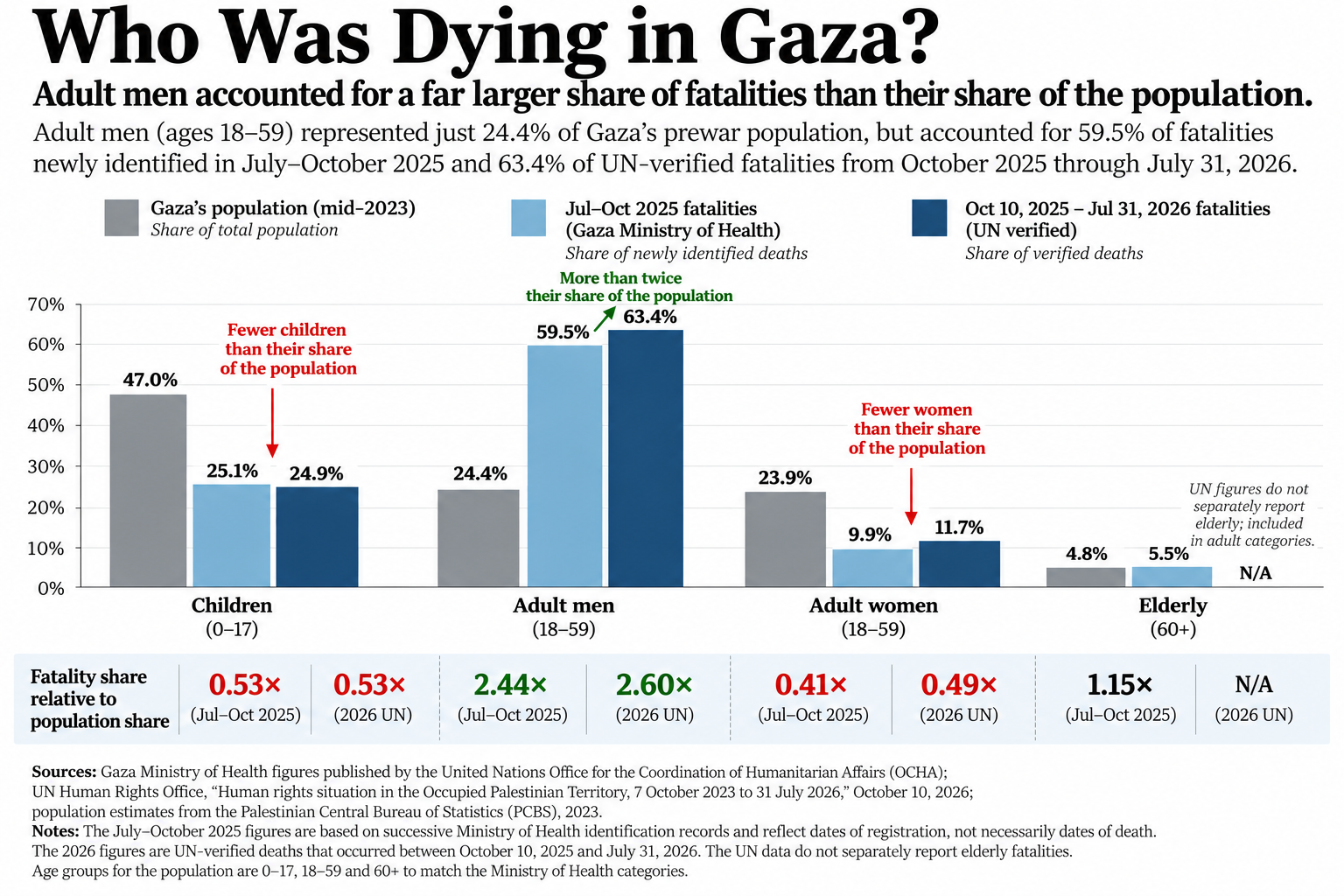
Before the war, children represented approximately 47% of Gaza’s population. Adult men ages 18–59 accounted for just 24.4%, adult women 23.9%, and the elderly 4.8%.
The composition of reported fatalities changed substantially as the war progressed.
Among deaths newly identified between April and October 2024, adult men accounted for 42%, children 34.4%, and adult women 14.1%. By July–October 2025, adult men’s share had risen to 59.5%, while children’s share had fallen to 25.1% and adult women’s share to just 9.9%.
Adult men were therefore accounting for nearly two and a half times their proportion of Gaza’s population, while women and children represented substantially smaller shares of fatalities than their respective population shares.
The pattern continued after the October 2025 ceasefire. Among 1,076 fatalities verified by the UN Human Rights Office through July 2026, 63.4% were men, 24.9% children and 11.7% women. The UN’s categories differ from the earlier Ministry of Health breakdown, but the disproportionate representation of men remains striking.
Hamas combatants are overwhelmingly adult men. The growing concentration of fatalities among this demographic is consistent with Israeli forces increasingly engaging combatants as they gained control of the battlefield and improved their ability to identify and target Hamas and other terrorist group’s positions.
From More Than 90 Deaths a Day to Fewer Than Five
The changes in the daily death toll are equally dramatic.
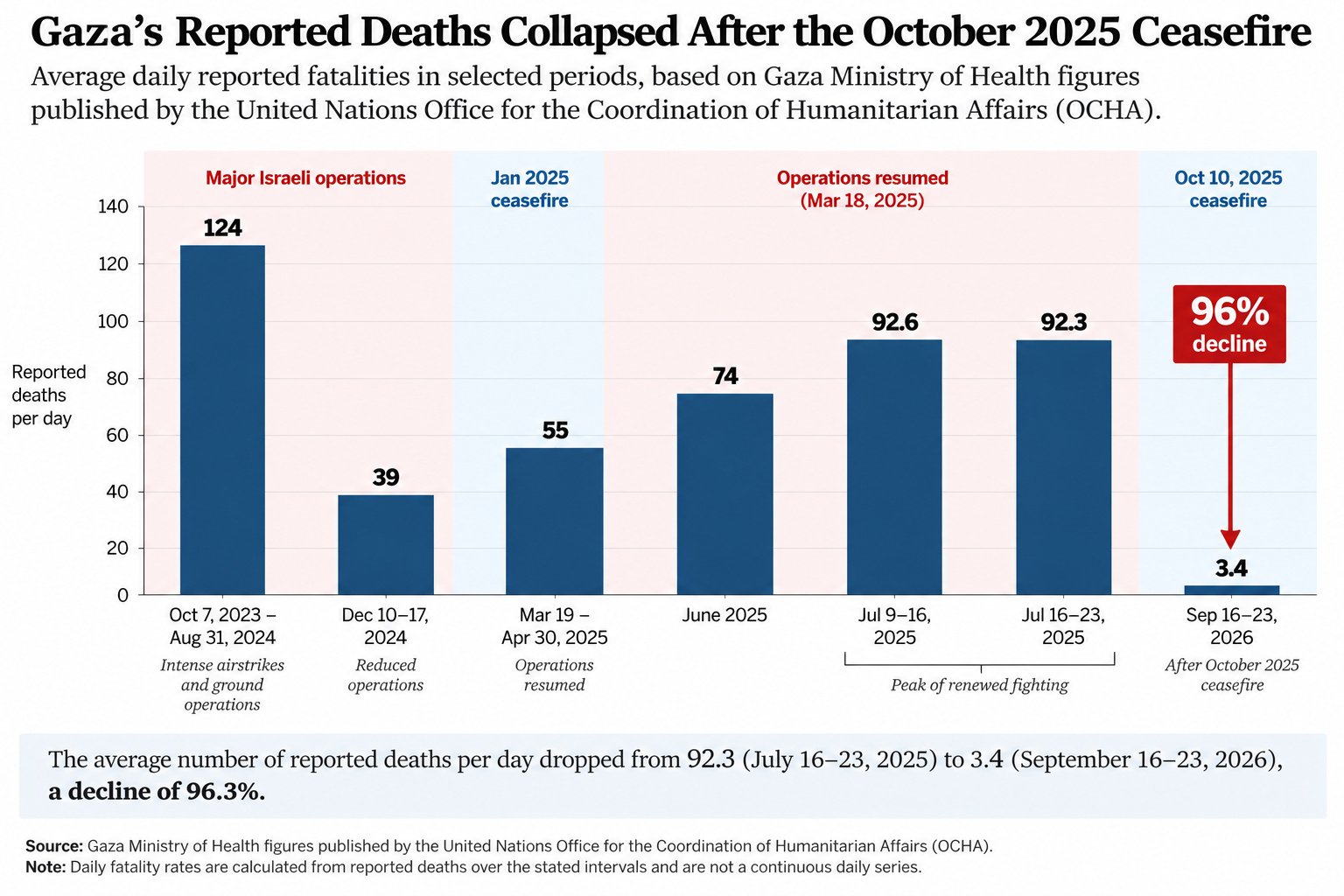
During the first eleven months of the war, Gaza reported an average of approximately 124 fatalities per day. Following the January 2025 ceasefire, the rate declined sharply before rising again when major military operations resumed in March.
During intense fighting in July 2025, the Ministry of Health reported more than 90 deaths per day. Following the October 2025 ceasefire, that figure collapsed. By September 16–23, 2026, just 24 fatalities were reported over seven days, an average of 3.4 per day. That represents a decline of more than 96% compared with the July 2025 reporting interval.
The numbers demonstrate how dramatically the intensity of military operations affected fatalities. They also reveal how misleading it can be to treat Gaza’s cumulative death toll as though it describes an unchanging level of violence.
The Death Toll Includes Deaths From Earlier Years
Another remarkable feature of Gaza’s reported death toll is how many fatalities are being added retrospectively.
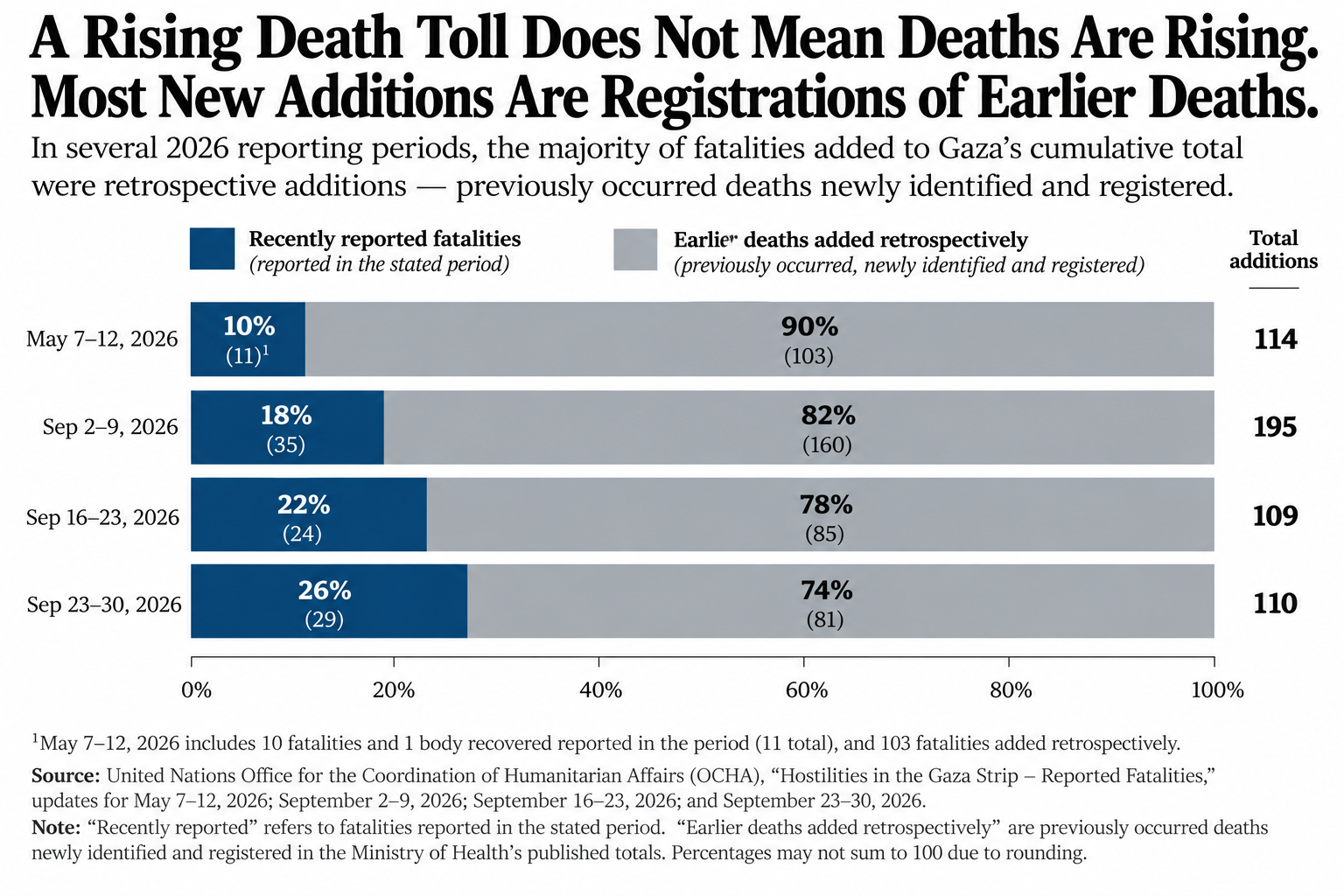
Hamas’s Ministry of Health continues identifying bodies, reconciling records and approving deaths that occurred in earlier periods. Those deaths enter the cumulative total when they are registered, regardless of when or how they occurred. In several 2026 reporting periods, retrospective registrations accounted for the majority of additions to the published total.
Between September 16 and 23, for example, 24 fatalities were reported for the period while another 85 earlier deaths were added after their identification details were approved. Retrospective registrations therefore represented 78% of the combined increase.
That distinction is almost entirely lost when the media simply announces another increase in Gaza’s cumulative death toll.
What the Numbers Say About Israel’s Campaign
The world has spent three years judging Israel’s military campaign largely through a steadily increasing cumulative death toll. Yet the underlying statistics reveal a campaign whose reported fatality patterns changed dramatically.
As Israeli forces gained control of the battlefield, adult men accounted for an increasingly disproportionate share of identified fatalities. Women and children represented progressively smaller shares, well below their proportions of Gaza’s population.
These patterns are consistent with a military increasingly able to distinguish and target Hamas combatants. They challenge the portrayal of a campaign conducted without regard for the distinction between fighters and civilians.
Meanwhile, the reported daily death rate has collapsed, and much of the recent growth in the cumulative total during selected periods has come from deaths registered long after they occurred.
The accusation of indiscriminate slaughter collapses when looking into the data. The numbers have been available. The story they tell has largely gone unread.
Sources: Gaza Ministry of Health fatality figures published by UN OCHA; Palestinian Central Bureau of Statistics, 2023 population estimates; UN Human Rights Office verified-fatality reporting. Demographic identification cohorts and UN-verified post-ceasefire deaths use different methodologies and should not be interpreted as directly comparable measures of battlefield fatalities.


