Michelle Goldberg, an opinion columnist for The New York Times, wrote a piece called “How Israel Lost America,” which made it sound like a country actively did something to turn Americans on it. She wrote:
“Conspiracy theories about Israel manipulating America into another Middle Eastern conflict are bound to flourish, especially because there will be a grain of truth to them.”
Pause there.
The claim that Israel manipulates America into war is not new. It echoes dual loyalty accusations against Jews who support Israel. It echoes the suspicion of hidden influence. It echoes the charge that Jews entangle great powers in foreign conflicts.
To say such conspiracies will flourish is observation.
To say they contain “a grain of truth” is validation.
That sentence does not merely predict antisemitic rhetoric. It lends it credibility.

The column builds toward that moment.
Goldberg wrote:
“Israel, by behaving appallingly and then trying to silence any condemnation of its appalling behavior as antisemitic, gives ammunition to Jew haters.”
Israel behaves appallingly – seemingly against America’s values and/or interests – and then pulls out the antisemitism card to try to silence critics, and that combination arms the Jew haters.
The causal arrow points away from the antisemite and toward the Jewish state. Hatred becomes consequence. Antisemitism becomes reaction. And it becomes so, because Israel itself decided to flag it, not the Jew hater.
To give credence to her theory, Goldberg quotes Jeremy Ben-Ami of the left-wing group J Street, warning of “blowback” when antisemitism is invoked in political disputes:
“You’re going to get some blowback against the people doing that.”
Again, antisemitism is framed as backlash. The focus shifts from the existence of anti-Jewish hostility to whether Jews and Israel are provoking it.
Layer these claims together and the pattern emerges:
Israel behaves badly.
Antisemitism claims are overused.
Blowback follows.
Conspiracies flourish.
There is “a grain of truth.”
The article never touches upon the truth of Gazans slaughtering Jews. The column doesn’t write about the antisemitic genocidal Hamas Charter. Goldberg doesn’t discuss the anti-Israel mobs in America celebrating the slaughter of elderly Jews, raping of Jewish women, and the burning of Jewish families alive. Other than to validate their feelings.
But the most consequential move in the column is quieter.
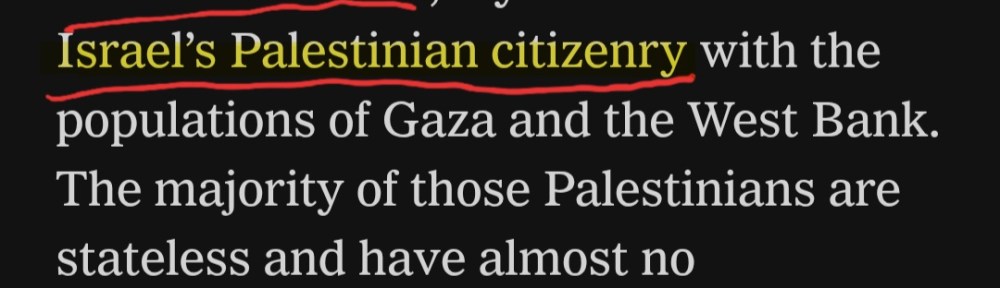
Israelis are discussed in ways readers instinctively map onto Jews. Israeli Arabs are transformed into “Israel’s Palestinian citizenry”, separating them rhetorically from the category of “Israelis.” Roughly a quarter of Israel’s citizens are not Jewish, yet that demographic fact disappears from the frame. Israeli Arabs are no longer part of the “Israel” that is “losing America” because they are really part of the counterparty in the war. That means that only Israeli Jews are the problem. The contrast is especially stark as the world cannot conceive of a “Palestinian Jew.”

The result is a subtle transformation. The conflict shifts from a dispute between a sovereign state (Israel) and a national movement (Stateless Arabs from Palestine, SAPs, seeking a new state) into something older and more volatile: Jews versus non-Jews in the Middle East.
Once that transformation occurs, every Israeli policy becomes Jewish policy. Every American alignment becomes Jewish influence. The state and the people fuse.
Now return to the “grain of truth.”
If Israel has already been rhetorically collapsed into Jews, then the suggestion that conspiracies about Israeli manipulation contain truth does not land on a neutral government. It lands on a people historically accused of secret power.
This is how respectable language normalizes ancient suspicions. The words are measured. The tone is analytic. The effect is corrosive.
Criticizing Netanyahu is legitimate. Opposing war is legitimate. Debating American foreign policy is legitimate. People do it all of the time about leaders and policy for all countries all over the world.
Yet people don’t turn the vile behavior of Iran into criticism of all Muslims. People don’t say Catholics run the drug cartels of Colombia, where a greater percentage of the country is Catholic than Israel is Jewish. People do not make people of faith the subject, unless it’s Jews.
Framing antisemitism as a foreseeable reaction to Israel’s – which we are informed should be read as “Jews'” – conduct while granting partial legitimacy to manipulation conspiracies crosses a line. And it leads to a public that no longer wants to combat antisemitism, as it has become conditioned to rationalize the ancient hatred.

 First One Through
Should submit in oped form to NYT. They might run it. Or Free Press.
LikeLike