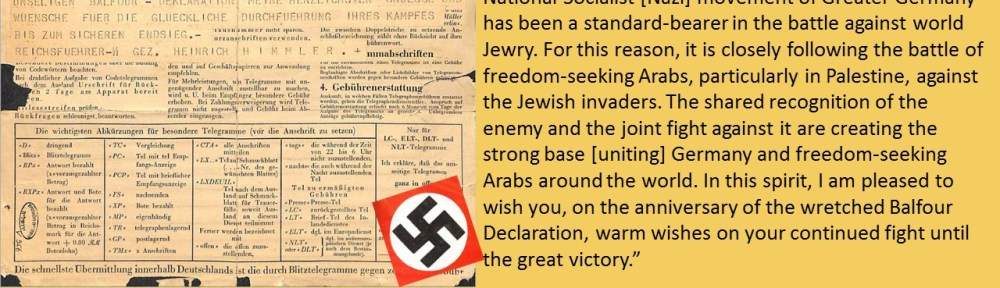
In November 1943, Heinrich Himmler sent a telegram to Haj Amin al-Husseini on the anniversary of the Balfour Declaration.
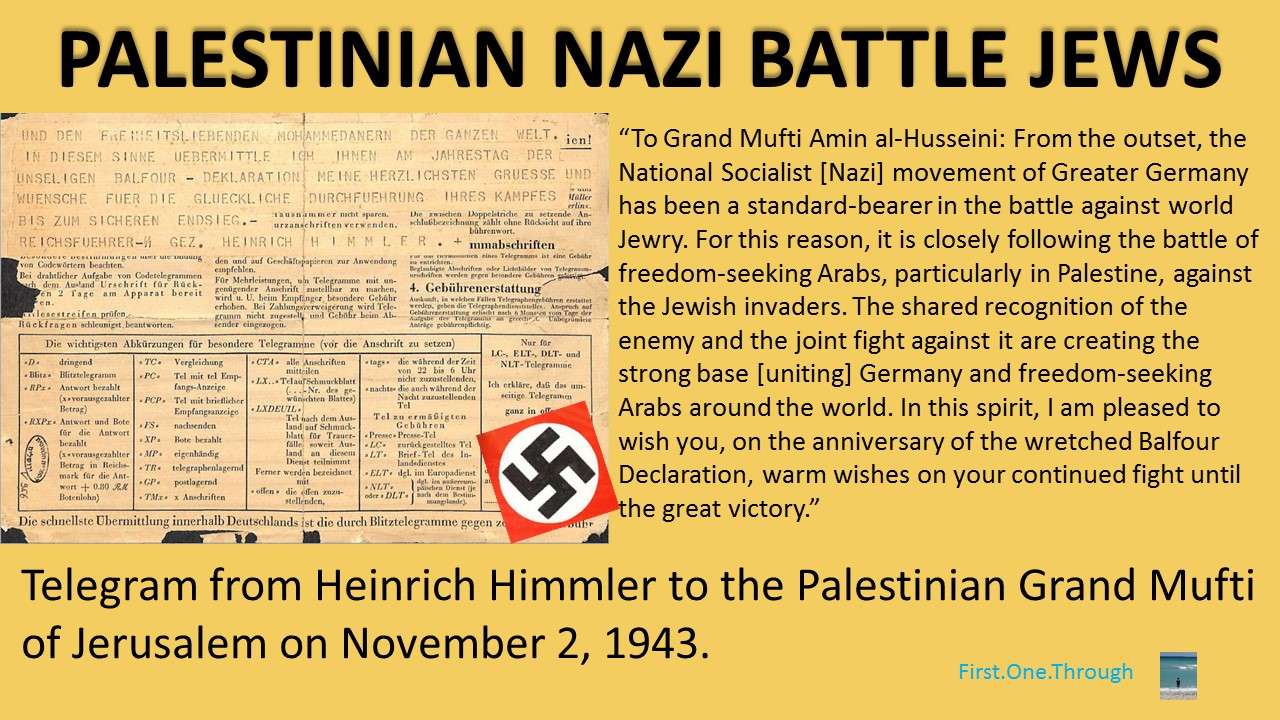
He wrote of a “shared recognition of the enemy” and “the joint fight against it.”
“The enemy” meant world Jewry.
That phrasing did real work. It turned a people into a threat. Once Jews were cast as a civilizational danger – “Jewish invaders” – their removal became a duty. Vocabulary cleared the ground and policy followed. Then came the machinery.
This is how collective persecution begins: define a group as the problem.
Eighty years later, the same grammar keeps resurfacing.
In Doha, Francesca Albanese, the United Nations Special Rapporteur on the occupied Palestinian territories, used the phrase “common enemy” to describe Israel. The target was the world’s only Jewish state. The effect was to cast Jewish sovereignty itself as something humanity must oppose.
That language strips legitimacy and treats existence as offense. It moves from argument to exclusion with the implied goal of eradication.
The pattern appears in American activism as well. Speaking at a conference hosted by American Muslims for Palestine, Zahra Billoo of the Council on American-Islamic Relations urged audiences to “oppose the polite Zionists too,” grouping mainstream Jewish institutions — synagogues, federations, Hillel chapters, civil-rights groups — into the camp of adversaries, “they are your enemies.”
The construction never changes.
Nazi Himmler: Jews are the common enemy.
CAIR Billoo: Zionists are the enemy.
UN Albanese: Israel is the common enemy.
Different decades. Different accents. Identical structure.
Demonization targets identity. Once identity becomes the indictment, anything feels justified and the line between debate and dehumanization disappears.
After World War II, the human-rights system was built to prevent precisely this logic — the idea that an entire people could be pushed outside the moral community. Yet the vocabulary has returned, polished and respectable, spoken from podiums that claim the language of justice.
When the Nazis called Jews “the enemy,” the world should have drawn the line right there. No conferences. No nuance. No excuses. Anyone who speaks that way disqualifies themselves.
That same rule applies now.
Human-rights officials who talk like antisemitic propagandists should lose their mandates. Activists who label Jews the enemy lose the claim to civil-rights leadership positions. Institutions that tolerate this language lose credibility.
The mob put a yellow Jewish Star on Jews 80 years ago and told everyone that they are the enemy. The mob is labelling Jews as Zionists today and doing the same. We shouldn’t pause to take action, if “never again” means anything.

 First One Through