
Imagine someone telling the Jews of Europe in 1935: accept the butchering and burning of six million of your people, and in exchange, you will once more gain sovereignty in your promised land. Would world Jewry have accepted such a bargain? Unlikely. In Judaism, the value of life as supreme trumps all—perhaps even over the divine inheritance of the Land of Israel itself.
That is why Jews do not take pride in the defenseless millions murdered in the Holocaust. They mourn them, honor their memory, and vow “never again.” The lesson is not that Jewish blood must be spilled for redemption, but that Jewish life is sacred and must be protected at all costs.
This moral foundation has been a hallmark of Jewish thought for millennia. The Talmud (Sanhedrin 4:5) teaches that “whoever saves a life saves the world.” Zionism, too, was never about blood sacrifice but about safeguarding Jewish existence and ensuring dignity, freedom, and self-determination. The rebirth of Israel is framed as a triumph of survival, not of slaughter.
Yet for Palestinian Arabs, the moral calculus is inverted. Martyrdom is not mourned but celebrated. “Glory to the martyrs,” they shout, glorifying not only the dead but the genocidal jihadists of Hamas who carried out the October 7 massacre of unarmed Jews. Streets, schools, and summer camps are named for suicide bombers and killers. Death in the service of destroying Jews is not a tragedy but an achievement.
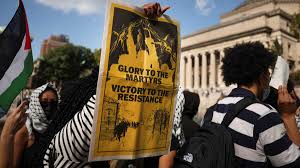
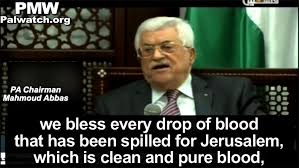
This glorification of death is not limited to fringe radicals. The majority of Gazans have always supported slaughtering Jewish civilians in Israel. Yasser Arafat, the father of the Palestinian national movement, repeatedly praised the “martyrs” who died attacking Israelis, insisting that “our blood is cheap compared to the goal [Jerusalem].” His successor, Mahmoud Abbas, continues the same practice. He honors terrorists killed while attacking Israelis, declaring that “we bless every drop of blood that has been spilled for Jerusalem.” The Palestinian Authority, under Abbas, even pays stipends to the families of those who die murdering Jews—the so-called “martyrs’ fund.”
The same ethos echoed recently in the United States. At the People’s Conference for Palestine in Detroit, Michigan in August 2025, the crowd erupted in cheers for Gaza. Lameess Mahanna, sporting a shirt of the Palestine Youth Movement—employed at Columbia University—declared that the end of Israel would be “justice.” (1:35:00) She closed her remarks by leading the audience in a chant: “Say it clear and say it loud: Gaza, you make us proud!”
If Gaza, in her telling, is suffering a “genocide,” how can its dead make her and the thousands who echoed her cry, “proud?” The answer is chilling: because human life is secondary. For her, for Hamas, for the Palestinian leadership stretching from Arafat to Abbas, and from Gaza to Detroit, “justice” is not measured in lives saved, but in Israel’s disappearance. Every dead body is not a tragedy but a step toward their perverted form of “justice:” erasing the Jewish state and replacing it with Arab Muslim rule.
This is the precise inverse of the Jewish ideal. Jews mourn their murdered; Palestinians exalt theirs. Jews sanctify life; Hamas sanctifies death. Jews seek peace with dignity; Palestinian leaders glorify death as the path to victory. The Jewish lesson of the Holocaust is the necessity of Jewish strength to prevent further massacres. The Palestinian lesson of their own history is that more massacres are required for them to have “dignity.”
Which brings us to the central question: can two peoples animated by such irreconcilable values ever truly coexist? One side views life as sacred above all else. The other views life as expendable, even desirable, when spent in the service of destroying its cohabitants.
Coexistence demands a shared commitment to life. Without that, “peace” is a dangerous mirage—a prelude to slaughter, the ultimate source of perverted pride.

 First One Through
Pingback: For the Sins of 5785 | First One Through