
The most consequential move in the New York Times coverage was quiet. It described Mayor Zohran Mamdani’s response to pro-Hamas chants as an effort to avoid inflaming “tensions on either side of the Israel–Gaza war.” The language sounded responsible. It also erased the central reality.
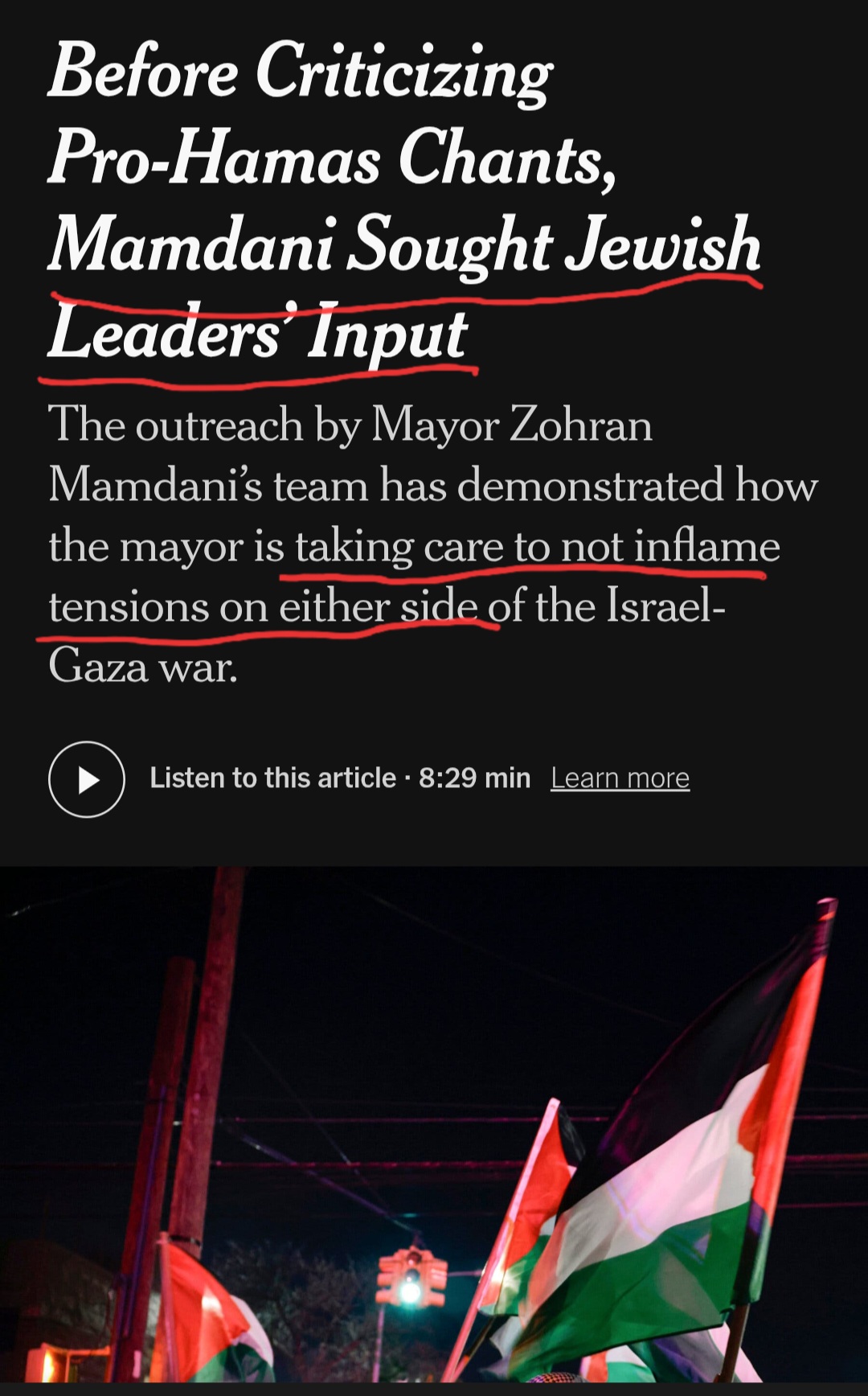
There were no equivalent sides involved. One group openly chanted support for Hamas, a U.S.-designated terrorist organization responsible for mass murder, rape, kidnapping, and calls for genocide. The other side was a Jewish community standing outside its own synagogue, defending it from terrorist sympathizers.
That location matters. This did not unfold at City Hall or on a random street corner. It took place in front of a synagogue. For Jews, synagogues are communal sanctuaries, not neutral backdrops for geopolitical theater. Geography conveys intent. Bringing terror slogans to a Jewish house of worship transforms speech into targeting.
The New York Times chose to smooth this away. By framing the episode as “tension on either side,” it recast explicit support for Hamas as a legitimate pole of community expression. The chant was softened. The targeting dissolved into abstraction. Readers were reassured that calm was being preserved with statements such as “Mr. Mamdani’s team repeatedly debated the wording and fairness of the language,” as if a group chanting for the genocide of Jews required “fairness.”
This is how extremism gets normalized. When terror advocacy demands careful calibration rather than moral clarity, the boundary quietly shifts. Such framing would collapse instantly if crowds praised ISIS outside a mosque or neo-Nazis gathered at a Black church.
Protesters understand what editors seem determined to whitewash: location is the message. No amount of “Palestine-washing” can absolve the antisemitism in the Times coverage.
Reassurance purchased at the cost of truth carries consequences. It teaches extremists that intimidation can be reframed as passion and that targeted terror speech will be treated as just another civic grievance. That does not cool tensions. It redraws the line of what is acceptable.

 First One Through