Modern political language compresses history into slogans. The United Nations speaks of “occupied Palestinian territory,” which it insists be Jew-free. The “pro-Palestinian” movements echo false claims of Jewish colonialism, as if Jews are newcomers.
Archaeology answers differently—through the infrastructure of everyday life.
Across Jerusalem, Judea, Samaria, and the Galilee, ancient mikva’ot—Jewish ritual immersion baths—appear in homes, villages, farms, and neighborhoods. They date from the First Temple and Second Temple periods and into the Mishnaic era. Their construction follows strict Jewish law. Their distribution tracks permanent settlement. Their purpose is singular: Jews lived here as a rooted society, organizing life around inherited religious practice.
This is not an argument from ideology. It is a statement of fact.
Jerusalem—Including the East: A City Immersed
Jerusalem contains the highest concentration of ancient mikva’ot anywhere in the world, with hundreds surrounding the Jewish Temple Mount as people immersed themselves before entering. In the City of David—today known as Silwan, a village established by Yementite Jews in the 19th century—dozens of ritual baths are embedded in residential quarters dated from the 1st century BCE to 70 CE. North and east of the later city walls, mikva’ot appear in neighborhoods now called Shuafat and Sheikh Jarrah, including the Shimon HaTzadik complex. The ancient mikvahs are also found to the west and south.
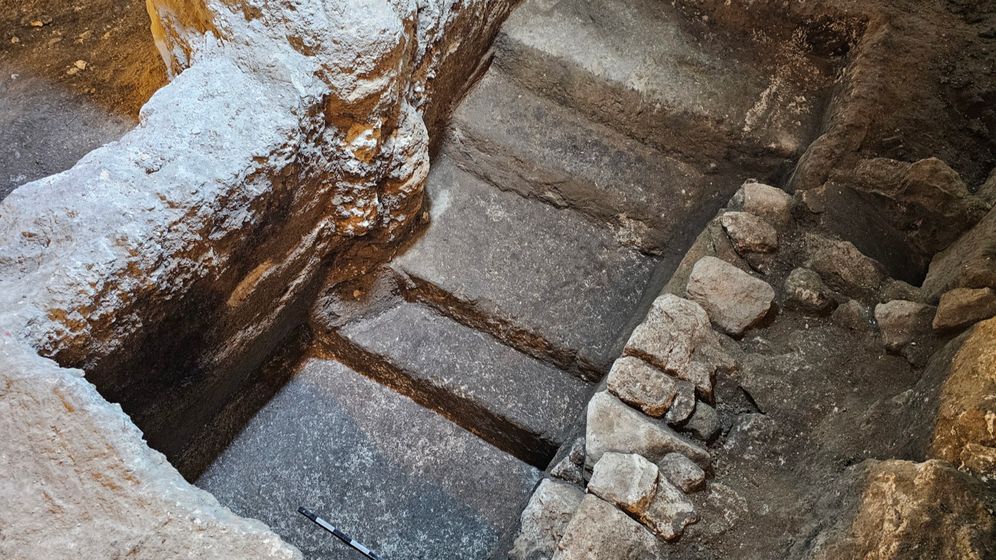
Ronny Reich and Eli Shukron, summarizing decades of excavation, write:
“The widespread distribution of ritual baths in and around Jerusalem reflects strict observance of Jewish purity laws as part of everyday life.”
These installations predate Islam by centuries. They show a city whose rhythm followed Jewish law across its full geographic footprint—west and east alike.
Judea: Bethlehem, Jericho, Hebron, and the Southern Hills
South of Jerusalem, the Judean Hills—now routinely labeled “occupied”—were a Jewish heartland in antiquity. Around Bethlehem, archaeological surveys identify rock-hewn mikva’ot associated with agricultural estates and villages from the Hasmonean and Herodian periods. Comparable installations appear near Hebron and Tekoa.

Boaz Zissu’s regional studies conclude:
“Ritual baths, agricultural installations, and burial caves indicate dense Jewish settlement throughout the Judean Hills during the Second Temple period.”
These were family communities organized around Jewish practice, embedded in the land over generations.
Samaria: Villages of Law and Land
In Samaria—today’s northern “West Bank”—mikva’ot appear in rural villages and estates tied to farming and household life. Near Shiloh, stepped pools carved into limestone meet halakhic requirements and date to the late Second Temple period.
These finds demonstrate continuity between biblical Israelite centers and later Jewish communities. They record a population living according to inherited law, rooted to fields and seasons, long before later demographic changes.
What Mikva’ot Prove
Mikva’ot appear only where Jewish law structured daily behavior. They require permanence, planning, and communal norms. They cluster where families lived and expected their children to live.
Plotted together, they form a map that predates:
- Arabic language in the region
- Creation of Islam
- Medieval and modern political boundaries
They belong to a Jewish civilization indigenous to the land for centuries before the Arab conquests of the seventh century.
Conclusion
International bodies can rename the land and activists can repeat slander but archaeology restores history to human scale. Mikva’ot record where Jews prepared for worship, marriage, birth, and community life. They mark neighborhoods, not narratives.
Across all of Jerusalem and through Judea and Samaria, these ritual baths establish a simple historical truth: Jews are indigenous to this land, and their daily life shaped it long before later conquests and long before modern politics.

 First One Through