The United Nations Secretary General released the biannual report on the threat posed by ISIL (Islamic State in Iraq and Levant) on August 8, 2024. Vladimir Voronkov, Under-Secretary-General and Head of the United Nations Office of Counter-Terrorism noted that the threat of terrorism has spread throughout the world, and in Africa in particular, noting “a vast territory stretching from Mali to northern Nigeria could fall under their effective control.”
Various countries commented on the report and the threat of terrorism by Islamic radical groups including Boko Haram, Al-Qaida in the Islamic Maghreb, Islamic State in the Greater Sahara, and ISIL-Khorasan. The representative of Sierra Leone, Council President for August, spoke in his national capacity, noting that “this new epicentre of terrorism [in Central Sahel and West Africa] accounts for almost 50 per cent of all deaths from terror acts globally.” Roughly 2,000 people in Burkina Faso were killed in 258 incidents in 2023, accounting for nearly a quarter of all terrorist deaths globally.
Many discussed the issue of border control as an essential tool in combating terrorism. Sierra Leone’s representative said that “terrorist groups often exploit porous borders, weak border controls and security vulnerabilities for cross-border illegal trafficking of weapons, drugs and people.” The Republic of Korea’s delegate warned that “terrorists can exploit a lack of governance in border areas, which exacerbates various security problems beyond those areas.” Natalia Gherman, Executive Director of the Counter-Terrorism Committee Executive Directorate opined that there needs to be “an integrated approach to border security.”
Some members referenced the Accra Initiative which is designed to combat the spread of terrorism in Africa. One of the primary focuses was border security, where efforts led to the arrest of 700 people in 2018 and 2019. Albert Kan-Dapaah, Ghana’s national security chief said that unemployment was a factor in terrorism [a statement not proven by research] and his country would focus on job creation. “We don’t want to have a situation beyond our control, so we will also make it difficult for the jihadists to radicalise youth in border communities.”
Not one country mentioned Hamas, the jihadi Palestinian Arab terrorist group that killed over 1,200 people, until the United States was disgusted by an accusation by the Russian representative and rose to criticize Russia and “its growing influence with terrorist groups such as Hamas, Hizbullah and the Houthis, as well as with Iran — the leading State sponsor of terrorism — to end their terrorist attacks.”
While the U.S. was able to remember the threat of genocidal jihadi extremists when vilified by Russia, the Biden-Harris Administration has seemingly not been worried about terrorists streaming across U.S. borders.
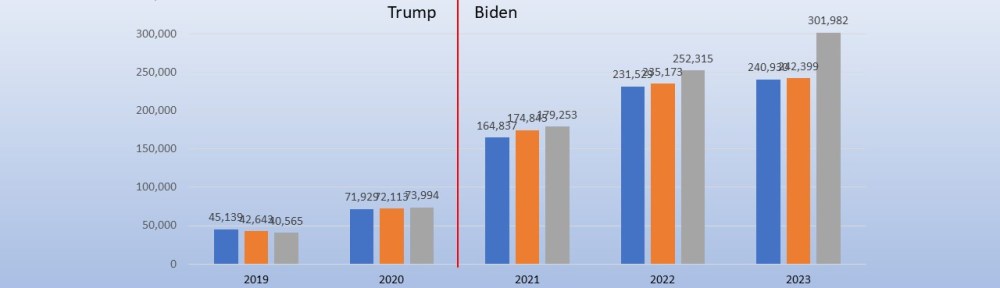
The number of illegal border crossings from December 2020 (under the Trump Administration) to December 2023 went up an astounding 744% according to statistics compiled by the U.S. Center for Border Protection (CBP).

Some of those illegal entries were terrorists.
On August 14, 2024, The New York Post reported that a wanted Palestinian Arab terrorist was captured trying to cross into the United States in New Mexico. That came just a few weeks after three Palestinian Arab terrorist suspects were nabbed in California.
According to the March 2024 Global Terrorism Index (GTI), the United States accounted for 70% of the terrorist attacks among western countries in 2023, with only the U.S. and Belgium having fatalities from terrorism.
GTI noted that Hamas, a “designated as a terrorist organisation by several countries,
including the United States, Israel, and the European Union” had been “relatively inactive as a terrorist organisation in the five years before the October 7th attacks, with only 14 attacks and one fatality recorded between 2015 and 2022.” But the political-terrorist group used that time to carefully prepare for an enormous attack which killed 1,200 and brought the region to an all-out war.
Israel is intent on maintaining a presence in the Philadelphi Corrider between Gaza and Egypt, which has long been used to bring in weapons, trained terrorists and tunnel building materials into the terrorism enclave. Doing so is blocking the restocking of Hamas in the current war and will impede its rearming in the future.
Global communities are focusing intently on their border security and immigration policy as well.
The United States is on edge with rampant antisemitism on streets and campuses with a jihadi-socialist alliance growing ever more bold. How much of it is from foreign students legally permitted into the country? How much from people entering illegally? What are they planning for the new semester? How soon until the vitriol and harassment becomes terror?
Related articles:
US Embassy In Israel Only Invites Muslims To US To Study (September 2023)
Saudi Students In United States (September 2023)
United Kingdom’s Home Grown Terrorism, Abroad (June 2023)
The Collective Punishment Of Terrorism (June 2023)
Kamala Harris Fails Spectacularly At Border (February 2023)
Fun With Cause-and-Effect: Gaza Border Protests (April 2018)
Crises at the Borders (July 2014)

 First One Through
Pingback: A Milestone For US Recognition Of Foreign Terrorist Groups | First One Through
Pingback: For The Sins of 5784… | First One Through