The World Cup’s final stages are being played in the United States, home to the largest Jewish community in the diaspora. Jews fill stadiums and gather in homes, bars, and public squares to cheer for their favorite teams. Many of the Jewish fans are descendants of families who fled persecution in the final four team countries, who found refuge in America.
By a remarkable twist of history, three of the four semifinalists are themselves home to three of the five largest Jewish communities in the diaspora: France (#2), the United Kingdom (#4), and Argentina (#5). Spain, whose once-great Jewish civilization was destroyed by the expulsion of 1492, today has only a small Jewish community.
The four teams were not traveling to America alone. Each arrived with ghosts.
England’s ghosts date to 1290, when King Edward I expelled all Jews from his kingdom. A Jewish community that had lived there for generations was driven out and would not officially return for more than three and a half centuries.
Spain’s ghosts carry the keys of 1492, when Ferdinand and Isabella ordered Jews to convert or leave. One of the world’s great Jewish civilizations disappeared almost overnight, scattering Sephardic communities across the Mediterranean, the Middle East, and eventually the Americas.
France’s ghosts stretch from repeated medieval expulsions to the Vichy regime, when French authorities enacted antisemitic laws and helped arrest and deport tens of thousands of Jews. They include the children rounded up in the Vel d’Hiv before being sent east.
Argentina’s ghosts are more recent. After World War II, the country became a refuge for Nazi fugitives, including Adolf Eichmann. Then, in 1994, the AMIA Jewish community center in Buenos Aires was bombed, killing 85 people. More than three decades later, those accused of orchestrating the attack have never stood trial in Argentina.
Now these four nations compete for soccer’s greatest prize before enormous crowds in the very country where so many descendants of those earlier Jewish communities ultimately built new lives.
Jewish fans cheer for England, Spain, France, and Argentina. They wear the jerseys, sing the anthems, and celebrate spectacular goals like everyone else.
But perhaps there are other spectators in the stands. Quietly observing.
The rabbi who clutched Torah scrolls as England closed its gates. A Sephardic mother who had cried as she locked the door of her home in Toledo for the last time. A Jewish child wearing a yellow star in Paris. Families standing outside the shattered AMIA building praying for loved ones.
Those ghosts would see something they could scarcely have imagined: not only the world’s largest Jewish diaspora community hosting the World Cup, but thriving Jewish communities once again in England, France, and Argentina. Against every expectation, Jewish life somehow endured.
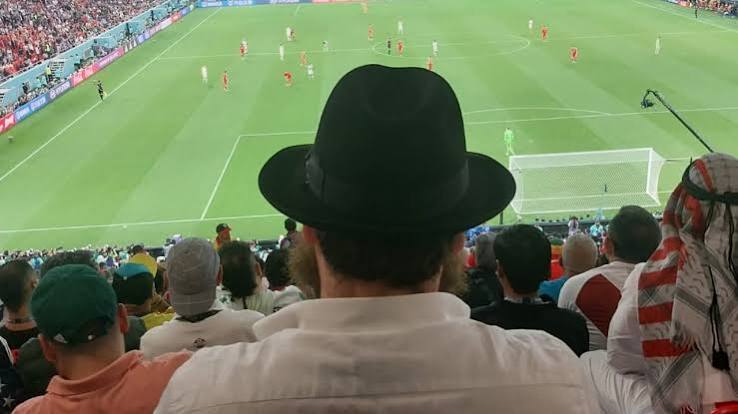
ABBI ELI CHITRIK watches a World Cup match, wearing a traditional Orthodox Jewish hat, even as a Muslim wearing a keffiyeh is among the other fans sitting nearby.(photo credit: Rabbi Mendy Chitrik)
Then, they would whisper.
They would remind us that England, Spain, France, and Argentina were all, in their own time, places where Jews believed they belonged until history proved otherwise.
Their warning would not be that America is destined to follow the same path. History never repeats itself so neatly. Their warning would be simpler: antisemitism rarely arrives all at once. It begins with words, exclusion, indifference, and the comforting belief that it cannot happen here.
As the Jewish descendants cheer from the stands, they wonder if they are hearing voices directed at them above the roar. The whispering ghosts watch too, not only the game, but today’s generation of Jews feeling both at home and increasingly distinct from their home countries.
The soccer tournament will end on Sunday. And Jews will consider their jerseys in a very different way than every other fan, in the days and weeks after they take theirs off and have to consider life beyond the game.
Related:
Watching Jewish Ghosts (March 2018)

 First One Through
Very poetic.
LikeLike
Thank you
LikeLike