
The modern Paralympic Games began far from the grandeur of an Olympic stadium. Their origin lies on the grounds of a British hospital, shaped by the vision of Ludwig Guttmann, a Jewish refugee physician who transformed both medicine and sport.
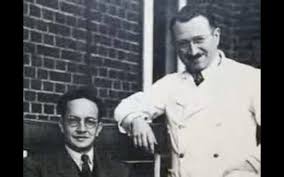
Guttmann was born in 1899 in Breslau, then part of Germany. He rose to prominence as a neurologist specializing in spinal cord injuries. With the rise of Nazism, Jewish professionals were pushed from academic and medical institutions, and Guttmann lost his post as antisemitic laws narrowed the space for Jewish life. During the “Kristallnacht” violence of 1938, he reportedly used his hospital authority to admit Jewish patients and shield them from arrest. Soon after, he fled Germany with his family and rebuilt his career in Britain.
In 1944, the British government asked him to lead a new spinal injuries unit at Stoke Mandeville Hospital. At that time, severe spinal cord injury often led to early death. Patients were confined to beds, vulnerable to infection, and frequently treated as beyond recovery. Guttmann rejected that assumption. He believed survival required more than medical stabilization. It required discipline, ambition, and restored self-respect.
He introduced sport as a core part of rehabilitation. Archery, wheelchair polo, and organized competition became structured therapy. Training cultivated strength and focus. Competition rebuilt identity. Patients who had been defined by injury began to see themselves as athletes preparing for events.
On July 29, 1948, the same day the 1948 Summer Olympics opened, Guttmann organized a small archery competition for sixteen wheelchair athletes on the hospital grounds. He called it the Stoke Mandeville Games. The symbolism was intentional. As Olympians competed in London, injured veterans competed at Stoke Mandeville. Each demonstrated excellence within their arena.
The event became annual and soon attracted international participants. In 1960, following the 1960 Summer Olympics, Rome hosted what is widely recognized as the first official Paralympic Games. A hospital initiative had grown into a global movement.
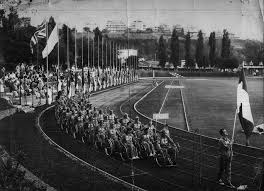
Guttmann’s work carried deeper resonance because of the era he had survived. Nazi racial ideology had targeted Jews and people with disabilities as unworthy of life. The regime’s euthanasia program murdered tens of thousands of disabled individuals before the broader genocide unfolded. As a Jewish physician forced into exile, Guttmann understood the danger of systems that ranked human worth by race or physical capacity.
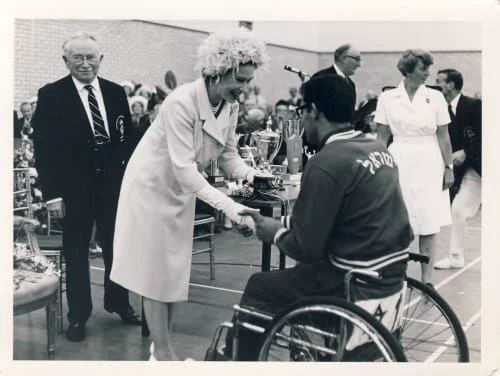
His response was constructive and public. He placed disabled athletes on fields of competition and invited the world to witness their performance. Strength, in his framework, was measured by discipline and achievement rather than conformity to an imposed ideal.
Britain recognized his contributions. He became a citizen in 1945, was appointed an Officer of the Order of the British Empire in 1950, and was knighted in 1966 as Sir Ludwig Guttmann. Within medicine, he is regarded as the founder of modern spinal injury treatment. Within sport, he is honored as the father of the Paralympic movement. During major Games, particularly the 2012 Summer Paralympics, his story has been prominently commemorated.
Today the Paralympics stand as one of the world’s largest sporting events, watched by millions. Their origin traces back to a Jewish refugee doctor who believed that dignity could be restored through competition. From the trauma of exile emerged an institution that reshaped how the world understands disability, excellence, and human worth.

 First One Through