
The story of the 1936 Summer Olympics is usually told as a duel between tyranny and talent.
- Adolf Hitler builds a showcase for Aryan supremacy.
- Jesse Owens wins four gold medals.
- The German hateful ideology collapses.
But Berlin was more complicated. The Games revealed two prejudices at once: Nazi racial doctrine and American racism and antisemitism. While very different in scale and intensity, both were present on both sides of the Atlantic.
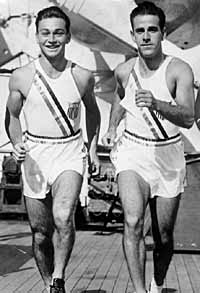
Two Jewish-American sprinters – Marty Glickman and Sam Stoller – were expected to run the 4×100 relay. Yet hours before the race, they were removed from the lineup and replaced by Owens and Ralph Metcalfe.
The official explanation was tactical: field the fastest possible team. The United States won gold in world-record time.
Yet the context was unavoidable. Glickman and Stoller were the only two Jewish runners on the U.S. track squad. Nazi Germany had already stripped Jewish athletes of meaningful participation. Their removal ensured that no Jewish athlete would stand on the Berlin track podium.
Glickman later said:
“I’ve always believed that we were taken off the relay team because we were Jews.”
Stoller observed:
“The only two Jews on the team were replaced.”
No archival proof confirms American coordination with Nazi officials. But antisemitism did not need a written agreement to operate. In the 1930s, American universities maintained Jewish quotas. Elite institutions limited Jewish membership. Prejudice was structural, even if unofficial.
Berlin exposed it.
Owens and Segregated America
Owens’ victories shattered Nazi racial mythology in the stadium but did not dissolve racial barriers in America.
The popular tale claims Hitler snubbed Owens. Owens himself redirected the accusation:
“Hitler didn’t snub me—it was our president [Franklin D. Roosevelt] who snubbed me. The president didn’t even send me a telegram.”
Owens continued:
“I wasn’t invited to shake hands with Hitler, but I wasn’t invited to the White House to shake hands with the President either.”
And when he returned home:
“After those stories about Hitler snubbing me, I had to live under segregation.”
In Berlin, Owens stayed in the same hotel as white teammates. In parts of the United States, he entered through separate doors.
Two Systems, One Lesson
Nazi Germany codified antisemitism and racism into law and would soon escalate that hatred into genocide. While the United States did not operate extermination camps, it did operate segregated schools, restricted neighborhoods, Jewish quotas, and closed clubs.
The differences in scale and brutality were enormous. The presence of prejudice in both societies was real.
One of those hatreds remains embedded in American history, while the other has been buried.
The common narrative that Owens and Team America gave a big middle finger to Hitler’s Germany in the 1936 Olympics by showcasing Black talent is incomplete. In many ways, the real lasting insult and pain was to Jews, not Nazis.

 First One Through